- The paper demonstrates that traditional single-event parameter estimation with unphysical priors produces biased results compared to population-informed methods.
- The paper employs hierarchical Bayesian inference using LVK data to correct bias and achieve astrophysically meaningful parameter interpretations.
- The paper reveals that adopting population-informed analysis enhances the reliability of extreme event detection and catalog-level conclusions.
Introduction
This paper, "Gravitational-wave astronomy requires population-informed parameter estimation" (2604.15885), scrutinizes the prevailing methodology of parameter estimation (PE) in gravitational-wave (GW) astrophysics. The authors emphasize that interpreting source parameters from GW event catalogs using conventional single-event PE—under unphysical reference priors—yields systematically biased results and should be regarded solely as an intermediate product. Instead, they advocate for hierarchical, population-informed inference, demonstrating with LIGO–Virgo–KAGRA (LVK) data that only such methods ensure accurate, astrophysically meaningful interpretation, particularly concerning extreme events in GW catalogs.
Pitfalls of Single-Event Parameter Estimation
GW collaborations have traditionally distributed single-event PE posteriors computed under reference, often unphysical, priors for masses, spins, and other parameters. These choices simplify technical and archival concerns but ignore population-level information, introducing biases that invalidate naive astrophysical interpretation. The misalignment between the Bayesian prior used in PE and the true astrophysical parameter distribution induces systematic errors.
The authors empirically demonstrate this by generating a probability–probability (P–P) plot from simulated detections following a realistic GW source population (fit to GWTC-3). They show that, under unphysical priors, coverage deviates significantly from expectation: true source parameters do not fall within their nominally credible intervals at the correct rates. This starkly violates "perfect coverage," a key Bayesian property, confirming that naïve single-event PE is unsuitable for catalog-level interpretation.
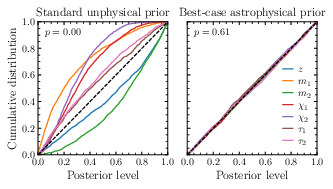
Figure 1: P–P plot showing significant coverage bias when using unphysical priors (left) compared to appropriate population-informed priors (right).
Bayesian Hierarchical Inference: The Correct Paradigm
The solution is hierarchical Bayesian inference, in which all events in the GW catalog are analyzed jointly. This approach introduces a population model—with hyperparameters governing the astrophysical distributions of masses, spins, redshifts, etc.—that is inferred directly from the dataset. In this formalism, the posterior probabilities for individual events and for catalog-level hyperparameters are coherently determined, yielding "population-informed" PE. This method not only reduces statistical uncertainties but, crucially, ensures that the inferred prior is astrophysically motivated and learned from the data itself.
Standard hierarchical inference techniques are detailed in the paper, including rigorous accounting of selection effects and likelihood normalization. The authors discuss current practical methods, such as importance resampling of PE samples, but also stress that naïve recycling of single-event posteriors can break down as catalogs grow, pointing to more scalable direct hierarchical sampling as potentially necessary for future large datasets.
Impact on Catalog Extremes and Event Exceptionality
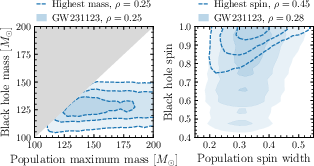
Applying their hierarchical inference to the latest LVK catalog (GWTC-4), the authors focus on source properties such as black hole (BH) mass and spin, with particular attention to "exceptional" events—those at the extremes of these distributions. For example, GW231123 previously stood out as containing the most massive and fastest-spinning BHs.
Population-informed inference yields several key qualitative and quantitative findings:
These results underline that the detection of outlier events and the reliability of claims about extreme astrophysical phenomena are highly sensitive to the correct probabilistic accounting for population-level structure. Population-informed PE produces more robust and physically interpretable statements about the distributional boundaries and exceptions in GW catalogs.
Implications for On-The-Fly and Out-of-Catalog Events
Events identified during ongoing observing runs (e.g., GW241011 and GW241110)—often scrutinized prior to full catalog-level analysis—are prone to misclassification or misinterpretation if analyzed under single-event priors. The authors show, using order statistics and population-informed PE, that these events frequently appear less "extreme" relative to prior catalog members when correctly analyzed. This mitigates the risk of overinterpreting the astrophysical significance of newly detected, pre-catalog events.
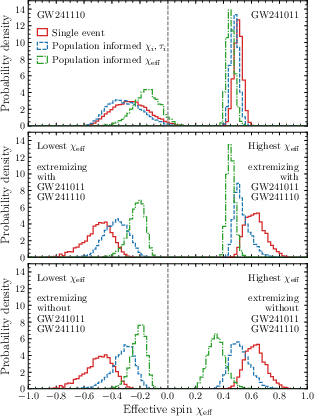
Figure 3: Effective spin χeff distributions for select outlier events under single-event versus population-informed inference frameworks.
Theoretical and Practical Implications
The broader implication is that parameter estimates in GW astronomy must always be interpreted within the context of the population they are drawn from; using unphysical, event-independent priors is actively misleading. Population models, even when potentially misspecified, are more flexible, learnable, and thus preferable to fixed, unphysical priors. The authors caution against catalog construction or population inference pipelines that treat single-event posterior products as final, or that select events for population study based on biased PE estimates.
As datasets increase in size and quality, the community will require more scalable and robust hierarchical inference methods, likely moving toward direct hierarchical posterior sampling and increasingly sophisticated models for likelihood and selection effects. Future inferences about source populations, rare events, or tests of fundamental physics (e.g., claims of unexpected source properties) will hinge on adopting this population-informed methodology.
Conclusion
This work provides a rigorous critique of conventional, single-event parameter estimation in GW astronomy, exposing its failure for astrophysical interpretation. By demonstrating that only joint, population-informed (hierarchical) Bayesian inference yields unbiased, astrophysically meaningful parameter estimates, the paper advocates a change in both scientific and cataloging practice. Future research and data analysis pipelines must prioritize population-informed inference as standard to guarantee the validity of population-level conclusions and claims of exceptional events within GW datasets.