- The paper presents a quantum algorithm that identifies a hidden d-regular base graph by exploiting spectral reduction via a spired graph construction.
- It employs a Hadamard test on quantum walk evolution at an optimally chosen time, reducing the complex graph dynamics to tractable Chebyshev polynomial equations.
- Numerical evidence shows the method distinguishes challenging graph families with polynomial complexity, contrasting sharply with classical exponential query needs.
Quantum Identification of Hidden Graphs: Spectral Algorithms and Exponential Separation
The paper "Quantum Algorithm for Identifying Hidden Graphs: Spectral Theory and Numerical Evidence" (2605.11228) introduces and rigorously analyzes a quantum algorithm for the identification of a hidden d-regular base graph G from oracle access to an exponentially obfuscated version generated via a novel "spired graph" construction. The work integrates detailed spectral theory with scalable numerics and conjectures an exponential quantum-classical separation in the black-box model, extending beyond the traversal problems common in prior quantum walk separations.
The central task is the identification (not traversal) of a hidden graph G, given only an oracle for a highly obfuscated spired graph Gspire and a finite set of candidate base graphs {G1,…,Gr}. The Gspire construction proceeds in several steps:
- Vertex Lifting: Each vertex of G is replaced by a cluster of DL vertices where D=cd and c is a thickening parameter.
- Random Cluster Connections: Clusters corresponding to adjacent vertices in G0 are joined by randomly-chosen G1-regular bipartite graphs, obfuscating direct adjacency.
- Crowning with Spires: Each cluster is augmented with a balanced G2-ary spire (an inverted tree of depth G3), hiding structural connectivity behind bottlenecks.
- Random Labeling: Vertices are relabeled randomly, and all observable information is limited to the degrees of apex vertices and the value of G4.
This obfuscation—particularly the spire structure—ensures that classical algorithms require traversing exponentially large search spaces to reconstruct any global spectral signature of the base graph. The key security parameter is G5, which controls the exponential blowup in graph size.
Quantum Algorithm: Spectral Reduction and the Hadamard Test
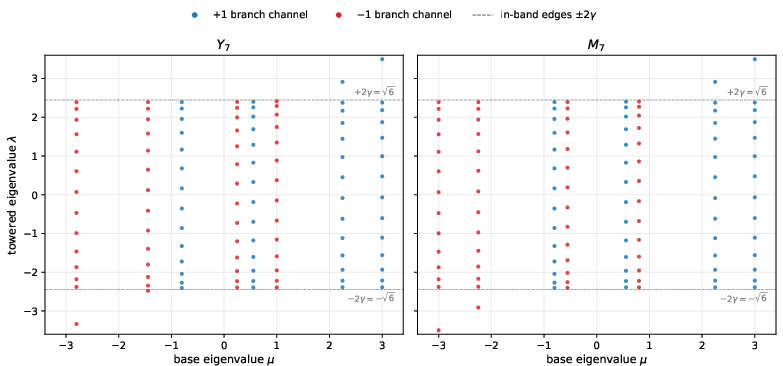
The proposed quantum algorithm leverages continuous-time quantum walks initiated at the apex of a spire corresponding to a distinguished vertex of G6. The analysis shows that quantum evolution from this apex is confined to a polynomially-dimensional invariant subspace, where the effective Hamiltonian reduces to the adjacency matrix of a "towered graph" G7.
This reduction is formalized by block-diagonalizing the Hamiltonian into independent tridiagonal systems (each associated with a single eigenvalue of the base graph's adjacency matrix) that can be solved explicitly via Chebyshev polynomial secular equations. The key outcome is that quantum evolution on the exponentially large G8 can be classically simulated (for the purposes of algorithm design) with polynomial complexity.
The quantum algorithm itself comprises a single Hadamard test on the quantum walk evolved for an optimally precomputed time G9—chosen to maximize distinguishability between candidate return amplitudes. The approach enables the estimation of a single complex amplitude whose value sharply distinguishes among candidate base graphs.
Spectral Theory: Reduction and Explicit Solvability
The spectral framework is rigorously developed:
Numerical Evidence: Scaling and Polylogarithmic Constructive Interference
A comprehensive numerical study targets the hardest-to-distinguish family pair: the prism G8 and M\"obius ladder G9 graphs. These are 3-regular, vertex-transitive, and differ only in a minimal Gspire0-cycle, making the problem maximally challenging.
Strong empirical evidence supports a precise conjecture for quantum efficiency: to distinguish Gspire1 from Gspire2 with constant success probability, it suffices to perform only Gspire3 quantum measurements at the evolution time Gspire4, where Gspire5. The quantum algorithm's performance is dominated by a constructive interference effect: among Gspire6 spectral components, a polylogarithmic subset aligns to form a peak distinguishability scaling as Gspire7.
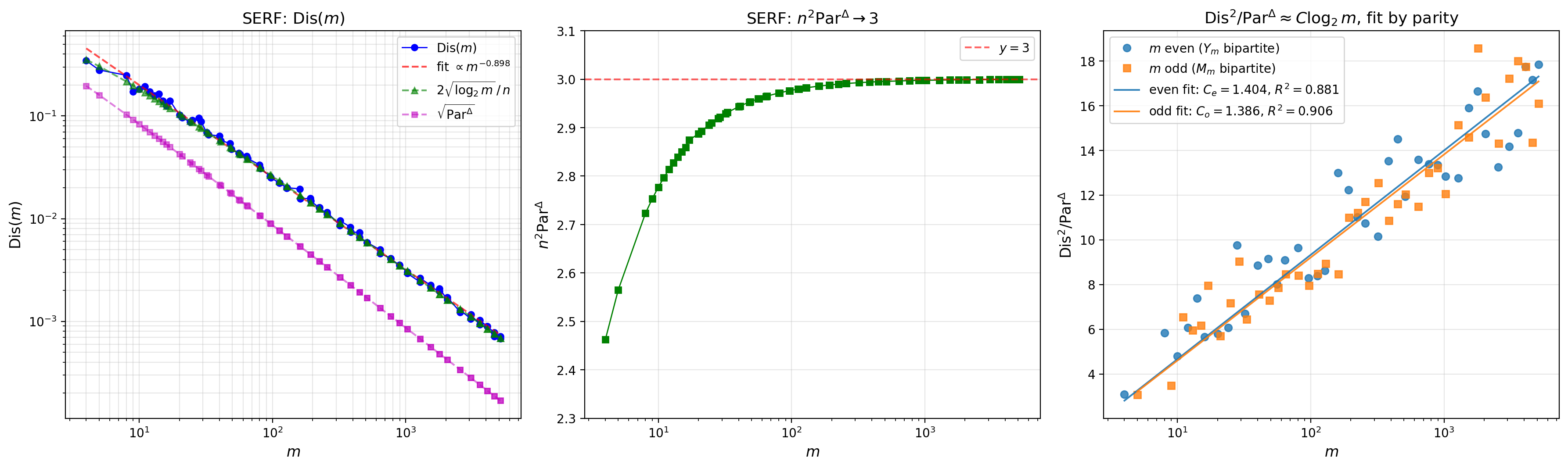
Figure 4: Cross-graph scaling at 80 values of Gspire8 demonstrates the empirical scaling law and effective quantum distinguishability across three orders of magnitude in system size.
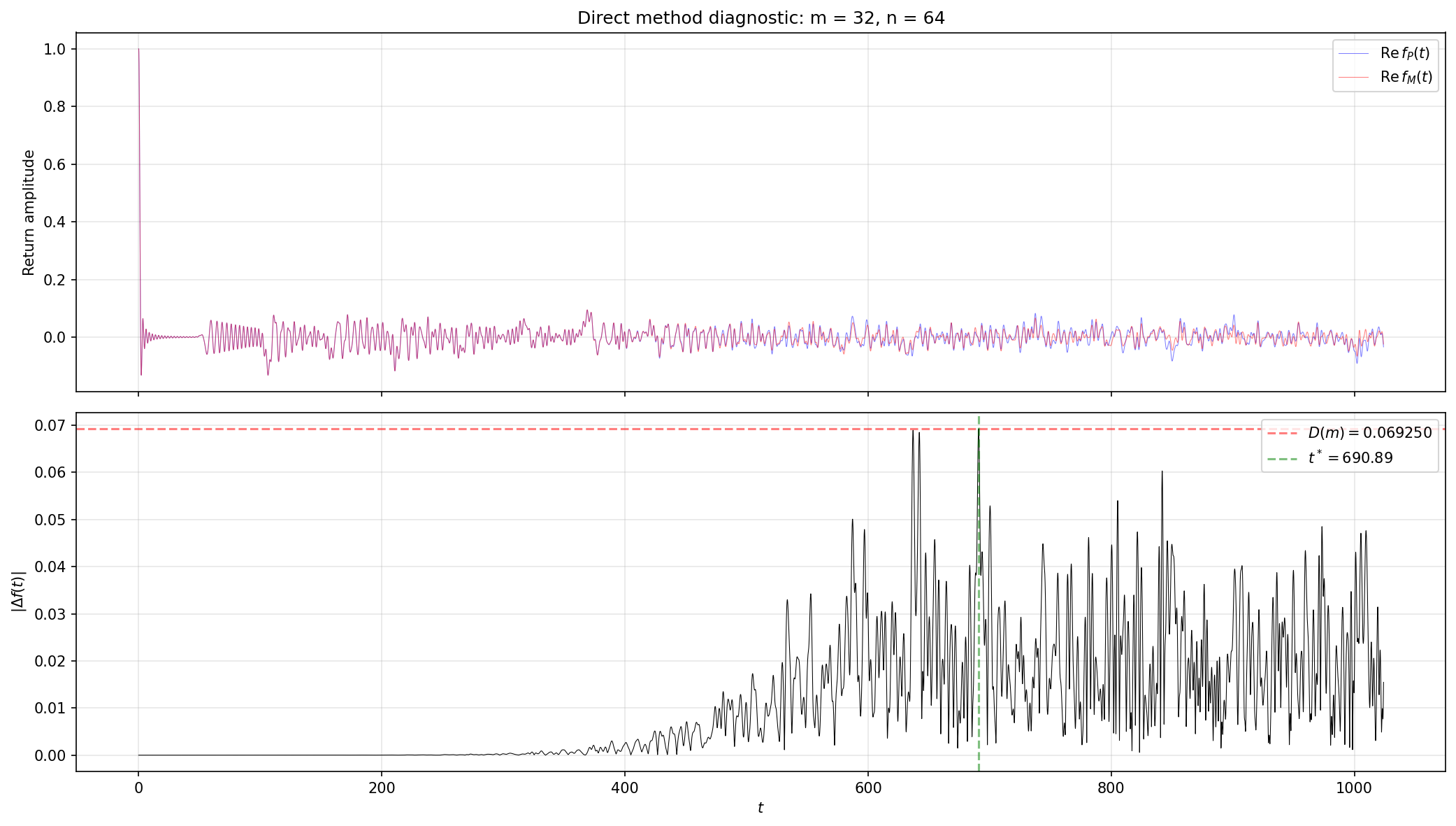
Figure 6: Diagnostic plot for Gspire9, {G1,…,Gr}0, showing the time-resolved return amplitude and the emergence of peak distinguishability from constructive spectral interference.
Classical Hardness: Conjectural Exponential Separation
Building on the structure inherited from the welded-trees construction of Childs et al., the authors conjecture that any classical algorithm for the same identification problem requires queries exponential in {G1,…,Gr}1 (specifically, {G1,…,Gr}2 for cluster degree {G1,…,Gr}3 and spire height {G1,…,Gr}4), matching or exceeding the best known lower bounds for related black-box graph problems.
The conjecture is rooted in the indistinguishability of the differing subgraph (the {G1,…,Gr}5-cycle) to any local or random walker until an exponential number of spire levels has been traversed. The quantum algorithm, by contrast, accesses global spectral information in polynomial time through quantum interference.
Implications and Directions for Future Research
This work decisively extends the domain of quantum–classical separations in the black-box setting from traversal (search, hitting time) problems to identification and spectral inference. The implications are substantial:
- Algorithmic Design: The spectral reduction approach sets a template for exploiting symmetry and quotient structure in obfuscated quantum data access models.
- Complexity Theory: The conjectured exponential separation draws a sharp line for the capabilities of quantum walks versus all classical adaptive algorithms in certain obfuscating oracles.
- Practical Potential: While practical instances of such hidden graphs may be rare, the techniques are robust to generalizations—including increased degree, alternative base graph families, and potentially real-world cryptographic applications involving hidden spectral information.
- Theoretical Generalizations: The spectral analysis and numerics generalize to arbitrary {G1,…,Gr}6-regular, vertex-transitive graphs. Open problems include explicit extension to highly expanding base graphs (such as Ramanujan graphs) and the search for alternative structures (beyond balanced spires) supporting quantum-efficient identification.
- Extensions: There is substantial scope for exploring exit-finding and hybrid identification/traversal tasks, as well as for leveraging nuanced spectral features beyond simple eigenvalue signatures.
Conclusion
The paper establishes a striking confluence between graph obfuscation, spectral graph theory, and quantum algorithms, providing compelling evidence that quantum resources can exponentially outperform classical methods in the identification of heavily hidden graph structure. The work's combination of explicit spectral construction, scalable numerical methods, and concrete conjectures sets a benchmark for further research on quantum algorithms for graph isomorphism, spectral identification, and oracle separations.