- The paper introduces a quantum adaptive algorithm that nearly quadratically speeds up classical property testers for bounded-degree directed graphs.
- The paper establishes upper and lower bounds, proving that constant-query testable properties classically require n^(1/2-Ω) quantum queries in the unidirectional model.
- The paper leverages adaptive edge sampling and quantum techniques like counting and Grover search to enable efficient subgraph counting in practical network applications.
Quantum Property Testing of Bounded-Degree Directed Graphs
Introduction & Motivation
This paper investigates the quantum query complexity of property testing for bounded-degree directed graphs (digraphs), focusing particularly on the distinction between two established access models: the bidirectional model (where both in- and out-neighbor queries are allowed) and the unidirectional model (where only out-neighbor queries are permitted). The central thesis is the transfer of constant-query classical property testers in the bidirectional model to efficient sublinear-query quantum property testers in the restrictive unidirectional model—a regime that closely matches practical scenarios in web crawling, social networks, and recommendation systems.
Quantum property testing bridges quantum computing with graph-theoretical property testing, following the broader landscape outlined by [DBLP:journals/toc/MontanaroW16], and examining the potential for quantum algorithms to outperform classical testers in both query efficiency and structural reach.
Frameworks & Technical Overview
The classical CPS approach ([10.1145/2897518.2897575]) reduces bounded-degree digraph property testing in the bidirectional model to estimating the frequency vectors of isomorphism types of q-discs, rooted subgraphs within a neighborhood of radius q. This method leverages the power of bidirectional queries: with constant query complexity, it characterizes whether the graph satisfies certain properties (e.g., subgraph-freeness, connectivity).
The paper introduces a quantum adaptive algorithm that iteratively expands sampled subgraphs using quantum counting and Grover search, extending the non-adaptive CPS strategy and yielding an almost quadratic speedup. For a property Π testable with Oε,d(1) classical queries in the bidirectional model, the quantum unidirectional query complexity is shown to be n1/2−Ωε,d(1).
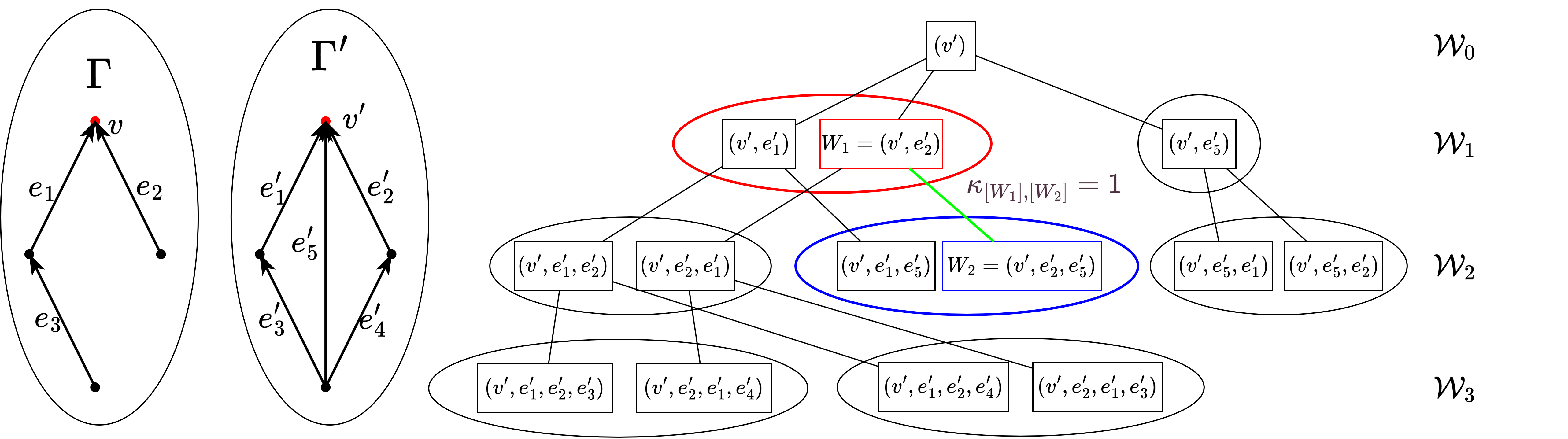
Figure 1: Rooted directed graphs (Γ and Γ′) and a tree structure representing ordered expansion paths for q-disc isomorphism types.
This structural expansion relies on controlled edge ordering within isomorphism types and systematic correction for false positives, encoding the graph's local neighborhoods' combinatorial complexity in the quantum sampling process.
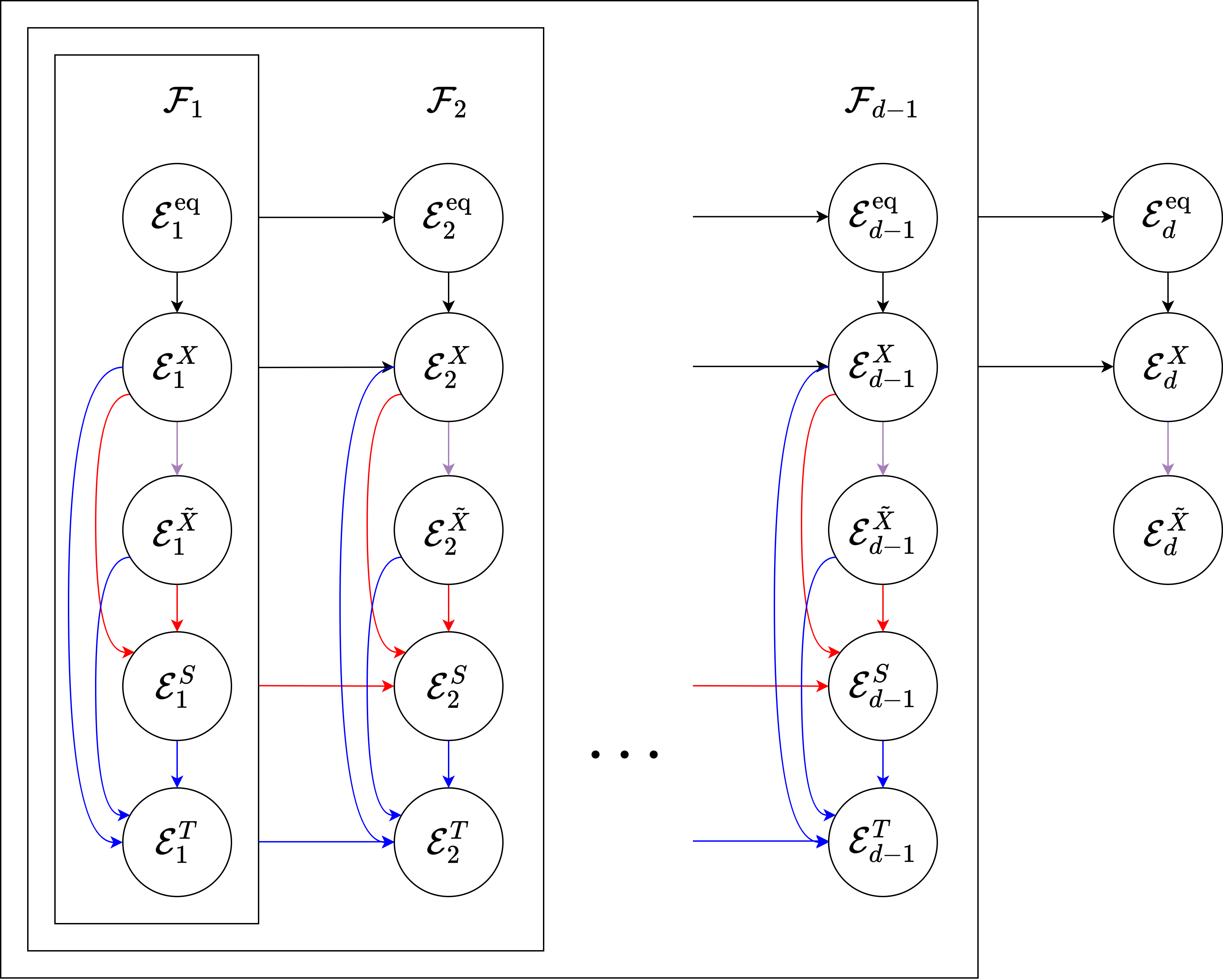
Figure 2: Dependencies among probabilistic events in the sampling process, with high-probability event arrows and explicit error bounds.
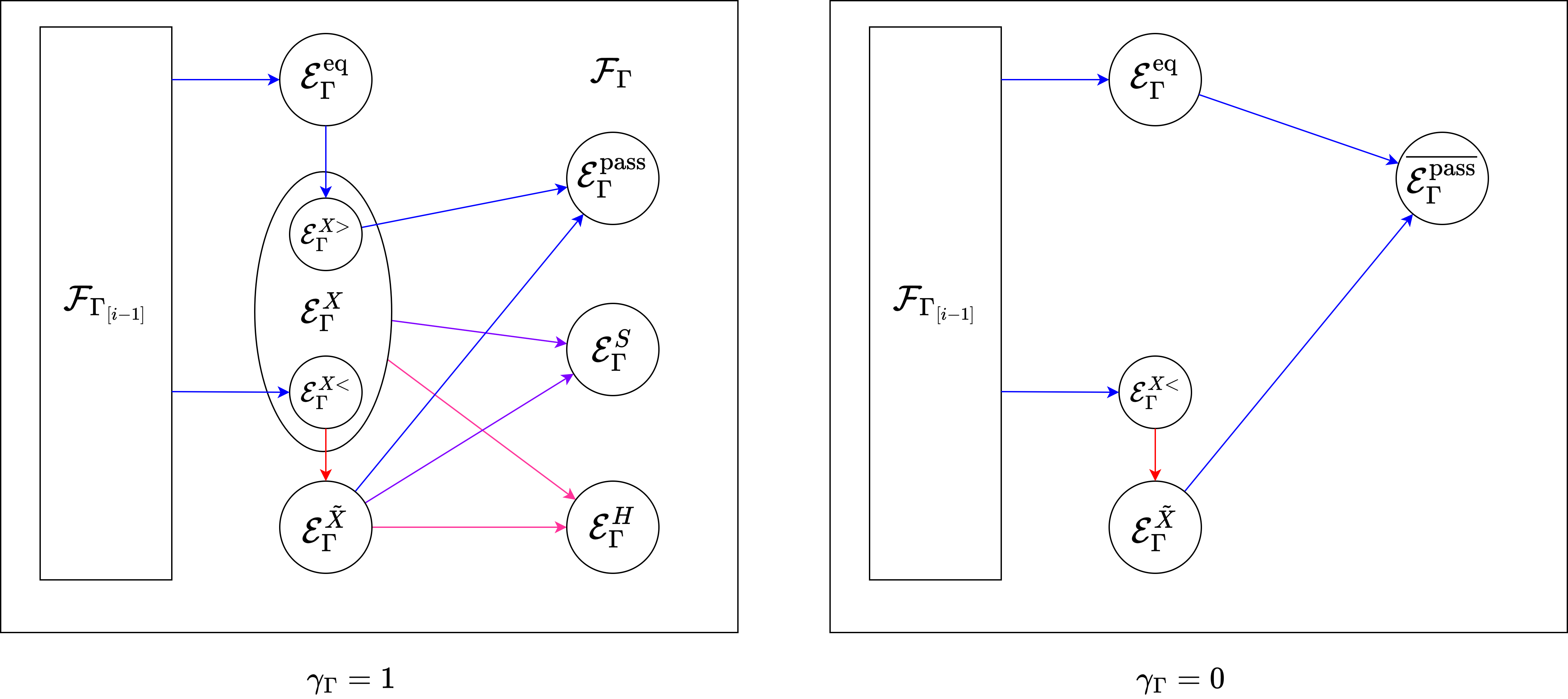
Figure 3: Event dependency structure for the general q-disc counting algorithm, illustrating critical event intersections across expansion rounds.
The algorithm is adaptive in the edge sampling sequence, dynamically aborting iterations where candidate isomorphism types are rare and employing parameter filtering to mitigate indeterminate regimes, ensuring high-confidence results uniformly over all types.
Results: Quantum Upper and Lower Bounds
The principal result is the generic translation of classical constant-query bidirectional testers to quantum sublinear-query unidirectional testers for all properties testable with a constant number of classical queries:
$\text{If a graph property is $\varepsilon−testablewithO_{\varepsilon,d}(1)classicalqueriesinthebidirectionalmodel,itis\varepsilon−testablewithn^{1/2-\Omega_{\varepsilon,d}(1)}$ quantum queries in the unidirectional model.}$
This transformation encompasses numerous graph properties: subgraph-freeness, strong connectivity, Eulerianity, q0-connectivity, and first-order properties. It immediately implies efficient quantum algorithms for approximating constant-size subgraph counts, such as q1-instance frequency estimation with q2 quantum queries.
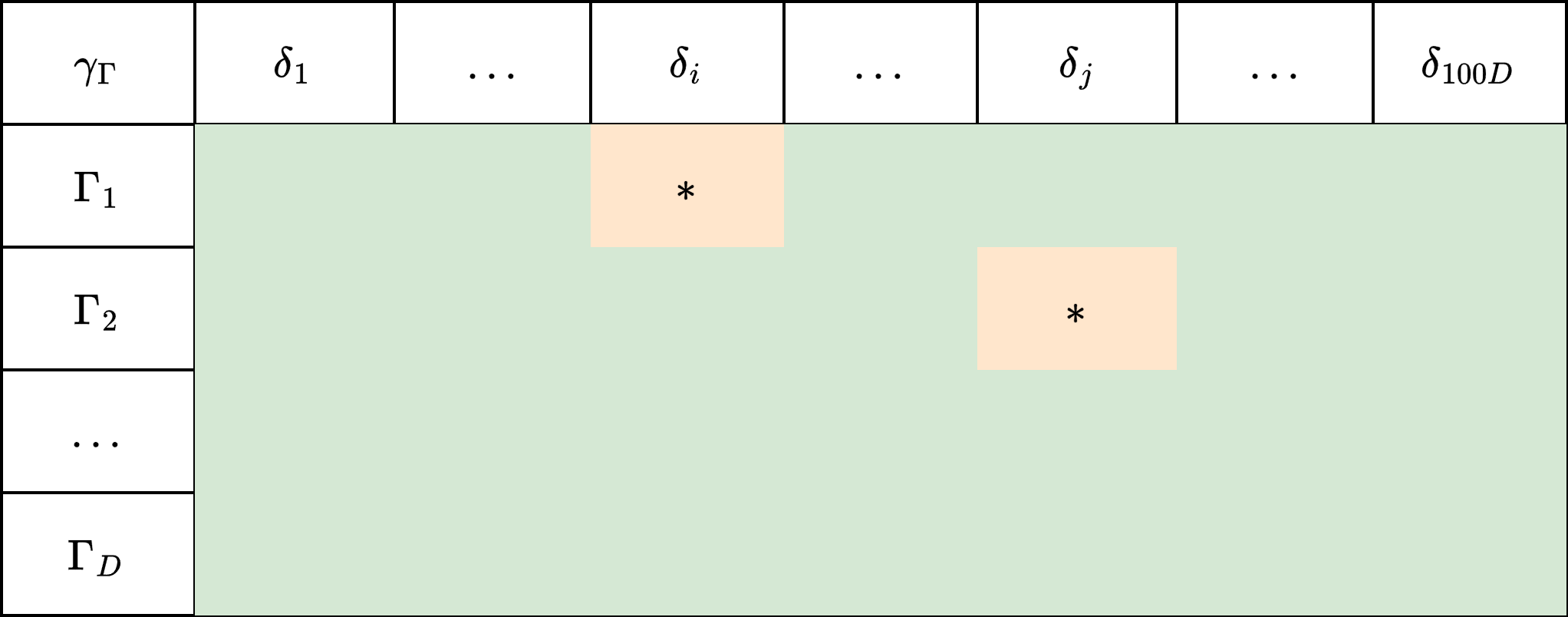
Figure 4: Disjointness of threshold intervals for various isomorphism types in parameter filtering, illustrating control over indeterminate regions.
Lower Bound: Tightness via q3-Star-Freeness
The paper establishes nearly tightness for this transformation. For any sufficiently small q4, there exists a property q5 (e.g., q6-star-freeness for appropriate q7 and degree bound) such that it is constant-query testable classically, but requires q8 quantum queries in the unidirectional model, where q9 as Π0. This directly extends previous lower bounds from the bounded-out-degree regime to full bounded-degree and leverages dual polynomial methods ([bun2018polynomial]) in the analysis of Π1-occurrence-freeness query hardness.
The proof intricately composes dual witnesses for block-constructed Boolean functions (gap-promised OR and bounded threshold), zeroing out extraneous mass and ensuring pure high degree—demonstrating that even quantum testers cannot surmount the Π2 barrier for Π3-star-freeness.
Applications & Practical Implications
A key application is quantum-efficient estimation of arbitrary constant-size subgraph counts—crucial for network motif analysis and graph preprocessing in massive digraphs—achievable with query complexity Π4 in the unidirectional model.
The results highlight the role of adaptivity in quantum property testers—adaptive edge expansion enables the critical quadratic speedup. The canonical testers devised here represent a new paradigm for quantum graph algorithms operating under practical access constraints.
Future Directions
Two primary open directions arise:
- Generalization to Unbounded-Degree Digraphs: Extending the transformation to settings with unbounded maximum degree (or only bounded out-degree), potentially through canonical testers on Π5-bounded Π6-discs, remains an open challenge. The overlap and frequency estimation complexity may necessitate fundamentally new quantum techniques.
- Role of Adaptivity: Quantifying and optimizing the trade-off between adaptivity and query complexity in quantum property testing, especially for non-adaptive or limited-adaptivity algorithms, is a critical question for both theoretical and practical deployments ([girish2024power]).
Conclusion
This work provides a rigorous framework for translating classical bidirectional property testers into quantum-efficient unidirectional algorithms for bounded-degree digraphs, quantifying upper and lower bounds with fine control over parameter regimes and combinatorial structure. The adaptive quantum disc-sampling approach achieves nearly quadratic speedup and supports practical quantum algorithms for global property estimation in massive networked systems. The tight lower bounds and applications in subgraph counting further reinforce the methodology and lay the groundwork for future research into adaptive quantum query algorithms and their limits for sparse and massive digraphs.
References
- (2604.07954) Quantum Property Testing for Bounded-Degree Directed Graphs
- [bun2018polynomial] The Polynomial Method Strikes Back: Tight Quantum Query Bounds via Dual Polynomials
- [10.1145/2897518.2897575] Relating two property testing models for bounded degree directed graphs
- [DBLP:journals/toc/MontanaroW16] A Survey of Quantum Property Testing
- [apers2024quantumpropertytestingsparse] Quantum property testing in sparse directed graphs
Figure 1: Rooted directed graphs (Π7 and Π8) and tree structure encoding sequential expansion paths.
Figure 2: Dependencies among events in quantum iterative sampling stages.
Figure 3: Event graph for adaptive disc expansion across rounds.
Figure 4: Disjoint intervals in threshold filtering across isomorphism types.