- The paper proposes QSSA, a quantum algorithm that achieves quadratic speedup for fixed-cardinality subgraph identification by minimizing Frobenius norm distance.
- It encodes candidate subgraphs as Dicke states and utilizes block encoding and amplitude estimation to efficiently prepare and process vectorized Laplacians.
- Numerical simulations on IEEE bus systems validate QSSA's exactness and scalability, highlighting its potential in power grid reliability and spectral clustering.
Quantum Algorithm for Similar Subgraph Identification under Fixed Edge Removal
Problem Definition and Motivation
The paper introduces a quantum algorithm, the Quantum Subgraph Similarity Algorithm (QSSA), for the identification of the subgraph that is most similar to a given weighted reference graph, under the constraint of removing a fixed number x out of N edges. This problem, a variant of the N-x contingency analysis in power grids, is cast as a cardinality-constrained binary quadratic optimization problem (CC-BQP), known to be NP-hard and widely applicable, including to the densest-k-subgraph problem and constrained network design. Given a reference graph Laplacian B, the optimization minimizes the squared Frobenius norm ∣∣B−B′∣∣F2 over all subgraphs B′ with x inactive edges.
For N edges and N0 removals, there are N1 feasible subgraph topologies, inducing a combinatorial explosion in computational cost. Classical exhaustive search thus scales as N2, quickly becoming intractable for moderate N3, particularly in critical applications (e.g., resilience analysis for power grids under multiple failures).
Quantum Algorithm Framework
The QSSA leverages quantum state preparation, controlled operations, amplitude amplification/estimation (AA/AE), and quantum minimum finding to achieve a polynomial speedup over classical approaches. The key innovations are:
- Dicke State Encoding: All edge-removal configurations with fixed cardinality N4 are encoded into a Dicke state, N5, forming a uniform superposition over feasible configurations. Dicke state preparation circuits with depth N6 are used for quantum efficiency.
- Quantum State Association for Laplacians: Graph Laplacians are vectorized and associated with quantum states using block encodings. This allows efficient representation and controlled manipulation of Laplacian objects in superposition, with reference and subgraph Laplacians differentiated by controlled edge deactivation.
- Parallel Evaluation: The superposition allows quantum-parallel computation of the Frobenius distances for all N7 candidate subgraphs, encoded as measurement probabilities or with further encoding using amplitude estimation for quantum label registers.
- Quantum Minimum Finding: Building on Dür and Høyer’s algorithm, the QSSA iteratively marks and amplifies the configurations with smaller Frobenius distance, yielding a total runtime of
N8
steps, versus the exponential cost of brute-force classical enumeration.
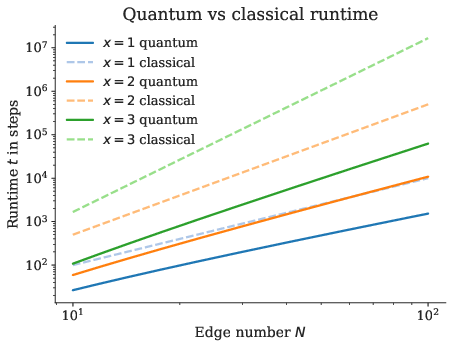
Figure 1: Comparison of runtime scaling between QSSA and classical brute-force methods as a function of the number of edges N9 and number of removals N0. QSSA achieves super-polynomial speedup for all N1.
Algorithmic Structure
QSSA consists of the following phases:
- State Preparation: Construct the superposition representing all possible subgraphs with Dicke states; encode edge weights via amplitude encoding and initialize registers for edge and vertex states.
- Topology-Controlled Operations: Conditionally deactivate the weights of removed edges using multi-controlled quantum gates, informed by the Dicke state encoding.
- Block Encoding: Use fast approximate block encodings for mapping vectorized Laplacian contributions to the quantum state.
- Frobenius Distance Labelling: Employ quantum amplitude estimation (QAE) to estimate and store, in an additional register, amplitudes directly related to the squared Frobenius distances of subgraphs.
- Minimum Finding: Apply Dür and Høyer’s quantum minimum finder to iteratively amplify the lowest-distance configurations, using quantum comparisons and controlled Grover-style search.
Complexity Analysis
The quantum runtime exhibits quadratic speedup in the number of feasible configurations N2 and efficient gate-level implementation up to logarithmic factors, with low circuit overhead in Dicke state generation and block encodings. Quantum memory requirements are
N3
qubits, which allows applicability to networks with sizable N4 and moderate N5. Rigorous complexity breakdown distinguishes contributions from control logic, amplitude estimation, and block encoding.
Numerical Validation
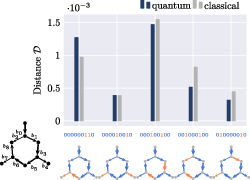
The paper presents numerical simulations on benchmarking instances relevant to power grid analysis (IEEE 4-bus and 9-bus systems):
Theoretical and Practical Implications
The algorithm demonstrates the practical feasibility of quantum-accelerated combinatorial subgraph search under cardinality constraints for problems with exact solution requirements. Unlike quantum heuristics (e.g., QAOA with penalty encoding), QSSA deterministically restricts evolution to the feasible set, guaranteeing the global optimum under sufficient quantum resources. This provides a framework for constrained graph optimization with reliable solution quality, and can be extended to evaluation of quadratic forms and energy functionals on families of graphs.
Key implications include:
- Quantum-Accelerated Infrastructure Analysis: QSSA is directly applicable to contingency analysis in power grids, network vulnerability studies, and other infrastructure resilience problems with hard topology constraints.
- Generalizable to Broader CC-BQP Problems: The Dicke-state-based constraint handling is broadly transferable to other domains of cardinality-limited combinatorial optimization, including bioinformatics, cheminformatics, and logistics.
- Algorithmic Extensibility: The methodology admits calculation of quantities beyond the Frobenius distance (e.g., spectral or energy-based measures).
Limitations and Outlook
Full practical quantum advantage will ultimately depend on scalable quantum hardware, QRAM for edge data, and low-overhead Dicke/block encoding circuits; hybrid and variational extensions may be required for near-term quantum devices (NISQ). A systematic comparison between exact search (as in QSSA) and quantum approximate heuristics remains open.
Future research directions:
- Efficient Dicke state and multi-controlled gate synthesis for constrained subspace sampling.
- Integration with quantum machine learning kernels using Laplacian-based similarity measures.
- Co-design with classical preprocessing for constraint reduction and further quantum-classical hybrid pipelines.
Conclusion
QSSA establishes an exact quantum-algorithmic framework for constrained subgraph identification, offering a clear polynomial runtime advantage over classical enumeration for all N8. By exploiting Dicke states, block encoding, and quantum minimum finding, it robustly addresses NP-hard CC-BQPs with edge-cardinality constraints. These results lay foundational ground for quantum-enhanced optimization in networked systems and structured combinatorial search.