- The paper identifies that conflicting access needs serve as diagnostic sites for organizational power, accountability, and repair.
- It employs six months of fieldwork to reveal how diverse communication tools create labor-intensive, negotiable infrastructures.
- Findings urge designers to move beyond universal solutions and foster adaptable, multi-stakeholder communication frameworks.
Designing for Collective Access: Negotiating Accessible Communication in Mixed-Ability Non-Profits
Introduction
The paper "Designing for Collective Access: In Search of a Solution to Accessible Communication in a Mixed-Ability Non-Profit" (2605.10085) provides a rigorous empirical investigation of accessible communication in a nonprofit that evolved from a small, blind-focused athletic group into a cross-disability organization. Utilizing six months of fieldwork that included extensive interviews and observations, the authors dissect the persistent complexities and negotiation dynamics intrinsic to communication accessibility within a diverse membership comprising blind and low vision (BLV) athletes, people with physical and neurodevelopmental disabilities, parents, volunteers, and non-disabled staff. The central thesis challenges the dominant “problem-solving” approach in accessibility design, arguing that so-called “conflicting access needs” should be viewed as generative sites for organizational reflection, power analysis, and opportunities for collective accountability and repair.
Context: Organizational Dynamics and Access Work
The study site is a nonprofit characterized by a fluid and volunteer-reliant structure, shifting membership, and the transition from mono-disability (BLV-focused) to cross-disability service. The organization’s activities, as detailed in the qualitative data, span regular competitive and recreational programs, community outreach, and operational management—all of which necessitate robust and adaptable communication infrastructures.
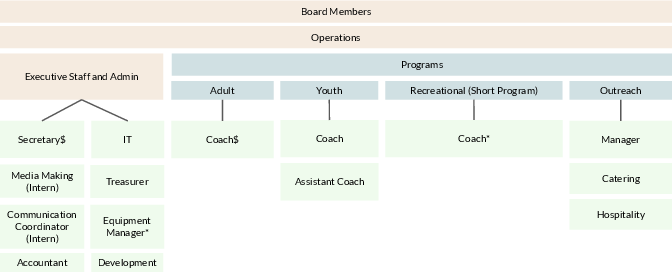
Figure 1: The organizational chart reveals role fluidity, high turnover, and multi-positionality, mapping board, operations, staff, and program functions in the nonprofit studied.
The organizational complexity uncovered in this site functions as an amplifier for communication challenges, with staff, board members, coaches, parents, and athletes imposing disparate and sometimes incompatible access preferences. This diversity leads to persistent fragmentation in communication workflows and infrastructural "patches" that are suboptimal for portions of the membership at any given time.
Negotiating Access: Beyond Universal Design
The findings dismantle the assumption that a singular technical solution can resolve the multifaceted and evolving access needs of heterogeneous groups. Instead, communication infrastructure emerges as an assemblage: WhatsApp, Slack, TeamSnap, texting, and in-person conversations are pragmatically—and sometimes chaotically—adopted, pushed, or rejected based on varying axes of accessibility, habitus, technological fluency, and role responsibilities.
Technology Tensions
- Text Messaging: Favored by BLV members for screen reader compatibility but inadequate for group structuring or persistent information sharing.
- TeamSnap: Embraced by sports management–oriented staff and parents for organizational features; critiqued as inaccessible by BLV athletes due to visually complex interfaces.
- Slack/WhatsApp: Provide structural advantages for organizational workflows and message segmentation but require onboarding and additional labor from members unfamiliar or uncomfortable with their interfaces; Slack, in particular, lacks universal accessibility even when technically compliant.
The result is continuous, distributed, and labor-intensive work to bridge communication divides—calendars manually copied, direct outreach for information missed due to fractured flows, and ongoing tool adoption debates that surface latent power relations between staff, coaches, and participants with marginalized access needs.
Conflicting Needs as Generative Friction
A contribution of the paper is the reframing of “conflicting access needs” not as purely technical or logistical problems but as primary diagnostic sites for organizational power, accountability, and repair. Rather than seeing friction as a failure or obstacle, the authors assert its value in making visible the embedded hierarchies and labor inequalities of access work. For example, pressures to adopt more "professional" or scalable tools (e.g., Slack, TeamSnap) often result in disproportionate labor and marginalization for BLV members, whose access requirements are deprioritized in favor of administrative convenience or mainstream expectations of digital literacy.
These negotiations also expose the limitations of universal design rhetoric. While UD is posited as designing for “everyone,” the paper, in conversation with critical disability scholarship, demonstrates that UD in practice defaults to anticipated, normate bodies and fails to account for intersectional needs, shifting member composition, and the lived politics of organizational life.
Collective Access and Distributed Responsibility
A major thematic in the ethnographic data is the ongoing redistribution of both access labor and decision-making. Decision authority often rests with coaches and leadership, but real communication work is diffused across staff, parents, and athletes—sometimes by proactive inclusion efforts, and sometimes by necessity, as individuals compensate for systemic or infrastructural breakdowns. The authors observe that access must be continually enacted and repaired through mutual aid, active information sharing, adapted role expectations, and negotiation of communication norms.
Importantly, the paper argues that democratizing technology selection via group voting or consensus does not resolve underlying inequalities; such moves risk further marginalizing the least-represented needs (especially when social conformity or organizational inertia dominate).
Organizational Scale, Cross-Disability Pressures, and Policy Constraints
The organization’s expansion introduces fresh access tensions as new forms of disability enter the ecosystem (e.g., Deaf, autistic, physically disabled, neurodevelopmentally disabled members). The study surfaces how adherence to privacy regulations (e.g., HIPAA), fungibility of volunteer labor, and outreach ambitions create new points of access conflict, further problematizing the pursuit of a singular solution. The practical upshot is that even as best practices and compliance measures accumulate, access remains contested, contingent, and susceptible to exclusion, especially for those at the periphery of engagement or with non-typical needs.
Implications for Accessibility, HCI, and Future AI Developments
The empirical contribution of the paper substantiates a reconceptualization of accessibility in collaborative, mixed-ability settings away from static technical compliance and toward an ethics of ongoing, situated, power-aware care. Design recommendations inferred from the study include:
- Treat access “conflicts” as essential, reflective touchpoints for organizational repair and accountability, rather than simply as problems to be solved.
- Center multi-stakeholder perspectives and contest the invisibility of access labor, especially that of the most marginalized members.
- Shift research in HCI/accessibility from a focus on developing universal solutions toward supporting infrastructural adaptability, explicit mechanisms for labor recognition, and tools for cross-platform information curation and repair.
- Extend these insights to the development and deployment of AI systems for accessibility, urging that “conflict” and failure should not be collapsed to mere error but should trigger repair, multi-modal fallback, and continuous community-driven adjustment, aligning with emerging critical literature on responsive AI accessibility practices [venkatasubramanian2025toward, tang2025everyday, mcdonnell2023easier].
Conclusion
This study delivers a nuanced and empirically grounded account of collective access in a non-profit setting, foregrounding how negotiation, power, and continuous repair define accessible communication for mixed-ability groups. The assertion that no single technology or norm can universally satisfy all stakeholder needs stands as a direct challenge to prevailing accessibility paradigms. Such findings call for sustained organizational and design attention to the dynamic, political, and relational character of access work. The work opens avenues for accessibility research to move decisively toward models emphasizing generative conflict, mutual aid, systemic repair, and continual, reflective adaptation—principles that must be operationalized in both organizational processes and emerging AI-driven communication platforms.