- The paper introduces a comprehensive micromagnetic analysis that maps equilibrium configurations and energy barriers in 30 nm p-STT-MRAM nanopillars.
- It employs detailed phase diagrams to illustrate the trade-offs between SAF asymmetry, interlayer coupling, and magnetic state stability.
- Energy barrier mapping highlights design strategies balancing free layer reliability and reference layer switching behavior.
Magnetization Alignment in Spin-Transfer-Torque Magnetic Random-Access Memory
Introduction
Perpendicular spin-transfer-torque magnetic random-access memory (p-STT-MRAM) leverages synthetic antiferromagnet (SAF) reference layers to achieve high thermal stability, low switching currents, and scalability at the nanoscale. The SAF, composed of two ferromagnetic layers (FM1 and FM2) separated by a nonmagnetic spacer, is engineered such that its antiferromagnetic coupling mitigates stray fields acting on the free layer (FM3), which is critical for reliable MRAM operation. However, standard characterization via thin-film magnetometry is not sufficient to capture the complete set of magnetization configurations and energy barriers present in patterned nanopillar devices, where finite size, shape anisotropy, and interlayer interactions significantly perturb the underlying energy landscape.
In "Magnetization alignment in spin-transfer-torque magnetic random-access memory" (2605.09201), a comprehensive micromagnetic analysis is conducted to systematically map the equilibrium configurations and associated energy barriers of 30 nm diameter p-STT-MRAM nanopillars, exploring a broad range of material parameters and interlayer coupling strengths. The work provides a robust dataset, phase diagrams, and design principles for both collinear and noncollinear SAF reference layer engineering, and elucidates the interplay between material asymmetries, interlayer exchange, and energy barriers relevant for memory stability and read/write reliability.
Micromagnetic Model and Device Geometry
The system consists of a cylindrical nanopillar with diameter 30 nm, comprising FM1 and FM2 (the SAF), separated by a spacer, and an adjacent CoFeB-based free layer (FM3). A key feature is the explicit treatment of both bilinear (J1) and biquadratic (J2) interlayer exchange coupling, as even small J2 values can substantially affect magnetic alignment, especially after high-temperature processes or when magnetic impurity-doped spacers are used.
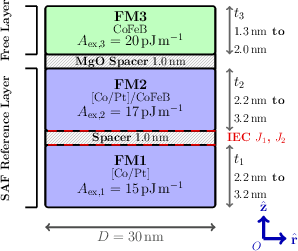
Figure 1: Schematic cross-section of the three-layer MRAM nanopillar stack, showing the SAF (FM1 and FM2), interlayer exchange, and free layer (FM3).
FM1 and FM2 are parameterized using experimental data for [Co/Pt] multilayers, while FM3 employs a dual-MgO-interface CoFeB system. Meshing respects the respective exchange length scales, ensuring resolution of all salient micromagnetic features. The effective anisotropy and thermal stability (Δ=KeffV/(kBT)) are computed for each layer, spanning the typical range of interest for reliable MRAM operation.
Classification of Magnetization States
Equilibrium states are obtained by relaxing multiple initial magnetization configurations using overdamped Landau-Lifshitz-Gilbert dynamics. States are classified via layer-averaged polar angles, yielding four principal groups:
- Collinear Antiparallel (APc)
- Noncollinear Antiparallel (APnc)
- Collinear Parallel (Pc)
- Noncollinear Parallel (Pnc)
For a three-layer stack, this results in 16 possible magnetic configurations, grouped by energy and symmetry properties.
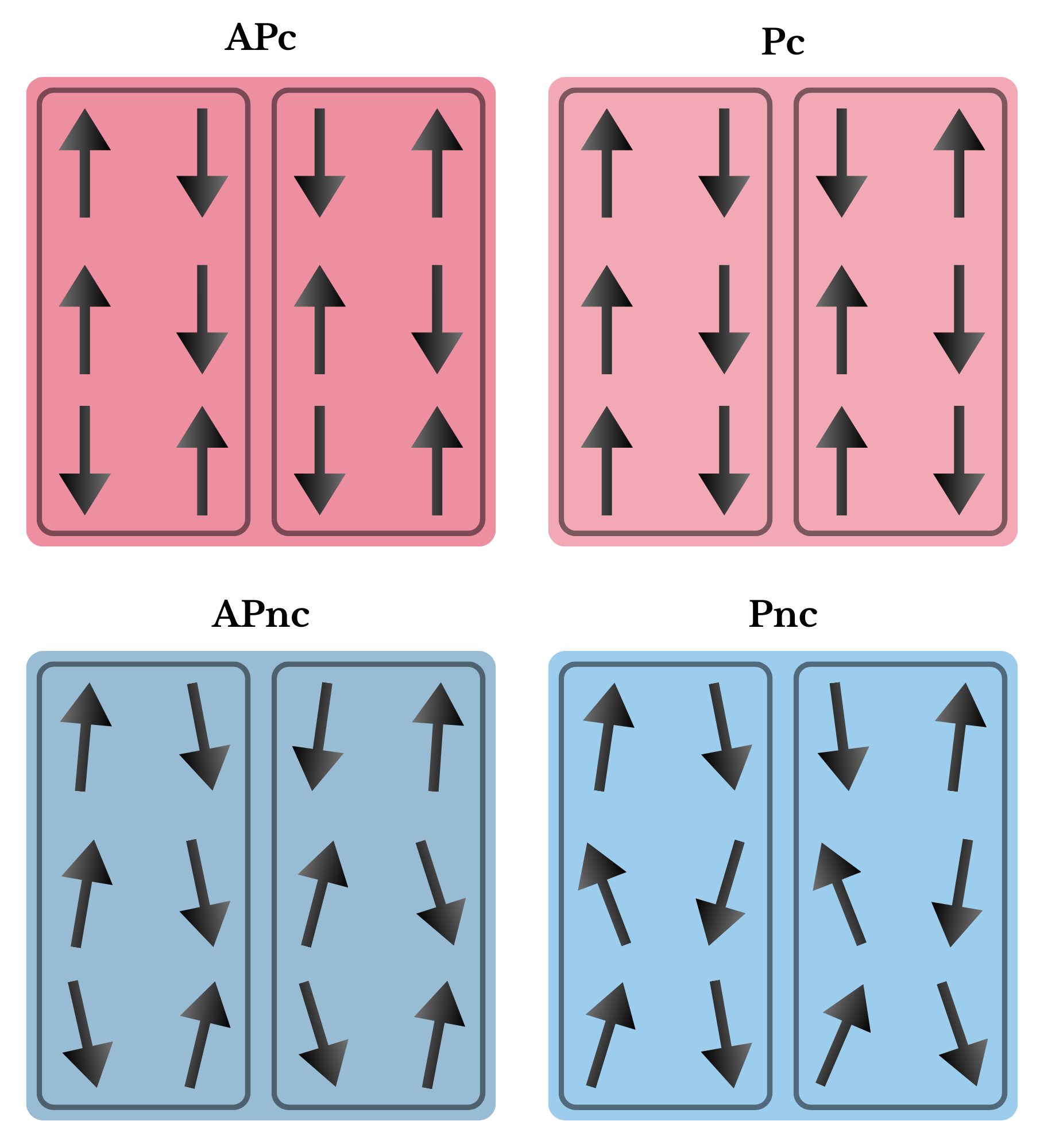
Figure 2: Enumeration of the 16 possible magnetic states in the three-layer system, organized into four classes based on collinearity and parallel/antiparallel alignment.
Phase Diagrams: Interlayer Coupling and Layer Asymmetries
By varying J1 and J2 across experimentally accessible regimes, detailed phase diagrams are constructed. These maps delineate regions supporting only APc or APnc alignments (thus minimizing stray field on FM3), as well as regions with mixed or competing states.
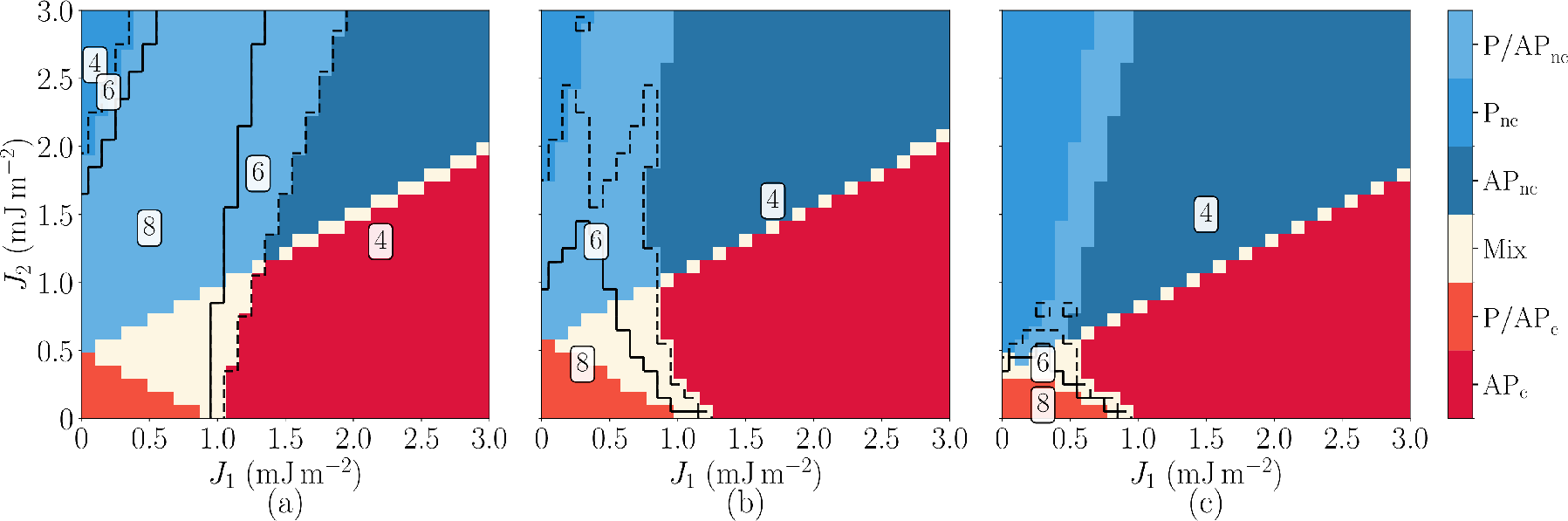
Figure 3: Phase diagrams illustrating stable magnetic configurations as a function of bilinear (J1) and biquadratic (J2) coupling for different SAF asymmetries.
A strong finding is that introducing asymmetry between FM1 and FM2—either in saturation magnetization, anisotropy, or thickness—shifts the boundaries of the antiparallel-only domains, lowering the threshold for stable antiparallel alignments. This is particularly significant post-annealing, when J1 may be reduced. Conversely, highly symmetric SAFs require larger J1 to maintain APc stability.
Statistical Analysis of Antiparallel Stability
By aggregating across a large parameter space, the analysis quantifies what fraction of (J20, J21) points yield exclusive APc or APnc stability, as a function of SAF layer stability factors. Notably, strong SAF asymmetry enlarges the region supporting robust antiparallel configurations, while highly stable symmetric SAFs are less tolerant of weakened coupling.
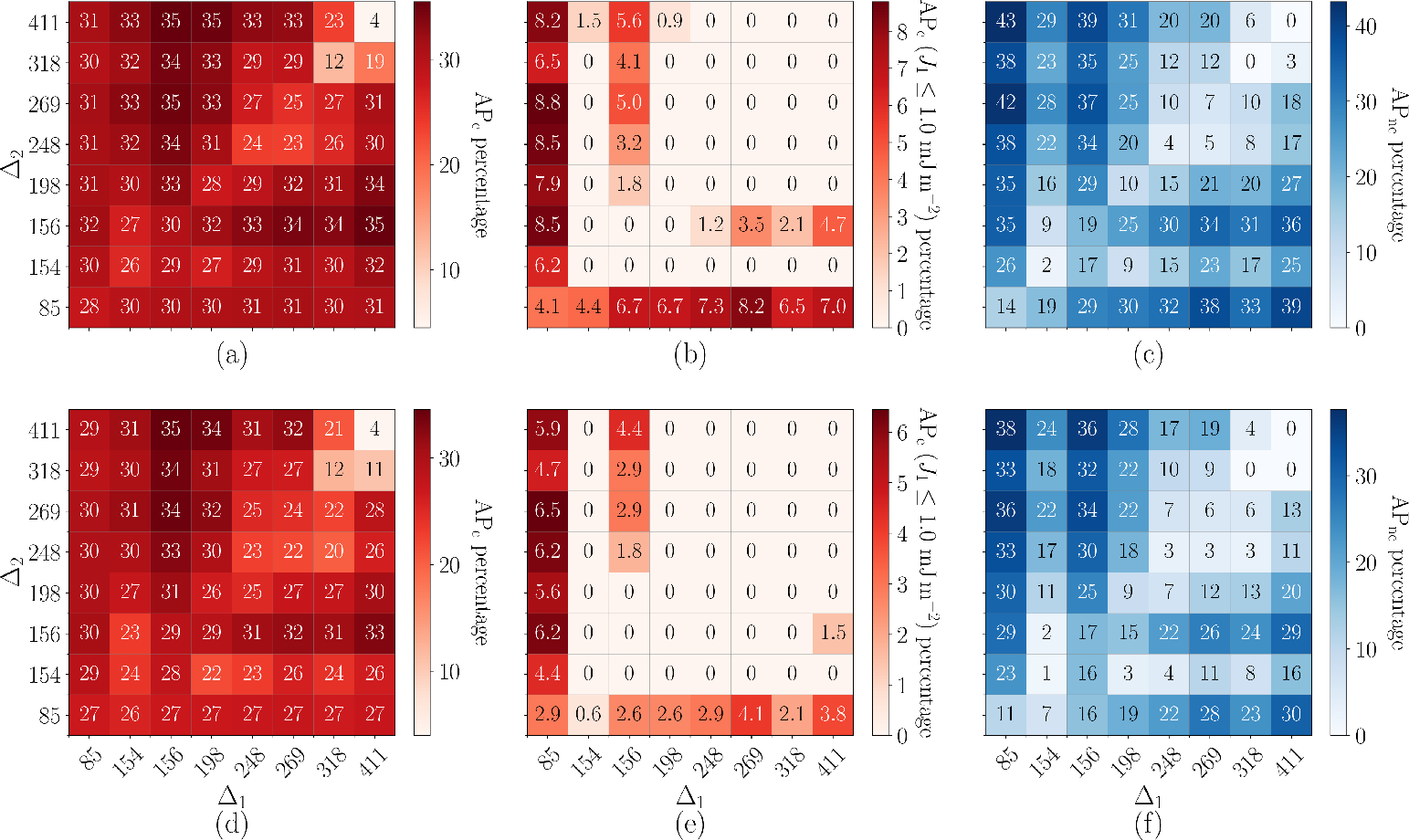
Figure 4: Statistical prevalence of APc (left) and APnc (right) alignment regions in coupling parameter space, as a function of SAF layer stability asymmetry and free layer properties.
Energy Barriers: Pathways and Reliability
Using string method-based minimum-energy path calculations, the stability of both the free layer (FM3) and the SAF is quantitatively assessed. Energy barriers for all relevant reversal processes are calculated, directly connecting equilibrium phase structure to probable switching pathways under thermal activation.
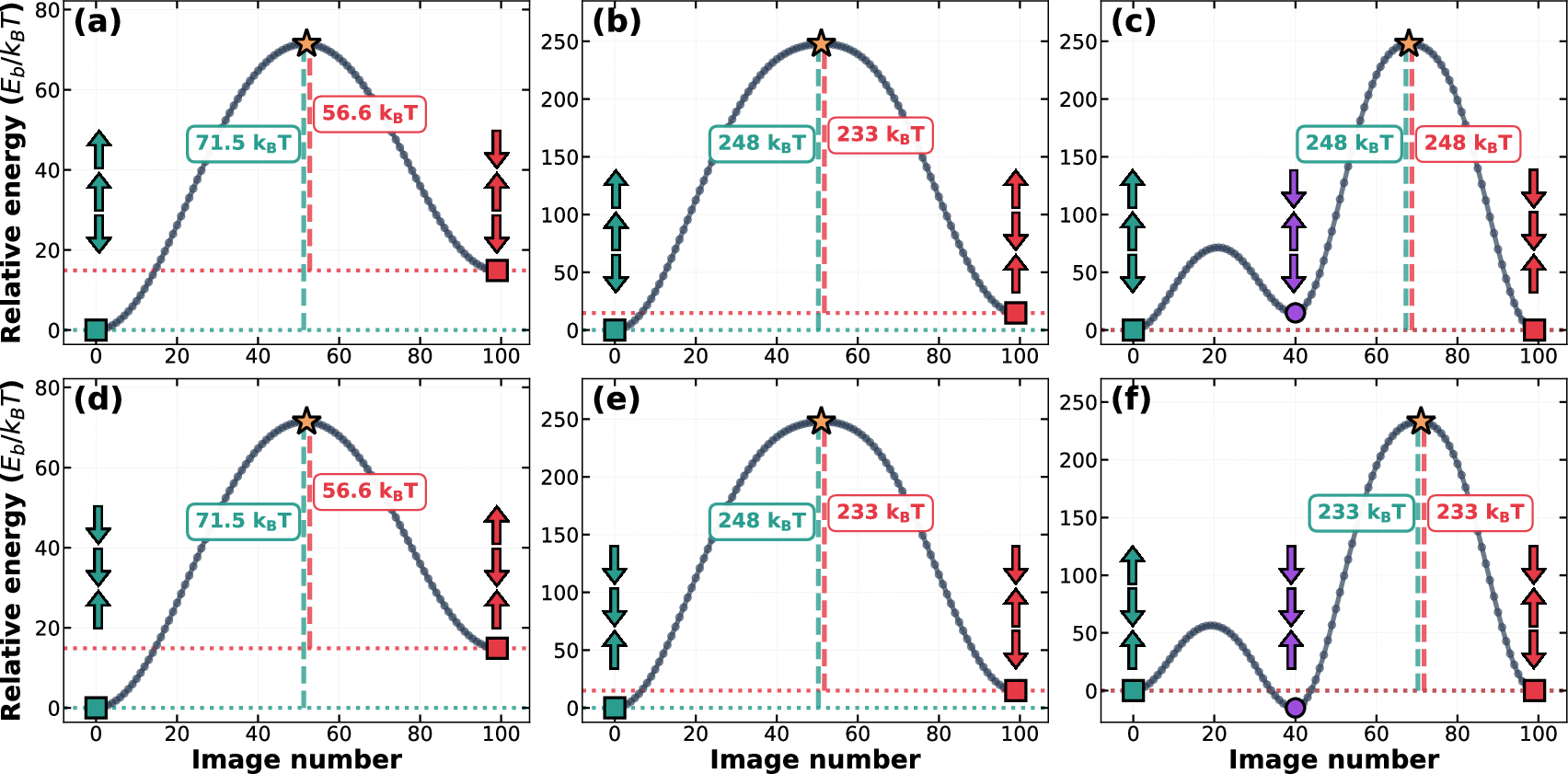
Figure 5: Minimum-energy paths for all transitions between APc minima, decomposing switching events into FM3, SAF, and synchronized reversal channels.
Maps of energy barriers as a function of (J22, J23) further reveal critical design trade-offs. In APc regions, FM3 barriers are relatively uniform and high, but in APnc regions, the interplay between SAF and FM3 properties leads to scenarios where increasing SAF asymmetry can raise the SAF reversal barrier but simultaneously lower the FM3 barrier, highlighting a trade-off between reference and free layer stability.
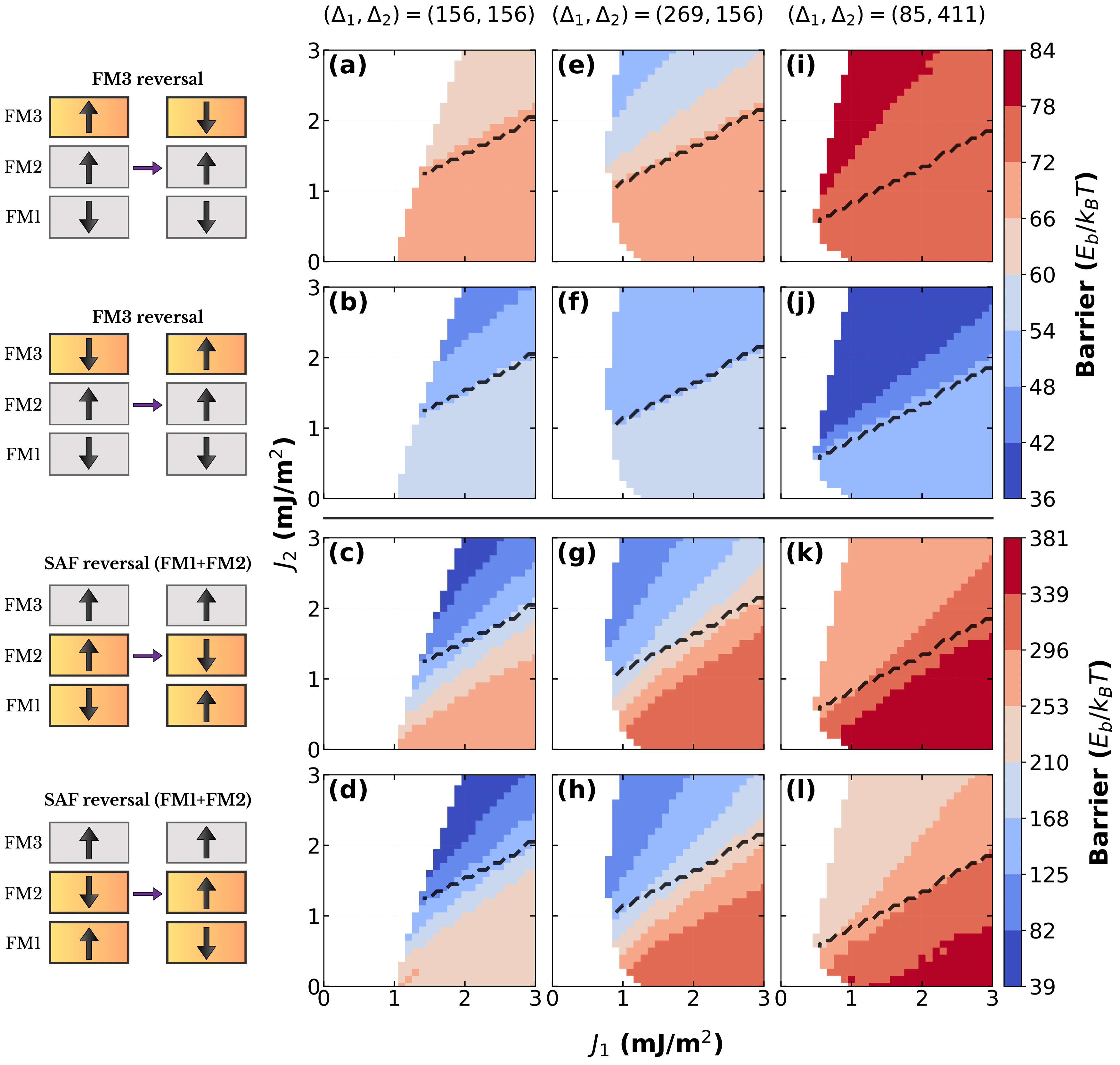
Figure 6: Energy barrier heatmaps for free layer and SAF reversal as a function of coupling parameters, for several representative SAF asymmetry cases.
Implications and Outlook
The micromagnetic analysis establishes several critical principles for p-STT-MRAM design:
- SAF Asymmetry as a Design Lever: Introducing asymmetry in FM1/FM2 facilitates robust APc or APnc reference states at lower coupling strengths, an important attribute for post-anneal device stability and for systems where J24 is technologically constrained.
- APnc as Functional State: While traditionally viewed as a competing or undesirable state, APnc regions can be exploited to engineer lower write currents and faster switching due to intrinsic noncollinearity and associated spin-transfer torque effects [Sbiaa, 2013].
- Barrier Interdependence: In noncollinear regimes, reference and free-layer barriers are in competition. Design must balance reliability (avoiding unintentional SAF reversals) and desired switching characteristics.
- Comprehensive Micromagnetic Dataset: The public release of equilibrium states, phase boundaries, and energy barriers will facilitate further theoretical modeling, device-scale simulations, and experimental benchmarking.
Future directions include introduction of current-driven dynamics to quantify switching time distributions, stochastic barrier crossing rates under bias, and the interplay with realistic fabrication-induced disorder. Ultimately, such modeling will enable precision engineering of next-generation MRAM devices by fully capturing the rich micromagnetic phase space inherent in nanoscale patterned SAFs.
Conclusion
This work provides an exhaustive micromagnetic mapping of equilibrium and metastable states in technologically relevant p-STT-MRAM nanopillars, revealing how interlayer coupling, SAF asymmetry, and stray fields determine the accessible magnetic configurations and energy barriers. The results directly inform material and stack design for low-error, thermally stable, and tunable MRAM cells, and position both collinear and noncollinear SAF strategies as viable and controllable options for advanced spintronic memory architectures.

