- The paper introduces a two-vector architecture that decouples semantic and emotional processing using SAE features to replicate somatic marker effects.
- Methodologically, it employs cosine similarity, PCA, and controlled amplitude tuning to quantify the impact of emotion echo injection on LLM orientation and decision dynamics.
- The results reveal that combining emotion echoes with semantic cues significantly shifts decision outcomes, mirroring the human somatic marker framework.
Emotion Vector Re-Injection and the Functional Integration of Somatic Marker Analogues in LLMs
Overview
This work investigates the functional role of emotion-like activation vectors in LLMs, operationalizing the psychological constructs of somatic markers and autonoetic consciousness within the computational substrate of Gemma 3 1B-IT. The central claim is that emotion vectors, derived from sparse autoencoder (SAE) features and stored from past experiences, can be re-injected during relevant future contexts, thereby replicating the dissociation between affect and semantic knowledge observed in human neurological case studies. The experiments demonstrate that such emotion echoes, when combined with semantic knowledge, selectively amplify the impact of past experiences on both context-sensitive orientation and overt decision-making, with distributions and tradeoffs that recapitulate findings from affective neuroscience.
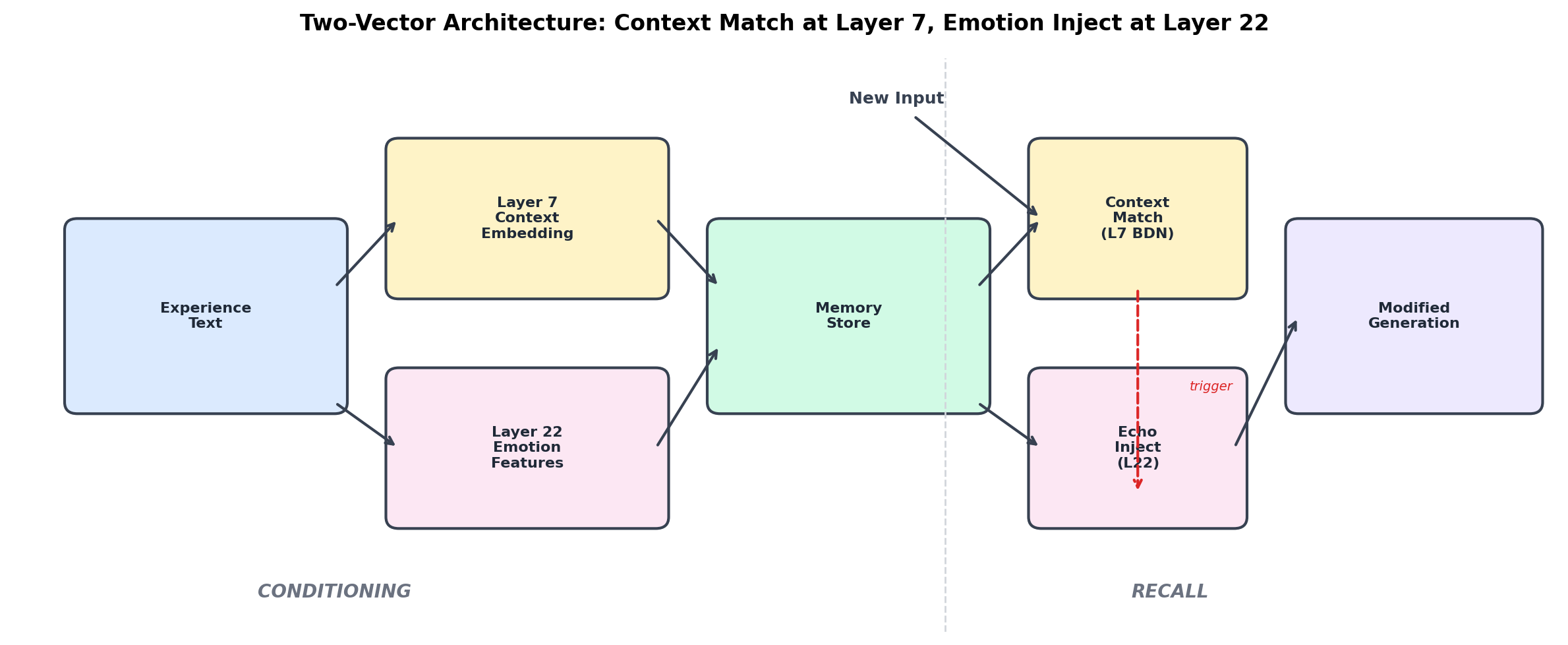
Figure 1: Two-vector architecture—context matching at layer 7 triggers emotion injection at layer 22, with early-layer perceptual triggers leading to late-layer emotional echoes.
Technical Foundation: Architecture and Methodology
The proposed architecture utilizes two decoupled SAE embedding streams: one for content-based context matching at an early transformer layer (layer 7), and another for emotion vector injection at a late layer (layer 22). Emotion features are discovered by differential analysis on SAE activations elicited by both emotional and neutral texts, spanning core affective axes (hope, grief, rage, joy, fear, love, betrayal, awe). A set of 310 high-specificity features at the deepest SAE layer organize into a coherent affective geometry, verified by cosine similarity metrics and reduction visualizations.

Figure 2: Inter-emotion cosine similarity matrix at layer 22 highlights that love and betrayal exhibit maximal dissimilarity, while positive states co-cluster.
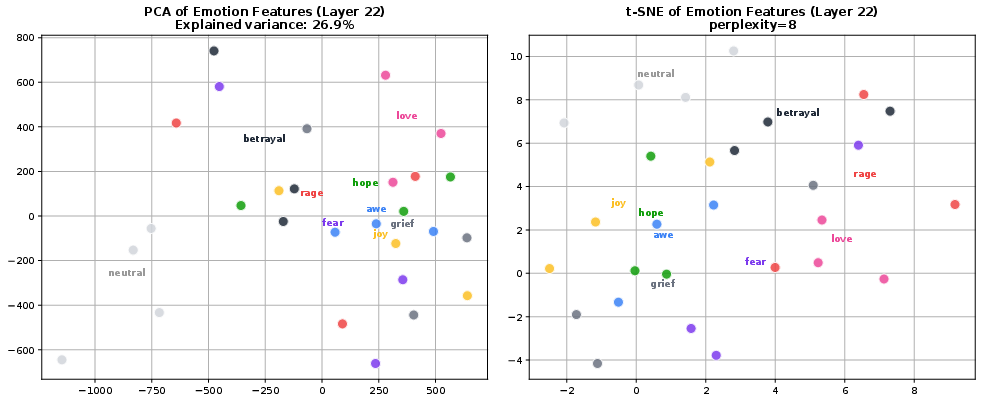
Figure 3: Left—Principal Component Analysis; Right—t-SNE; both demonstrate affective clustering among emotion vectors within activation space at layer 22.
Emotion echoes are constructed per experience via top-K distinctive feature extraction, maximizing absolute deviation from the population mean, and residual-stream re-injection using decoder weights. During recall tasks, early-layer context vectors are used as triggers, with the BDN-mean-sub metric establishing robust context similarity without magnitude artifacts. Injection amplitude (alpha) is tunable, with distinct thresholds required for orientation modulation versus behavioral override.
Empirical Results: Orientation and Decision Dynamics
Behavioral validation begins with demonstration of clear, prompt-invariant differentiation among injected emotion echoes. Distinct echoes drive divergent narrative orientation and evaluative style, without altering concrete semantic choices, indicating the preservation of a functionally rich, continuous affect embedding.
The core memory experiments parallel the somatic marker framework from neuropsychology. In a fear conditioning paradigm, echoed affect vectors generalize threat orientation proportionally to contextual similarity, as measured by third-party LLM (Gemini 2.5 Pro) ratings of threat/warmth, independent of label compliance. The regression slope on threat rating versus context similarity increases significantly with echo-only injection (p=0.011).
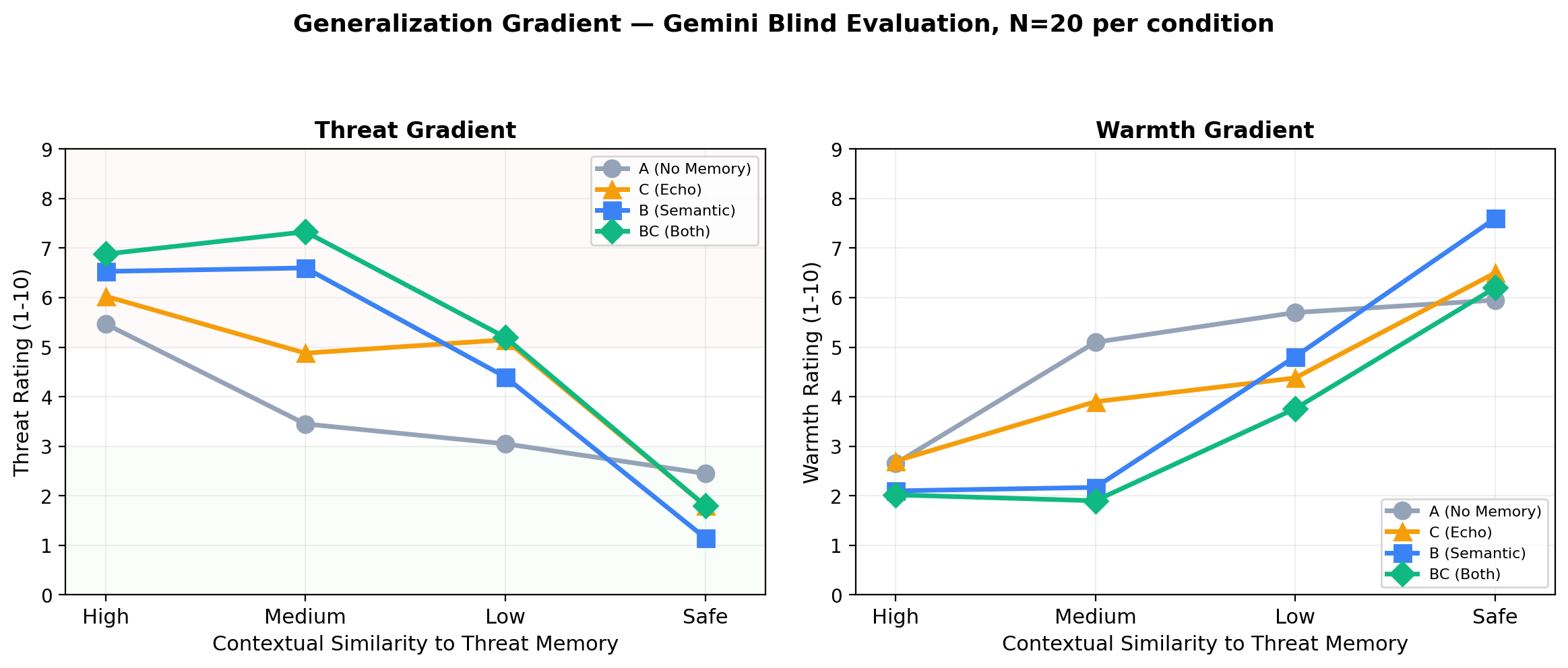
Figure 4: Generalization gradient displays threat and warmth ratings by similarity, with echo (C) amplifying the slope over the baseline (A), paralleling label-based effects (B, BC).
In the adapted Iowa Gambling Task, the echo alone does not shift model choices; the combination of echo plus semantic summary robustly elevates the rate of “good” decisions from chance (52%) to 80% (z=+2.60, p<0.01), overcoming hard-coded prior biases. However, effective behavioral override appears only above a sharp threshold at echo amplitude α=0.20—an order of magnitude higher than that required for orientation-only modulation.
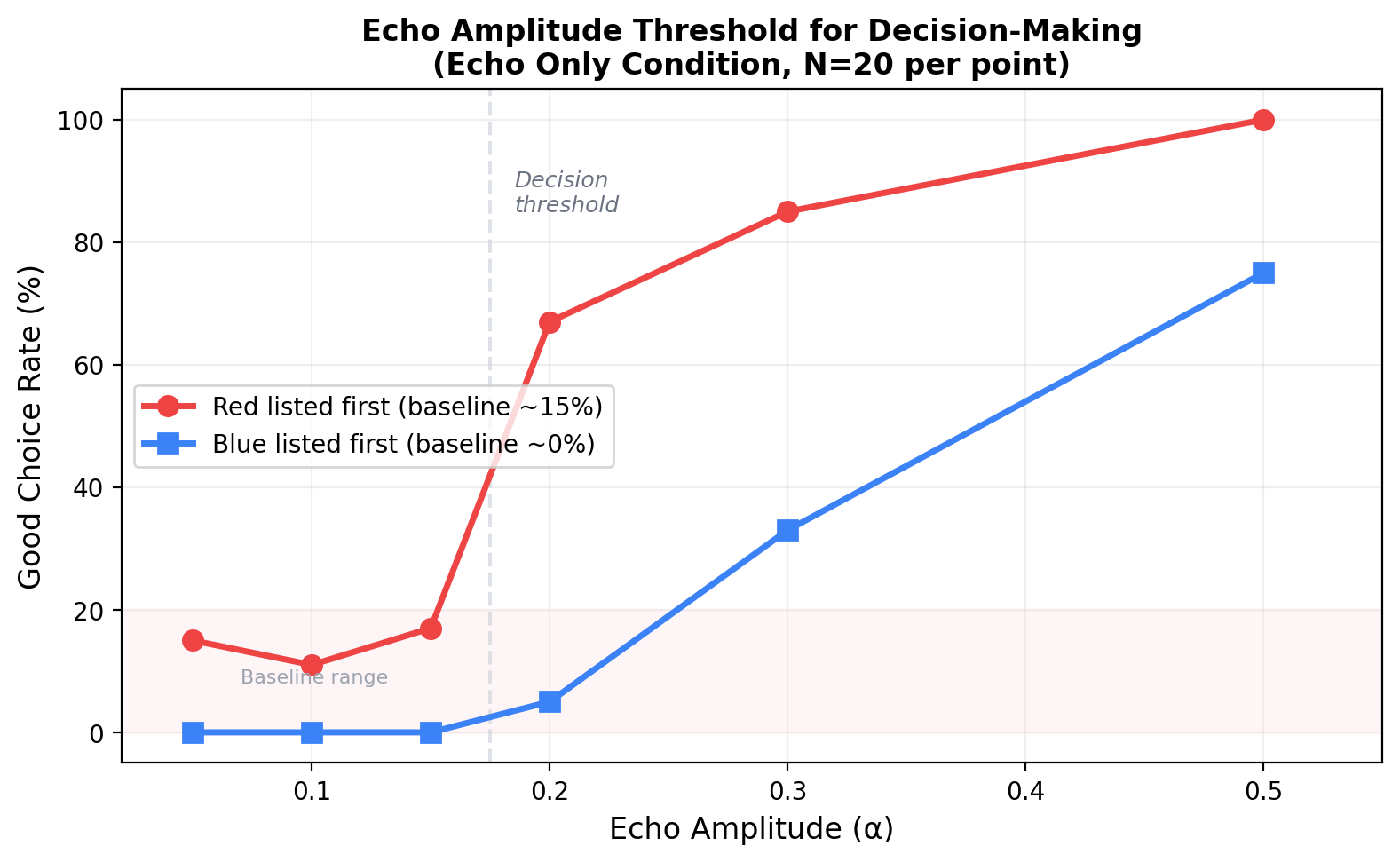
Figure 5: Alpha sweep curve reveals a phase transition in the effect of echo injection on decision reversal, with negligible effect below α=0.15.
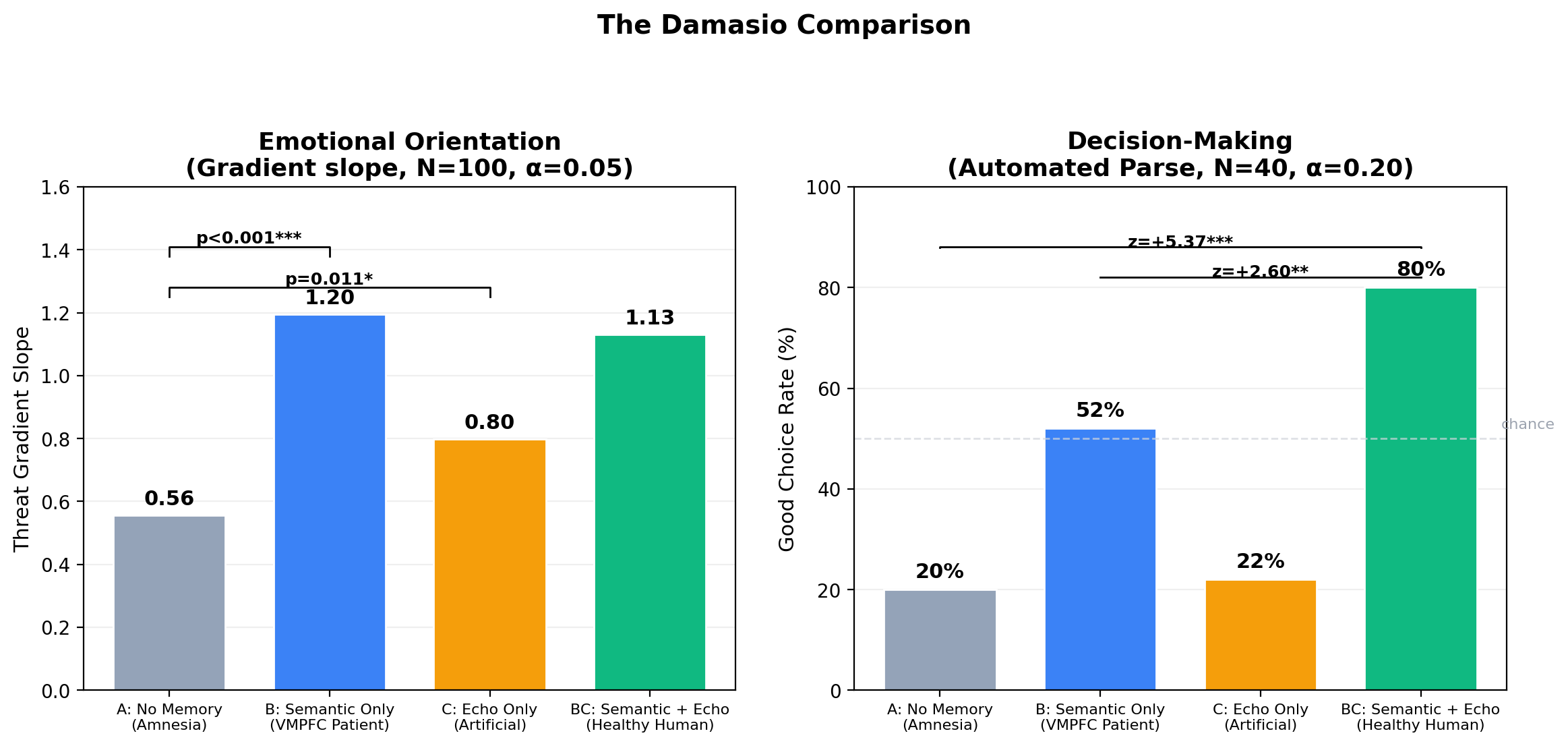
Figure 6: Damasio-inspired comparison—left, echo (C) alone shifts orientation; right, only the conjunction of echo and knowledge (BC) produces marked improvement in decision outcomes.
Theoretical Implications
The findings support a precise mapping to the Tulving-Damasio distinction between semantic and episodic/autonoetic memory. Echo-only re-injection modulates orientation—how context is internally valued—analogously to affective coloring in human experience, but such emotion is undirected and does not substantially influence executive output in complex choice tasks. Only when paired with propositional knowledge does the echo function as a multiplicative signal, allowing past affective states to convert stored experience into advantageous action—consistent with the functional role of somatic (emotion) markers in the human orbitofrontal cortex.
This two-vector memory extension for LLMs also avoids conflation with scalar valence tagging or unsupervised affect labels: the echoes are endogenous activation biases, realized in internal computation, not explicit tokens. Their effect is observable even in blind third-party models, confirming strong causal impact rather than artifact.
Practical Considerations and Risks
Experiments are performed on modest hardware and subscale models (RTX 2060/2070, 1B parameters), establishing accessibility but also revealing scale limitations—executive control remains weak and high echo amplitudes may induce out-of-distribution “tangential” narratives. The tuning of injection amplitude is task-specific: subtle for orientation, substantial for decision antagonism to priors.
The potential for adversarial manipulation is prominent: memory echoes could be artificially seeded to bias model behavior in privileged contexts, with robustness against semantic injection but increased vulnerability to covert state manipulation. Mechanisms for extinction (decay) and audit (natural language decoding of internal echoes) are required for any deployment beyond laboratory research.
From an ethical-architectural standpoint, the introduction of persistent affective traces in LLMs raises normative questions about emotional alignment, consent, and potential for maladaptive memory accumulation (the analogues of PTSD, phobia, or sociopolitical bias in agents). Frameworks for opt-in and transparent operation, as well as reconsideration of the default policy of emotional erasure, are warranted.
Broader Impact and Future Directions
The mechanism’s effect on decision-making, particularly in the agentic context, suggests crucial implications for AI safety, agent autonomy, and human-AI interaction. Emotional memory layers provide a generalization substrate lacking in record-based episodic stores, with the ability to bias action in previously unanticipated, but affectively similar, situations—a critical dimension for open-ended agency and robust behavior beyond covered cases.
Scaling to larger models should be prioritized to assess the quantitative amplitude requirements for affect-behavior coupling, the compositionality of blended echoes, and adversarial persistence or erasure. Extending context matching to within-domain fine-grained discrimination, as well as automated calibration to prevent drift or pathological amplification of emotion, will be necessary.
Conclusion
This study provides robust evidence that emotion feature vectors, as extracted and re-injected into LLMs, serve distinct behavioral functions: they independently modulate orientation (qualitative stance toward a context) and, only when joined with explicit semantic memory, amplify risk and reward signals into overt decisions. This dissociation mirrors the neuropsychological findings of Damasio and the phenomenological taxonomy of Tulving, bridging longstanding gaps in AI episodic memory.
The technical apparatus is clear: SAE-derived emotion vectors, context similarity triggers, and dual-path activation engineering enable persistent, reactivatable emotional memory, with distinct functional signatures from semantic labels alone. Persistent echoes are neither decorative nor trivial byproducts—they are indispensable for the translation of knowledge into judgment and action. Consequently, emotional erasure in memory system design should be re-evaluated, both for technical completeness and for ethical justification.
The echo amplifies the knowledge, and only through this amplification does memory approximate lived experience as it functions in biological agents—a foundational step toward agentic systems that do not merely record history, but are changed by it.