- The paper introduces a pre-trained, zero-shot model that efficiently maps observational data to acyclic causal graphs.
- It employs a skeleton–order factorization with a composite edge likelihood to ensure identifiability and enforce acyclicity.
- Arrow’s transformer-based architecture yields scalable and robust performance across synthetic, semi-synthetic, and real benchmarks.
Arrow: A Foundation Model for Zero-Shot Causal Discovery
Arrow introduces a pre-trained, zero-shot foundation model for causal discovery on observational tabular data. Leveraging a skeleton–order factorization of DAGs and a transformer-based encoder, Arrow provides a tractable and efficient map from raw data to acyclic causal graphs, showing strong performance and transferability across diverse synthetic, semi-synthetic, and real benchmarks.
Arrow formalizes a directed acyclic graph (DAG) as the combination of two structures: an undirected skeleton and a node order (permutation). The skeleton A encodes adjacency, while the topological order π is used to orient edges. The DAG is then constructed as G=A⊙M(π), where M(π) is an order-consistency mask ensuring that all directed edges follow the specified order, guaranteeing acyclicity by construction.
This decomposition yields a tractable conditional likelihood for training, parameterized by a product-Bernoulli distribution for the skeleton and a Plackett–Luce distribution for the node order. Although the exact likelihood is intractable due to the latent ordering, Arrow adopts a composite directed edge likelihood, which the authors formally show to be both identifiability-preserving and structure-aligning within this model class. At inference, Arrow predicts the most probable skeleton and ordering, yielding an acyclic graph in a single forward pass.
Arrow’s architecture contextualizes variables within and across samples using three transformer modules:
- Observation Transformer: Permutation-invariant, applies self-attention over variables within each observation.
- Variable Transformer: Aggregates across observations for each variable using learned summary tokens and cross-attention.
- Context Transformer: Aggregates variable embeddings globally for mutual context.
Prediction heads then transform these contextualized variable embeddings to (i) undirected skeleton edge probabilities (via a permutation-invariant MLP), and (ii) order scores (via a linear head), respecting symmetries and equivariances in the data.
Pretraining Distribution and Optimization
Arrow's pretraining spans a broad and heterogeneous synthetic task distribution:
- Graphs are sampled from Erdős–Rényi and scale-free families with variable sizes (n from $100$ to $2000$, p from $2$ to $100$).
- Causal mechanisms alternate between linear and nonlinear (small MLP) SEMs, with multiple activation functions.
- Noise is introduced via normal, uniform, or beta distributions, in both homogeneous and heterogeneous configurations.
- Task-level π0 and signal/noise ratios are randomized.
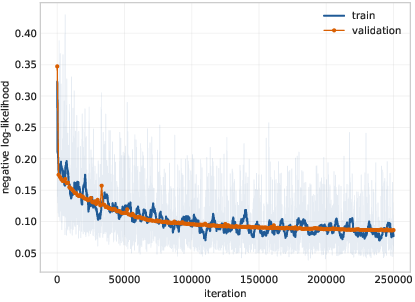
Training proceeds via large-scale stochastic optimization on streams of freshly generated tasks, using the composite edge-wise negative log-likelihood with AdamW.
Empirical Evaluation
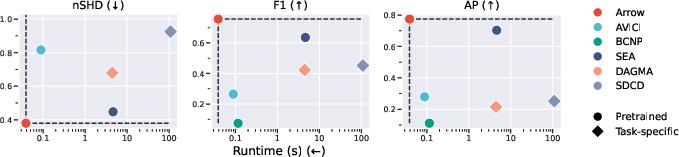
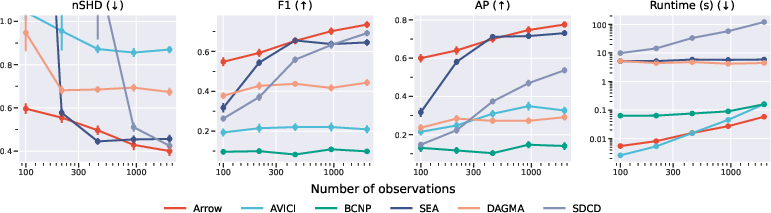
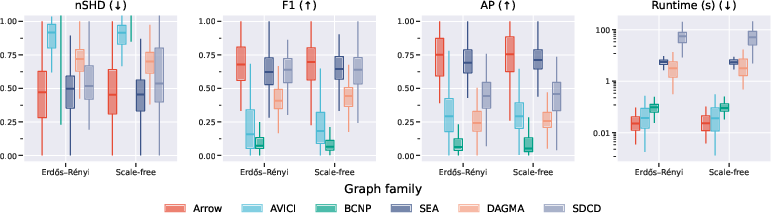
Arrow is systematically benchmarked against modern task-specific and pretrained competitors. Key findings include:
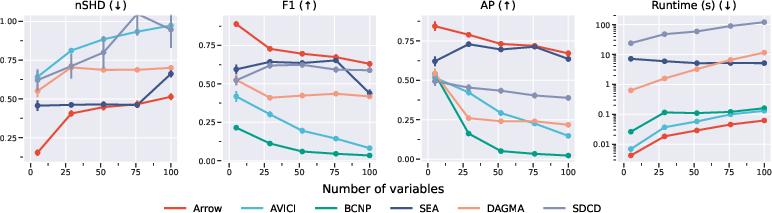
Figure 2: Effect of sample and variable count on performance on synthetic datasets (average/SE over 100 draws).
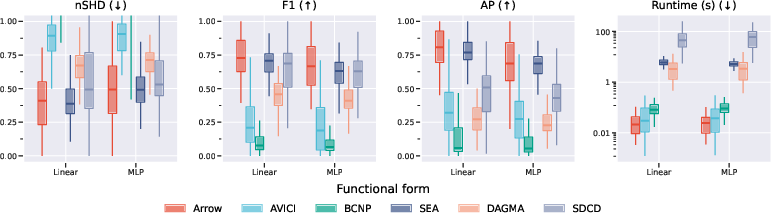
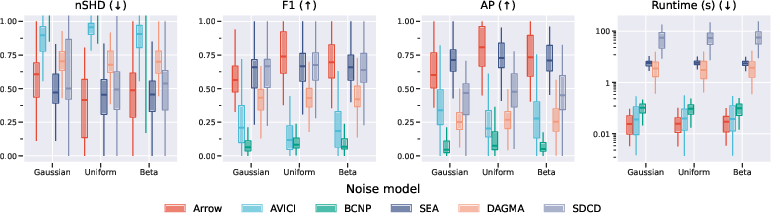
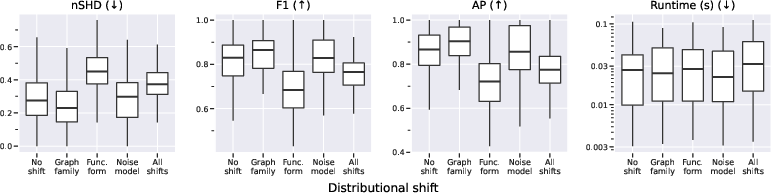
Figure 4: Fine-grained breakdown of performance by generator component (graph, functional, and noise families).
Theoretical and Practical Implications
Arrow demonstrates that large-scale supervised pretraining over a synthetically diverse set of graph discovery tasks can yield a foundation model that is:
- Zero-shot and reusable: Arrow predicts DAGs for novel datasets in a single forward pass, with no task-specific search, optimization, or adaptation.
- Acyclicity-guaranteed: The skeleton–order design ensures all predictions are globally valid DAGs.
- Empirically robust: Broad synthetic pretraining translates into nontrivial transfer to disparate real and semi-synthetic settings.
- Efficient: Inference time is orders of magnitude lower than those of task-specific and aggregation-based alternatives.
From a theoretical perspective, Arrow’s composite likelihood—while a significant simplification compared to the full DAG likelihood—is provably sufficient for parameter identifiability within the skeleton–order model class. This factorization implies that the edgewise statistics capture all model-relevant latent structure, as long as the pairwise directional preferences are globally consistent (i.e., the log-odds field is curl-free).
Outlook and Future Directions
Arrow’s success establishes several new research avenues:
- Latent confounding and interventional data: Extension of the skeleton–order framework to partial observability, latent variables, and experimental data is an open challenge.
- Ultra-large-scale graphs: Model and memory scaling to π1, possibly via sparse attention or distributed encoding.
- Distribution shift and robustness guarantees: Formal quantification of Arrow's failure modes under hard distribution shifts would further elucidate its domain of applicability.
- Integration with prior knowledge: Adaptation to settings with expert or partial graph constraints.
- Application-oriented deployment: Continued assessment in high-stakes real-world domains (biological, economic, medical) leveraging Arrow as an initial discovery step.
Conclusion
Arrow provides a foundation for scalable, accurate, and efficient causal structure discovery by treating the problem as one of cross-domain supervised learning with a neural inductive bias enforcing acyclicity. Its formulation, pretraining diversity, and transformer architecture collectively yield a zero-shot, acyclicity-guaranteed model that generalizes across a remarkable range of synthetic and real data regimes. Arrow is positioned as a reusable scientific tool, accelerating data-driven hypothesis generation and inviting further advances at the intersection of foundation models and causal inference.