- The paper introduces an elastic post-training framework that embeds nested submodels, enabling zero-shot extraction and dynamic phase-wise budget control.
- The methodology leverages importance estimation, a learnable router with Gumbel-Softmax optimization, and Nested Quantization-Aware Distillation to achieve up to 16% higher accuracy and 1.9× lower latency.
- The framework significantly reduces training and deployment costs, offering up to 360× lower token costs and halved storage requirements compared to separate model training.
Star Elastic: Many-in-One Reasoning LLMs with Efficient Budget Control
Motivation and Contributions
The "Star Elastic" framework addresses the prohibitively high computational and storage costs associated with training and deploying families of reasoning LLMs, especially when each model variant is independently trained. Existing approaches for model compression primarily utilize knowledge distillation or structured pruning, but these still require linear scaling in token costs per variant and lack unified, nested deployment. Star Elastic introduces an elastic post-training paradigm that embeds N nested submodels within a single parent, enabling zero-shot extraction and deployment of multiple model sizes without additional fine-tuning or retraining. This extends the Nemotron Elastic framework to hybrid Mamba--Attention--MoE architectures, unlocking elasticity across embedding channel, SSM, MoE, and FFN axes.
Core contributions include:
- The first elastic post-training solution for hybrid Mamba--Transformer--MoE reasoning LLMs.
- Dynamic, phase-wise elastic budget control during inference, yielding up to 16% higher accuracy and 1.9× lower latency.
- End-to-end learnable router architecture, optimized by knowledge distillation, that efficiently determines nested submodel structures, supporting heterogeneous per-layer compression (e.g., FFN and expert selection).
- Significant training and deployment cost reduction: 360× less than pretraining from scratch and 7× compared to state-of-the-art compression.
- Nested Quantization-Aware Distillation (QAD) for elastic checkpoints in FP8 and NVFP4, preserving zero-shot slicing and further reducing deployment footprint.
This paradigm dismantles the rigid resource allocation in static architectures and systematically advances accuracy--latency trade-offs via dynamic, per-phase model selection.
Methodology: Elastic Model Construction and Training
Star Elastic's pipeline comprises three stages:
- Importance Estimation and Model Preparation: Model components (embedding channels, Mamba heads, attention heads, MoE experts, FFN channels) are ranked by activation-based importance scores, extending group-aware constraints for SSM structures. For MoE, Router-Weighted Expert Activation Pruning (REAP) ensures principled expert selection, considering both activation frequency and output magnitude.
- Elastic Formulation: The architecture embeds nested, weight-shared submodels that vary in both width (embedding dimension, head/expert/channel counts) and depth (layer count), forming strictly nested hierarchies via importance rankings. This enables resource-aware extraction along width and depth axes, supporting homogeneous and per-layer heterogeneous configurations.
- Elastic Training: A learnable router, parameterized by budget specification, produces differentiable masks for each axis. Mask selections are optimized via Gumbel-Softmax and supervised through knowledge distillation from the non-elastified parent. A two-stage curriculum-based sampling strategy is adopted: uniform budget sampling at short context, followed by weighted non-uniform sampling for extended context. The loss combines knowledge distillation and router resource-matching, enabling end-to-end sub-network optimization.
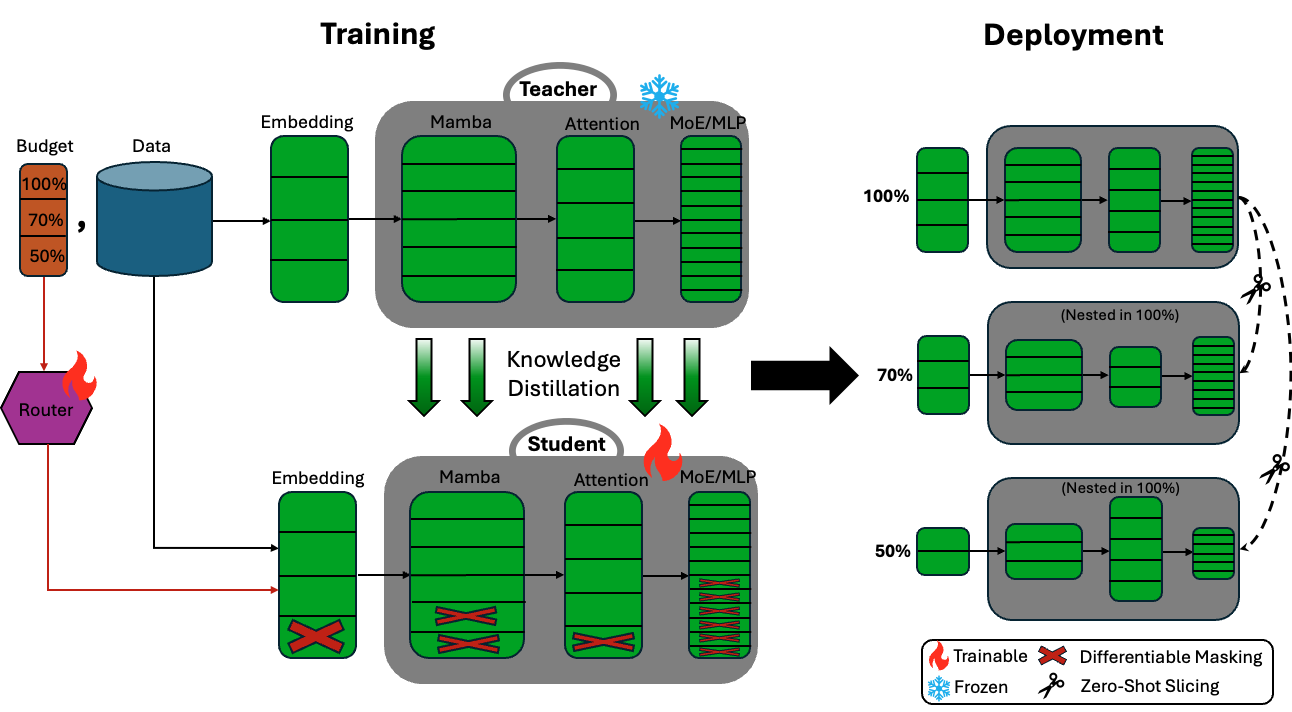
Figure 1: Overview of the Star Elastic pipeline showing joint optimization and zero-shot deployment of nested submodels from a single checkpoint.
This unified post-training method eliminates the need for separate compression/distillation runs per variant, regularizes smaller submodels via training signals from the full budget, and supports immediate extraction of any nested variant.
Elastic Budget Control
Traditional budget control in LLM inference applies a fixed architecture across all reasoning phases, missing opportunities for differentiated resource allocation. Star Elastic introduces elastic budget control—allocating varying model sizes for reasoning ("thinking") and answer synthesis ("answering") phases. Phase-specific nesting enables lower-cost long-horizon reasoning with smaller models and high-fidelity answer generation with larger models.
The optimal configuration empirically is to use a smaller model for the thinking phase and a larger one for the answering phase (e.g., $23$B for reasoning, $30$B for answer synthesis), aligning model capacity with phase-specific requirements. Star Elastic ensures cache compatibility across nested variants, facilitating cache transplantation and potentially eliminating recomputation overhead.
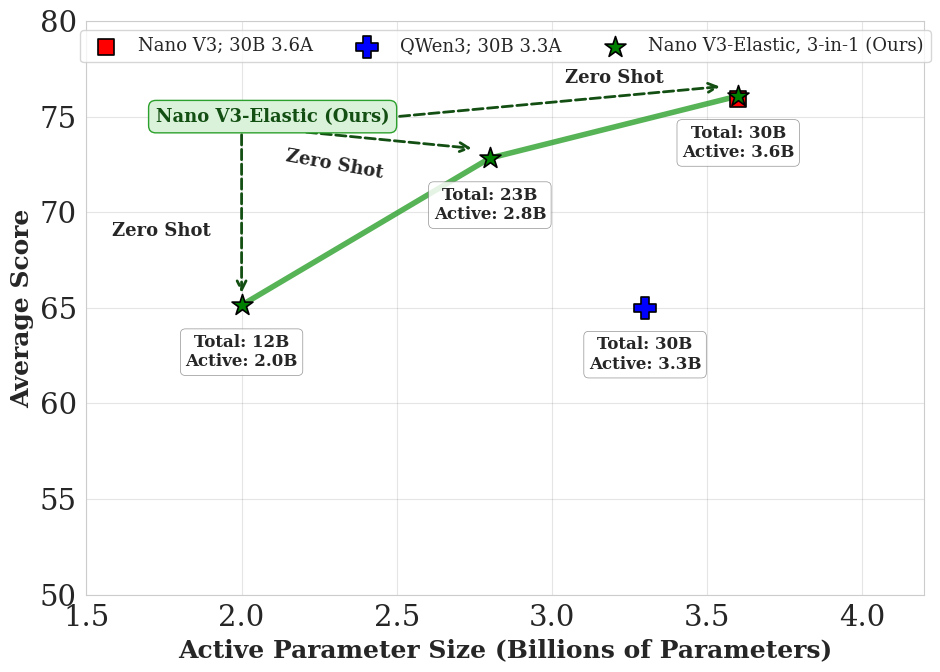
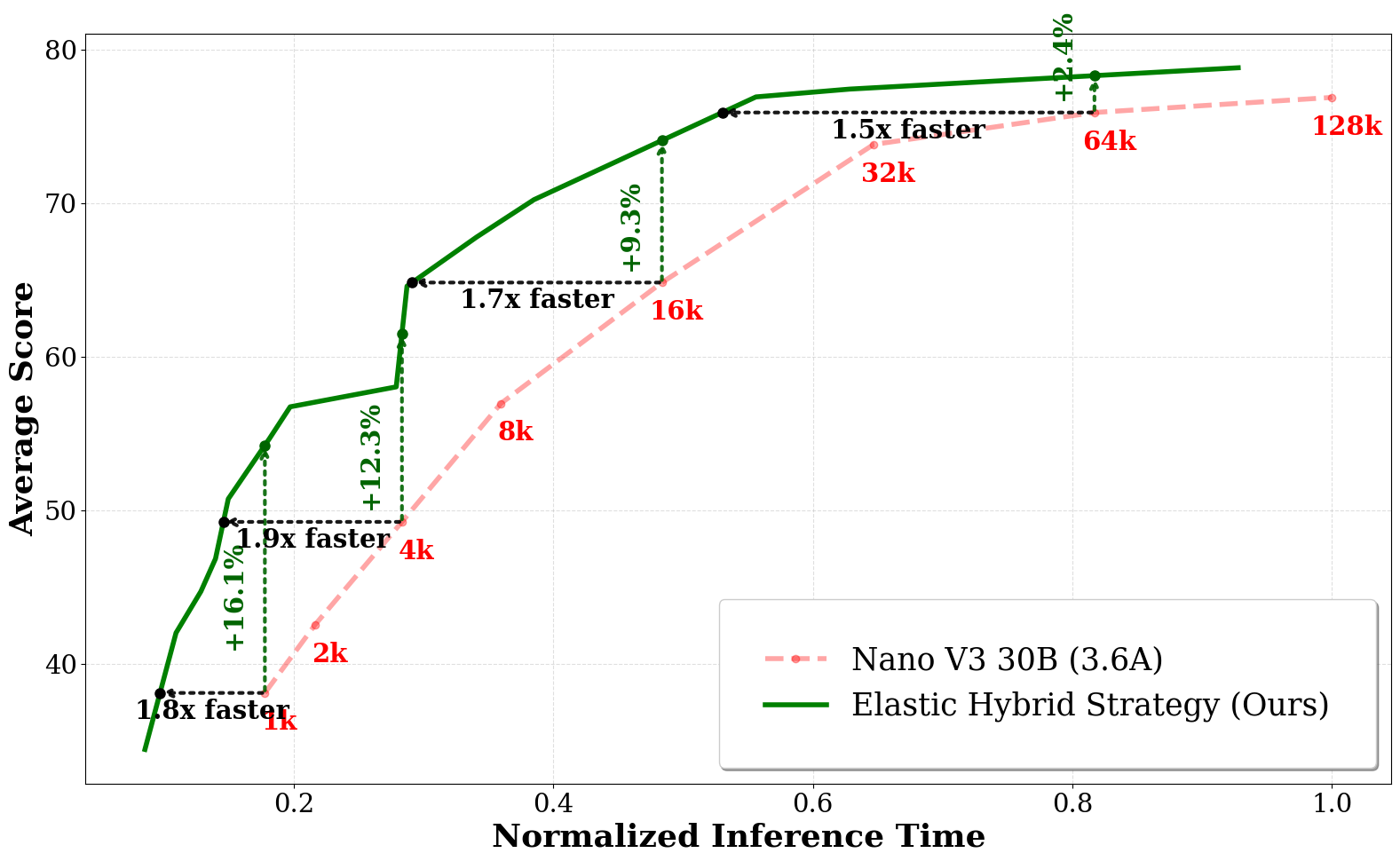
Figure 2: Left: Star Elastic achieves superior accuracy compared to parent and Qwen on multiple reasoning benchmarks. Right: Hybrid elastic budget control dominates the accuracy--speed Pareto frontier relative to static control.
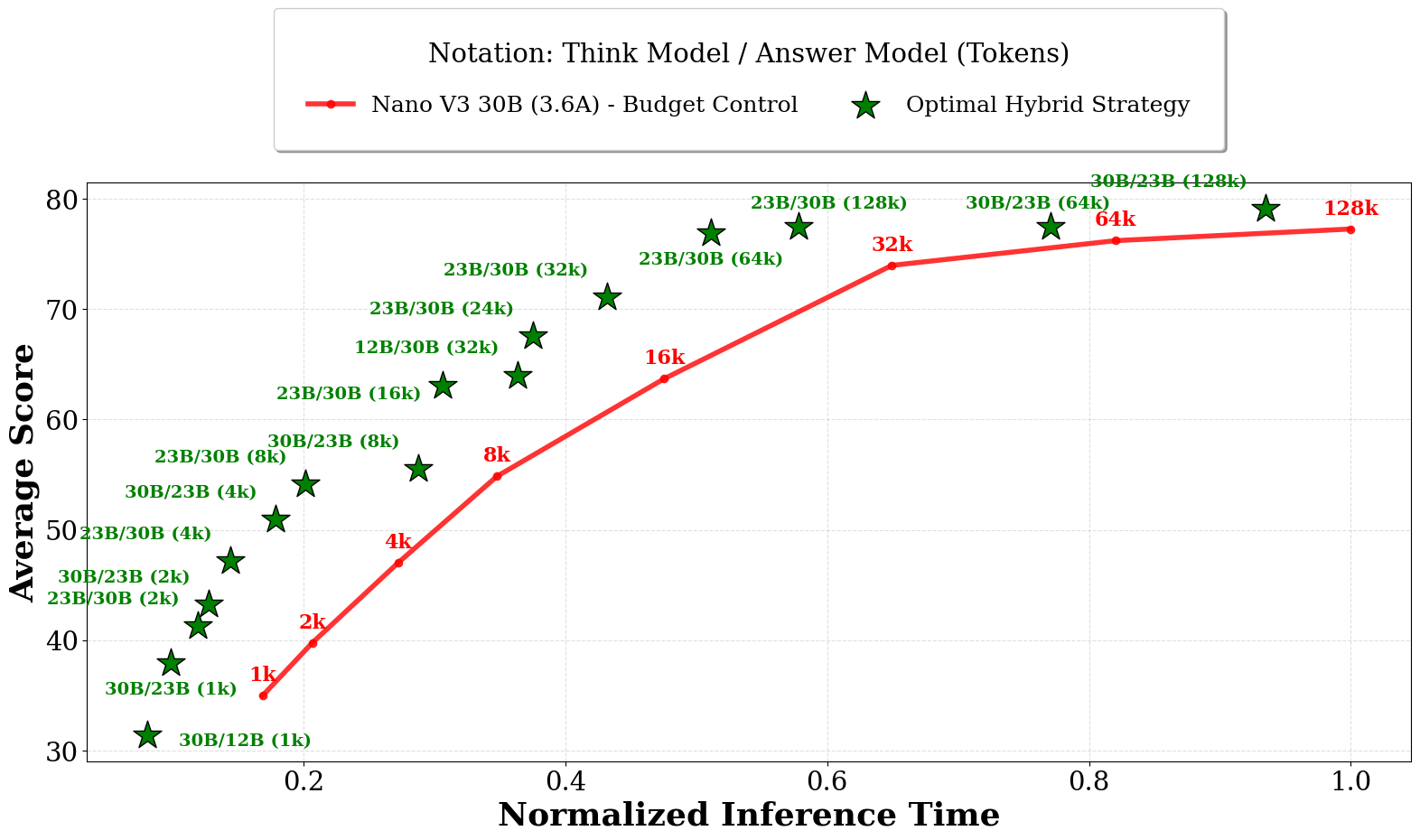
Figure 3: Elastic budget control configurations across computational budgets, with the MS→ML configuration offering the best accuracy--latency tradeoff.
Empirical Results
Accuracy and Efficiency
Experiments focus on Nemotron Nano v3 (30B/3.6A), compressing to nested 23B/2.8A and 12B/2.0A variants with 160B tokens. All nested models match or outperform independently trained baselines at comparable size, with strong results on reasoning benchmarks: AIME-2025, GPQA, LiveCodeBench v5, MMLU-Pro, IFBench, and Tau Bench.
Elastic budget control advances the Pareto frontier: up to 16% higher accuracy and 1.9× lower latency through dynamic phase allocation. Nested models enable higher batch throughput and fit on lower-memory hardware, further reducing deployment friction.
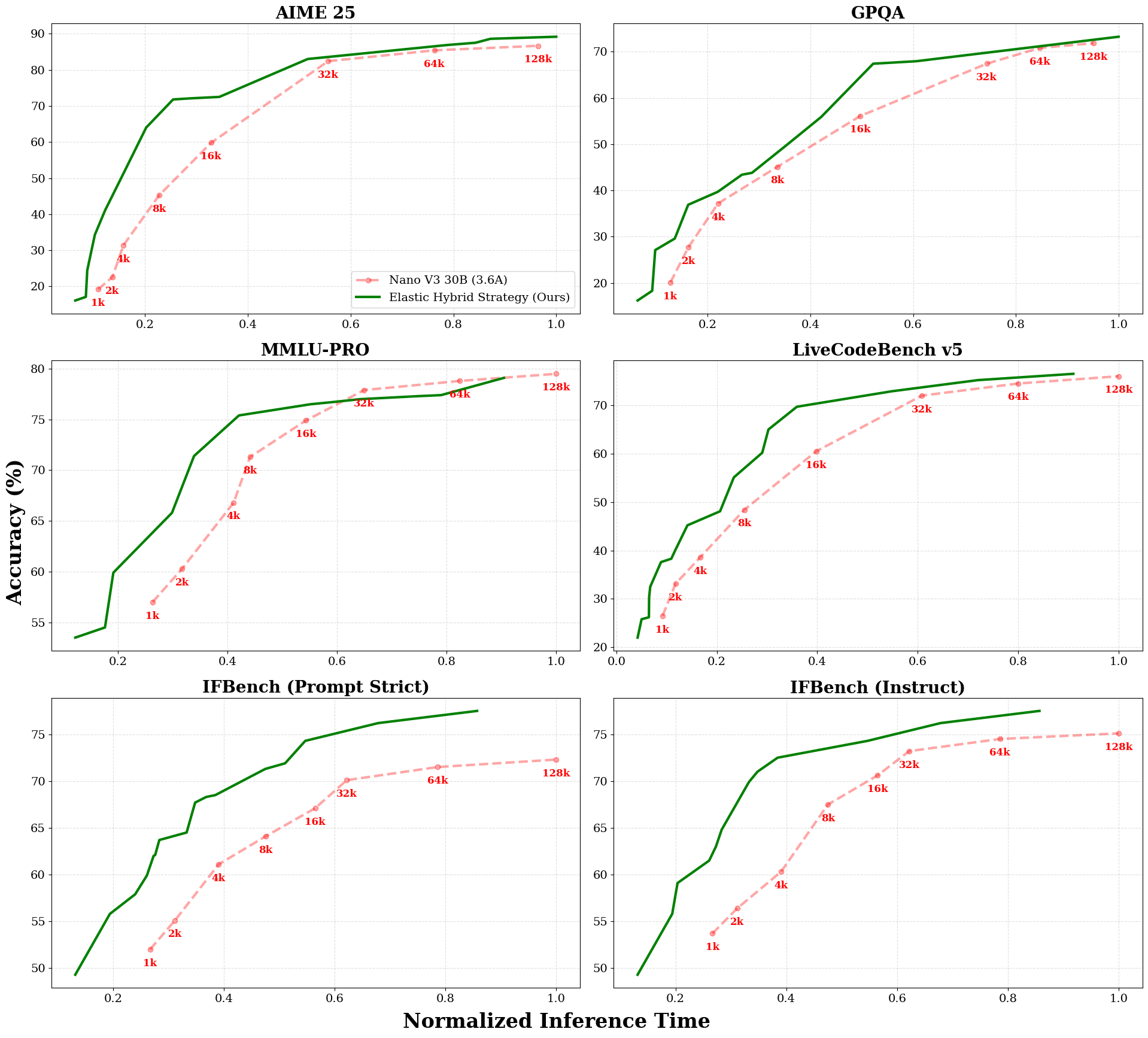
Figure 4: Per-benchmark Pareto frontiers showing elastic budget control configurations outperform static baselines across accuracy--speed.
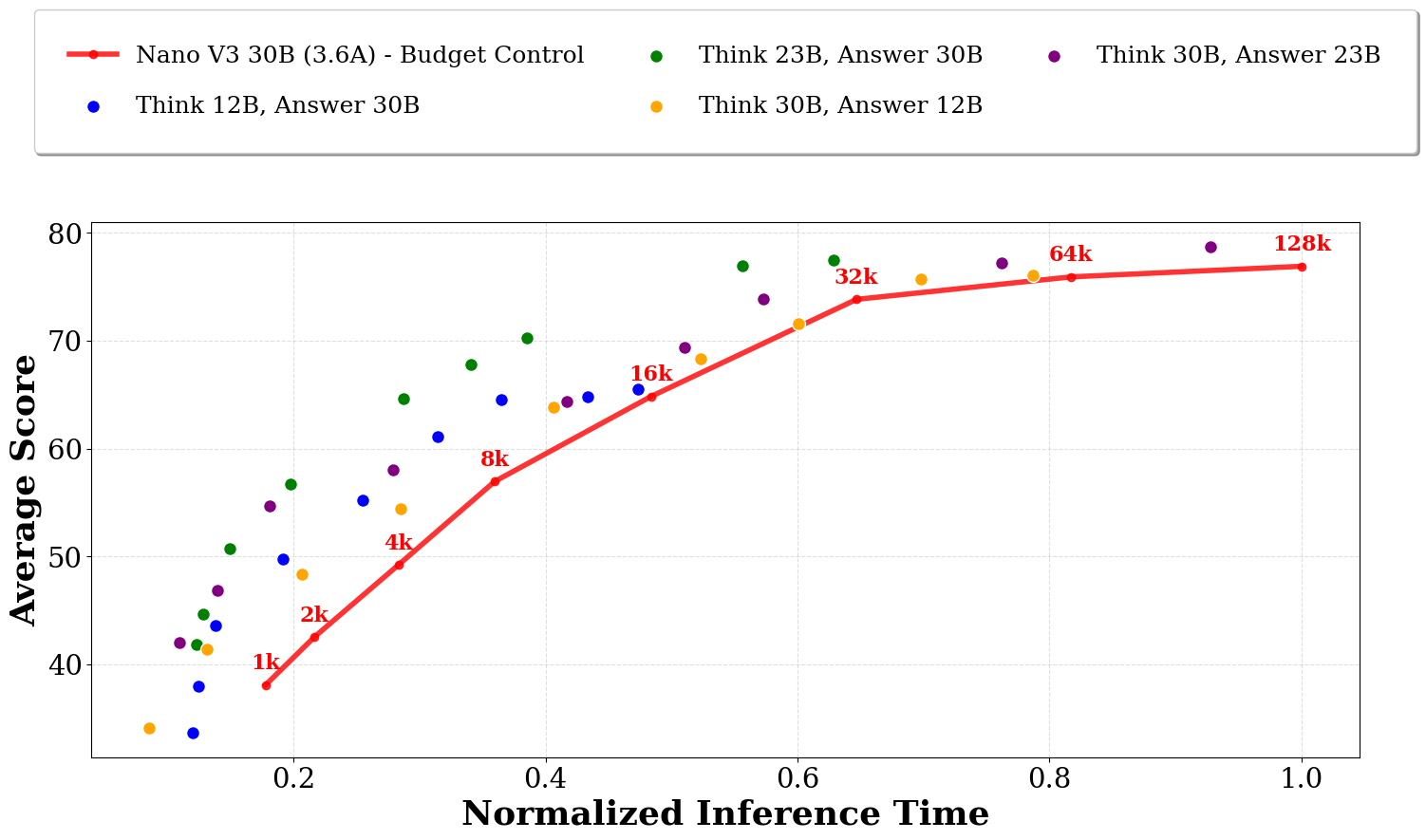
Figure 5: Detailed configuration breakdown; $23$B-$30$B dominates at high accuracy/moderate latency, ×0B-×1B and ×2B-×3B optimal for low-latency.
Training and Deployment Cost
Star Elastic achieves ×4 reduction in token cost (relative to pretraining) and ×5 over sequential compression, delivering all variants from a single training run. Storage requirements scale only with the largest model due to weight sharing; for Nano v3, an elastic checkpoint requires less than half the memory vs. separate models.
Quantized Elastic Models
The framework extends elastification to FP8 and NVFP4 formats. For FP8, post-training quantization maintains accuracy via simple quantization. For NVFP4, QAD is necessary for accuracy recovery. Nested QAD preserves the elastic structure, facilitating zero-shot slicing of quantized variants. Quantized elastic checkpoints achieve 3.4×6 throughput improvement and fit larger models on lower-end GPUs, drastically reducing memory and bandwidth requirements without compromising performance.
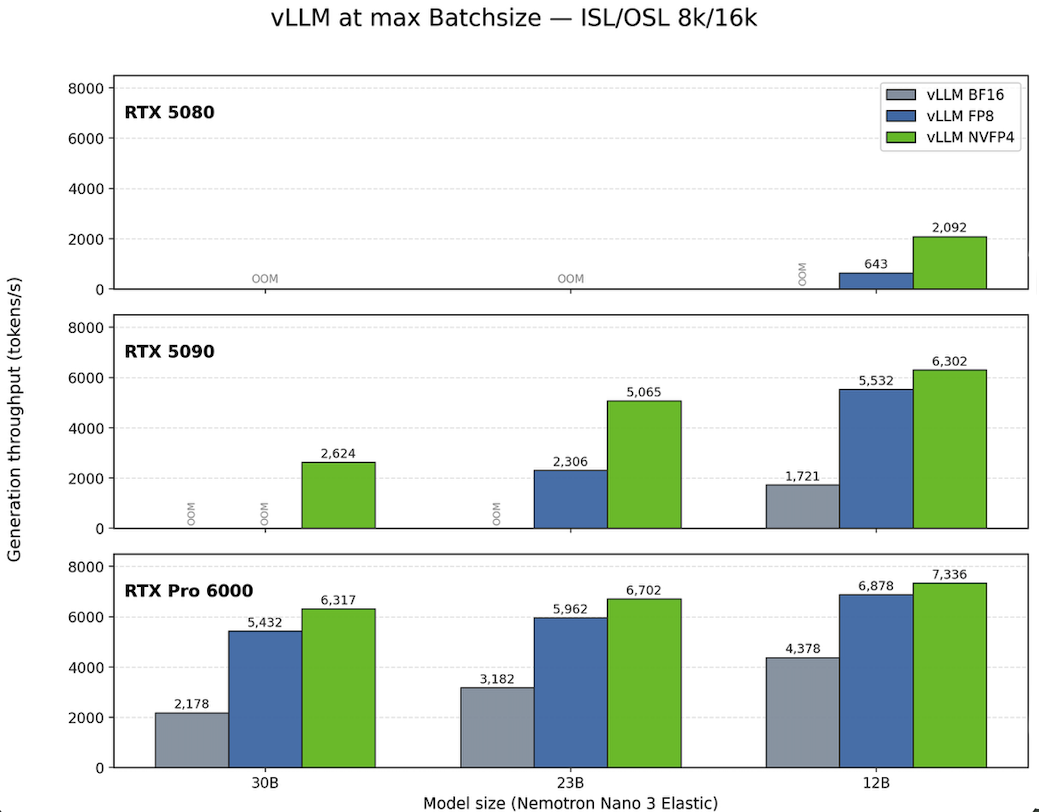
Figure 6: Throughput (tokens/s) of Star Elastic variants under vLLM in BF16, FP8, NVFP4, across RTX 5080/5090/Pro 6000; NVFP4 enables deployment under tighter device constraints.
Star Elastic builds upon the Nemotron Elastic post-training framework, extending it from Mamba--Attention to MoE-hybrid architectures. Prior work (e.g., Flextron, MatFormer) established nested weight sharing and zero-shot slicing in transformer-based models. Structured pruning and knowledge distillation (e.g., Minitron, REAP, group-aware SSM pruning) are outperformed by Star Elastic's single-run, nested approach.
Quantization-aware training and post-training quantization (PTQ/QAD) are widely used for dense transformers, but Star Elastic demonstrates their efficacy in preserving elastic structure across quantized regimes. The phase-wise dynamic allocation of nested model sizes introduces a novel axis of efficiency not previously explored.
Implications and Future Directions
Star Elastic sets a new paradigm in training and deploying model families, coupling flexibility, efficiency, and performance. The practical impact is immediate: rapid deployment of nested models, real-time adaptation to inference resource constraints, and substantial reduction in both cost and device footprint. Theoretical implications include new avenues for dynamic envelope modeling and joint optimization of nested substructures under distillation. Future directions span ultra-low-budget compression, automated task/domain-specific routing, and advances in cache-state transplantation. Further integration with context-aware adaptation and heterogeneous configuration will strengthen both generalization and resource utilization.
Conclusion
Star Elastic delivers a unified post-training solution for constructing elastic, reasoning-capable LLM families under hybrid Mamba--Transformer--MoE designs. The methodology efficiently scales multiple nested variants in a single run, dynamically calibrates inference resources via phase-wise budget control, and produces quantized checkpoints for device-constrained deployment. The nested, many-in-one paradigm shrinks both training and deployment requirements, improves accuracy--latency trade-offs, and generalizes across precision regimes. Star Elastic represents a substantial step towards practical, adaptive LLM deployment for complex reasoning workloads (2605.07182).