Consistent Geometric Deep Learning via Hilbert Bundles and Cellular Sheaves
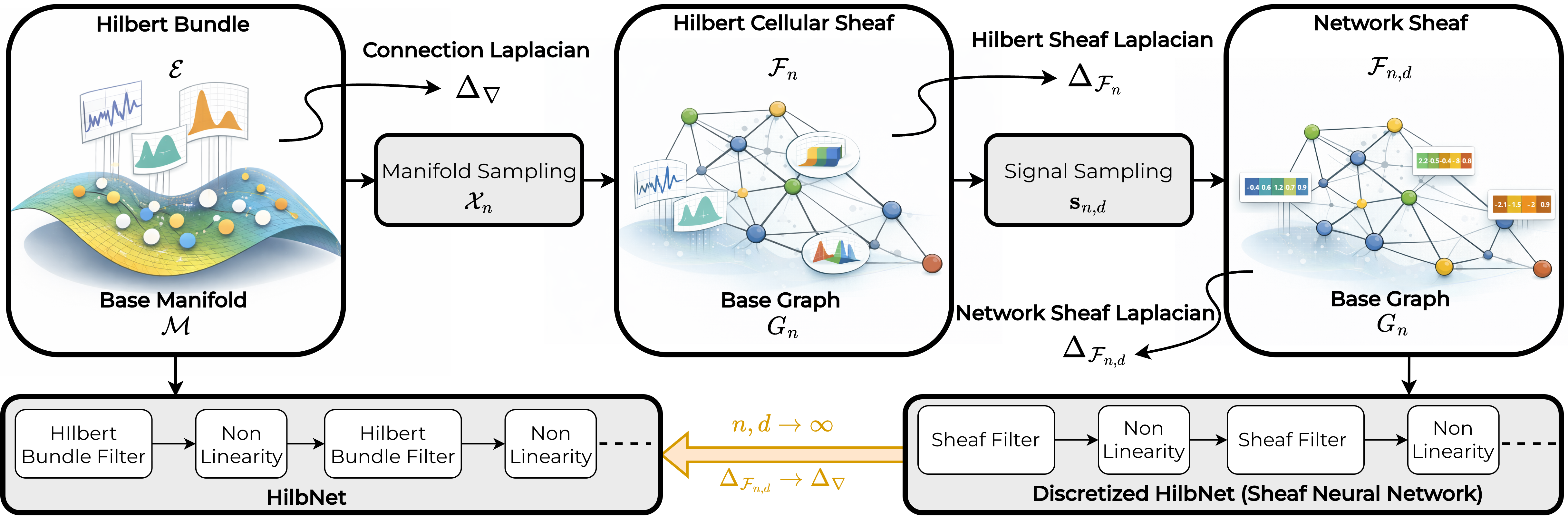
Abstract: Modern deep learning architectures increasingly contend with sophisticated signals that are natively infinite-dimensional, such as time series, probability distributions, or operators, and are defined over irregular domains. Yet, a unified learning theory for these settings has been lacking. To start addressing this gap, we introduce a novel convolutional learning framework for possibly infinite-dimensional signals supported on a manifold. Namely, we use the connection Laplacian associated with a Hilbert bundle as a convolutional operator, and we derive filters and neural networks, dubbed as \textit{HilbNets}. We make HilbNets and, more generally, the convolution operation, implementable via a two-stage sampling procedure. First, we show that sampling the manifold induces a Hilbert Cellular Sheaf, a generalized graph structure with Hilbert feature spaces and edge-wise coupling rules, and we prove that its sheaf Laplacian converges in probability to the underlying connection Laplacian as the sampling density increases. Notably, this result is a generalization to the infinite-dimensional bundle setting of the Belkin & Niyogi \cite{BELKIN20081289} convergence result for the graph Laplacian to the manifold Laplacian, a theoretical cornerstone of geometric learning methods. Second, we discretize the signals and prove that the discretized (implementable) HilbNets converge to the underlying continuous architectures and are transferable across different samplings of the same bundle, providing consistency for learning. Finally, we validate our framework on synthetic and real-world tasks. Overall, our results broaden the scope of geometric learning as a whole by lifting classical Laplacian-based frameworks to settings where the signal at each point lives in its own Hilbert space.
Paper Prompts
Sign up for free to create and run prompts on this paper using GPT-5.
Top Community Prompts
Explain it Like I'm 14
What is this paper about?
This paper builds a new kind of deep learning tool—called a HilbNet—that can learn from very rich signals that don’t fit neatly into pictures or grids. Think of data like a whole time series, a sound clip, or even a full probability distribution attached to every point on a curved surface (like locations on Earth). The authors design a way to do “convolutions” (the core idea behind many successful neural networks) on this kind of data, even when each point holds an infinite amount of information.
What questions are the authors trying to answer?
In simple terms, they ask:
- How can we define convolution and build neural networks for signals that live on irregular shapes (manifolds) when each location stores a complex, possibly infinite-dimensional object (like a whole time series)?
- How can we turn this continuous, ideal mathematical model into something you can actually compute on a computer?
- Can we prove that the practical, discrete version really approximates the ideal, continuous version as we collect more data and use better approximations?
- Will the learned models stay reliable when we change the sampling of the same underlying shape (so they’re not tied to one specific point cloud)?
How do they do it? (Methods in everyday language)
First, a few gentle translations:
- Manifold: a fancy word for a shape that can be curved or irregular (like a sphere or a road network), not just a flat grid.
- Hilbert bundle: imagine every location on your shape has its own “little space” that can be huge—like a whole bookshelf filled with numbers (e.g., an entire time series or a full probability distribution). That “bookshelf” is a Hilbert space, and the collection of these spaces over the shape is a Hilbert bundle.
- Parallel transport: a rule for how to “carry” or compare information from one location’s bookshelf to another’s in a consistent way.
- Laplacian (here, the connection Laplacian): think of the “heat spreading” operator—if you place heat at one point, this tells you how it diffuses over time. In learning, Laplacians are used like geometry-aware averaging or smoothing tools.
Here’s the approach:
- Define convolution by “filtering” with the connection Laplacian. Convolution is like applying a music equalizer to a song, turning certain frequencies up or down. Here, instead of music, the “equalizer” is built from the Laplacian that knows the geometry of the shape and how to compare signals across locations (via parallel transport). This gives a principled way to smooth, mix, or transform the data while respecting the geometry.
- Build HilbNets: neural networks that stack these filters with simple nonlinear functions (like ReLU), applied point-by-point in each local “bookshelf.”
- Make it computable with a two-step sampling trick:
- Step 1: Sample points on the shape to form a graph. But this isn’t just a normal graph: each node stores a whole Hilbert space (e.g., a time series), and each edge stores a rule for how to compare signals between nodes (coming from parallel transport). This structure is called a Hilbert cellular sheaf. It produces a “sheaf Laplacian,” the discrete version of the connection Laplacian.
- Step 2: Sample the signals themselves. Since computers can’t handle infinite shelves, pick a finite set of coordinates (for example, the first d Fourier coefficients of a time series) at each node. Now everything is finite and can be computed. The result is a block-matrix version of the Laplacian and a practical neural network you can train.
- Prove consistency: show that as you sample more points on the shape and keep more signal coordinates, the discrete model and its outputs get closer and closer to the continuous, ideal one.
What did they find, and why does it matter?
Main findings:
- A general convolution for infinite-dimensional signals on manifolds. They define filters using the connection Laplacian and a powerful tool (called functional calculus) that handles operators directly. This lets HilbNets process very rich signals while respecting geometry.
- A discrete, implementable pipeline. The two-stage sampling (of the shape and then the signals) turns the theory into a working model. The resulting “sheaf Laplacian” is like a graph Laplacian with extra structure that knows how to compare complex signals across edges.
- Strong theoretical guarantees. They prove that:
- The sheaf Laplacian converges to the true (continuous) connection Laplacian as the number of sampled points grows. This generalizes a famous result for ordinary graphs to their much richer setting.
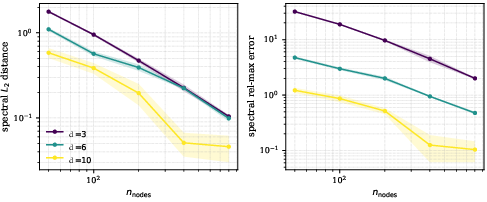
- The fully discrete HilbNets converge to the continuous HilbNets as both the number of sampled points and the number of signal coordinates increase.
- Models are transferable: if you re-sample the same shape differently, the learned network behaves consistently. That’s important for robustness and working across different datasets of the same system.
- Practical wins. On synthetic tasks and real traffic forecasting, versions of HilbNets that use learned parallel transport often outperform baselines, especially when the geometric prior helps organize how signals should be compared across locations.
Why this matters:
- Many real datasets are not just “a number per location.” They’re “a whole time series per location,” or “a distribution per location.” This work gives a principled, geometry-aware way to learn from such data and proves that the practical method really approximates the ideal theory.
What could this change in the future? (Implications)
- Broader geometric deep learning: The paper extends the toolbox from images and simple graph signals to far richer signals (time series, distributions, even operators) attached to points on complex shapes.
- Consistent learning across resolutions: Because the discrete models converge to the continuous ones, you can trust that as you collect more data or change resolution, your model’s behavior remains stable.
- Better use of prior knowledge: Parallel transport encodes how to compare signals across space. You can plug in domain knowledge (like physics, geometry, or learned transformations) to guide the model, which can help in low-data or noisy settings.
- Applications: This can impact climate modeling (fields over the globe), sensing and robotics (signals on 3D surfaces), healthcare (distributions over body or brain manifolds), and transportation (time series on road networks), among others.
In short, the paper shows how to bring the power of convolutional networks to complex, infinite-dimensional signals on curved or irregular domains, makes the approach practical, and proves it works in a consistent and reliable way.
Knowledge Gaps
Knowledge gaps, limitations, and open questions
Below is a consolidated list of concrete gaps and open problems that remain unresolved and can guide future work.
- Assumptions on sampling: convergence results rely on iid uniform sampling over a closed Riemannian manifold. Extensions to:
- non-uniform sampling densities (with or without known density),
- manifolds-with-boundary, non-compact manifolds, or stratified spaces,
- sampling with noise, outliers, and missing points,
- unknown manifold metrics/distances (when only a graph is observed).
- Graph construction: the theory uses a complete graph with Gaussian weights. Practical and theoretical impacts of:
- sparsified constructions (k-NN, ε-graphs) on consistency and rates,
- adaptive/learned kernels and bandwidth selection,
- anisotropic kernels tailored to connection/curvature.
- Bandwidth schedule and rates: the bandwidth choice delivers asymptotic convergence, but:
- finite-sample, high-probability error bounds and explicit rates are not provided,
- optimality of the schedule and its dependence on curvature, injectivity radius, and connection properties is not analyzed,
- data-driven selection of in finite samples is left open.
- Operator convergence strength: results are pointwise/L2 for fixed smooth sections. Open questions include:
- operator-norm (or strong/weak) convergence of the sheaf Laplacian to the connection Laplacian,
- uniform convergence over function classes, not just a single ,
- convergence guarantees for filtered operators beyond polynomials.
- Regularity requirements: convergence assumes . It remains open to:
- relax smoothness requirements to or Sobolev-class sections,
- quantify the dependence of errors on section regularity.
- Parallel transport availability: the results presuppose known (true) parallel transport. Unresolved issues:
- how to learn parallel transport from data with guarantees (identifiability, consistency, sample complexity),
- stability and bias when learned transport deviates from the true connection,
- regularization strategies to keep learned transports unitary/gauge-consistent and preserve self-adjointness.
- Geodesic choices and cut loci: the construction fixes a geodesic and uses midpoints; however:
- geodesics may be non-unique beyond the injectivity radius,
- the sensitivity of the sheaf Laplacian and convergence to the choice of geodesic/midpoint is not analyzed,
- practical rules for handling cut loci or long-range pairs are not provided.
- Fiber discretization on nontrivial bundles: the projection to a -dimensional subspace uses a fixed basis of a “generic” fiber. Open questions:
- how to construct consistent local bases on nontrivial bundles and patch them (transition functions, atlas compatibility),
- how discretization interacts with transport when bases vary across the manifold,
- error analysis for fiber truncation that accounts for nontrivial topology and changing frames.
- Basis dependence of nonlinearities: fiberwise nonlinearities are applied coordinate-wise in a chosen basis. It is unclear:
- whether network outputs are stable to changes of basis (or how to enforce basis-invariant nonlinearities),
- how basis choice impacts expressivity and training in practice.
- Spectral filtering on non-compact spectra: the Laplacian on Hilbert bundles may have continuous spectrum; unanswered are:
- practical, convergent approximations for general Borel filters without explicit eigen-decompositions,
- approximation rates for polynomial/Chebyshev approximations on unbounded or continuous spectra,
- conditions ensuring stability of under discretization.
- Computational scalability: building and operating on is costly. Missing:
- complexity analysis and memory costs for large and large ,
- fast multiplications (e.g., localized sparsification, multigrid, iterative methods),
- structure-exploiting implementations (FFT-like speedups when transports are circulant/Toeplitz) and their accuracy trade-offs.
- Robustness to noise and missing data: the impact of:
- noisy spatial samples, noisy signal samples, and missing fibers/time steps,
- mis-specified distances/edges and perturbed restriction maps,
- is not theoretically quantified.
- Heterogeneous fibers: the framework assumes a common separable Hilbert space and a common truncation dimension . Future work should:
- handle heterogeneous fibers (different Hilbert spaces or dimensions per node),
- study convergence when varies across nodes or layers.
- Learned restriction maps and PSD-ness: when restriction maps are learned, conditions to ensure:
- self-adjointness and positive semidefiniteness of the sheaf Laplacian,
- well-posedness of the resulting heat dynamics and stability of the network,
- are not formalized.
- Transferability beyond resampling: the results show consistency across resamplings of the same bundle, but:
- transfer across different manifolds/bundles (e.g., different cities/roads) is not addressed,
- domain adaptation and out-of-distribution generalization remain open.
- Choice of kernel location (edge stalks at midpoints): alternatives (e.g., different edge stalk locations or averaging schemes) are not explored, and their effect on bias/variance and convergence is unknown.
- Connection design for non-Euclidean signal geometries: for distribution-valued signals, the paper mentions L2 quantile embeddings but:
- does not define or discretize connections consistent with Wasserstein/Otto geometry,
- leaves open how to align bundle connections with non-linear statistical manifolds (e.g., Fisher-Rao).
- Dynamic and time-varying settings: the theory targets static manifolds/graphs. Extensions to:
- time-evolving manifolds/graphs and non-stationary fibers,
- online/streaming updates of the sheaf Laplacian and transports,
- are not provided.
- Hyperparameter selection: practical guidance for choosing:
- (fiber truncation) versus approximation error and computation,
- kernel bandwidth in finite samples,
- is not given; automated selection with theoretical guarantees remains open.
- Finite-sample training theory: optimization and generalization of HilbNets are not analyzed:
- loss landscapes and implicit bias when transports and filters are learned jointly,
- generalization bounds that exploit geometric priors,
- sample complexity as a function of , , curvature, and noise.
- Empirical scope: experiments focus on a synthetic recovery task and traffic forecasting. Open directions:
- broader benchmarks with genuinely infinite-dimensional fibers (e.g., spectra, functional connectomes, operator-valued signals),
- ablations on learned vs. fixed transports, sparsification, bandwidths, and basis choices,
- scaling studies and wall-clock/runtime comparisons.
- Practical estimation of geometric inputs: the framework assumes access to geodesic distances, midpoints, and transports. Needed:
- algorithms to estimate these from raw data (point clouds, meshes, road graphs) with error guarantees,
- sensitivity analyses linking estimation errors to downstream prediction performance.
- Gauge and curvature considerations: learned transports implicitly define a discrete connection (with curvature/torsion). Unanswered:
- how curvature of the learned connection affects filtering and stability,
- whether gauge-invariant formulations or regularizers improve identifiability and performance.
Practical Applications
Immediate Applications
Below are concrete use cases that can be deployed with today’s tools by instantiating the paper’s discretized HilbNets (network sheaf neural networks) with polynomial filters, standard bases (e.g., Fourier, wavelets, PCA), and either specified or learned parallel transport maps.
- Spatiotemporal forecasting on sensor networks (transportation, energy, water, telecom)
- Sector: transportation, energy, utilities, telecom; daily life (commuting, outage mitigation)
- What to do: build a network sheaf from a known graph of sensors; choose a fiber basis for time-series (e.g., truncated Fourier of length d); construct the sheaf Laplacian using kernel weights and transport maps (identity, circulant, or constrained orthogonal O(d)); train a polynomial HilbNet layer as a drop-in GNN variant for forecasting and imputation.
- Tools/products/workflows: “Sheafify your graph” pipeline; HilbNet layers for PyTorch Geometric/DGL; transport-map modules (identity/circulant/free-orthogonal) with constraints; bandwidth selection and kernel builders.
- Assumptions/dependencies: access to graph topology and node time series; ability to compute or approximate geodesic/sensor distances; reasonable choice or learnability of transport maps; basis truncation d chosen to balance compute and fidelity.
- Traffic flow prediction and control
- Sector: smart cities, mobility; daily life (route planning)
- What to do: replicate the paper’s traffic experiments—construct a time-basis fiber L2([0,T]) with truncation; use learned O(T) transports to model inter-sensor temporal phase/lag; train HilbNets for multi-horizon forecasting; deploy for adaptive signals and routing.
- Tools/products/workflows: traffic-specific sheaf builders; integration with existing ITS platforms; inference services for rolling forecasts.
- Assumptions/dependencies: accurate sensor calibration and network topology; reliable data ingestion and latency constraints; compute budgets for real-time inference.
- Distribution-valued graph learning (risk, demand, returns, quality)
- Sector: healthcare (regional risk distributions), retail (demand distributions), finance (return/volatility distributions), public health (incidence distributions)
- What to do: represent each node’s data as a probability distribution via quantile functions in L2([0,1]) fibers; build the network sheaf and sheaf Laplacian; train HilbNets for classification/regression/forecasting/anomaly detection on distribution-valued signals.
- Tools/products/workflows: quantile-feature extraction utilities; Wasserstein-to-L2([0,1]) adapters; HilbNet heads for distributional prediction.
- Assumptions/dependencies: sufficient per-node samples to estimate distributions; suitability of the quantile representation; careful handling of tail behavior and censoring.
- Neuroimaging on curved domains (signals on cortical surfaces)
- Sector: healthcare, neuroscience; academia
- What to do: treat the cortical mesh as the base manifold; fibers hold fMRI/MEG/EEG time-series; use (Levi-Civita or learned) connection to define transport; apply HilbNets for smoothing, denoising, decoding, and condition classification respecting surface geometry.
- Tools/products/workflows: pipeline from FreeSurfer/HCP meshes to network sheaves; geodesic kernels; polynomial HilbNets for spatiotemporal decoding.
- Assumptions/dependencies: good surface reconstructions; reliable geodesic computations; stable basis truncation for long scans.
- Robotics tactile and multi-sensor fusion on body surfaces
- Sector: robotics, industrial automation
- What to do: model robot body or gripper surface as a manifold; fibers store high-rate sensor time-series; encode kinematics into transport maps; use HilbNets for state estimation, contact localization, and control policies.
- Tools/products/workflows: CAD-to-manifold discretization; kinematics-aware transport layer; HilbNet inference on embedded compute.
- Assumptions/dependencies: accurate kinematic models; synchronization across sensors; real-time constraints and model compression.
- Environmental and climate monitoring networks
- Sector: environment, agriculture, public policy; daily life (air quality nowcasting)
- What to do: deploy HilbNets on air-quality, weather-station, or soil-sensor networks; fibers as time-series; learned transports to capture advection-like couplings; forecast/nowcast and spatial imputation with resolution-consistent deployment across different networks.
- Tools/products/workflows: geospatial sheaf builders (distance, terrain-aware kernels); spatiotemporal forecasting services.
- Assumptions/dependencies: irregular coverage and missing data; careful kernel bandwidths; domain shifts across deployments.
- Resolution-consistent model transfer across sensor layouts
- Sector: all industries operating multiple deployments; policy (interoperability)
- What to do: train on one sampling of a domain and transfer the same filter bank to different sensor densities or placements using the convergence and transferability guarantees; reduce data collection cost for each new deployment.
- Tools/products/workflows: cross-deployment packaging of filters and transports; calibration utilities for bandwidths and bases; transfer diagnostics (theory-inspired metrics).
- Assumptions/dependencies: similar underlying manifold and fiber structure; Lipschitz nonlinearities; sufficient sampling density for target deployment.
- Sheaf-GNN as a robust upgrade to message passing
- Sector: software and ML platforms; academia
- What to do: replace scalar edge weights with transport matrices (restriction maps) and use the sheaf Laplacian in standard GNN stacks; capture richer coupling (e.g., time-shifts or channel rotations) with minimal changes to training loops.
- Tools/products/workflows: drop-in sheaf Laplacian operators; polynomial filter layers; CUDA kernels for block-matrix sparsity.
- Assumptions/dependencies: memory/compute overhead scales with nd; need sparse block operations; constraint handling for learned transports.
- PDE-inspired image and mesh processing via connection choices
- Sector: imaging, graphics
- What to do: use connections to induce anisotropic diffusion on surfaces or images (e.g., vector bundle over meshes) to denoise, inpaint, or regularize features; implement HilbNet layers as learned generalizations of heat flows.
- Tools/products/workflows: mesh sheaf builders; connection libraries for anisotropy; training data with perceptual metrics.
- Assumptions/dependencies: mesh quality; selecting or learning appropriate connection to encode desired geometric bias.
- Academic toolchain for geometric deep learning on Hilbert bundles
- Sector: academia, education
- What to do: provide reproducible implementations for HilbNets (filters via Borel functional calculus approximated by polynomials), sheaf Laplacians, basis selection, and convergence/transfer diagnostics; enable new courses and labs on sheaf-based ML.
- Tools/products/workflows: open-source library (graph-to-sheaf, fiber bases, transport modules); tutorials and synthetic benchmarks (transport recovery).
- Assumptions/dependencies: community contributions; consistent APIs across graph/mesh libraries.
Long-Term Applications
These opportunities likely require additional research on estimating/learning connections at scale, handling very large n and fiber dimensions d, integrating domain physics, or standardization.
- Physics-informed HilbNets with domain-specific connections
- Sector: energy (power grids), fluids (CFD), materials, neuroscience
- Vision: encode physically meaningful parallel transports (e.g., power-flow Jacobians, advection/diffusion operators, connectome-informed transports) for forecasting, control, and inverse problems on irregular domains.
- Potential products: physics-constrained transport learners; hybrid PDE–HilbNet solvers; certified controllers.
- Dependencies: reliable physical models or data-driven surrogates for transports; adjointable training; verification/certification.
- Digital twins with resolution-consistent learning
- Sector: manufacturing, smart cities, logistics
- Vision: represent assets or cities as manifolds; fibers hold high-dimensional time-series or distributions; use HilbNets to fuse simulation and live streams, transferring filters across changing sensor densities and twin versions.
- Potential products: Sheaf-ML modules for digital twin platforms; online calibration over evolving meshes/graphs.
- Dependencies: tight integration with simulation engines; data governance; streaming compute pipelines.
- Earth-scale geospatial modeling with distribution-valued states
- Sector: climate, agriculture, disaster response; policy (planning, adaptation)
- Vision: model states as distributions (uncertainty-aware) over very large geospatial networks; HilbNets to couple scales and modalities (satellite, in-situ) while maintaining transferability across regions/sensors.
- Potential products: cloud services for sheaf-based multiscale climate analytics; uncertainty-aware nowcasting.
- Dependencies: massive-scale sparse block linear algebra; multigrid/spectral approximations; standardized geodesic/transport layers.
- Sheaf-based multimodal fusion
- Sector: autonomous systems, AR/VR, remote sensing
- Vision: unify video, LiDAR, radar, and weather signals as fibers on a shared manifold; define cross-fiber transports to align modalities; train HilbNets for perception and prediction.
- Potential products: cross-modal transport libraries; calibration kits for sensor manifolds.
- Dependencies: principled cross-fiber operators; synchronization and calibration; large-scale multimodal datasets.
- Operator- and function-space fibers for scientific ML
- Sector: drug discovery (conformational ensembles), control systems, materials
- Vision: treat fibers as operators or function spaces (e.g., spectra, Green’s functions) and learn on these infinite-dimensional objects with consistent discretizations and transports.
- Potential products: operator-learning HilbNets; libraries for operator-valued fibers and spectral bases.
- Dependencies: stable bases and truncations; new regularizers; task-specific transport constraints.
- Federated and privacy-preserving deployment across jurisdictions
- Sector: healthcare, public sector; policy
- Vision: share only filter banks and transport parameters across sites while keeping raw data local; leverage transferability across different samplings to minimize retraining and data exchange.
- Potential products: federated sheaf-learning frameworks; compliance toolkits.
- Dependencies: protocols for sharing sheaf parameters; privacy regulations; robustness to non-iid sampling.
- Certification and standards for geometry-aware ML
- Sector: standards bodies, regulators; industry platforms
- Vision: certify resolution consistency and cross-sampling robustness using the paper’s convergence results; define benchmarks and APIs for sheaf Laplacians and transport learning.
- Potential products: compliance tests for transferability; standardized data schemas for sheaf metadata.
- Dependencies: consensus on metrics; reproducible open datasets; tooling for formal verification.
- Real-time adaptive control (traffic lights, grid dispatch, UAV swarms)
- Sector: transportation, energy, defense
- Vision: couple HilbNet forecasts with control policies that exploit learned transports; adapt to topology changes and sensor failures while preserving stability via spectral constraints.
- Potential products: real-time controllers with sheaf-ML inference; transport-constrained policy optimizers.
- Dependencies: strict latency budgets; safe exploration; hardware acceleration and lightweight models.
- Education and workforce development
- Sector: education, professional training
- Vision: curricula and interactive visualizations for sheaf-based ML on manifolds with Hilbert fibers; prepare practitioners to build and audit geometry-aware systems.
- Potential products: MOOCs, lab toolkits, simulators.
- Dependencies: high-quality open-source implementations; pedagogy aligned with practitioner needs.
Notes on common assumptions and dependencies across applications:
- Existence (or learnability) of an underlying manifold and connection; availability of geodesic distances or surrogates.
- Sampling assumptions (iid, sufficient density) and bandwidth choices; Lipschitz nonlinearities in layers.
- Basis selection and truncation d for fibers trade off compute versus fidelity; polynomial filter order K tunes locality and stability.
- Efficient sparse block-matrix kernels for the sheaf Laplacian; GPU support.
- Data quality (noise, missingness) and domain shifts; transport constraints (identity/circulant/orthogonal) can regularize learning.
- Governance, privacy, and interoperability standards when sharing filters/transports across deployments.
Glossary
- Bochner integral: A notion of integration for functions taking values in a Banach/Hilbert space, generalizing the Lebesgue integral. "Integration of sections in this setting should be understood in the Bochner integral sense, a generalized notion of integration for functions whose values lie in a Hilbert space rather than in ."
- Borel functional calculus: A framework that applies bounded Borel functions to self-adjoint operators via their spectral measures. "Using the Borel functional calculus, we then define Hilbert bundle convolutional filters for infinite-dimensional manifold signals."
- Cellular sheaf: A sheaf defined on a cell complex (e.g., a graph) assigning data spaces to cells and restriction maps between them. "Cellular sheaves are combinatorial instances of sheaves introduced in \cite{shepard1985cellular} and later rediscovered in \cite{curry2014sheaves}."
- Connection Laplacian: The Laplacian associated with a connection on a bundle, given by the composition of the adjoint and the connection (∇*∇). "The connection Laplacian is then the self-adjoint operator ."
- Covariant derivative: The derivative of sections of a bundle defined with respect to a connection, respecting the bundle’s geometry. "recovers the usual notion of connection and covariant derivative when restricted to finite-dimensional bundles."
- Discretized HilbNets: Implementable versions of Hilbert bundle CNNs obtained via manifold and signal sampling. "Discretized HilbNets are fully implementable and can be compactly written using Def.~\ref{HilbNet-defn} with the connection Laplacian of replaced by the sheaf Laplacian of ."
- Edge stalk: The space assigned by a cellular sheaf to an edge in a graph, serving as the common space for comparing adjacent node data. "for each , referred to as the edge stalk over ."
- Fisher–Rao metric: A Riemannian metric on statistical manifolds derived from information geometry, locally related to KL divergence. "equipped with a Riemannian structure by either the Otto-Wasserstein or Fisher-Rao metric, the latter of which locally recovers KL divergence."
- Fréchet connection: A connection on infinite-dimensional bundles defined using Fréchet differentiability between Hilbert spaces. "We therefore refer to this construction as a Fréchet connection, which recovers the usual notion of connection and covariant derivative when restricted to finite-dimensional bundles."
- Fréchet differentiability: The infinite-dimensional analogue of differentiability, requiring a best linear approximation between Hilbert spaces. "Intuitively, Fréchet differentiability is the infinite-dimensional analogue of ordinary differentiability: it asks that a section admit a best linear approximation under small perturbations, but where the linear approximation acts between Hilbert spaces."
- Geodesic distance: The length of the shortest path between points on a manifold, measured with the manifold’s metric. "where , with the geodesic distance on "
- Graph Laplacian: A discrete Laplacian defined on graphs via edge weights, central to spectral graph theory. "convergence result for the graph Laplacian to the manifold Laplacian"
- Heat equation: A partial differential equation describing diffusion (or smoothing) driven by the Laplacian operator. "Formally, the connection Laplacian is the generator of the heat equation in "
- Hilbert bundle: A fiber bundle whose fibers are (possibly infinite-dimensional) separable Hilbert spaces. "a Hilbert bundle over is a bundle whose potentially infinite-dimensional fibers are separable Hilbert spaces over ."
- Hilbert Cellular Sheaf: A cellular sheaf with Hilbert space-valued stalks and bounded linear restriction maps. "sampling the manifold induces a Hilbert Cellular Sheaf, a generalized graph structure with Hilbert feature spaces and edge-wise coupling rules"
- Hilbert Sheaf Laplacian: A Laplacian operator acting on signals over a Hilbert cellular sheaf, generalizing graph Laplacians via restriction maps. "The Hilbert sheaf Laplacian is the bounded linear operator"
- HilbNet: A Hilbert bundle convolutional neural network using filters defined via the connection Laplacian and pointwise nonlinearities. "A Hilbert bundle convolutional neural network, or HilbNet, is specified by a filter bank with , and a Lipschitz continuous nonlinear activation ."
- Information geometry: A field studying manifolds of probability distributions equipped with natural geometric structures. "In information geometry, the key objects of study are manifolds given by the underlying parameters of some family of data distributions."
- Laplace–Beltrami operator: The canonical Laplacian on a Riemannian manifold generalizing the usual Euclidean Laplacian. "whose Laplacian converges to the Laplace-Beltrami operator of the underlying manifold in probability"
- Levi–Civita connection: The unique torsion-free, metric-compatible connection on a Riemannian manifold. "with the Levi-Civita connection"
- Manifold hypothesis: The assumption that high-dimensional data lie near a low-dimensional manifold embedded in ambient space. "This hypothesis posits that, although data may live in a high-dimensional ambient space, they are effectively generated by sampling from one or several low-dimensional Riemannian manifolds"
- Network sheaf: A finite-rank cellular sheaf on a graph used to implement sheaf-based neural networks. "We refer to as a network sheaf."
- Otto–Wasserstein metric: A Riemannian metric associated with optimal transport, endowing the space of distributions with geometric structure. "equipped with a Riemannian structure by either the Otto-Wasserstein or Fisher-Rao metric"
- Parallel transport: A map that transports elements between fibers along a path according to a connection, enabling comparisons across fibers. "Inducing parallel transport maps for a path "
- Point-cloud Laplacian: An operator extending a sheaf Laplacian to act on continuous sections via samples from the manifold. "may be extended to the point-cloud Laplacian $\hat{\Delta}_{F^t_{n}$"
- Riemannian manifold: A smooth manifold equipped with an inner product on each tangent space varying smoothly across the manifold. "Given a closed Riemannian manifold "
- Section: A map selecting an element from each fiber of a bundle over the base manifold. "A section is a map that picks an element at every point."
- Separable Hilbert space: A Hilbert space with a countable dense subset, often assumed in infinite-dimensional analysis. "separable Hilbert spaces over "
- Spectral measure: The measure associated with a self-adjoint operator used to define functions of the operator via integration. "by instead integrating over its spectral measure."
- Stalk: The space assigned by a sheaf to a cell (vertex or edge), serving as the local data container. "referred to as the node stalk over ."
- Tangent bundle: The bundle assigning to each point of a manifold its tangent space, comprising all tangent vectors across the manifold. "tangent bundle signals correspond to "
- Trivial bundle: A bundle that is globally a product of the base space and a fixed fiber. "A bundle is called trivial when, for a generic fiber , it can be written as a product ."
- Wasserstein distance: An optimal transport-based distance between probability measures, often inducing the geometry of distribution spaces. "the Wasserstein distance becomes the distance between quantiles"
Collections
Sign up for free to add this paper to one or more collections.