- The paper demonstrates that rubric edits incorporating representative examples and context significantly increase human-autorater agreement across evaluation benchmarks.
- It employs bootstrapping and Bonferroni corrections in both holistic and analytic scoring to derive statistically significant improvements.
- Findings reveal that rubric complexity and conservative aggregation methods can reduce agreement, underlining the need for tailored rubric design.
Quantifying the Statistical Effect of Rubric Modifications on Human-Autorater Agreement
Motivation and Problem Statement
The use of autoraters, particularly LLM-as-judge paradigms, is expanding across evaluation and moderation contexts in NLP, such as Automatic Essay Scoring (AES) and instruction-following tasks. Despite their prevalence, there is insufficient statistical analysis regarding how modifications in rubric design—a critical interface between rater and task—impact the agreement between human raters and autoraters. The paper directly interrogates whether rubric edits (examples, context, bias reduction, decomposition) systematically increase or decrease human-autorater agreement, and quantifies these effects in both holistic and analytic scoring settings, presenting rigorous significance testing for these effects.
Experimental Design and Methodology
A comprehensive experimental setup is implemented, analyzing four conditions: holistic and analytic rubrics, each scored by both humans and autoraters. Rubric modifications explored include the addition of representative examples, context, and mitigation of positional bias. Aggregation methods (Pareto dominance for AES, instruction-following ratio for IF) are used to translate analytic criteria into holistic agreement measures, facilitating cross-type comparison. Statistical significance is established via bootstrapping and Bonferroni-corrected confidence intervals.
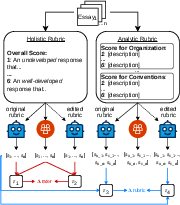
Figure 1: Experimental setup showing human and autorater agreement comparisons for holistic and analytic rubrics, with pathways for statistical significance testing and the impact of rubric modifications.
Empirical Findings
Effect of Rubric Editing on Agreement
Empirical results demonstrate that edited rubrics with representative examples and explicit context consistently yield higher human-autorater agreement (e.g., GPT-4o batch prompt τ for AES prompt 1 word choice rises from 0.439 to 0.554 with rubric edits). This improvement is statistically significant in most cases for GPT-4o and Llama-3.1-70B-Instruct, though domain sensitivity is evident: in instruction following tasks, analytic rubric edits sometimes fail to improve agreement, underlining contextual dependency.
Rubric edits also enhance autorater self-alignment, where agreement between an autorater's own holistic and analytic scores exceeds human inter-rater agreement in most conditions, highlighting unique model self-consistency.
Reducing Confirmation Bias
Separating analytic sub-criteria into distinct API calls (as opposed to batch prompts) systematically reduces confirmation bias for both models, significantly increasing human-autorater agreement. Autoraters, like humans, exhibit positional bias in batch evaluations; the first-presented sub-criteria receive disproportionately higher agreement τ values. Separate prompt designs mitigate this, yielding distributions more closely matching observed human ratings.
Complexity and Aggregation Effects
The paper asserts that increased rubric complexity or conservative aggregation mechanisms (e.g., Pareto) can decrease human-autorater agreement. In AES prompt 1, analytic rubrics outperform holistic, but this reverses for prompts 4 and 6, indicating that complexity interacts nontrivially with rubric decomposition strategies. In IF, analytic rubric performance is strictly lower than holistic, contradicting simplistic expectations that decomposition invariably boosts agreement.
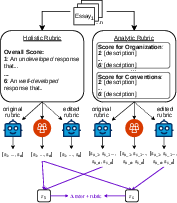
Figure 2: Comparison of human-autorater agreement τ across holistic and analytic rubrics, with effects of rubric editing and decomposition level.
Human Inter-Rater Agreement as a Predictor
The analysis confirms that high human inter-rater agreement is a strong predictor of high human-autorater agreement, both for AES and instruction-following benchmarks. Rubric modifications cannot resolve inherent ambiguity in ambiguous tasks; establishing stable “ground truth” is necessary for meaningful autorater evaluation.
Practical and Theoretical Implications
These findings mandate careful rubric engineering for autoraters in practice. Authoritative rubric edits must be tailored to domain, model, and rubric complexity, with empirical data informing the choice between holistic and analytic decomposition. Conservative aggregation methods must be employed prudently, given their tendency to depress overall agreement metrics. The study underscores the necessity for domain-specific benchmarking and iterative rubric design for robust deployment of LLM judges.
Theoretically, the interaction between rubric specificity, decomposition, and aggregation mechanisms challenges assumptions of monotonic gains with rubric simplification. Confirmation bias can be structurally addressed in LLM-based evaluation via prompt design, offering actionable levers for future work on AI evaluators.
Future Directions
Future research should expand to additional domains (summarization, dialogue, multimodal tasks) and a broader array of LLM architectures, including multilingual settings. Investigating cross-rubric transfer and collaborative scoring involving mixed human/LLM teams will further clarify the boundary conditions of rubric-induced agreement. The development of metrics that better capture aggregation of analytic scores and mitigate aggregation-related artifacts is also recommended.
Conclusion
This paper systematically quantifies the statistical impact of rubric modifications on human-autorater agreement, establishing that exemplary and contextual rubric edits substantially enhance agreement, but the benefit is domain- and construct-dependent. Confirmation bias in analytic rubrics is addressable via prompt design. Rubric complexity and aggregation methods exert nonuniform effects on agreement. For practitioners and theorists alike, rubric optimization is nontrivial, requiring empirical grounding and context-specific adaptation. Future investigations must generalize these findings across tasks, languages, and raters to support principled, statistically justified LLM judge deployment.