- The paper introduces the Matrix-Decoupled Concentration (MDC) framework to yield dimension-free variance bounds for autoregressive sequences with sparse rewards.
- It transforms classical scalar bounds into matrix-vector operations capturing causal dependencies via a strictly upper-triangular interdependence matrix, ensuring tight guarantees.
- Applications to LLMs demonstrate that MDC prevents variance inflation in long-context evaluations, supporting robust RLHF and other reward-based training paradigms.
Matrix-Decoupled Concentration for Dependent Sequences
Introduction
The paper "Matrix-Decoupled Concentration for Autoregressive Sequences: Dimension-Free Guarantees for Sparse Long-Context Rewards" (2605.06017) addresses concentration inequalities for dependent sequences with applications to sequence-level rewards in LLMs. Classical frameworks, including McDiarmid-type inequalities, fail to natively handle the causal structure intrinsic to autoregressive generation and suffer from scalar collapse, which artificially inflates variance bounds for targets with coordinate-wise sparsity. This work introduces a Matrix-Decoupled Concentration (MDC) framework, yielding dimension-free guarantees by precisely encoding dependence via a causal interdependence matrix and retaining the exact sparsity structure of sensitivity vectors.
The Matrix-Decoupled Concentration Framework
The MDC framework redefines the variance proxy for sequence-level evaluations by replacing scalar summary statistics with algebraic matrix-vector multiplication. The causal interdependence matrix H captures directed, stepwise dependencies based on total variation shifts induced by altering past states. Due to strict causality, H is strictly upper-triangular and nilpotent, making (I−H) invertible. The resolvent matrix Γ=(I−H)−1 explicitly encodes how dependencies propagate through the sequence.
The main concentration bound for a measurable target function f with sensitivity vector c is given by:
P(∣f(X)−E[f(X)]∣≥t)≤2exp(−∥Γc∥222t2)
This form retains coordinate-wise sparsity of c, preventing scalar collapse and leading to order-optimal, dimension-free (O(1)) variance bounds for sparse rewards.
Structural Comparisons and Optimality
The MDC framework recovers classical optimality for contracting Markov chains. In this setting, Hi,j is non-zero only for H0, with contraction coefficient H1. MDC yields the variance multiplier H2, matching the optimal transport constant and bypassing metric conversion artifacts found in classical approaches.
For directed causal trees, MDC leverages H3-separation, maintaining an adjacency structure in H4 and yielding optimal H5 concentration. Contrasted with martingale graph methods that impose artificial dependencies due to linear filtration or spatial coupling techniques that violate causality constraints, MDC strictly respects the directed, sequential nature of autoregressive generation, preserving both sparsity and topological independence.
Application to LLMs
Autoregressive LLMs exhibit dense, non-Markovian dependencies due to attention mechanisms. The interdependence matrix H6 models the attention and memory-induced causal influences, with bounds provided by architectural parameters such as sliding window attention or contractive recurrent states.
For sequence-level targets with terminal sparsity (e.g., reward models in RLHF evaluated only on the final token), MDC's matrix algebra yields a variance proxy that scales independently of sequence length H7—crucial for evaluating long-context reasoning stability.
Theoretical variance proxies are evaluated for a non-Markovian sequence with sliding window attention and a sparse terminal target, demonstrating that classical macroscopic relaxation forces H8 scaling, whereas MDC maintains dimension-free stability:
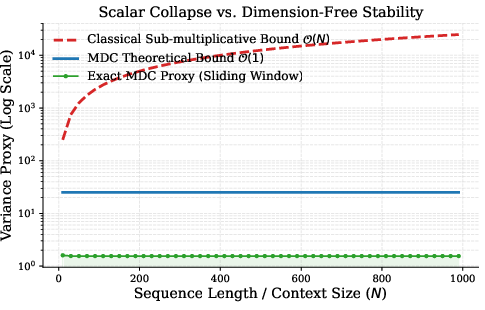
Figure 1: Numerical evaluation of variance proxy bounds for a non-Markovian autoregressive sequence reveals that MDC preserves coordinate-wise sparsity, preventing H9 inflation in variance for sparse terminal rewards.
Practical and Theoretical Implications
By breaking the scalar collapse present in classical concentration results, MDC delivers rigorous, dimension-free bounds for sequence-level evaluations in LLMs and other non-Markovian generative processes. Practically, this provides tight guarantees for RLHF, DPO, and ORM paradigms, supporting stable long-context generation essential for the scalability of modern LLMs. The shifting of bounding constraints from matrix row sums to column sums ensures that only relevant dependencies propagate through sparse sensitivity vectors, fundamentally justifying empirical observations of long-context stability.
Theoretically, MDC supplies a generalization mechanism adaptable to arbitrary dependency structures, including Markov chains and directed graphical models, aligning variance bounds with underlying causal topology.
Future Directions
Several research avenues emerge from this work:
- Predictable Quadratic Variation: Extension to Freedman/Bernstein-type bounds may provide tighter control for heavy-tailed systems by tracking data-dependent variances via matrix algebra.
- Annealed Average Coupling: Relaxing (I−H)0 from (I−H)1 (worst-case) to an (I−H)2 (average-case) formulation would broaden applicability to non-uniformly mixing sequences.
- Beyond Directed Time: Investigating MDC-type bounds for non-triangular dependency graphs, such as Markov random fields under non-causal dynamics, offers an intriguing intersection with statistical physics.
Conclusion
Matrix-Decoupled Concentration resolves foundational bottlenecks in sequence-level concentration for dependent, autoregressive processes. By retaining exact structural information via matrix decomposition and preserving coordinate-wise sparsity, MDC provides order-optimal bounds in a variety of dependency regimes and restores rigorous mathematical justification for long-context stability in LLMs. The algebraic matrix-based mechanism established here opens numerous directions for generalizing concentration inequalities beyond strictly causal sequential frameworks.