Quantum Simulation of the Real-time Dynamics in the multi-flavor Gross-Neveu Model at the utility scale using Superconducting Quantum Computers
Published 6 May 2026 in quant-ph and hep-ph | (2605.05479v1)
Abstract: We present a scalable quantum simulation framework for real-time dynamics of the multi-flavor Gross-Neveu model in 1+1 dimensions. Using superconducting quantum processors at utility scale, we develop a hardware-efficient Trotterization whose per-step circuit depth scales with fermion flavor number rather than total system size, enabling simulations beyond 100 qubits. A central contribution of this work is the Localized Diagonal Operator Approximation (LDOA), which systematically reduces the overhead associated with quartic interactions. We formulate diagonal unitary synthesis as a structured least-squares problem in phase space and obtain analytic solutions via the Moore-Penrose pseudoinverse. This formulation provides a principled and quantitatively controlled approximation: in the small Trotter-step regime, the unitary error is directly linked to the phase reconstruction error and vanishes asymptotically as the Trotter step size decreases. This establishes a clear mathematical foundation for the LDOA while significantly reducing two-qubit gate counts and circuit depth, and is broadly applicable to diagonal quantum operators with long-range structure, making it particularly well suited for quantum hardware with limited qubit connectivity. Using these techniques, we run large-scale simulations on IBM superconducting processors and study real-time observables, including density-density correlators. We benchmark against exact diagonalization and tensor network-based methods, finding strong agreement across system sizes. These results show that combining hardware-aware circuit design with rigorous approximations enables practical near-term simulation of interacting fermionic field theories and provides a scalable pathway toward more complex quantum field theory simulations.
The paper presents a scalable, hardware-aware quantum simulation framework using Trotter circuits and the LDOA for efficient mapping of the Gross-Neveu model onto qubits.
It demonstrates practical real-time dynamics and entanglement measurements on systems above 100 qubits, validated against classical benchmarks.
Comprehensive resource analysis reveals significant reduction in two-qubit gate counts, enabling experiments in regimes beyond classical tractability.
Quantum Simulation of Real-Time Dynamics in the Multi-Flavor Gross-Neveu Model Using Superconducting Quantum Computers
Introduction and Motivation
Quantum simulation of strongly correlated fermionic field theories is a central objective for near-term and future quantum hardware. The Gross-Neveu (GN) model in 1+1D, hosting N flavors of interacting Dirac fermions, is an archetypal relativistic quantum field theory with deep connections to dynamical symmetry breaking, asymptotic freedom, and many-body bound state formation, relevant for understanding nonperturbative dynamics in both condensed matter and high-energy physics. Numerical simulation of such real-time dynamics is obstructed by severe sign problems on classical platforms. The present work delivers a scalable, hardware-aware framework for quantum simulation of the multi-flavor Gross-Neveu model using superconducting quantum processors, demonstrating utility-scale quantum simulation above 100 qubits (2605.05479).
features massless Dirac fermions with quartic self-interactions. For quantum simulation, the authors employ Kogut-Susskind staggered fermion discretization: the Dirac spinor components per flavor are mapped to staggered lattice sites, with Jordan-Wigner transformation employed to encode the fermionic operators onto qubit registers. The mapping results in a qubit-efficient encoding where the per-step cost grows with flavor number N rather than full system size, facilitating large-scale implementations.
Optimized Trotterization Circuits
Real-time evolution is realized with digital Trotter-Suzuki decompositions. Both first- and second-order product formulas are benchmarked. Circuit synthesis is developed such that the depth per Trotter step is determined predominantly by the flavor number, not the total lattice size. This is accomplished by structuring circuits into local "blocks" operating on $2N$ neighboring qubits, interleaving quadratic (hopping) and quartic (interaction) evolutions alongside SWAP networks that enable fermionic statistics and emulate longer-range interactions on nearest-neighbor-constrained hardware.
The primary resource bottleneck for the quartic terms arises from required controlled-phase (CP) gates between distant qubits, which—without further optimization—would be addressed via $4(N-1)$ layers of SWAPs per block, resulting in excessive two-qubit gate overhead and decoherence vulnerability, especially as N increases.
Localized Diagonal Operator Approximation (LDOA)
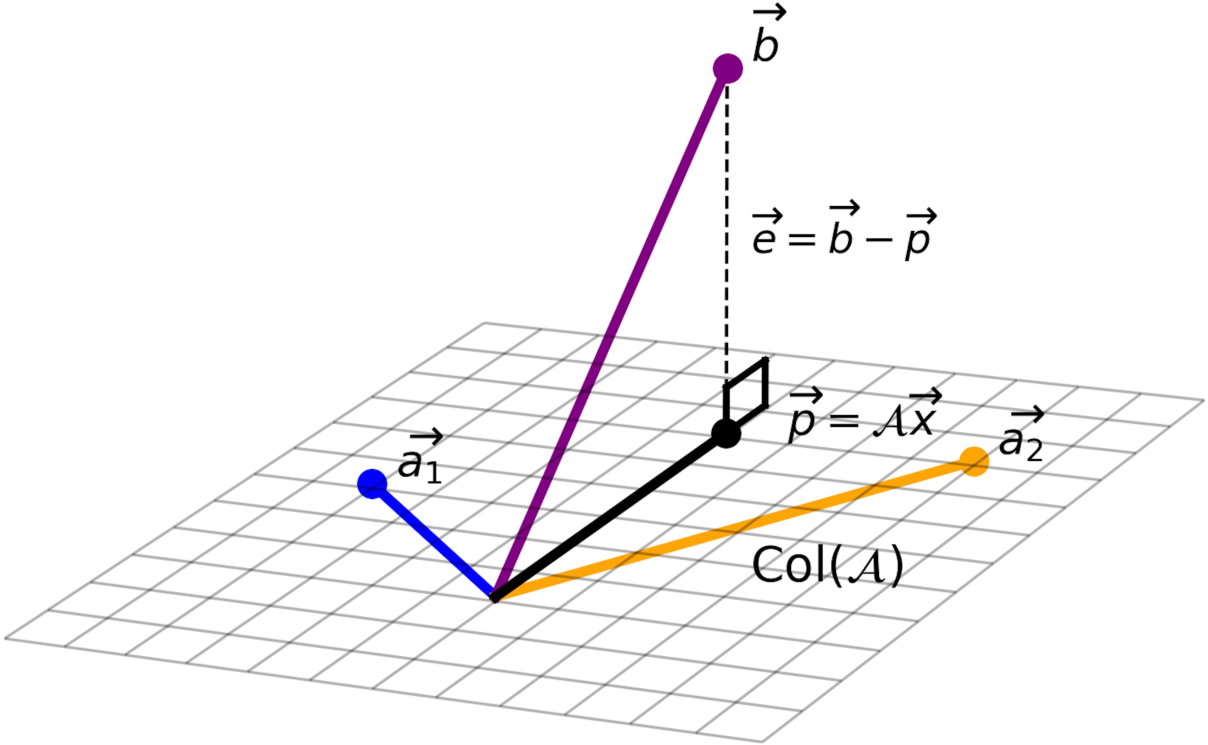
To address these compilation and hardware bottlenecks, the authors introduce the Localized Diagonal Operator Approximation (LDOA), a physically and mathematically principled circuit compression schema targeting diagonal (phase) gates encoding long-range quartic interactions. The key innovation is to reformulate the synthesis of the diagonal unitary as a linear least-squares optimization in phase space: the target unitary's diagonal phases ϕ are projected onto a parameterized circuit Ansatz via the Moore-Penrose pseudoinverse.
Figure 2: Geometric depiction of least-squares projection: the target phase vector b is orthogonally projected onto the column space Col(A) of the Ansatz, with the irreducible error e orthogonal to the subspace.
This approach yields analytic optimal parameters for both CP- and RZZ-based hardware Ansätze for two- through four-flavor models, providing tight control on the phase reconstruction error; in the small Trotter-step limit, this unitary error vanishes, establishing asymptotic consistency.
Hardware-Efficient Resource Analysis
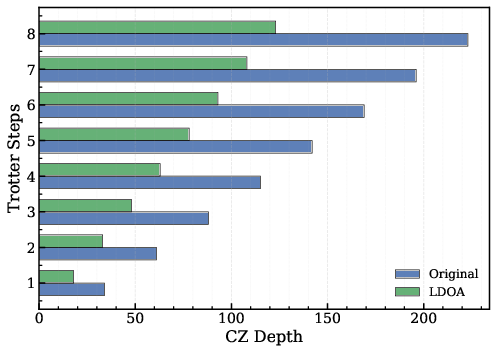
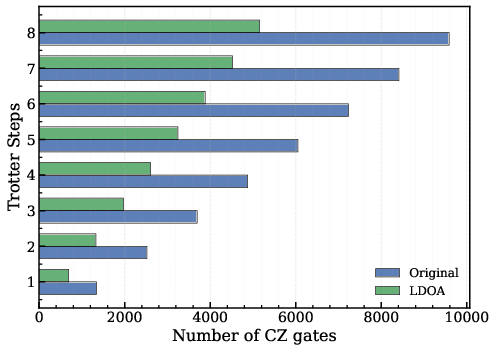
Comprehensive resource analysis is performed pre- and post-LDOA implementation. The LDOA yields a factor of H=∫dx−ib=0∑N−1ψˉbγ1∂xψb−2g2(b=0∑N−1ψˉbψb)2,0 reduction in CZ gate depth and absolute two-qubit gate counts for systems with 108 qubits compared to a naïve SWAP-based baseline approach.
Figure 4: Comparison of CZ gate depth and total CZ gate count as a function of Trotter steps for original and LDOA-optimized circuits; LDOA consistently yields lower two-qubit resource consumption.
This resource compression directly translates to improved circuit execution fidelity under NISQ-era hardware constraints, making large-scale real-time simulations feasible well beyond the reach of classical exact diagonalization, and even standard tensor network approaches for moderate entanglement proliferation.
Validation: Real-Time Dynamics and Observables
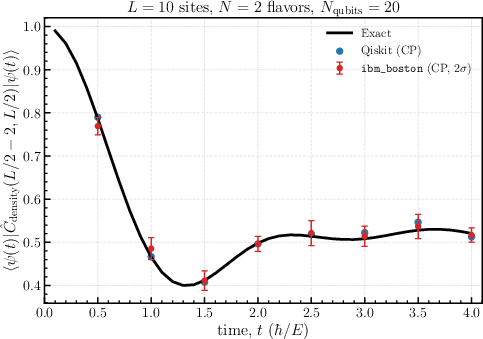
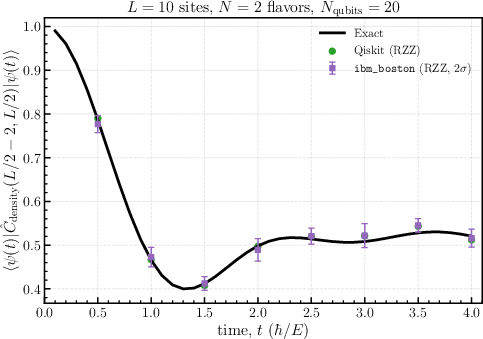
Benchmark simulations are performed for two-flavor GN model instances with H=∫dx−ib=0∑N−1ψˉbγ1∂xψb−2g2(b=0∑N−1ψˉbψb)2,1 sites (20 qubits) and H=∫dx−ib=0∑N−1ψˉbγ1∂xψb−2g2(b=0∑N−1ψˉbψb)2,2 sites (108 qubits) using IBM's superconducting platforms. For 20-qubit instances, quantitative agreement is achieved between hardware runs, noiseless simulation, and exact diagonalization for the nonequilibrium evolution of density-density correlators.
Figure 6: Time-evolution of density-density correlations for H=∫dx−ib=0∑N−1ψˉbγ1∂xψb−2g2(b=0∑N−1ψˉbψb)2,3 (H=∫dx−ib=0∑N−1ψˉbγ1∂xψb−2g2(b=0∑N−1ψˉbψb)2,4). LDOA-optimized hardware runs (experimental data with error bars) track both exact results and simulated outputs with high fidelity.
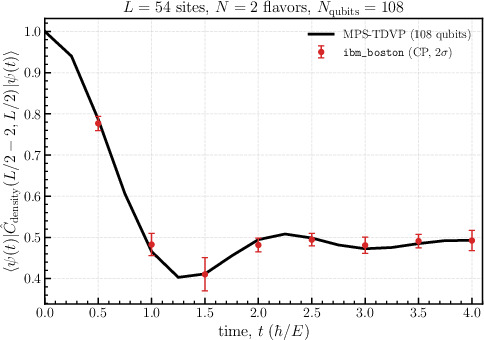
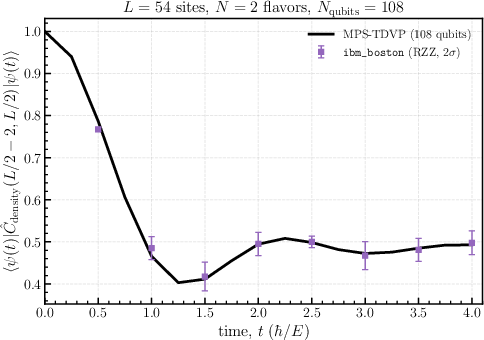
For H=∫dx−ib=0∑N−1ψˉbγ1∂xψb−2g2(b=0∑N−1ψˉbψb)2,5 qubit systems, validation leverages tensor network MPS-TDVP benchmarks, again demonstrating the LDOA-enabled hardware's ability to resolve physical observables (density-density correlations) in direct correspondence with large-bond-dimension classical simulation.
Figure 8: Temporal evolution of density-density correlations for H=∫dx−ib=0∑N−1ψˉbγ1∂xψb−2g2(b=0∑N−1ψˉbψb)2,6 (H=∫dx−ib=0∑N−1ψˉbγ1∂xψb−2g2(b=0∑N−1ψˉbψb)2,7, 108 qubits) confirms that LDOA-based hardware circuits can access regimes inaccessible to brute-force classical methods; strong agreement with MPS-TDVP is observed.
Measurement of Entanglement Dynamics
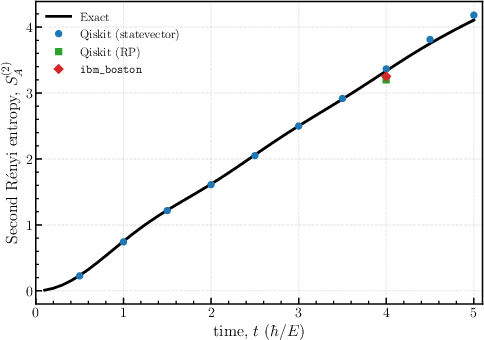
The framework enables the first utility-scale quantum hardware measurement of entanglement spreading in interacting field theory dynamics. Using a randomized measurement protocol, the second Renyi entropyH=∫dx−ib=0∑N−1ψˉbγ1∂xψb−2g2(b=0∑N−1ψˉbψb)2,8 of a half-chain is robustly extracted and compared to exact statevector and classical results.
Figure 10: Second Renyi entropy H=∫dx−ib=0∑N−1ψˉbγ1∂xψb−2g2(b=0∑N−1ψˉbψb)2,9 measured via randomized measurements on hardware, alongside exact and noiseless simulation. Hardware values deviate by N0 from noiseless simulation after error mitigation, demonstrating reliable access to entanglement dynamics.
Quantum Error Mitigation
Extensive quantum error mitigation (QEM) is deployed, coupling Twirled Readout Error Extinction, dynamical decoupling, Pauli twirling (especially for two-qubit gates), and zero-noise extrapolation. Circuit-level optimizations and multi-programming/parallelization (with careful crosstalk management) are further used to maximize throughput and minimize systematic bias, ultimately enabling rigorous benchmarking of quantum hardware performance against the best available classical techniques in the strongly-interacting regime.
Implications and Outlook
This work establishes an experimentally validated, scalable approach for simulating real-time dynamics of interacting fermionic quantum field theories well beyond the classical tractability threshold. The LDOA generalizes as a model-agnostic circuit reduction scheme for diagonal operators with long-range structure and will be directly applicable for Hamiltonians with relevant nonlocality (e.g., Hubbard-type, gauge-field couplings).
Pragmatically, the demonstration of model-accurate dynamics and entanglement growth in the utility regime (100+ qubits, low circuit depth per evolution step) benchmarks the climbing capability curve of superconducting quantum hardware for nontrivial quantum field dynamics. This capability is foundational for future explorations of nonequilibrium quantum matter, dynamical phase transitions, scrambling and thermalization, and the simulation of high-energy gauge theories where classical methods fail.
The LDOA and block-optimized Trotterization strategies inform algorithmic and compilation development for both NISQ and future fault-tolerant architectures, where reducing two-qubit gate count and depth remains paramount (e.g., for error correction thresholds and logical qubit savings). Extensions to higher dimensions and the inclusion of gauge fields or bosonic degrees of freedom are anticipated next steps.
Conclusion
The authors deliver a robust, mathematically principled, and experimentally realized paradigm for scalable quantum simulation of interacting relativistic fermion models tailored for superconducting processors. The Localized Diagonal Operator Approximation enables dramatic compression of essential nonlocal quantum evolution, thus facilitating the practical study of quantum field theory dynamics, operator growth, and quantum information scrambling in regimes unfathomable for classical simulation platforms. This work forms a technical foundation for future explorations of nonequilibrium quantum field theory and strongly correlated matter using quantum computers (2605.05479).
“Emergent Mind helps me see which AI papers have caught fire online.”
Philip
Creator, AI Explained on YouTube
Sign up for free to explore the frontiers of research
Discover trending papers, chat with arXiv, and track the latest research shaping the future of science and technology.Discover trending papers, chat with arXiv, and more.