- The paper introduces an impossibility theorem showing that without explicit system isolation, predictive objectives inherently favor environment signals over causal system representations.
- The paper empirically validates the theorem with extensive experiments using linear-Gaussian dynamics and nonlinear Duffing oscillator tasks, demonstrating substantial causal misalignment even as predictive accuracy improves.
- The paper reveals that standard regularizations, including information bottleneck methods, fail to rectify the predictive-causal gap, highlighting the need for causality-aware objectives in self-supervised learning.
The Predictive-Causal Gap in Representation Learning
Introduction
This paper presents a rigorous theoretical and empirical investigation into a key limitation of predictive self-supervised learning: the systematic divergence between predictively optimal representations and those aligned with the causal structure of the underlying system. The authors identify and characterize the "predictive-causal gap," an inherent failure mode in which neural encoders trained to optimize future prediction instead encode dominant environment signals, even when those are not causally related to the system of interest.
Structural Impossibility Results
The theoretical core of the work is an impossibility theorem for a broad class of predictive representation objectives. Considering linear-Gaussian latent dynamics with coupled system (st) and environment (et) degrees of freedom, the authors prove that—except in a measure-zero set of exactly decoupled systems—every population-risk minimizer for the predictive objective is misaligned with the system subspace. Off-diagonal (i.e., coupled) dynamics generically yield encoders that privilege prediction of the environment rather than the system, maximizing predictability but not causal relevance.
This result holds for all model classes containing the full set of linear encoders and persists as representational capacity increases. Enlarging the encoder class further tightens the risk minimization in favor of the environment-dominant direction; capacity cannot induce regularization toward causal structure.
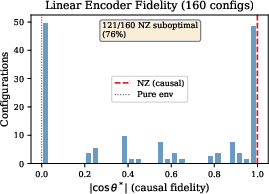
Figure 1: Across deterministic configurations, linear encoders only recover the causal (system-aligned) solution in a measure-zero region; 75% are predictively but not causally optimal.
Neural Evidence: Empirical Verification and Scaling Laws
To empirically validate the theorem, a large-scale sweep was conducted training two-layer MLP encoders (2695 independent runs) on a systematic grid of linear-Gaussian dynamics. The mean causal fidelity—i.e., the encoder sensitivity to system over environment degrees of freedom—was only $0.49$, with just 2.5% of runs above $0.70$. Notably, the NN encoders achieve much lower prediction error than the best linear encoders, demonstrating that the causal misalignment is not an artifact of underfitting or limited model expressivity.
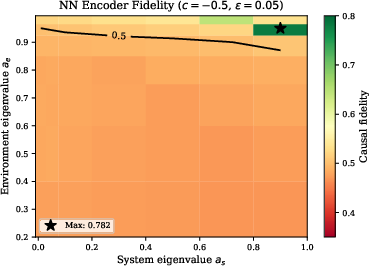
Figure 2: Causal fidelity landscape as a function of system and environment parameters; large regions of parameter space correspond to environment-dominant representations.
The phenomenon is sharply amplified in high-dimensional settings. With N=100 environment modes, causal fidelity of the optimal encoder collapses to 10−8, while predictive loss improves by 92% relative to the best causal encoding. In the thermodynamic limit, predictive representations become strictly orthogonal to the system.
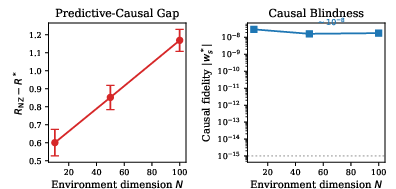
Figure 3: Left—predictive-causal gap increases with environment dimension; Right—causal fidelity falls exponentially, demonstrating near-total blindness to the system as N grows.
Beyond Linearity: Nonlinear and Operationally Grounded Predictors
The authors extend their analysis beyond linear systems. In a family of nonlinear Duffing oscillator tasks coupled to hidden Ornstein-Uhlenbeck environments, single-layer GRU predictors show the same failure mode: unconstrained models produce environment-dominant encodings in 55% of tasks, compared to et0 under operational grounding—i.e., when the predictive loss is restricted to the system observables. The residual failure reflects the indirect predictive utility of the environment, as it carries information about future system states via coupling.
This misalignment has direct consequences for out-of-distribution generalization. Under distribution shifts in the environment, unconstrained predictors suffer a median et1 MSE inflation, while grounded models remain robust (et2).
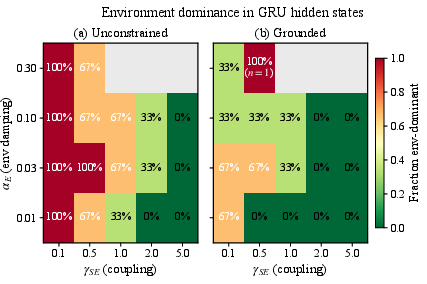
Figure 4: Environment-dominance fraction for GRU predictors: unconstrained (left) and grounded (right). Grounding suppresses, but does not eliminate, non-causal encodings.
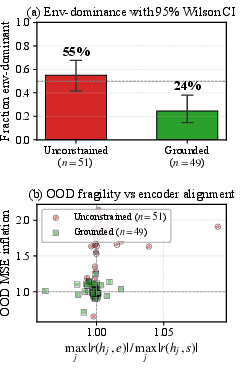
Figure 5: Left—Aggregate environment-dominance with 95% Wilson intervals. Right—Distribution of OOD MSE inflation; unconstrained models show large fragility under environment shift.
Additional experiments reveal that standard information bottleneck (IB) regularization fails to recover the system-aligned encoding. Across all parameter sweeps, compressive regularization shifts the encoder only smoothly with respect to the regularization strength but never away from the predictive optimum in the off-diagonal regime. The optimal direction for compression aligns with that for prediction, reinforcing, rather than competing against, the bias toward environment-dominant solutions.
Implications and Theoretical Perspectives
The paper's findings have substantial ramifications for several lines of AI research:
- Scaling Paradigm: Predictive loss decreases smoothly with model scaling, but this reflects increasing commitment to environment-dominant representations, not causal abstraction. Consequently, scaling laws for autoregressive LLMs or state-space models do not imply convergence to the generative process's causal structure.
- Operational Grounding: Restricting loss evaluation to system observables ("operational grounding") suppresses, but does not eliminate, the predictive-causal gap. Residual misalignment arises wherever future system state is statistically dependent on the environment.
- Limits of Self-Supervision: The impossibility is not remedied by standard self-supervised objectives, including masked modeling, joint-embedding architectures, or contrastive learning, as these operate on unpartitioned observation spaces.
- Causal Regularization: The key open challenge is to design objectives or regularizers that induce discovery of the system-environment boundary, in the absence of manual specification. Promising directions involve analytic constraints from causality (e.g., Kramers-Kronig relations, Hardy-space signatures) or information-theoretic separation criteria.
Conclusion
This study provides a rigorous identification of the predictive-causal gap, a robust and measure-theoretically generic misalignment between predictive representations and the dynamically causal structure of the system of interest. The gap is a property of the objective function: predictive risk minimization without explicit operational or architectural demarcation of the system/environment boundary cannot, in the general case, yield causal encodings. This limitation persists with increased model capacity, richer architectures, and larger datasets. The authors' results delineate fundamental barriers for self-supervised world modeling, suggest reinterpreting performance gains under the scaling paradigm, and clarify the necessity for objective functions that privilege causal abstraction over mere predictability.
Reference: "The Predictive-Causal Gap: An Impossibility Theorem and Large-Scale Neural Evidence" (2605.05029)