- The paper establishes sharp lower bounds showing that low embedding dimensions yield trivial triplet accuracy of 50%.
- It uses probabilistic methods to rigorously link representational accuracy with the intrinsic dimensionality of data.
- Empirical results validate a phase transition in triplet accuracy, underscoring a fundamental barrier in low-dimensional embeddings.
Provable Accuracy Collapse in Embedding-Based Representations under Dimensionality Mismatch
Introduction and Motivation
The analysis of embedding-based representations in Rd critically depends on the choice of embedding dimension d, which directly determines the ability of these representations to capture the relational structure of the input data. This work rigorously characterizes the information-theoretic and computational phenomena governing the tight coupling between representational accuracy and dimensionality, particularly within the context of contrastive (triplet-based) ordinal embedding. The paper establishes foundational lower bounds showing that, unless d is a constant-factor approximation to the ground-truth dimension D required to realize the triplet constraints, no embedding method can surpass a baseline accuracy of 50%. This collapse of accuracy is shown to be robust both in the information-theoretic and the algorithmic regime.
The main theorem asserts that for any set of triplets exactly realizable in RD, if the embedding dimension d is reduced to o(D), then the maximal achievable accuracy for triplet satisfaction is bounded above by $1/2 + o(1)$. Notably, even if d is only a constant factor smaller than d0, accuracy deteriorates to the trivial level obtained by random projections. This result provides the first sharp theoretical explanation for the empirically observed sudden accuracy drops in embedding truncation experiments for both synthetic and state-of-the-art models.
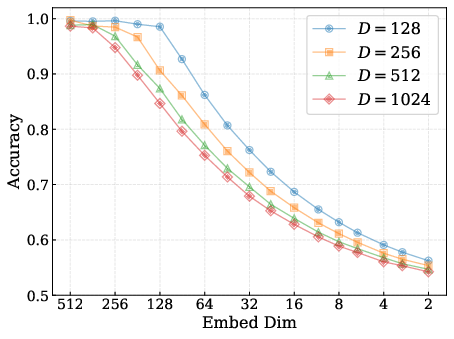
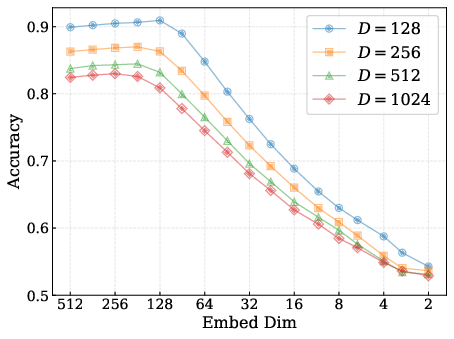
Figure 1: Ground-truth Euclidean embeddings: triplet accuracy as a function of both ground-truth d1 and embedding d2, demonstrating catastrophic collapse once d3 falls below a threshold—top: unconstrained, bottom: spherical embeddings.
The probabilistic method is leveraged to construct random collections of triplet constraints, which are simultaneously:
- perfectly realizable in d4 dimensions, but
- unsatisfiable above a d5 fraction by any embedding of dimension d6.
The collapse threshold is shown to be independent of model architecture, loss function, or optimization strategy, thus isolating this as a pure representational barrier. This behavior persists for ground-truth dimensions d7 scaling up to d8 for d9 objects, and also extends to analogous quartet-based constraints.
Computational Hardness and Approximation Resistance
Beyond the intrinsic representational limitations, the paper delivers a strong computational inapproximability result. Building on the Unique Games Conjecture, it is shown that even if all but an arbitrarily small d0-fraction of triplets are realizable in some (potentially large) dimension, it is NP-hard to efficiently approximate the optimal accuracy better than d1. Thus, no polynomial-time algorithm can out-perform the random embedding baseline—even allowing unbounded embedding dimension.
These results formally establish approximation resistance for the triplet embedding problem. The gap reduction to Maximum Acyclic Subgraph (MAS) transfers known approximation lower bounds from the ranking CSP literature to the embedding setting, further solidifying the tightness of the demonstrated limitations.
Empirical Validation
Experimental results on synthetic datasets substantiate the theoretical predictions. As d2 decreases below a critical threshold relative to d3, triplet accuracy for both unconstrained and spherical embedding models exhibits a pronounced phase transition toward the d4 baseline.
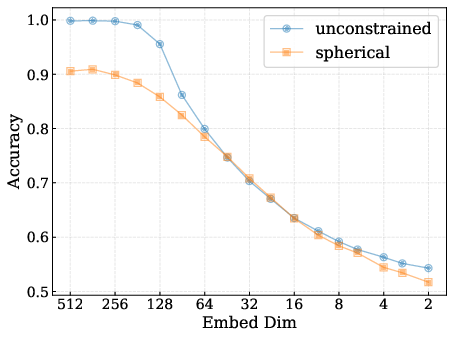
Figure 2: Uniformly random triplet instances: as embedding dimension d5 varies, triplet accuracy stays near 1 until a sharp fall to the baseline value (d6, d7).
The methodology involves (i) embedding d8 points in ground-truth dimensions d9, (ii) generating large sets of triplet constraints, and (iii) optimizing representations using triplet loss (AdamW) with varied target dimension D0. The accuracy curve's abrupt collapse for D1 is consistent with the theoretical bounding argument.
Extensions and Broader Implications
The analysis extends to quadruplet (ordinal) constraints with minimal technical modification. The conclusions immediately transfer to a broad class of representation learning paradigms and contrastive objectives, such as those employed in modern large-scale retrieval and multimodal alignment. The result circumscribes the performance achievable by models seeking aggressive dimension reduction, irrespective of advances in optimization or architecture, unless domain-specific structure can be leveraged to circumvent the lower bounds.
The theoretical framework exposes a tight inherent link between the intrinsic dimensionality of data and the maximal attainable relational accuracy using low-dimensional embeddings, raising critical considerations for the deployment and further compression of embedding-based systems. In particular, attempts to tune D2 below the problem’s ground-truth requirement (as determined by data intrinsic structure) are effectively guaranteed to fail catastrophically.
Conclusion
Embedding-based representations encounter a provable, sudden accuracy collapse whenever the embedding dimension D3 undershoots the critical threshold dictated by the ground-truth dimension D4 of the input instance. This phenomenon persists even under the mildest supervision—triplet comparisons—and is immune to algorithmic advances under standard complexity assumptions. The results resolve foundational open questions on the limits of representation compression, establishing both an explicit, unavoidable information-theoretic bottleneck and computational hardness. These findings direct future work toward probing how structured constraints or large-margin properties might be harnessed to circumvent accuracy collapse, or inform the optimal design of scalable embedding architectures for high-dimensional retrieval and reasoning tasks.
Reference: "Provable Accuracy Collapse in Embedding-Based Representations under Dimensionality Mismatch" (2605.03346)

