- The paper introduces a physics-informed denoising network that serves as a surrogate to Zero-Noise Extrapolation for efficient noise mitigation in VQAs.
- It employs a dual-branch neural architecture, combining feed-forward and GRU elements, to reconstruct denoised gradients with over 0.95 cosine similarity to ZNE references.
- The PIDN framework achieves a 4–6x reduction in quantum circuit executions in QAOA and VQE tasks without compromising convergence or solution fidelity.
Introduction
Variational Quantum Algorithms (VQAs), including VQE and QAOA, are central to NISQ-era quantum computing, yet their practical performance is fundamentally constrained by hardware-induced noise and shot limitations, which collectively degrade the cost function landscape and drastically increase measurement overheads. While Zero-Noise Extrapolation (ZNE) provides error mitigation by extrapolating cost function measurements to the zero-noise limit, it amplifies resource requirements, scaling measurement cost by the number of noise scales and gradient computations. The paper "Accelerating Noisy Variational Quantum Algorithms with Physics-Informed Denoising Networks" (2605.02066) introduces a Physics-Informed Denoising Network (PIDN) as a surrogate approach to ZNE, directly learning the noise-mitigated optimization trajectory to significantly decrease quantum execution without sacrificing solution fidelity.
The PIDN framework treats the VQA training as a discrete-time dynamical system whose trajectory in parameter space is corrupted by both shot noise and hardware noise. Instead of repeatedly estimating ZNE-corrected gradients at every iteration, PIDN learns a surrogate map from the noise-corrupted current observation and the historical trajectory to the denoised expectation value and the next parameter update. This is accomplished by a dual-branch (feed-forward and GRU-based) neural network architecture jointly predicting the denoised cost and parameter updates, trained using a composite loss targeting both value-matching and gradient-alignment with ZNE reference data.
The training workflow is partitioned into three stages:
- ZNE Data Collection: ZNE is applied in early iterations to generate high-fidelity reference cost, gradient, and parameter trajectories.
- Surrogate Training: The PIDN is trained to minimize denoising error and enforce directional consistency between its predicted gradients and those from ZNE.
- Surrogate-Driven Optimization: Subsequent optimization relies on PIDN for update directions, bypassing ZNE and thus reducing circuit evaluations for gradient estimation.
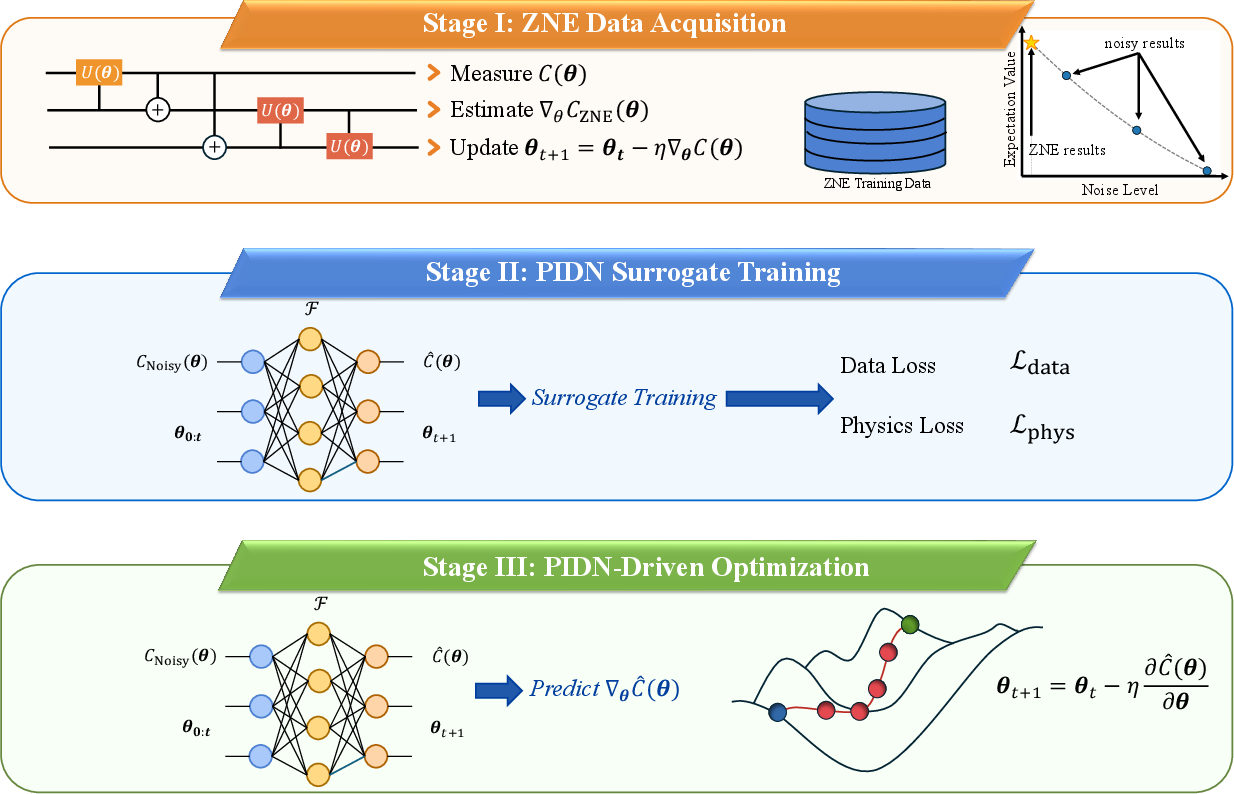
Figure 1: Unified three-stage workflow for physics-informed reconstruction of ZNE optimization, integrating initial ZNE data acquisition, surrogate training, and subsequent PIDN-driven optimization.
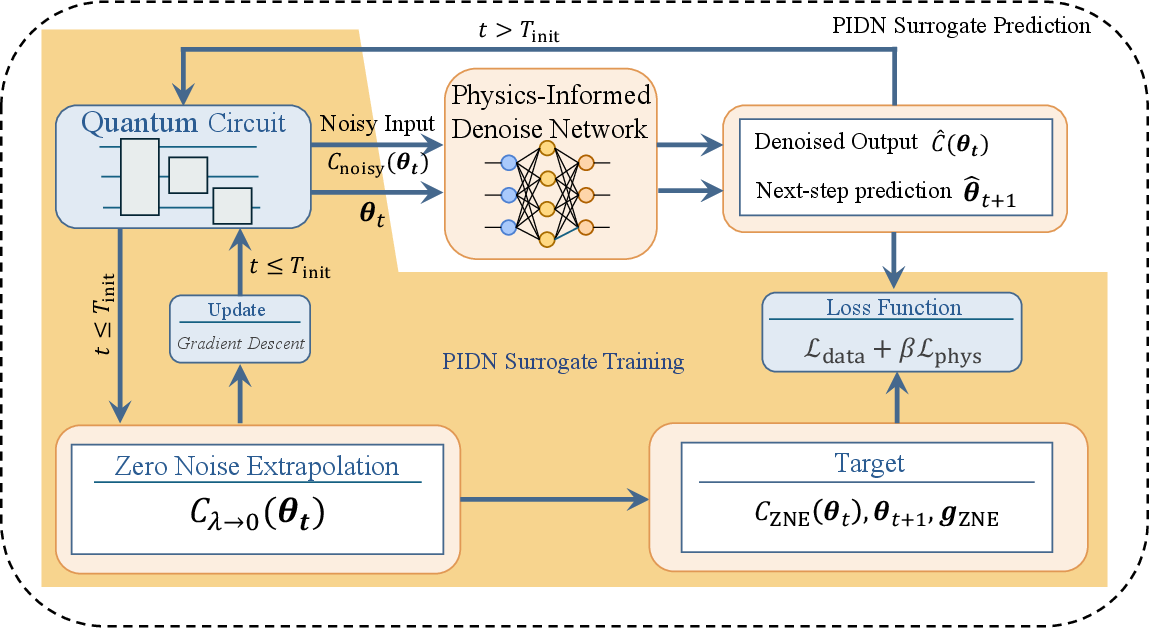
Figure 2: Schematic illustration of the PIDN-assisted optimization architecture, leveraging noisy circuit readout and trajectory history for denoising and parameter prediction.
Analysis of Loss Landscape and Trajectory Reconstruction
Empirical analysis demonstrates that hardware noise results in both global flattening and local high-frequency distortion of VQA loss landscapes, which impairs gradient-based optimization by suppressing informative basin structure and amplifying stochastic fluctuations. ZNE recovers low-frequency components but is not immune to extrapolation artifacts. PIDN is shown to reconstruct the ZNE-induced vector field with high fidelity, maintaining a cosine similarity above 0.95 with ZNE gradients across the training trajectory.
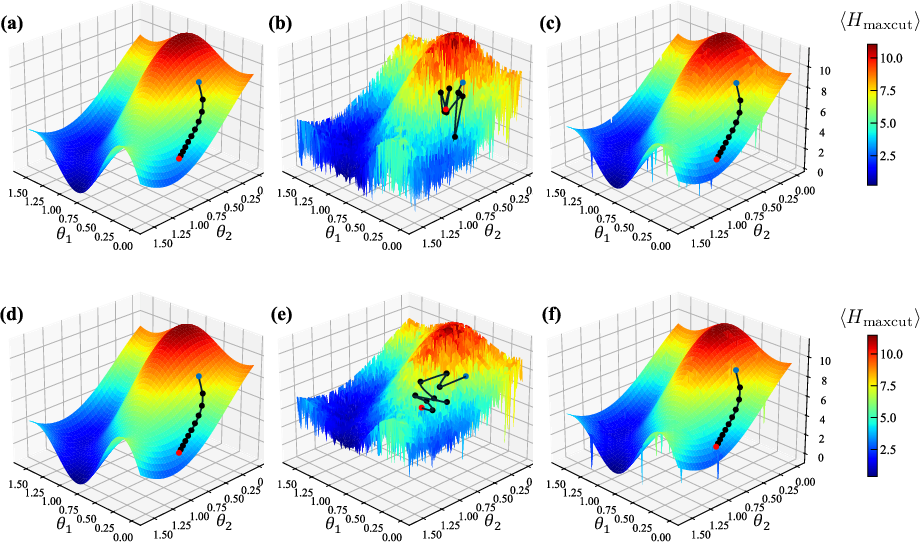
Figure 3: Noise-induced distortion in VQA landscapes; ZNE partially restores basin structure and optimization trajectories.
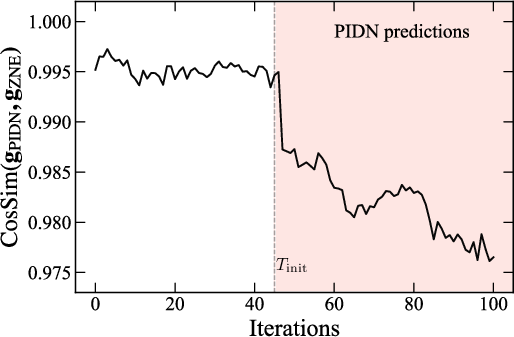
Figure 4: Cosine similarity between PIDN-predicted and ZNE gradients over iterations, indicating accurate vector field reconstruction.
Benchmarks on QAOA (for 3-regular graphs, SK model, TFIM) and VQE (LiH, BeH2, H2O) confirm that PIDN achieves ZNE-level optimization accuracy while reducing total quantum circuit executions by a factor of 4–6. In QAOA, noisy VQA saturates early due to poor landscapes, ZNE achieves high approximation ratios but with high resource costs, while PIDN surpasses in cost-efficiency without compromising convergence.
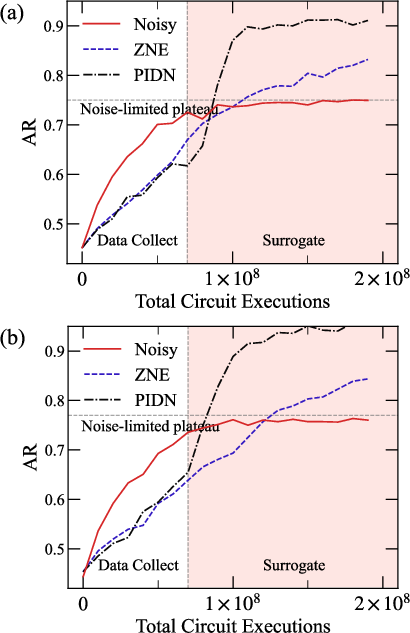
Figure 5: Approximation ratio versus executed circuits for QAOA under various noise mitigation schemes; PIDN combines ZNE-level performance with reduced shot costs.
In VQE simulations, PIDN maintains chemical accuracy with a similar speedup profile, independent of system size or complexity.
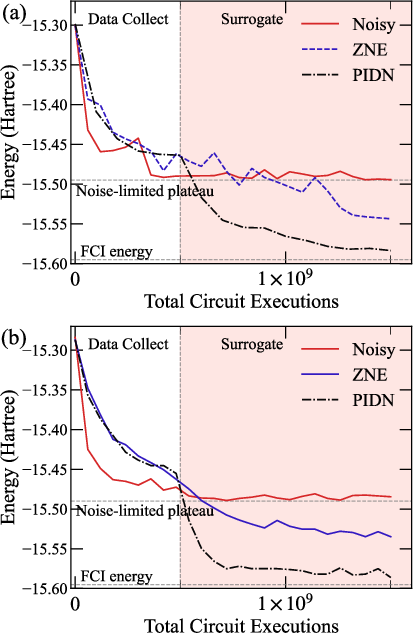
Figure 6: Ground-state energy convergence for BeH2; PIDN achieves rapid, accurate convergence with reduced execution overhead.
Robustness, Model Ablations, and Theoretical Insights
PIDN’s failure point aligns closely with that of ZNE—it reliably tracks ZNE-induced dynamics until ZNE itself becomes unreliable under high noise. The physics-informed loss (enforcing gradient alignment) is essential; omitting it degrades cosine similarity between predicted and reference gradients from ~0.95 to ~0.75, which substantially worsens optimization performance.
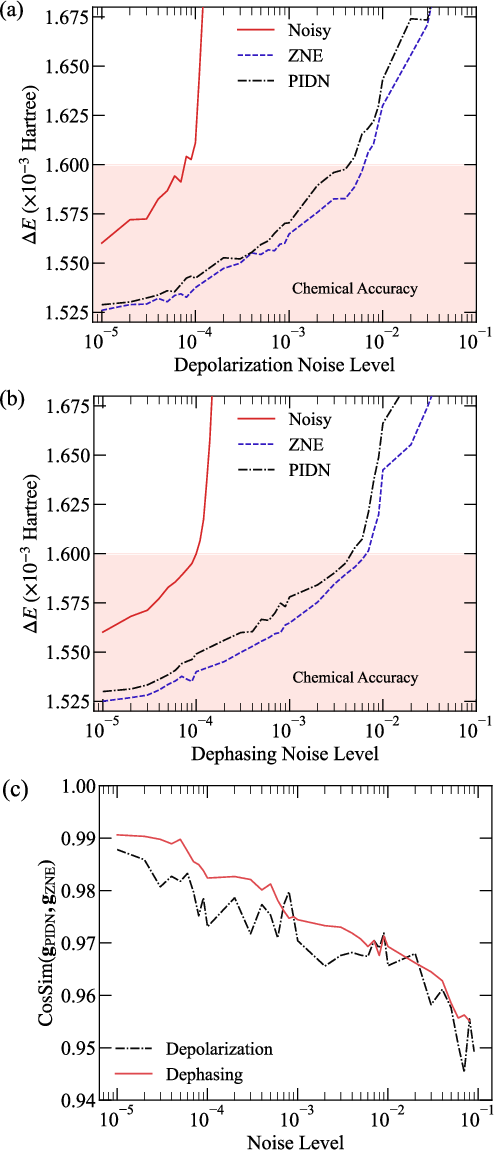
Figure 7: Final energy deviations versus noise strength; PIDN and ZNE fail at commensurate thresholds.
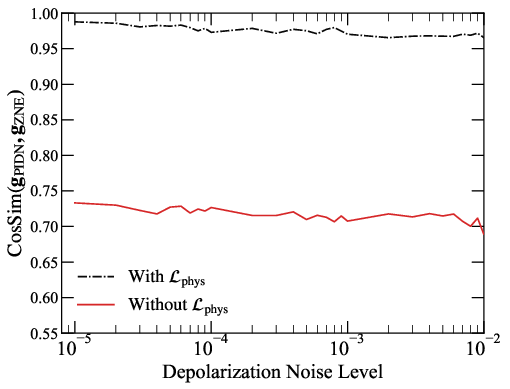
Figure 8: Physics-informed loss is critical for maintaining high gradient similarity and correct optimization dynamics.
Furthermore, PIDN’s trajectory-tracking accuracy is positively correlated with the low-frequency content of the loss landscape. As noise increases and high-frequency distortion dominates, PIDN’s update directions increasingly deviate from those of the reference (noisy or ZNE) optimizer.
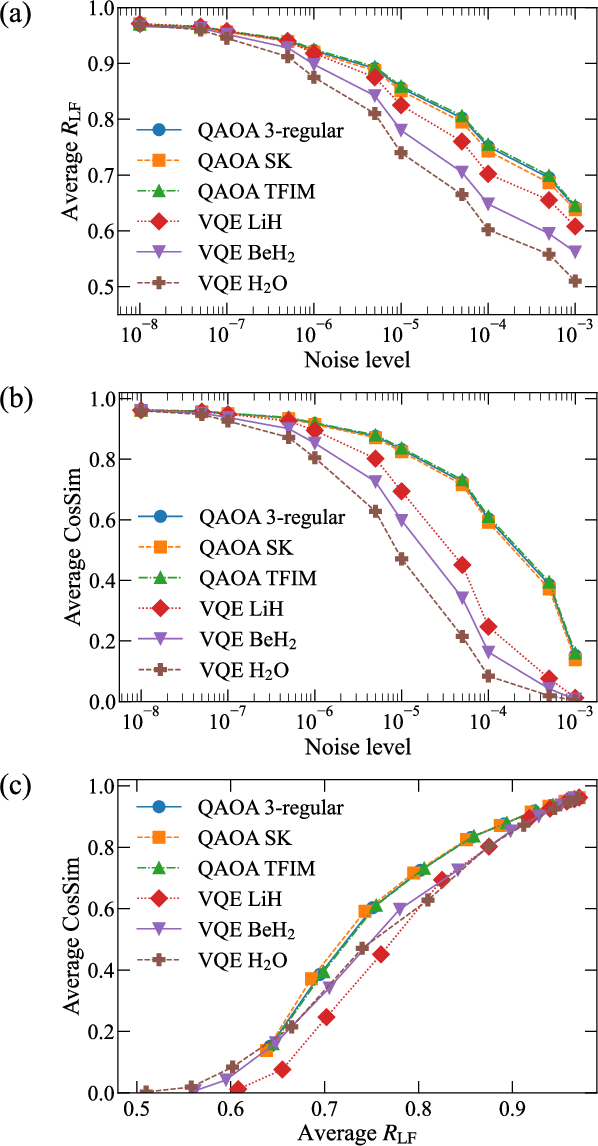
Figure 9: Trajectory-tracking accuracy as a function of spectral smoothness; PIDN best emulates optimization flow when low-frequency structure dominates the landscape.
Implications and Future Directions
This framework reframes error mitigation in VQAs as the identification and distillation of the underlying physics-driven optimization dynamics rather than pointwise correction of measured observables. By tailoring surrogate models to only the dynamically relevant region of parameter space and regularizing them to preserve optimization flow, substantial reductions in quantum resource requirements are feasible, while solution quality remains robust against significant noise.
Practically, PIDN offers a scalable mitigation tool for variational quantum algorithms on NISQ hardware and could be synergistically combined with advanced error mitigation or error-suppressing circuit design strategies. Theoretically, these results highlight the significance of landscape geometry—specifically, the preservation of low-frequency features—for both optimization and the efficacy of surrogate modeling approaches.
Prospective Extensions
Future work could address dynamic re-training for non-stationary noise, adaptation to alternate error mitigation frameworks, or the development of more sophisticated physics-informed architectures (e.g., those leveraging explicit quantum trajectory information or coarse-grained landscape modeling). Extensions to Hamiltonian simulation or time-dependent variational principles, as well as hybrid quantum-classical control, are logical next steps.
Conclusion
"Accelerating Noisy Variational Quantum Algorithms with Physics-Informed Denoising Networks" provides a principled and empirically validated framework for resource-efficient, noise-resilient variational optimization. By reconstructing and enforcing ZNE-induced optimization dynamics through a physics-informed surrogate, PIDN delivers ZNE-level results with a quantum execution cost reduced by up to an order of magnitude, provided that the effective landscape remains spectrally smooth. The approach unifies data-driven and physically-constrained learning, establishing a paradigm for the integration of classical machine learning and quantum variational methods in the NISQ regime.

