- The paper demonstrates that zero-noise extrapolation (ZNE) reduces error by up to 98% in variational PDE solvers at low noise levels.
- It shows that probabilistic error cancellation (PEC) provides near-exact correction at modest depths, though its sampling overhead limits scalability.
- It quantifies how physics-constrained circuit designs yield 25–47% higher fidelity than unconstrained models under similar noise conditions.
Quantum Error Mitigation in Variational PDE-Constrained Quantum Circuits
Introduction
This paper addresses the pressing challenge of quantum error mitigation (QEM) in deploying variational quantum circuits (VQCs) for partial differential equation (PDE) solving on noisy intermediate-scale quantum (NISQ) hardware. Unlike typical variational quantum algorithms (VQAs) for chemistry or optimization, PDE-constrained circuits employ loss functions directly encoding physical laws via residual constraints, yielding distinctive noise propagation behaviors and error landscapes. The authors systematically investigate the effects of various noise sources—depolarizing, amplitude damping, bit-flip—on the solution fidelity and convergence properties of VQC-based PDE solvers. Three prominent QEM strategies are benchmarked: zero-noise extrapolation (ZNE), probabilistic error cancellation (PEC), and measurement error mitigation. Additionally, the inherent noise resilience endowed by physics-constrained ansatz design is quantified both analytically and empirically. The analysis is conducted over three prototypical PDEs (heat, Burgers', and Saint-Venant shallow water equations), spanning progressively more intricate physical constraints.
Noise Models and Their Impact on PDE Solution Fidelity
The paper models three canonical noise channels prevalent in quantum hardware: depolarizing, amplitude-damping, and bit-flip noise. Solution fidelity decays exponentially with increasing noise strength; the impact is more severe for depolarizing noise due to its full Pauli-mixing character and is magnified as the PDE complexity increases, owing to the stricter parameter correlations required for accurate physical modeling. The fidelity degradation hierarchy (depolarizing > amplitude damping > bit-flip) is consistently observed across all evaluated circuits.
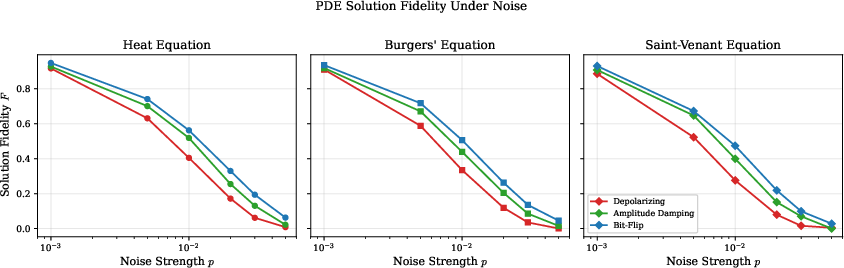
Figure 1: Solution fidelity versus noise strength for the three noise types across three PDEs; depolarizing noise is most destructive, particularly as PDE constraint complexity grows.
Effectiveness and Limitations of Error Mitigation Strategies
ZNE, implemented via Richardson polynomial extrapolation, demonstrates significant efficacy in the low-noise regime (p≤0.005), reducing absolute solution error by $82$–98%. Its effectiveness gracefully diminishes at higher noise strengths as low-order polynomial extrapolation loses accuracy—the mitigated error becomes subdominant compared to unmitigated contributions.
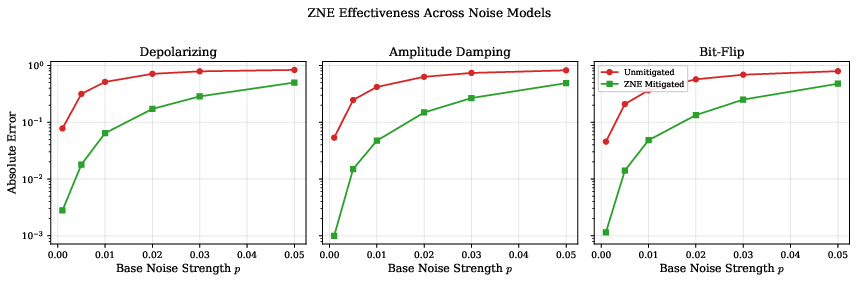
Figure 2: ZNE provides order-of-magnitude error reduction at low noise, but improvement attenuates as noise increases for all studied noise channels.
Probabilistic Error Cancellation (PEC)
PEC provides nearly exact correction at modest circuit depths and noise strengths, but the sampling overhead grows exponentially in the product ng⋅p (where ng is the number of noisy gates), limiting practical applicability to circuits with ng⋅p≲0.5. Beyond this threshold, the required sample sizes render PEC infeasible for NISQ hardware.
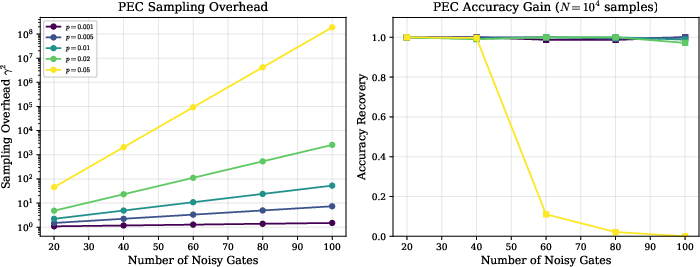
Figure 3: PEC sampling overhead escalates rapidly with circuit depth and noise rate; accuracy recovery remains high only when ng⋅p is small.
Measurement Error Mitigation
Although not the primary focus of numerical results, measurement error mitigation is included in the toolkit but generally cannot compensate for the more substantial coherent and stochastic errors addressed by ZNE and PEC.
Inherent Noise Resilience of Physics-Constrained Circuits
Physics-constrained variational circuits exhibit intrinsic noise resilience compared to unconstrained circuits. This effect arises from the structured optimization landscape induced by PDE residual losses, which restricts parameter deviations to physically meaningful subspaces. Analytical arguments, supported by empirical results, demonstrate that constrained circuits maintain $25$–>0 higher fidelity than unconstrained analogs at moderate noise levels (>1), with the fidelity advantage increasing in tandem with PDE complexity. This enhancement is quantified by a reduction factor >2 in the effective gradient noise.
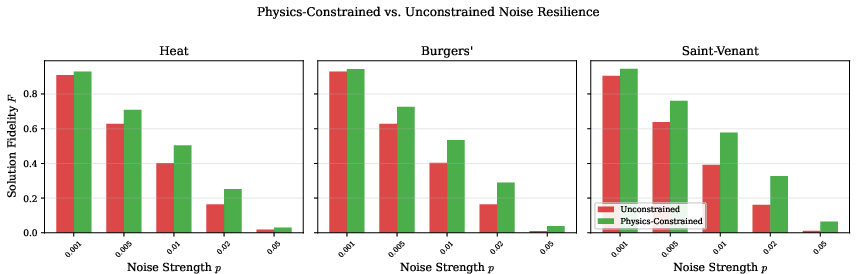
Figure 4: Physics-constrained circuits (green) consistently outperform unconstrained alternatives (red) in solution fidelity under depolarizing noise; the disparity widens for more complex PDEs.
Training Convergence and Error Budget Analysis
ZNE is further shown to substantially improve the convergence behavior of noisy training—lowering the achieved loss floor by factors as large as >3 at >4, thereby enabling more accurate PDE solutions in the presence of hardware noise.
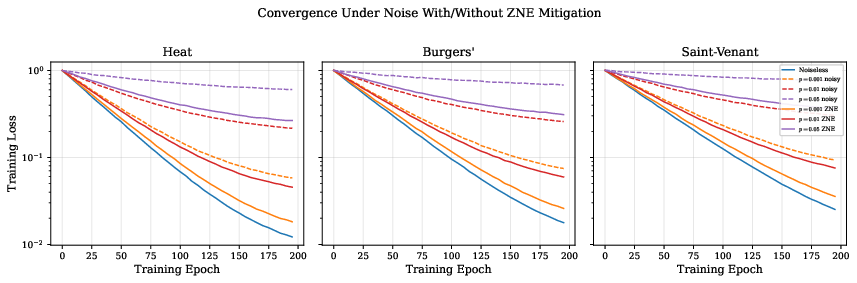
Figure 5: ZNE lowers the convergence floor for noisy training across all PDEs and noise strengths, evidencing improved optimization robustness.
Comprehensive error budget decomposition reveals that systematic (hardware-induced) errors dominate across all noise regimes, accounting for >5–>6 of the total error. The contribution from the PDE residual component grows with noise, reflecting the mechanism by which physical constraints absorb noise-induced parameter perturbations. This decomposition illustrates the multifaceted character of QEM challenges in variational PDE contexts.
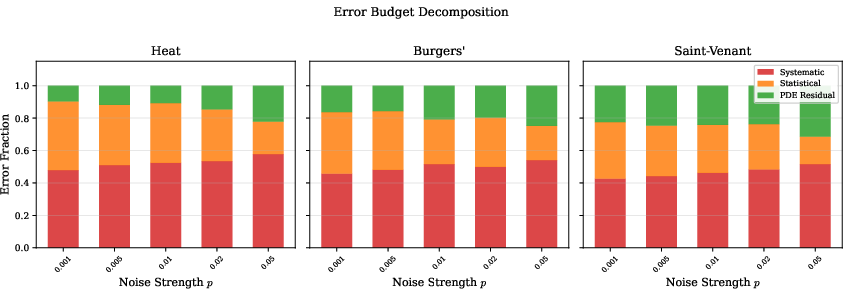
Figure 6: Systematic hardware errors (red) are the principal contributor across noise regimes; the fraction attributable to PDE residuals (green) increases with noise.
Implications for Practical Quantum PDE Solvers
The findings delineate clear operational regimes for QEM deployment in variational PDE solvers:
- Low-noise regimes (>7): ZNE is highly effective with manageable overhead; PEC is feasible for circuits with >8100 gates.
- Moderate-noise regimes (>9): Physics-constrained ansatz design offers substantial supplementary resilience; PEC is limited to shorter circuits.
- High-noise regimes (p≤0.0050): QEM efficacy drops rapidly; circuit design becomes the primary tool for damage control, and further hardware advancements or full error correction become necessary.
These insights suggest that the careful integration of physics-based constraints into VQCs is a critical axis of progress, complementary to QEM methods, for extracting utility from NISQ devices in realistic scientific computing tasks.
Future Directions
The presented analysis opens several avenues for future research. These include the exploration of correlated and non-local noise models, the synergistic integration of ZNE with physics-motivated ansatz architectures, and the validation of these strategies on state-of-the-art superconducting and trapped-ion quantum hardware. The framework established by this work provides a principled foundation for the co-design of algorithms and mitigation techniques suitable for NISQ-era scientific applications.
Conclusion
This paper systematically quantifies the interplay between circuit noise, error mitigation strategies, and physics-constrained ansatz design in variational quantum PDE solvers. ZNE remains the most practical mitigation tool, effective across typical noise channels at realistic noise rates. Physics-informed circuits exhibit a quantifiable, scalable enhancement in noise resilience, particularly for complex PDEs. The error budget is largely dictated by persistent hardware errors, highlighting the continued need for both hardware and algorithmic advances. These results guide practical implementation strategies for leveraging quantum resources in computational science under NISQ-era limitations, and inform the ongoing development of robust quantum machine learning algorithms for physical modeling.
Reference: "Quantum Error Mitigation Strategies for Variational PDE-Constrained Circuits on Noisy Hardware" (2604.10099).

