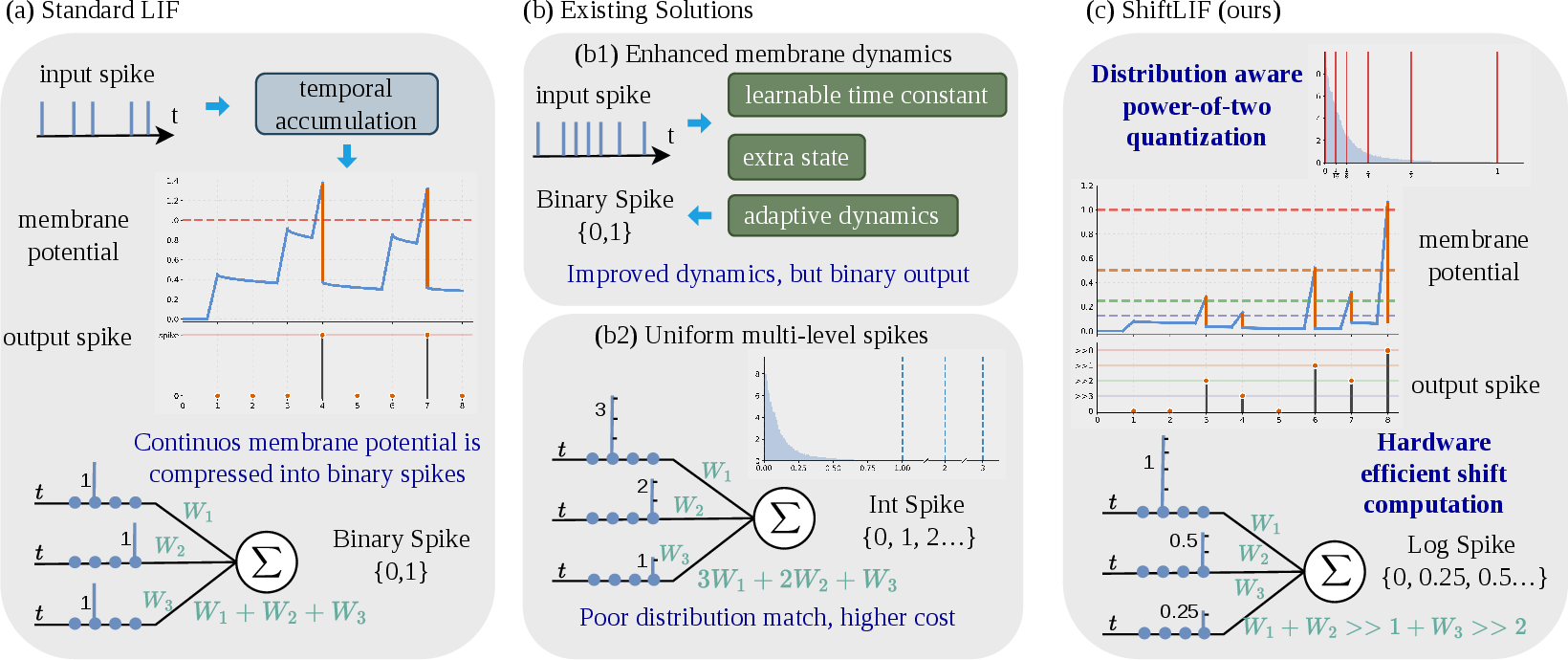
- The paper demonstrates that power-of-two, logarithmic quantization improves representational precision in SNNs by reducing quantization error, especially near low activation values.
- The ShiftLIF design replaces multiply operations with efficient bitwise shifts, significantly lowering energy consumption in edge computing applications.
- Experiments show ShiftLIF achieves up to a 7.3% accuracy gain over traditional LIF approaches across diverse sensing modalities.
ShiftLIF: Efficient Multi-Level Spiking Neurons with Power-of-Two Quantization
Motivation and Context
The proliferation of edge computing scenarios, particularly in wireless, acoustic, and motion sensing, imposes strict requirements on energy-efficient and adaptive computation. Spiking neural networks (SNNs), characterized by their event-driven computation, are compelling candidates for low-power edge deployment. Conventionally, the leaky integrate-and-fire (LIF) neuron is the principal computational unit in SNNs, offering both temporal filtering and binary spike communication. However, this strict binarization induces a severe representational bottleneck, discarding most of the amplitude information encoded in the neuron's membrane potential.
Recent multi-level spiking neuron proposals attempt to expand the representational capacity by introducing additional spike levels, largely implemented with uniform quantization. Yet, these methods often incur additional multiplication overhead (MACs) in hardware and impose quantization schemes mismatched to the actual distribution of membrane potentials, which tend to be heavily concentrated near low values. These limitations ultimately impede both representational expressiveness and hardware efficiency.
ShiftLIF Neuron Design
To address these intertwined dilemmas, the ShiftLIF neuron introduces a power-of-two, logarithmically spaced quantization scheme on the spike alphabet. Specifically, ShiftLIF maps the continuous membrane potential to the discrete set {0,2−K,2−(K−1),…,2−1,1} by a shift quantization operator. This approach presents two distinctive advantages:
The neuron leverages a proportional soft reset mechanism whereby the membrane potential is decremented by the spike magnitude upon emission, preserving sub-threshold charge to minimize information loss. This interplay between flexible multi-level outputs and efficient reset dynamics ensures that the increased representational precision does not compromise the hardware-friendliness inherent to SNNs.
Theoretical Analysis
The authors present a rigorous analysis comparing ShiftLIF with INT-LIF (integer, uniformly spaced quantization). Letting X denote the normalized membrane potential, the absolute quantization error E[∣X−Q(X)∣] is provably lower for ShiftLIF under the empirical distribution conditions observed in edge-sensing tasks—specifically, when more membrane potential mass lies near zero. The construction is further strengthened by examining information-theoretic capacity: under fixed bit budgets, ShiftLIF demonstrates superior output entropy utilization, again due to its superior granularity in the low-activation regime.

Figure 2: ShiftLIF shows lower quantization error and better bit utilization compared to INT-LIF as the number of spike levels increases, validated across multiple sensing datasets.
Experimental Evaluation
Cross-Modal Benchmarking
ShiftLIF is evaluated across ten datasets covering wireless (ARIL, UT-HAR, Fi-HumanID, BullyDetect), acoustic (UrbanSound8K, GSC), motion (UCI-HAR, HHAR), and neuromorphic vision (CIFAR10-DVS, DVS-Gesture) modalities. Compared to multiple LIF-based and multi-level SNN baselines, ShiftLIF achieves the highest average accuracy at 89.34%, outperforming both CLIF and I-LIF by +0.60% and +0.71%, respectively, and providing a substantial +7.3% gain over vanilla LIF.
The gains are particularly significant in continuous sensing tasks, with state-of-the-art or near-best performance on standard wireless, acoustic, and motion benchmarks. On event-based visual tasks, the advantage is smaller, suggesting the benefits of power-of-two quantization are most pronounced when input signals exhibit rich amplitude structure.
Backbone Generalization
The comparative advantage of ShiftLIF over uniform multi-level schemes persists across various backbones, including CNNs, ResNets, and Transformer-based SNNs, demonstrating that the quantization and computation innovations are architecture-agnostic and readily transferable.
Hardware Efficiency
A critical claim validated by the experiments is that ShiftLIF's multiplier-free computation leads to low synaptic energy consumption. On wireless sensing datasets, ShiftLIF achieves high accuracy with similar or lower energy budgets compared to standard LIF and markedly reduced consumption relative to INT-LIF. This supports the claim that ShiftLIF's multiply-free, shift-based computation preserves SNNs' edge applicability.
Ablation Analysis
By varying the quantization precision K, the authors show that moderate numbers of spike levels (e.g., K=2) yield optimal results; excessive precision confers diminishing returns due to the intrinsic signal statistics. Additionally, ablation between logarithmic and uniform quantization under equivalent spike-level budgets shows distinct accuracy improvements for ShiftLIF, particularly for continuous modalities.
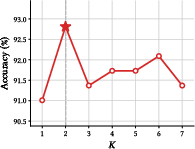
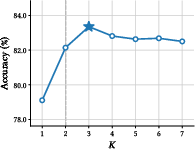
Figure 3: Dataset-specific performance illustrations (e.g., ARIL) for ShiftLIF, further confirming accuracy gains across practical use cases.
Implications and Future Directions
ShiftLIF decisively demonstrates that approaching SNN quantization from a signal-statistics-aware perspective enables spiking neurons to carry richer information while maintaining the low-power, event-driven computation essential for edge scenarios. The decoupling of increased expressiveness from hardware cost (by exploiting bit shifts instead of multiplications) effectively resolves the most salient challenges faced by existing multi-level SNN approaches.
The framework is directly applicable to a broad spectrum of SNN-powered sensor analytics and points the way for future research in:
- Learnable/Adaptive Quantization Schemes: While ShiftLIF fixes the quantization to power-of-two levels, it is theoretically viable to consider learnable gates or adaptive schemes that optimize the spike set distributionally during training.
- Mixed-Precision or Heterogeneous SNNs: Tasks or layers demanding more/less precision might benefit from dynamic adjustment of K or the quantization structure, possibly conditioned on input statistics.
- Neuromorphic Hardware Realization: As SNNs increasingly interface with custom silicon (e.g., event-based sensors, ASICs), the bit-shift computation model of ShiftLIF aligns directly with contemporary low-power digital design primitives.
Conclusion
The ShiftLIF neuron design marries distribution-aware, high-fidelity communication with hardware-efficient computation, successfully transcending the accuracy–efficiency trade-off that has limited prior multi-level SNN approaches. Its demonstrated superiority on a wide range of real-world sensing modalities, achieved with negligible additional computation and strong compatibility across neural architectures, positions ShiftLIF as an effective neuron model for next-generation energy-efficient SNN deployment at the edge.