- The paper presents a two-stage algorithm that leverages convex relaxation and a greedy packing procedure to achieve near-optimal solutions within 3-6% of MIP, with 100–2,500× speedups.
- It introduces shadow price computation via server shape aggregation to handle heterogeneous resources and complex constraints like anti-affinity and GPU demands.
- Empirical results demonstrate scalable scheduling performance with sub-1-second solve times and linear growth in runtime, ensuring practical deployment in large datacenters.
CvxCluster: Convex Relaxation for High-Speed, Granular Cluster Resource Allocation
Cluster resource allocation remains a central systems challenge, tightly coupling throughput, utilization, tenant fairness, and task latencies. Standard approaches model allocation as a high-dimensional Mixed-Integer Programming (MIP) problem—specifically, a multi-dimensional knapsack with side constraints. MIP-based resource allocation is known to be NP-complete, and combinatorial explosion renders these approaches impractical for modern cluster scales and online environments. Heuristics and localized search-based methods trade off optimality for tractability but often lack global resource-scarcity awareness and fail to robustly support nontrivial deployment constraints such as anti-affinity and heterogeneous accelerators.
CvxCluster presents a departure from explicit integer optimization and ad-hoc heuristics via a two-stage algorithm that first solves a convex relaxation of the resource allocation problem, then uses dual variables (shadow prices) to drive a greedy packing procedure. The critical insight is that by separating global resource pricing from discrete assignment, it is possible to achieve both substantial speed gains (two to three orders of magnitude over MIP) and high-quality allocations—demonstrated to be within 3% of the MIP objective in large-scale experiments.
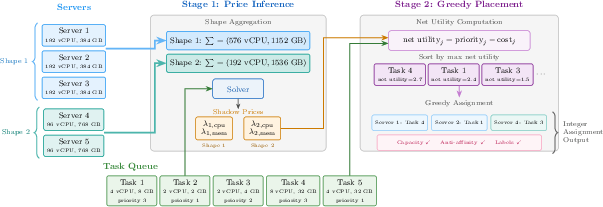
Figure 1: The CvxCluster pipeline: Stage 1 extracts shadow prices through convex relaxation over server shape-aggregated resources, Stage 2 consumes these prices for efficient greedy assignment.
Two-Stage Design: Convex Relaxation and Greedy Placement
Stage 1: Shadow Price Computation
The first stage aggregates servers by hardware "shape"—a practical datacenter motivation since real deployments contain tens (not thousands) of configurations. The original MILP is relaxed into a linear (convex) program by allowing task assignments to be fractional, which compresses the state space and yields global optima deterministically in polynomial time. The fundamental benefit is the extraction of per-resource, per-shape shadow prices, which encapsulate global scarcity. For instance, a surge in GPU-hungry workloads increases GPU shadow prices on such shapes, acting as high-fidelity, real-time signals of contention.
Stage 2: Price-Guided Greedy Allocation
Given these shadow prices, the scheduler computes per-task net utilities: the value or priority of the task minus the total cost induced by resource demands at current shadow prices. Pending tasks are sorted and packed greedily onto feasible servers of appropriate shapes, using fast constraint checks. The approach directly supports integration of arbitrary placement policies—standard resource feasibility, anti-affinity (encoded as per-group capacity variables), or shape-specific requirements.
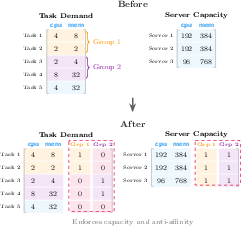
Figure 2: Anti-affinity constraints are tractably encoded by extending the resource and server capacity matrices, integrating seamlessly with convex relaxation and the greedy pipeline.
The design offers flexibility: new constraints are simply expressible in either stage, and the complexity and placement fidelity can be tuned by adjusting aggregation granularity (shape-level or global pricing).
Numerical Evaluation
Experimental results validate CvxCluster's strong runtime-quality tradeoff:
- Achieves 100–2,500× speedup over commercial MIP solvers (e.g., Gurobi) on static and dynamic workloads, even as cluster size scales to 100,000+ nodes and arrival intensity to 500,000× baseline rates.
- Solution quality is within 3–6% of MIP for priority-weighted placement objectives—including under complex anti-affinity and heterogeneous resource (GPU) constraints.
- Greedy placement preserves high-priority task allocations; deviations from optimality are primarily concentrated among low-priority and non-critical tasks.
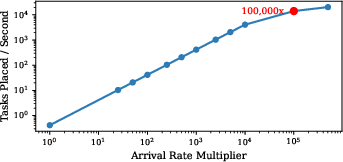
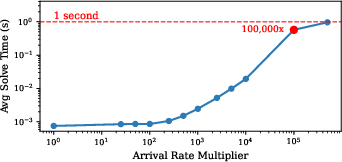
Figure 3: Scheduling throughput scales up to approximately 20,000 tasks/sec, with per-round solve time remaining beneath 1s even at extreme arrival rates.
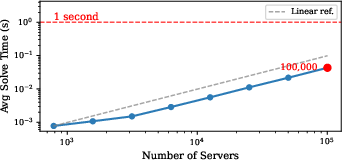
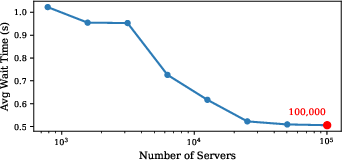
Figure 4: Solve time grows linearly with scheduling scale but always remains below the operational 1s budget, up to 100,000-server deployments.
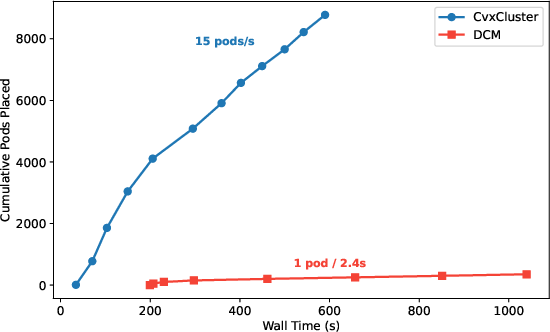
Figure 5: On a 785-node Kubernetes cluster replaying highly accelerated workloads, CvxCluster outpaces a SAT-based scheduler (DCM) by 38×.
CvxCluster’s empirical scaling demonstrates that shape aggregation and convex relaxation render the computational bottleneck dependent on task volume, not cluster or constraint cardinality. For GPU-extended clusters, solution optimality matches MIP for all tractable instances, validating the extensibility of per-shape convex pricing.
Practical and Theoretical Implications
CvxCluster’s methodology fundamentally alters the hardware and workload scaling envelope for cluster schedulers:
- Practical deployment: The approach enables fine-grained, high-frequency scheduling on warehouse-scale infrastructure with complex, heterogeneous demand and constraints, without forfeiting global placement quality.
- Extensibility: The convex + greedy separation supports rapid integration of constraints/policies common in production: job anti-affinity, shape eligibility, resource partitioning, and hierarchical/multi-cluster scheduling.
- Theoretical perspective: The work empirically demonstrates that, for large clusters with a modest number of resource shapes, convex relaxation combined with dual-guided rounding exposes a new regime where near-optimal solutions are computationally tractable.
- Interpretability and Economics: Shadow prices can be directly interpreted as economic indicators for resource scarcity and can inform admission control, chargeback models, or downstream learning-based control policies.
Limitations and Future Directions
The primary limitation arises from the rounding gap between fractional and discrete assignments, which is fundamentally irreducible without solving the full integer program. In highly overprovisioned clusters or those with extreme packing pressure, every percent of utilization informs placement decisions—though in typical large-scale settings, the 2–5% observed gap is operationally negligible.
Potential directions for future research include:
- Iterative re-solving with post-placement reduced capacities to close the rounding gap.
- Dynamic batch size and scheduling interval adaptation in response to queue depth and arrival burstiness.
- Generalization to more complex constraints and extension towards federated/multi-cluster topologies.
- Leveraging shadow prices and placement traces as features or labels for reinforcement learning or meta-scheduling models.
Conclusion
CvxCluster illustrates the practical power of convex relaxation and duality in operational datacenter scheduling. By structurally decoupling global price discovery from discrete, policy-aware packing, the methodology achieves order-of-magnitude speedups without meaningful sacrifice of allocation quality—even under granular placement and resource configuration. This paradigm has broad applicability across infrastructure scheduling, from container orchestration to accelerator allocation, and provides fertile ground for further theoretical and systems advances in scalable resource management.

