- The paper introduces a pricing-driven framework leveraging SaaS pricing abstractions to optimize resource allocation in heterogeneous, multi-provider environments.
- It employs a three-stage workflow—offer mapping, demand encoding, and optimization using the PRIME engine—to achieve cost-optimal deployments in sub-3 second median time for up to 200 nodes.
- Empirical evaluations on synthetic multi-provider scenarios demonstrate robust expressiveness, scalability, and cost-effectiveness for infrastructure planning across edge, fog, and cloud.
Pricing-Driven Resource Allocation in the Computing Continuum
Introduction and Motivation
Efficient resource allocation in the computing continuum—spanning edge, fog, and cloud—has become an inherently combinatorial and complex decision problem due to geographic distribution, infrastructure heterogeneity, and the need to satisfy both technical and business constraints. Existing approaches often rely on ad-hoc formulations for topology and demand representations, impeding solution generalization and comparison. This paper introduces a novel method leveraging the concept of "pricings"—standardized structures historically employed in SaaS ecosystems to represent configurable service offerings—as a general-purpose abstraction for modeling and optimizing resource allocation in heterogeneous, multi-provider environments (2604.12642).
Conceptual Framework
The authors frame the allocation challenge as the search for a cost-optimal configuration of nodes, mapped from infrastructure, capable of meeting aggregate demand under technical, economic, and governance constraints.
- Offer (O): Infrastructure topology consisting of nodes (with resource vectors and contextual metadata) and a set of business rules (e.g., mutual exclusions, interoperability).
- Demand (D): Aggregate resource vector required to service user workload for a region/conceptual deployment zone.
- Request (R): Additional constraints such as provider whitelist, bounding node number, spatial limits, and price ceiling.
The objective is to identify a subset of nodes C∗⊆N that jointly satisfy all constraints while globally minimizing deployment cost.
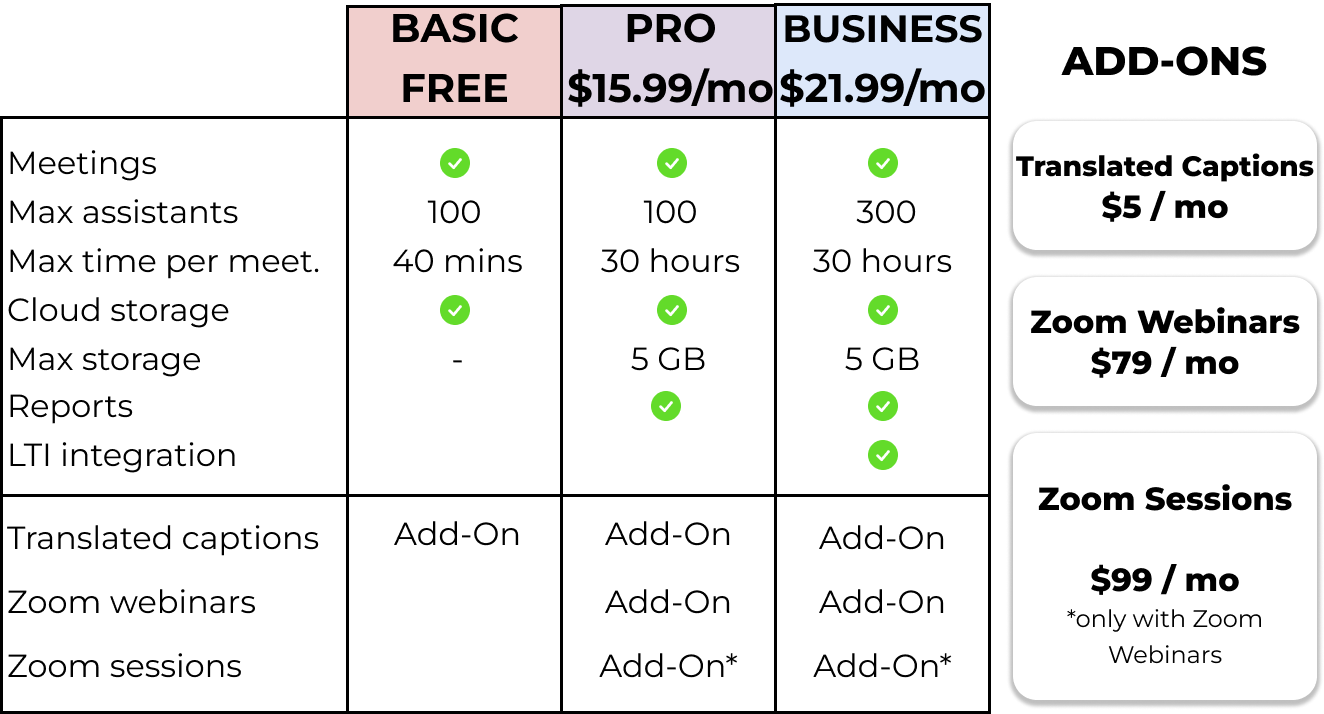
Figure 1: An example of a typical pricing structure (here, Zoom) comprising features, usage limits, multiple plans, and add-ons.
Pricing-Driven Workflow
The principal contribution is a structured, three-stage workflow that employs machine-oriented pricing artifacts (iPricings) and an automated analysis engine (PRIME) to solve the allocation problem.
1. Offer Mapping
Infrastructure nodes and relationships are mapped onto a pricing domain:
- Each node → Pricing add-on
- Node types → Features
- Resource capacities → Usage limits
- Provider/business exclusions → Add-on exclusions
This abstraction encodes both topological flexibility and commercial constraints.
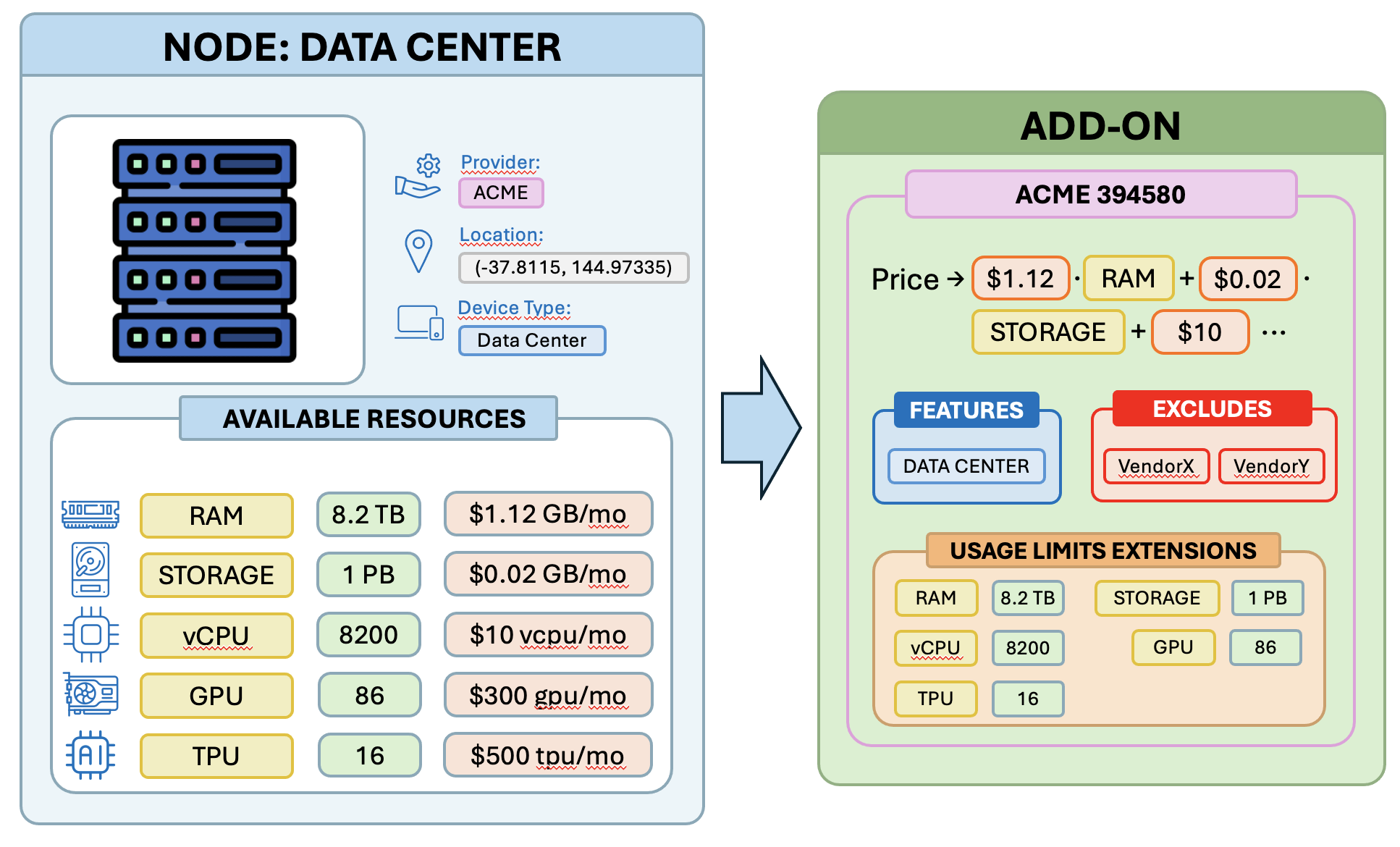
Figure 3: Projection of a sample infrastructure node into the pricing domain, demonstrating mapping from node capacities and business logic to add-on attributes.
2. Demand and Request Encoding
Demand vectors specialize usage limit constraints for each add-on, and concrete price expressions are instantiated per demand scenario—resource unit prices mapped to actual requirements. Requests introduce additional filters bounding the solution space (e.g., node budget, location).
3. Optimization and Back-Projection
The derived iPricing instance and scenario-specific filters are processed by PRIME, which resolves the CSP for cost-optimality; solutions are then projected back onto the original infrastructure.
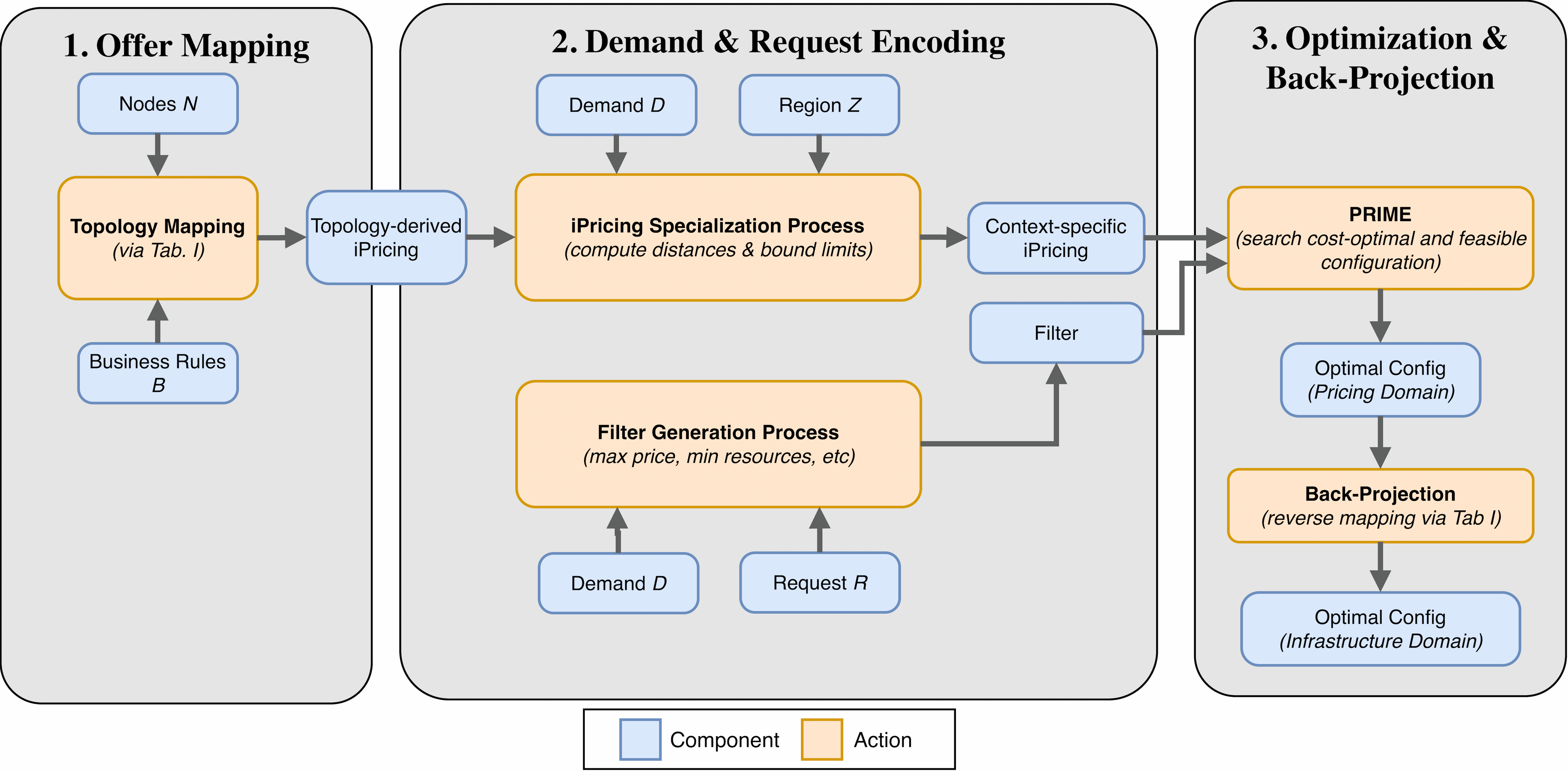
Figure 2: End-to-end workflow illustrating infrastructure mapping to pricing, demand/request encoding, and optimization loop.
Experimental Evaluation
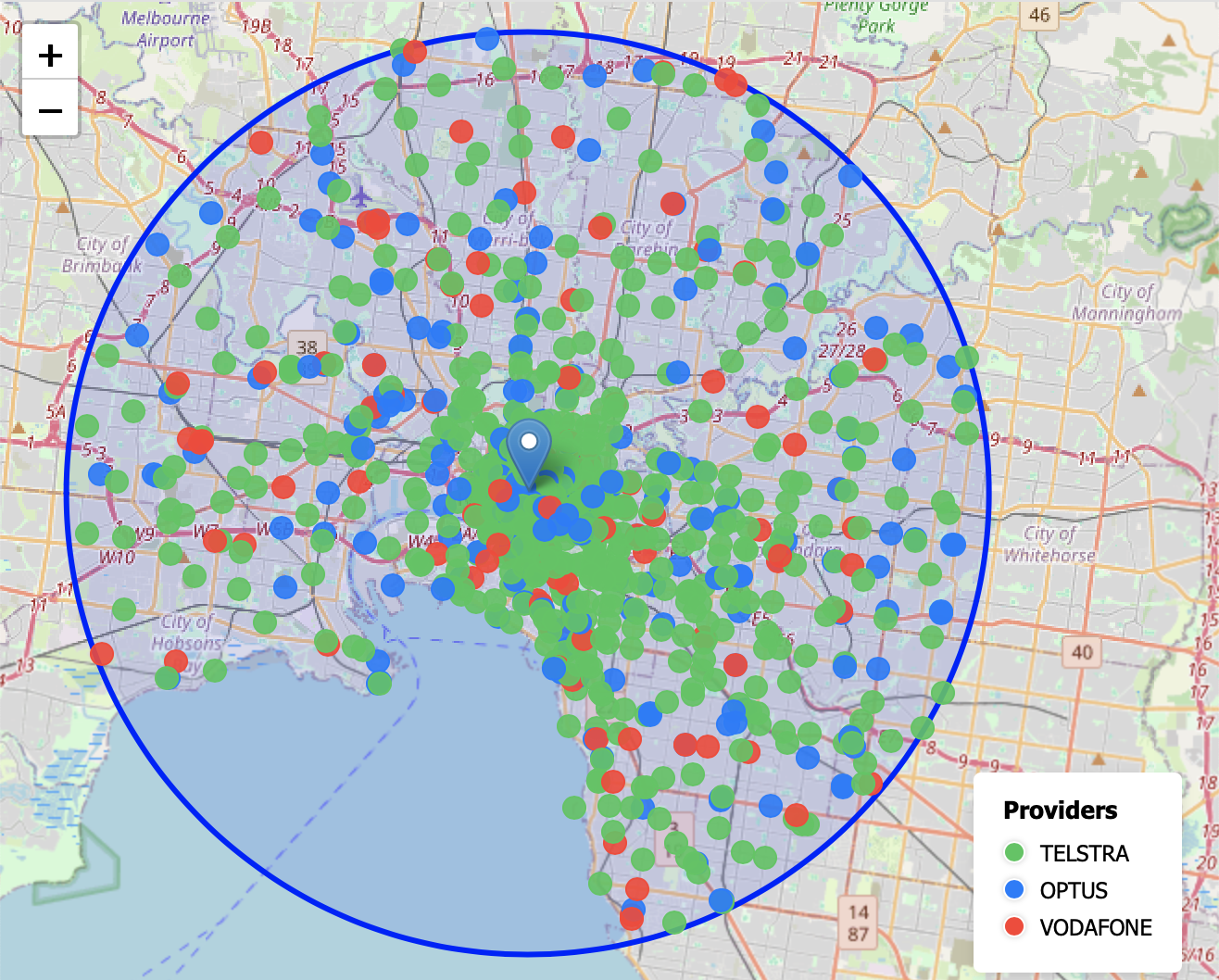
Comprehensive experiments are conducted using synthetic multi-provider topologies generated from the EUA dataset, focusing on both modeling expressiveness and computational viability.
Dataset and Scenario Synthesis
Benchmarks and Parameters
The methodology is validated over 9,600 distinct deployment scenarios, spanning four application types (CCTV, VR, robotics, LiDAR) and systematically varying demand intensity and topology scale. For each scenario, 100 diverse topologies are sampled to ensure robust statistics.
Results
- Modeling expressiveness: All scenarios—including multi-provider, multi-mode, and interoperability constraints—are expressible via the proposed abstraction without ad-hoc workarounds.
- Optimality and feasibility: PRIME consistently finds feasible, globally optimal deployments or correctly identifies infeasible scenarios (e.g., over-constrained requests).
- Scalability: Execution time remains stable with increasing demand. Computation time scales with candidate node count; for up to 200 nodes, median solving time remains sub-3 seconds—suitable for interactive or near-real-time planning.
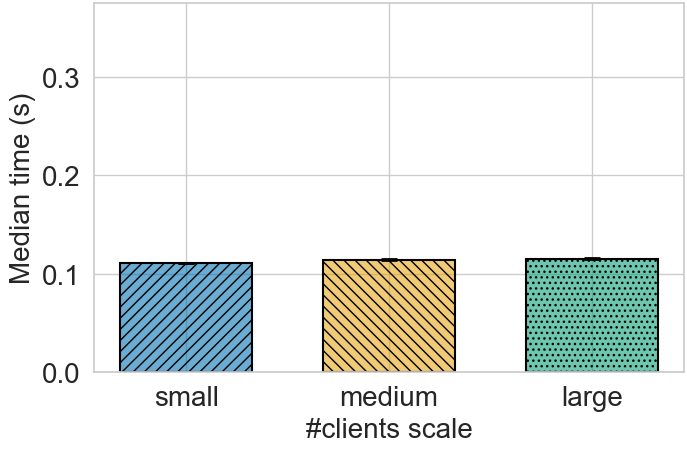
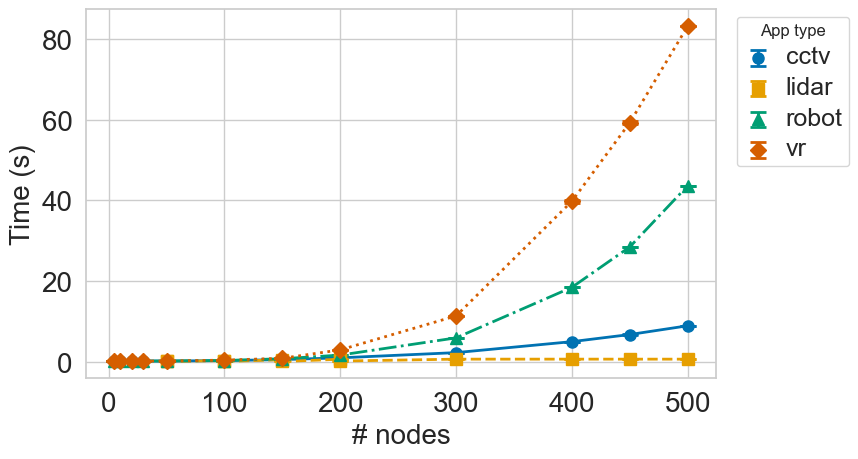
Figure 5: Execution time of the workflow under increasing problem size; median values across multiple topologies show bounded growth and negligible variance up to practical infrastructure sizes.
Theoretical and Practical Implications
This work establishes evidence that iPricing-based abstractions are not limited to business-layer SaaS configuration but can generalize to infrastructure resource allocation across the continuum. The ability to represent both technical and business/gov constraints compactly enables transfer and reuse of existing analysis tools—bridging a modeling gap between service-level variability and infrastructure-level compositionality.
On the practical side, the workflow allows automated, cost-aware, multi-provider resource planning, simplifying integration of pricing logic and technical constraints. Execution times suggest direct applicability to operational decision support for infrastructure deployments.
Limitations and Future Work
The experiments rely on synthetic resources and business constraints due to the lack of perfectly matched real-world datasets. Evaluation focuses on a single metro-scale region and a triad of providers, potentially limiting external validity. The proxies employed (e.g., geo-distance as a latency surrogate) simplify certain network realities.
Future research should expand to real-world provider data, broader geographic scales, and production workload traces. Incorporating online monitoring and re-optimization, generalizing the abstraction to other distributed computing domains (e.g., federated learning, energy-sensitive scheduling), and developing hybrid/distributed CSP solving approaches are promising directions for increased robustness and scalability.
Conclusion
The paper demonstrates that pricing-driven abstractions, originally confined to SaaS business logic, directly enable expressive and efficient resource allocation in the computing continuum. The proposed workflow, underpinned by iPricings and automated CSP analysis, shows empirical tractability and flexibility in multi-provider, resource-diverse environments. This modeling unification invites further exploration of cross-layer abstractions and tool reuse across the cloud-edge continuum, with implications for both research and operational infrastructure management.