- The paper demonstrates that the entanglement capacity in DTQWs is bounded by the logarithm of the maximum matching size in the network's bipartite double cover.
- It introduces a novel source-target entanglement framework that overcomes coin assignment ambiguities in irregular graphs.
- Simulations on ER and BA random graphs reveal that increased connectivity and clustering diminish nonlocal entanglement, guiding quantum communication design.
Entanglement Capacity in Complex Networks via Quantum Walks
Introduction and Motivation
The paper "Entanglement capacity of complex networks from quantum walks" (2605.00772) systematically investigates the structural limits and generation mechanisms of quantum entanglement in discrete-time quantum walks (DTQWs) on arbitrary networks. Traditional quantum walk analyses focus on regular graphs, utilizing coin-walker entanglement as a diagnostic and resource for quantum transport and algorithmic primitives. However, this approach is inapplicable to irregular networks where the Hilbert space factorization between coin and walker fails. To address this, the study introduces the notion of source-target entanglement, anchored in graph bipartitions that assign each node dual roles as both source and target.
The bipartite double cover construction enables a mathematically rigorous embedding of DTQW states into a representation compatible with arbitrary graph topologies. This framework reveals that graph-theoretic features, specifically matchings, dictate the upper limits of entanglement capacity, resulting in structure-dependent constraints on quantum correlations.
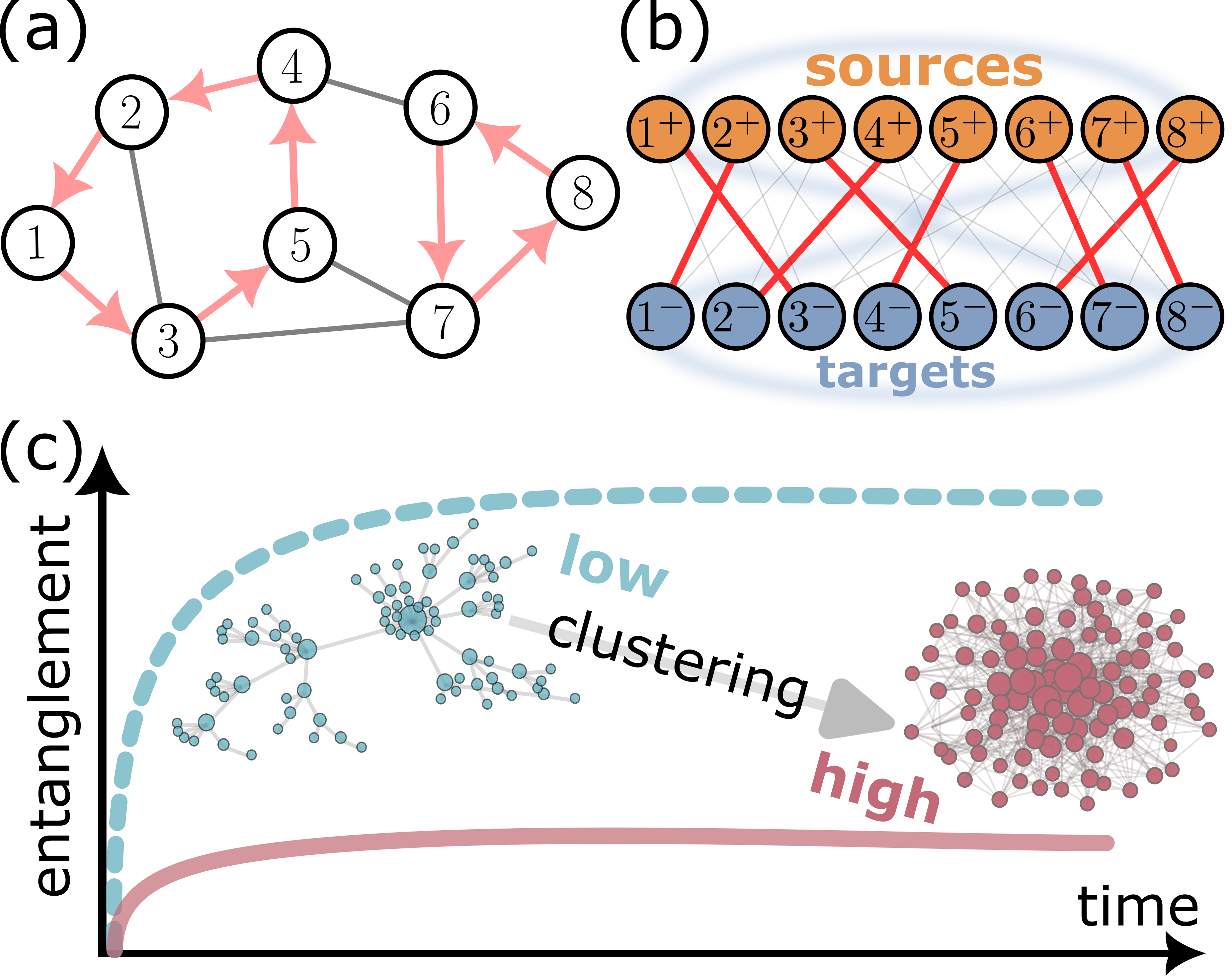
Figure 1: Illustration of DTQW states on a generic graph, mapping arcs to source-target bipartitions and highlighting maximum matchings as the entanglement-generating backbone.
Source-Target Entanglement: Formalism and Structural Context
On regular graphs, coin-walker entanglement quantifies correlations between a quantum walker's position and its coin degree of freedom, supporting ballistic transport and quantum algorithm efficiency. In irregular graphs, variable node degree and absence of global coin labeling invalidate straightforward bipartitions. To resolve this, the paper defines source-target entanglement by embedding the walker state into the Hilbert space of the bipartite double cover B(G), splitting each node into source (n+) and target (n−) identities.
Walker states are mapped as follows:
∣Ψ⟩=n,m∈N∑Ψnm∣n+⟩⊗∣m−⟩
where Ψnm captures quantum amplitudes along admissible arcs. Entanglement is then quantified via the von Neumann entropy of the Schmidt decomposition across the source-target bipartition.
A key technical insight is the non-uniqueness of coin assignments even in regular structures, producing ambiguity in coin-walker entanglement and motivating the need to shift to source-target metrics.
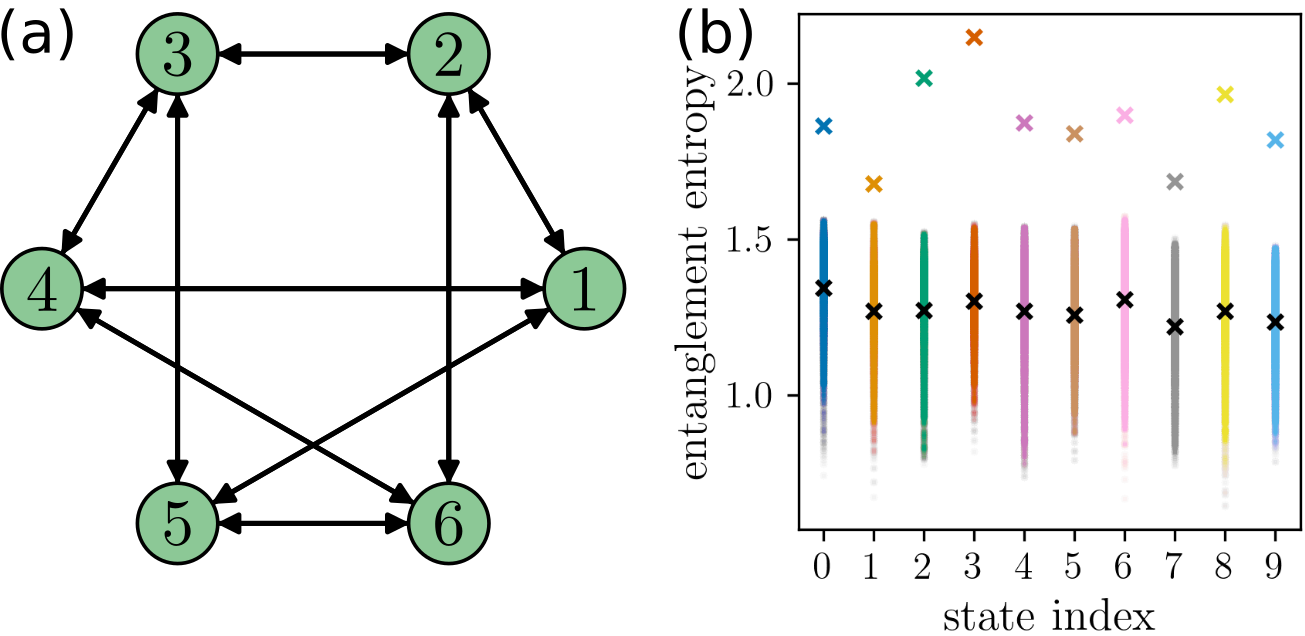
Figure 2: Distribution of source-target vs. coin-walker entanglement for Haar random states on a regular three-regular graph, demonstrating assignment sensitivity and distinct statistical behaviors.
Entanglement Capacity and Maximum Graph Matchings
The paper establishes a theorem linking the entanglement capacity of a DTQW state to the graph's maximum matching size in its bipartite double cover. Specifically, for any walker state ∣Ψ⟩, the source-target entanglement Sst[∣Ψ⟩] is bounded above by logs, where s is the largest matching size fully supported by the amplitude matrix. This bound is saturable: equal-weight superpositions over maximal matchings constitute maximally entangled states.
For cyclic graphs with N nodes, the entanglement capacity is n+0, but with subtleties arising from parity—bipartite structures for even n+1 allow additional maximally entangled superpositions over local cycles.
Dynamics of Entanglement Generation on Random Networks
Simulations performed on both Erdős–Rényi (ER) and Barabási–Albert (BA) random graph models systematically track time-evolution of DTQW-generated source-target entanglement. Across n+2 realizations per parameter setting, DTQWs quickly reach a fluctuating plateau in entanglement entropy. An increase in network connectivity—quantified either by edge creation probability (n+3 in ER) or preferential attachment (n+4 in BA)—provokes a monotonic decrease in attainable entanglement, with high clustering coefficients similarly suppressing nonlocal correlations.
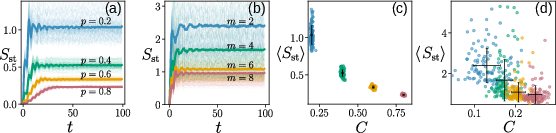
Figure 3: Time evolution and plateau statistics of source-target entanglement in ER and BA random graphs, elucidating the negative correlation between connectivity/clustering and entanglement generation.
This behavior is attributed to interference localization: high clustering networks reinject amplitudes locally, minimizing spatial separation and thus entanglement. Conversely, low-clustering, tree-like topologies permit sustained separation and stronger source-target correlations.
Coin-Walker vs. Source-Target Entanglement in Structured Walks
The paper further contrasts coin-walker and source-target entanglement in paradigmatic DTQWs like the Hadamard walk on the infinite line. Ambiguity in coin assignment leads to radically different values for coin-walker entanglement, whereas source-target entanglement directly tracks the spatial propagation of quantum correlations.
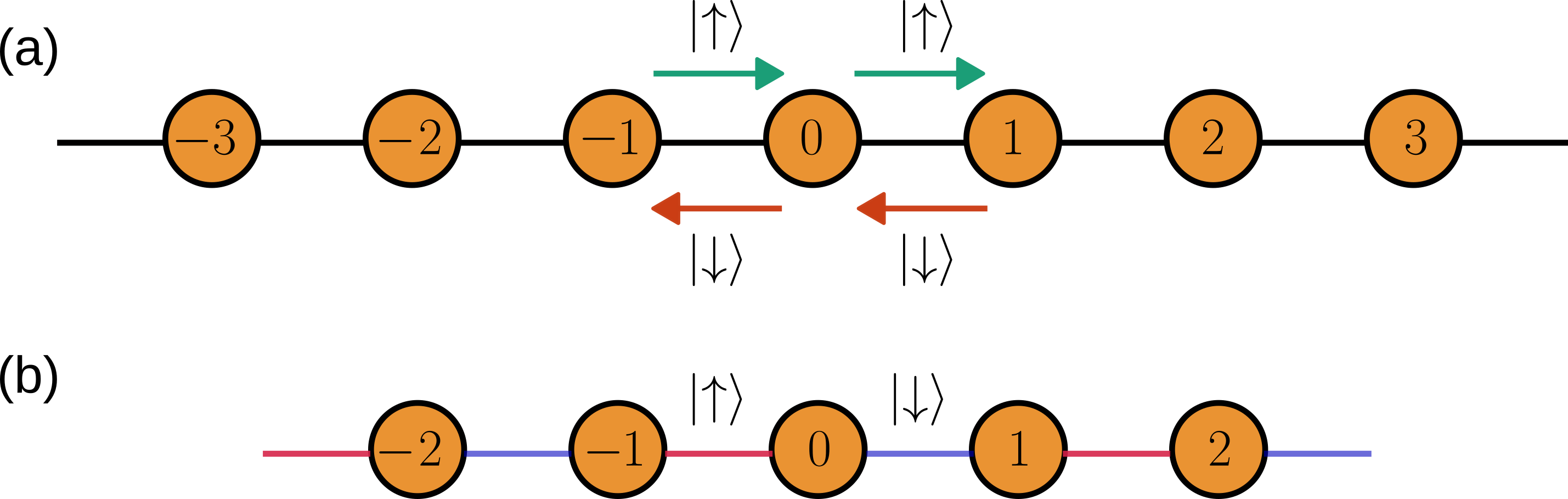
Figure 4: Schematic of coin-walker representation for Hadamard walks, highlighting assignment ambiguities that impact entanglement quantification.
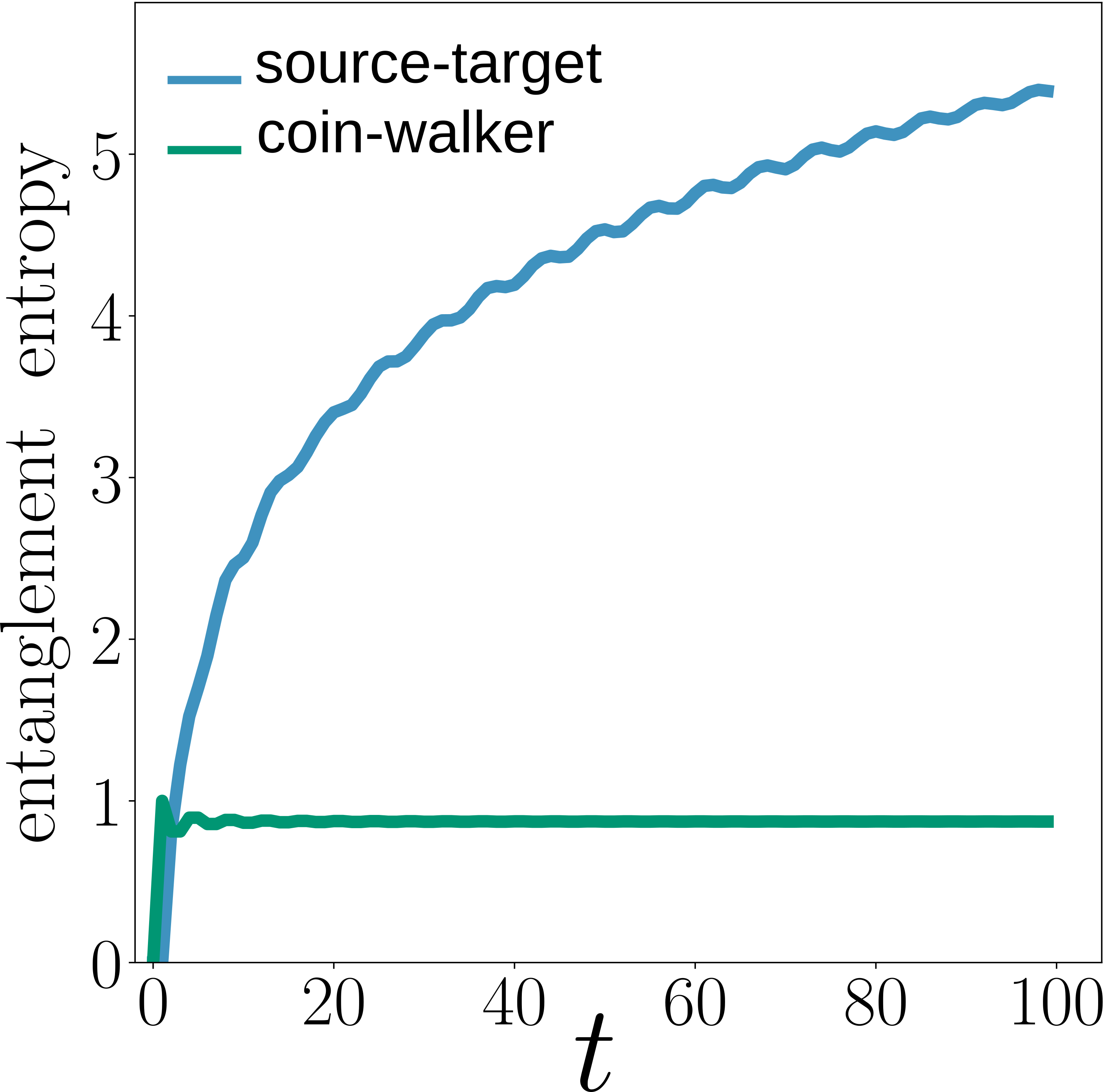
Figure 5: Temporal evolution of coin-walker versus source-target entanglement in the Hadamard walk, demonstrating diverging behaviors and sensitivity to partition structure.
Structural Analysis of Matchings in Random Graphs
Quantitative analysis of maximum matchings confirms that the bipartite double cover typically doubles the original graph's maximum matching size, though larger enhancements are possible for specific topologies (e.g., odd cycles).
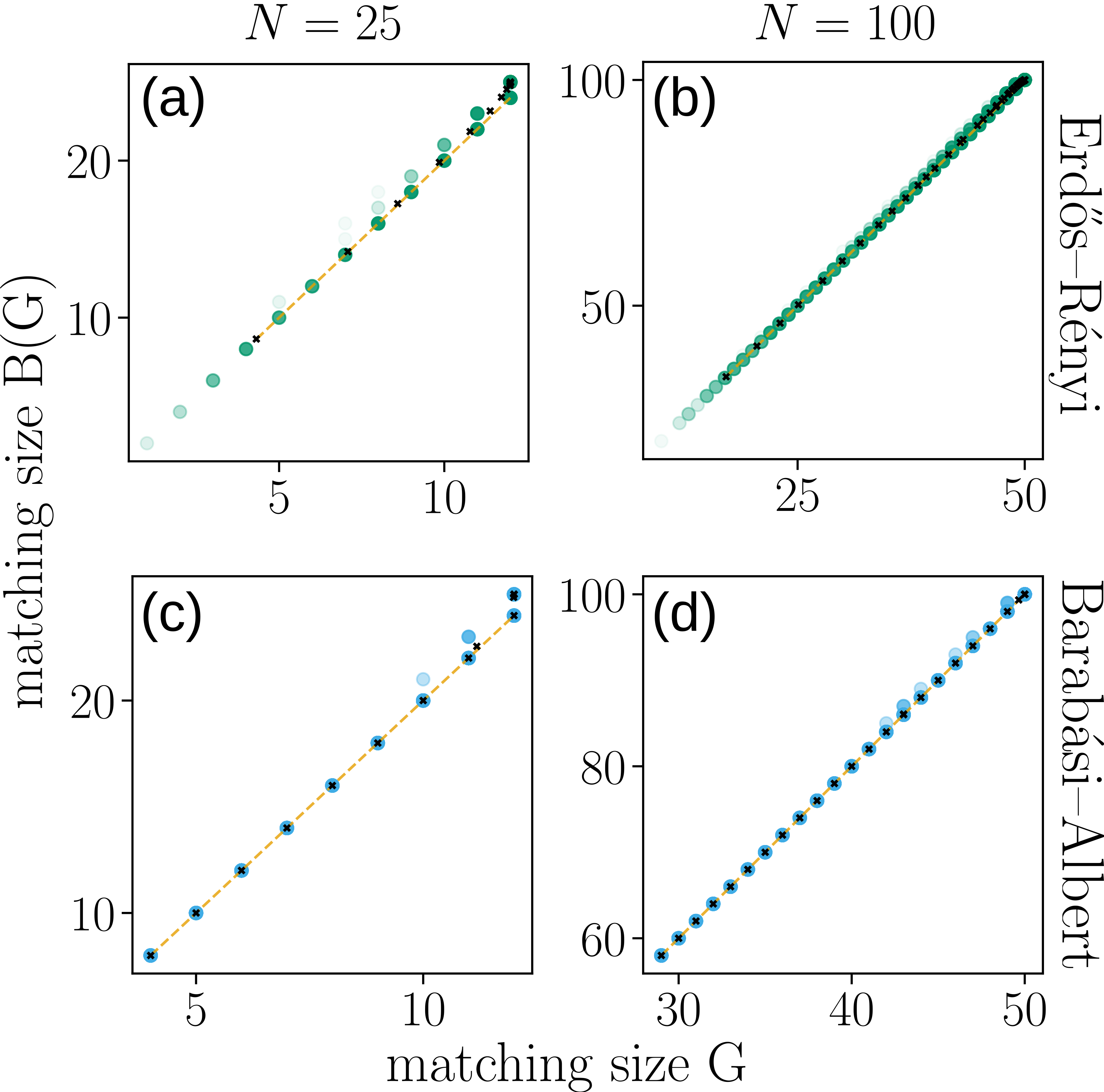
Figure 6: Scaling of maximum matchings in random graphs and their bipartite double covers, providing operational insight into structural determinants of entanglement.
Implications and Prospects
The results provide a rigorous, operational metric for entanglement capacity rooted in graph combinatorics. Practically, this guides quantum communication protocol design and quantum information processing on complex networks, as entanglement generation can now be controlled and predicted from graph-theoretic diagnostics. Theoretically, the framework fosters further exploration into the interplay between topology, localization phenomena, and quantum search/storage algorithms.
Control over quantum correlation spreading—via network modification or dynamic adjustment—emerges as a future direction, with implications for localization and search efficiency in settings exhibiting high clustering or non-trivial matching structures.
Conclusion
The source-target entanglement capacity of quantum walks is fundamentally determined by underlying network matchings, with tighter graph connectivity imposing strong upper limits on achievable quantum correlations. The paper establishes a versatile framework for quantifying and analyzing entanglement on arbitrary networks, superseding prior metrics reliant on coin-walker Hilbert space separation. These findings inform both the theoretical foundations and practical roadmap for quantum transport, communication, and computation in complex networked environments.

