- The paper introduces quantum-specific measures (QCM, QCF, QCC) to quantify functional connectivity in quantum networks based on entanglement quality.
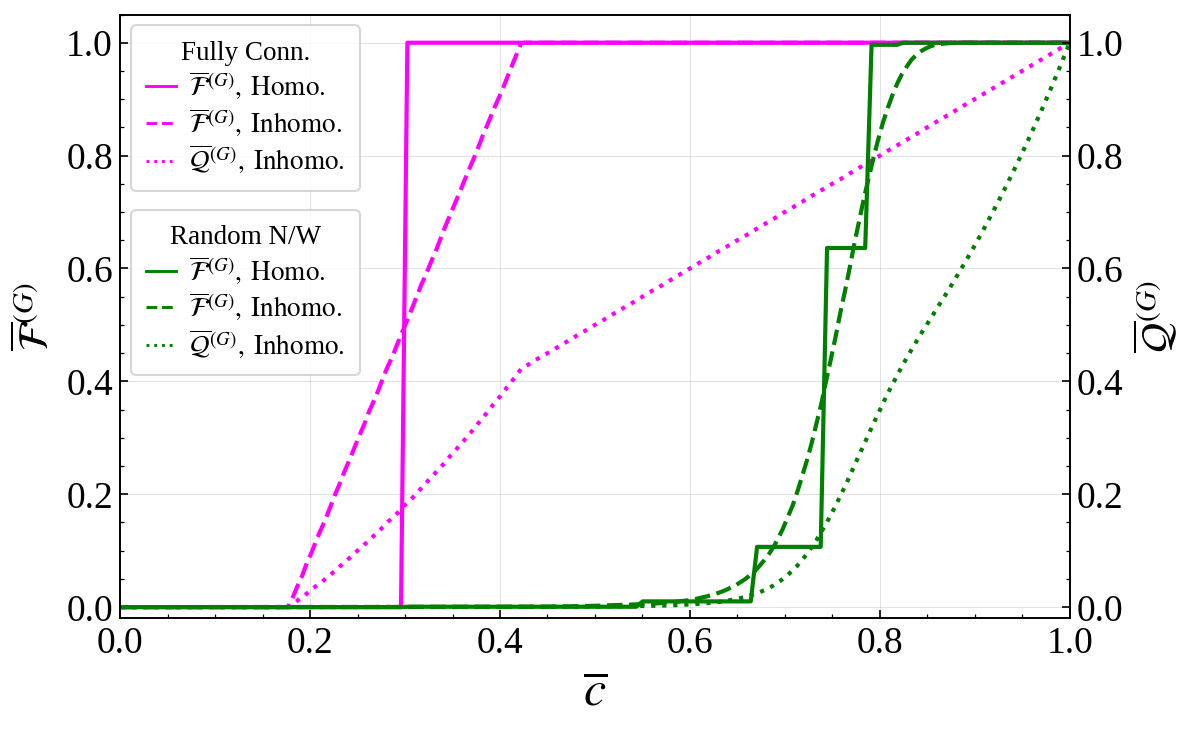
- Analytical derivations and simulations reveal threshold behaviors in connectivity metrics for both fully connected and random network models.
- The study highlights the divergence between classical and quantum connectivity, providing insights for protocol design and standardization of quantum internets.
Quantum Connectivity: Defining and Characterizing Functionality in Quantum Networks
Introduction
This work addresses a fundamental limitation in the understanding and quantification of connectivity in quantum networks (QNs). While classical network theory characterizes connectivity through topological measures (e.g., shortest paths, clustering coefficient, giant component), these are insufficient for quantum networks wherein entanglement—rather than mere physical links—determines the practical possibility of executing quantum information processing (QIP) tasks. The authors introduce a suite of quantum-specific metrics: the Quantum Connectivity Measure (QCM), the Quantum-Connected Fraction (QCF), and the Quantum Clustering Coefficient (QCC), which collectively quantify the functional connectivity of a QN, i.e., the ability of node pairs (or subsets) to execute a QIP task given the quality of distributed entanglement. The analysis spans both local and global scales, considers the impact of network protocols and physical-layer inhomogeneity, and is substantiated through analytical derivations and large-scale simulations for typical network topologies.
The central metric, the Quantum Connectivity Measure (QCM), is defined as the average connection strength over all node pairs in a subset N:
QN=∣N∣(∣N∣−1)/21i,j∈N∑Sij Θ[Sij−ϵ]
where Sij is the effective strength of entanglement between i and j (determined via the optimal entanglement-swapping path or purification), and ϵ is the threshold set by the QIP task. Only pairs surpassing ϵ contribute to QCM. In contrast to classical connectivity, functional connectivity in a quantum network can occur even for node pairs not directly connected in the underlying graph, provided a high-fidelity entanglement path exists.
From QCM, two important derived measures are introduced:
- Quantum-Connected Fraction (QCF): Proportion of node pairs with Sij>ϵ, reflecting the prevalence of functionally connected pairs regardless of connection strength.
- Quantum Clustering Coefficient (QCC): For a given node, evaluates the QCM among its neighbors, capturing the functional "cliquishness" in the network induced by quantum operations (e.g., swapping).
Crucially, these metrics incorporate quantum protocol and edge parameters, such as concurrence distribution, not just graph structure.
Fundamental Distinction with Classical Connectivity
The authors demonstrate that quantum connectivity is not commensurate with classical connectivity. In particular, a topologically connected network may be functionally disconnected if the quality of entanglement (mean edge-concurrence) is too low. As depicted in the star graph scenario:
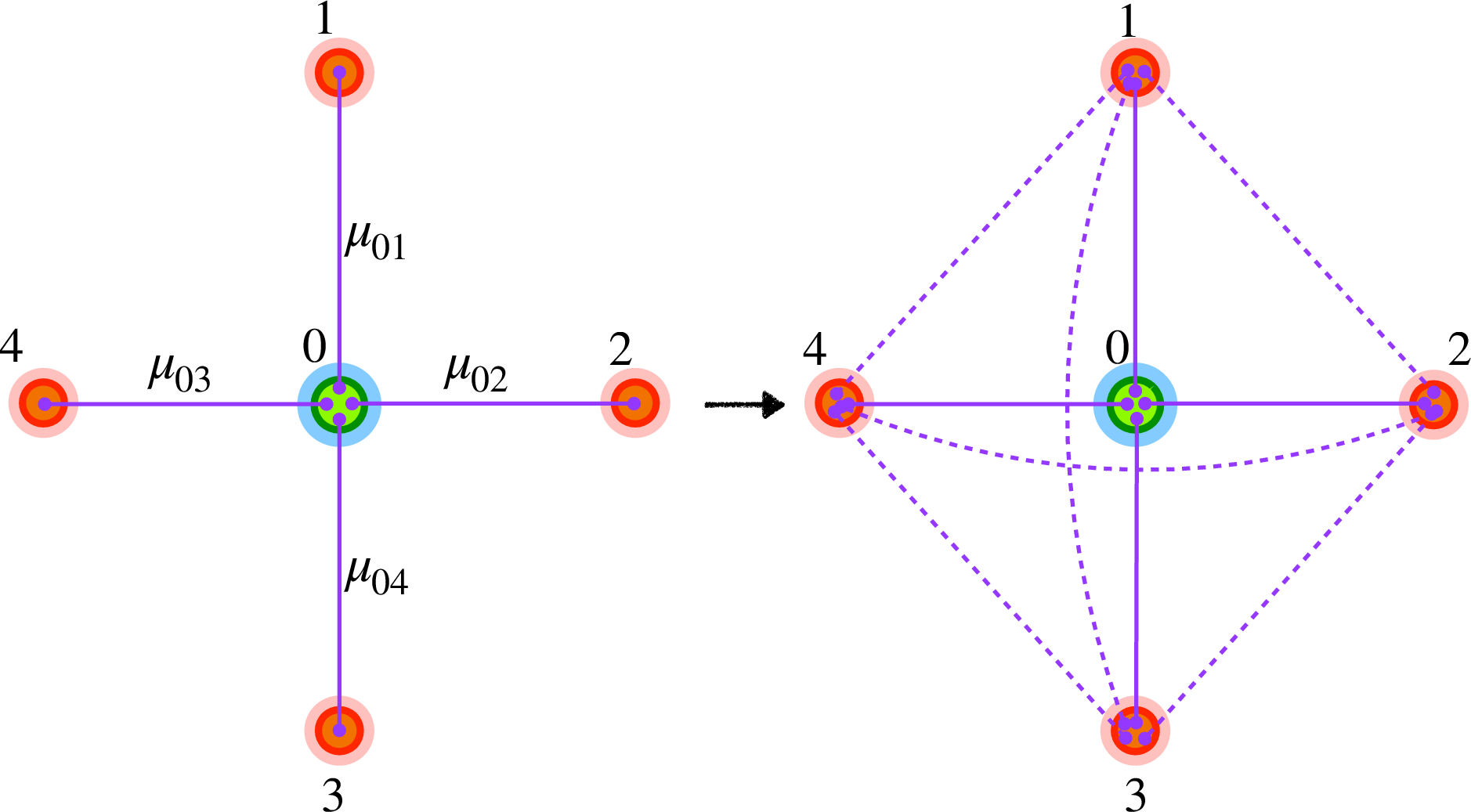
Figure 1: Quantum-enhanced connectivity in a star topology—entanglement swapping at the central node functionally connects the neighbors absent direct physical links, reflected in a non-zero QCC.
For classical networks, the star center has clustering coefficient zero, but in the quantum regime, with suitable entanglement swapping, the QCC becomes nonzero, illustrating the nonlocal enhancement unique to quantum operations.
Analytical Results for Canonical Network Models
The authors derive both closed-form and numerical expressions for QCM and QCF in two regimes: fully connected and random (Erdős–Rényi-type) networks, considering homogeneous (delta-distributed concurrence) and inhomogeneous (uniformly distributed concurrence) edge parameters.
Additionally, insights into the path length distribution in random graphs are provided via the empirical probability mass function:
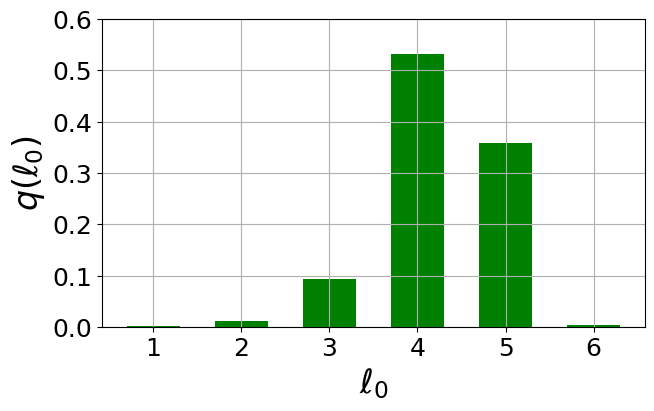
Figure 3: PMF of shortest-path lengths in a random network with QN=∣N∣(∣N∣−1)/21i,j∈N∑Sij Θ[Sij−ϵ]5, QN=∣N∣(∣N∣−1)/21i,j∈N∑Sij Θ[Sij−ϵ]6, informing the simulation and analytic treatment of QCM and QCF.
Spatial Variations and Realistic Quantum Internet Scenarios
Extending from global to local analysis, the QCM is computed regionally for a Waxman-type network model relevant to optical-fiber quantum internets. This reveals strong spatial heterogeneity—some regions permit QIP tasks (high local QCM), while others remain functionally disconnected even under uniformly moderate concurrence (Figure 4). This spatially resolved metric is therefore useful for practical network design, troubleshooting, and deployment strategies.
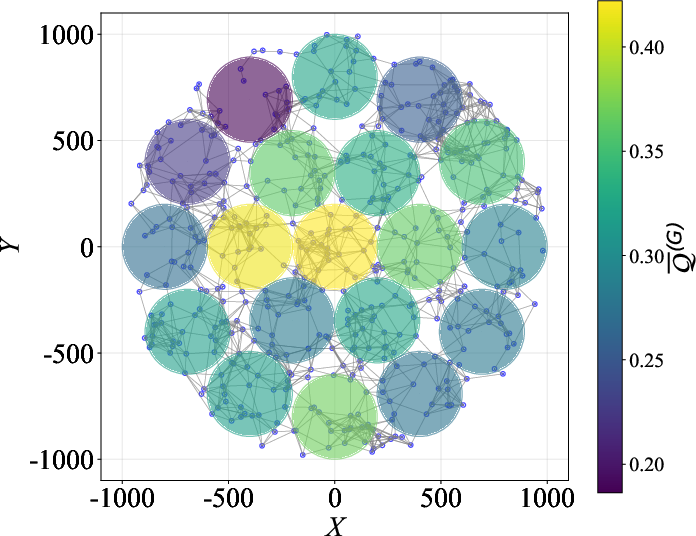
Figure 4: QCM evaluated over spatial partitions in a Waxman network (QN=∣N∣(∣N∣−1)/21i,j∈N∑Sij Θ[Sij−ϵ]7), visualizing regions with sufficient or insufficient entanglement connectivity for a threshold QIP task.
Implications and Future Directions
These quantum connectivity measures (QCM, QCF, QCC) provide actionable tools for benchmarking, design, and optimization of practical quantum communication infrastructures. Explicit distinctions with classical metrics underscore the necessity of protocol- and task-aware analysis. Notably:
- Discontinuities in QCF serve as design targets: modest improvements in edge concurrence can produce step-wise gains in the fraction of usable node pairs, critical for resource allocation.
- Protocol dependence: Since all metrics depend on the entanglement distribution strategy—swapping, purification, multipath routing—protocol development for future QN deployments should be guided by these functional measures.
- Theoretical modeling: The analytic framework allows extension to other graph ensembles, edge parameter distributions, and more elaborate QIP tasks (e.g., multipartite entanglement, secret sharing).
- Benchmarking: For quantum internet standardization, these operationally relevant metrics go beyond topology to support the comparison and certification of disparate network realizations.
Conclusion
This work systematically formulates and characterizes quantum connectivity for quantum networks at both global and local scales, emphasizing the disconnect between topological and functional connectivity due to quantum entanglement constraints and tunable thresholds set by QIP task requirements. The QCM, QCF, and QCC metrics bridge this divide, providing a robust platform for evaluating, designing, and optimizing quantum internet architectures where traditional graph-theoretic notions fail to capture operational realities. The findings have significant implications for future protocol design and for the benchmarking of emergent quantum networks as they progress towards practical deployment.