Quenched Amplification and Tail Shaping in Networked Systems with Memory and Regime Switching
Published 1 May 2026 in stat.OT, math.PR, math.ST, and nlin.AO | (2605.00750v1)
Abstract: Networked systems operating under intermittent adverse conditions and long memory can remain stable on average while exhibiting rare but extreme trajectory-level excursions. We study linear regime-switching network dynamics with Volterra-type memory, formulated through a finite-dimensional lifted ordinary differential equation embedding. Despite finite-horizon annealed boundedness, we show that quenched amplification emerges generically from the interaction of regime persistence, memory accumulation, and non-normal lifted operator geometry. A lower bound on burst-size distributions reveals power-law tails whose exponent is determined by the ratio between unfavorable dwell-time rates and an operator-defined instantaneous growth parameter. This parameter is computable online via the Euclidean logarithmic norm of the lifted operator, yielding a practical early-warning indicator. Building on this structure, we introduce a dynamic data-driven intervention strategy that enforces contraction on demand along rare amplification channels, thereby shaping or truncating tail risk without altering exogenous regime statistics or typical system behavior. The results provide a geometrically grounded and operationally actionable framework for understanding and mitigating extreme events in memory-driven regime-switching systems.
The paper establishes that quenched tail risk arises from the interplay of memory effects, non-normal operator geometry, and regime switching.
It introduces a DDDAS control policy that selectively enforces contraction during elevated risk periods without altering typical regime behavior.
Numerical experiments validate that the dynamic intervention mitigates rare extreme bursts and imposes deterministic finite-horizon tail bounds.
Quenched Amplification, Heavy-Tailed Transients, and Tail Shaping in Networked Systems with Memory and Regime Switching
Overview and Context
The manuscript "Quenched Amplification and Tail Shaping in Networked Systems with Memory and Regime Switching" (2605.00750) provides a comprehensive framework for analyzing and mitigating extreme-event probability in large-scale, linear networked dynamical systems subject to persistent memory effects and intermittent, Markovian regime switching. The key focus is on the emergence of rare, high-impact trajectory-level excursions—phenomena that remain hidden from classical stability and variance-based diagnostics—resulting from the interaction of Volterra-type memory, non-normal operator geometry, and stochastic regime persistence. The authors rigorously establish the separation between annealed (mean) stability and quenched (pathwise) tail risk and propose an operator-theoretic, Dynamic Data-Driven Applications Systems (DDDAS) policy for selective contraction that provably mitigates such extremes.
Mathematical Formulation: Lifted Switched ODEs and Memory Effects
The study considers networked systems whose dynamics, in each Markovian regime, are described by deterministic, memory-augmented ODEs. Memory is encoded by general, completely monotone Volterra kernels, represented via sum-of-exponentials (SOE) for finite-dimensional Markovian embedding, leading to a lifted state-space model of the form: X˙(t)=Az(t)(m(t))X(t)+f(t)
where z(t) is a finite-state CTMC regime process, Az(t)(m(t)) are mode-dependent lifted matrices capturing both instantaneous and memory dynamics, and f(t) is the lifted forcing vector. The system switches its dynamics according to both the exogenous regime process and an endogenous DDDAS control policy that intervenes based on computable operator-based indicators.
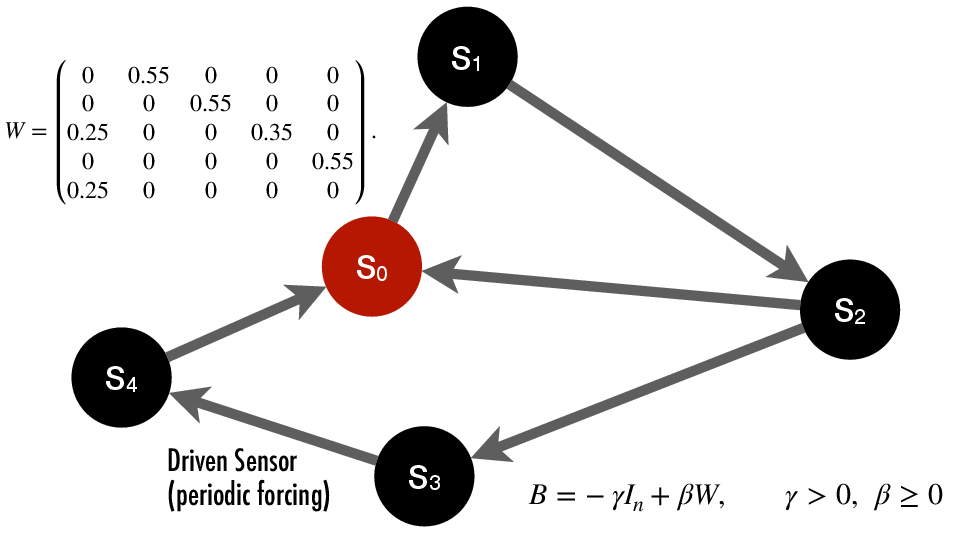
The underlying network is represented by a directed weighted graph, leading to non-normal coupling structures in the instantaneous matrix B, augmented with SOE-based memory accumulation and decay.
Figure 1: Illustrative directed sensor network used in the experiments, emphasizing the structured memory-augmented operator with non-normal amplification geometry.
Annealed Stability and Pathwise Tail Risk: Analytical Mechanism
A foundational result is that, under mild assumptions (bounded-forcing, piecewise-constant operators, finite-dimensional lifting), the system remains annealed-bounded on any finite time horizon: all moments of ∥X(t)∥ remain finite, and typical trajectories exhibit stable, periodic, or bounded oscillations. However, this ensemble-level stability is fundamentally disconnected from pathwise extremes—rare trajectories where coherent memory accumulation and persistent exposure to the unfavorable regime generate heavy-tailed bursts.
Central to the analysis is the identification of a growth channel in the lifted space, characterized by the Euclidean logarithmic norm (matrix measure) of the current operator: S(t)=λmax2Az(t)(m(t))+(Az(t)(m(t)))⊤
which acts as an instantaneous susceptibility diagnostic and a theoretically-justified early warning signal. Memory alignment, measured by latent load
L(t)=∑k∥yk(t)∥2
further signals the system’s proximity to hazardous amplification configurations.
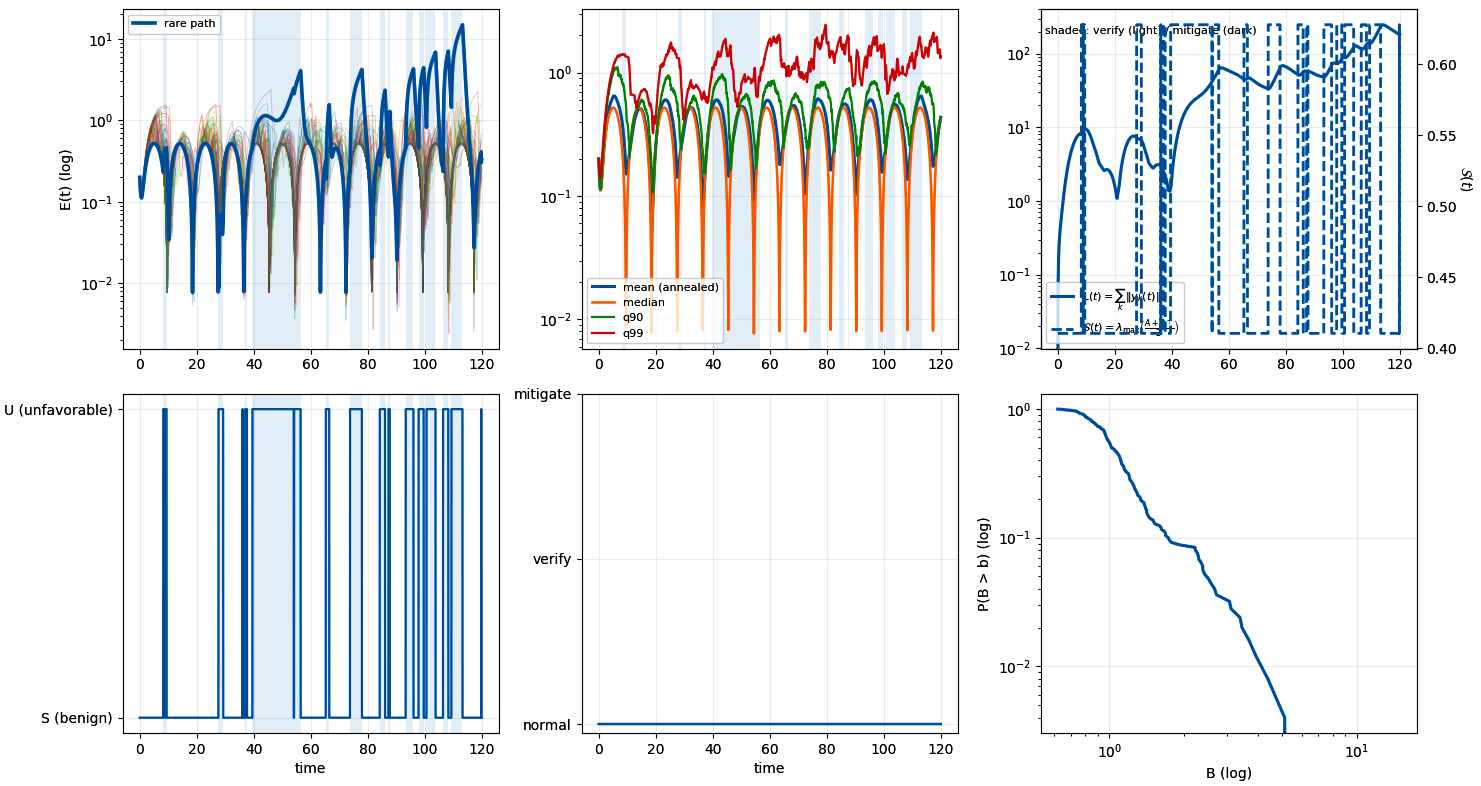
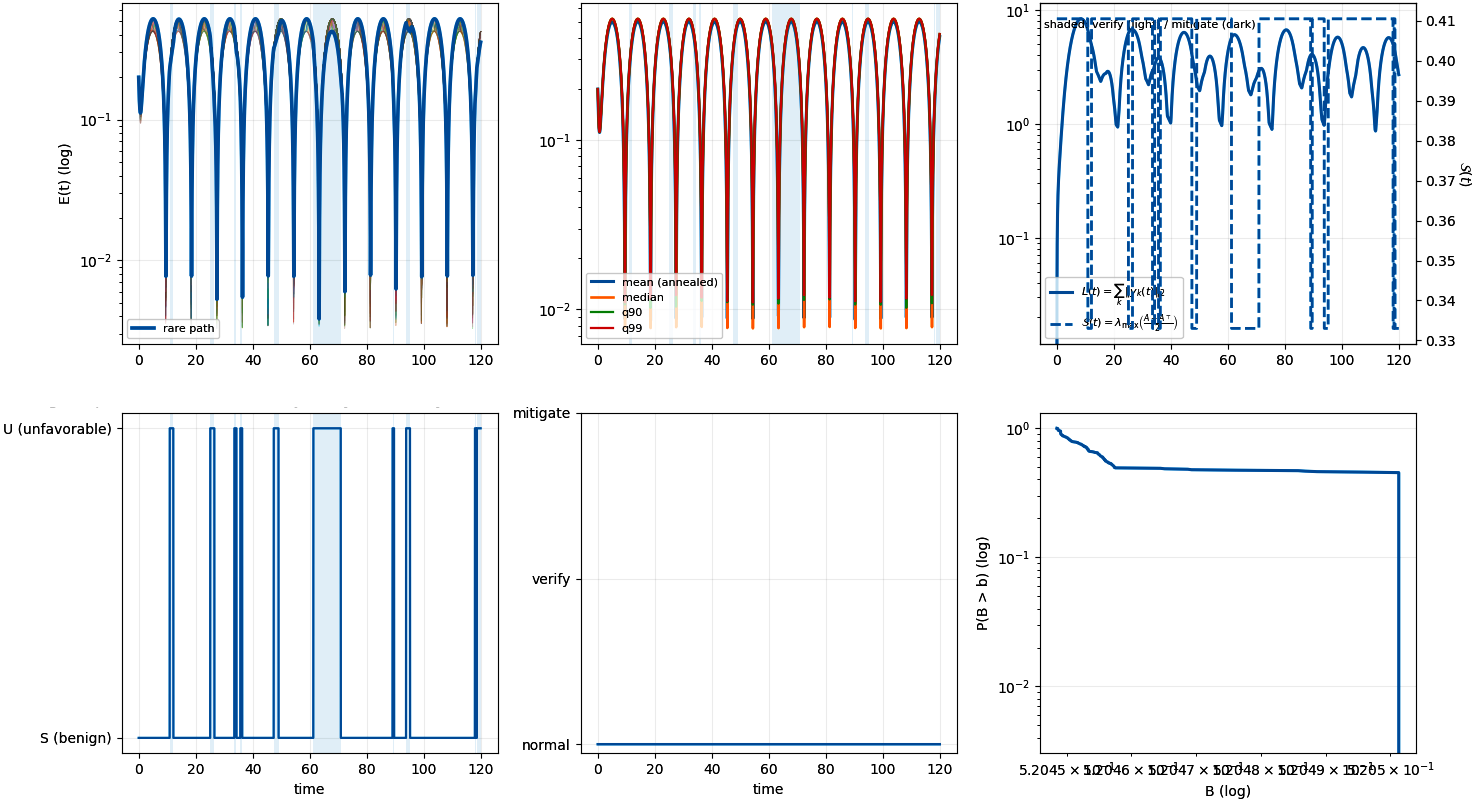
Figure 2: Without interventions, memory-induced accumulation during unfavorable regimes produces rare bursts in energy, with ensemble-averaged quantities failing to capture tail risk.
The authors provide a lower bound on the complementary CDF of the burst-size observable BT=supt≤T∥x(t)∥2: P(BT>b)≳Cb−λU/γU
where z(t)0 is the (Markov) unfavorable regime exit rate and z(t)1 the effective lifted growth rate during z(t)2-dwells. The exponent is structurally predicted, independent of empirical tail fitting, and operationally computable from regime and operator data.
Dynamic Data-Driven Applications Systems (DDDAS) Policy: Tail Shaping by On-Demand Contraction
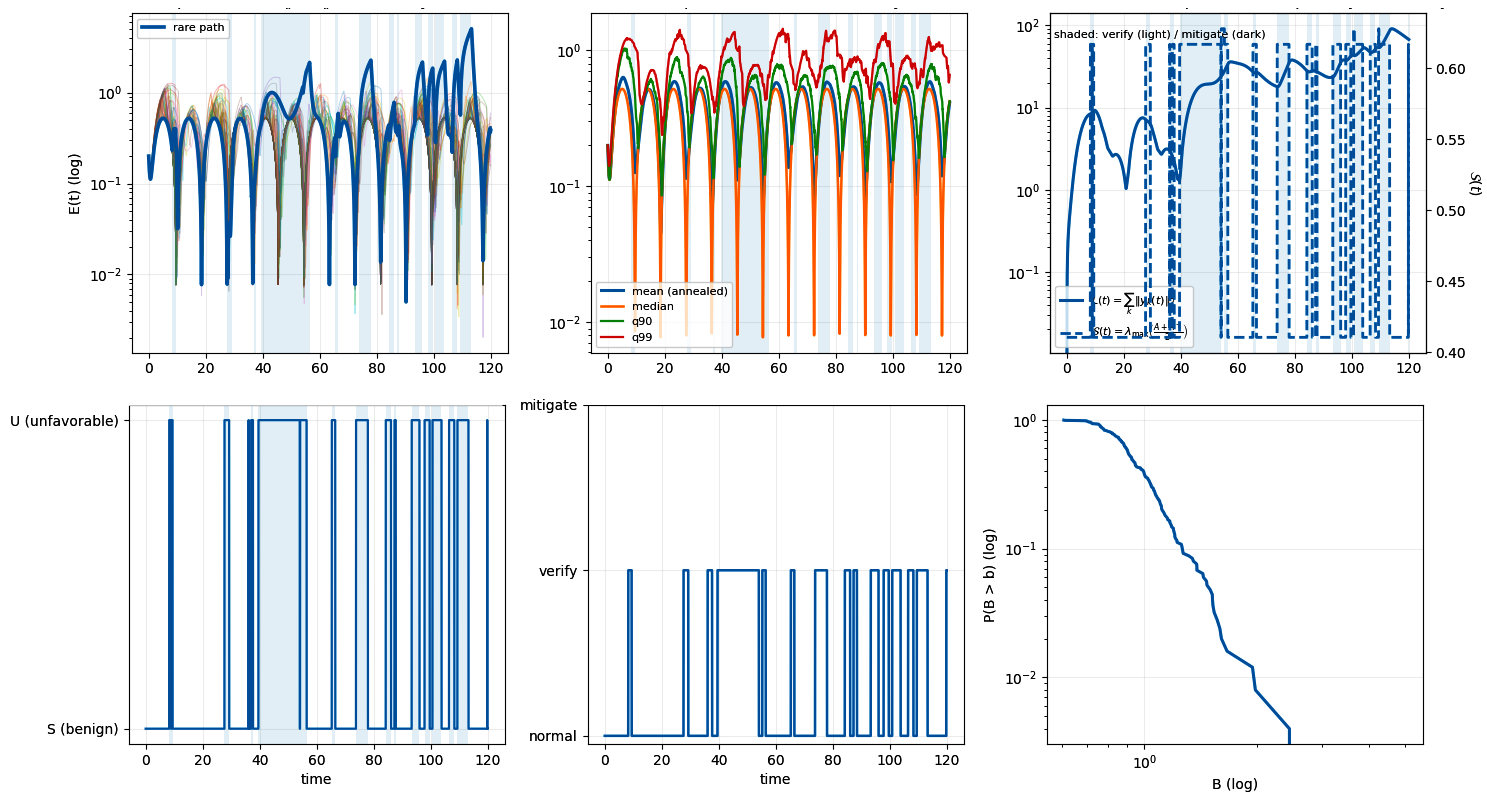
The paper introduces an active, indicator-triggered control strategy (DDDAS), which monitors z(t)3 with hysteresis and minimum dwell-time constraints. Upon detection of elevated tail risk (i.e., when either indicator crosses a fidelity threshold), the policy switches system dynamics to a more contractive lifted operator.
Crucially, the exogenous regime process remains unaffected, so tail mitigation occurs without biasing typical behavior or dwell statistics. The theoretical analysis shows that, under enforced strict contraction during mitigation windows, the burst-size distribution acquires a deterministic finite-horizon bound, i.e., the probability of exceeding a threshold z(t)4 is identically zero: z(t)5
In less aggressive settings, DDDAS steepens the tail slope (i.e., increases the effective exponent) without complete truncation, corresponding quantitatively with observed CCDF behavior.
Figure 3: The DDDAS policy suppresses rare amplification events by enforcing contraction only during periods of elevated operator-susceptibility and memory load.
Experimental Validation and Comparative Tail Analysis
The numerical investigations systematically validate all analytical claims. SOE-lifted ODE simulations of non-normal directed networks with periodic injection and Markovian switching reveal:
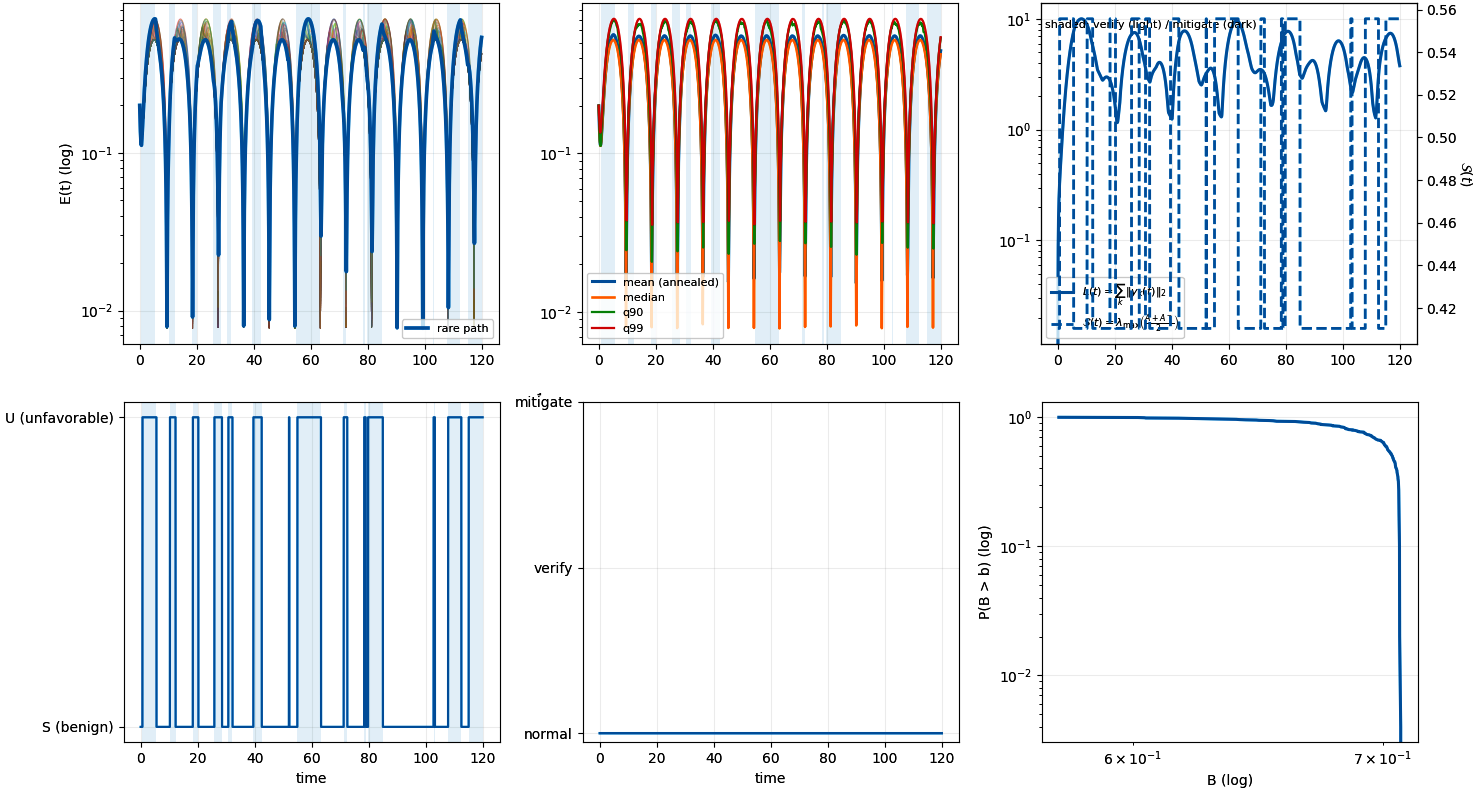
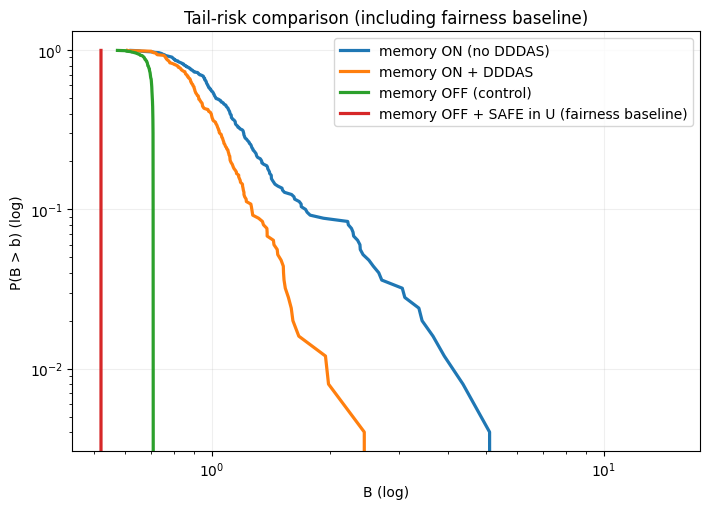
Persistent memory and regime persistence are necessary for unbounded tail risk. When memory is inactive (all z(t)6), regime-switching alone does not produce heavy-tailed bursts.
In the uncontrolled, memory-activated scenario, power-law tails with slopes predicted by z(t)7 emerge.
Under DDDAS control, extreme events are strongly suppressed, with substantial reduction in both the frequency and magnitude of rare bursts, as quantified by ensemble CCDFs.
Figure 4: Memory OFF baseline, demonstrating the necessity of long memory for the emergence of heavy tails under regime persistence.
Figure 5: SAFE-in-U baseline, which structurally eliminates tail risk at the cost of over-damping and distortion of regime statistics.
Quantitative CCDF slope estimation confirms alignment with the operator-based theoretical exponent in all cases.
Figure 6: Empirical comparison of burst-size CCDFs across strategies shows DDDAS achieves tail risk reduction comparable to the over-damped SAFE-in-U baseline, preserving the original regime statistics.
Discussion and Theoretical Implications
The work identifies the core mechanism behind extreme-event amplification as the interaction of (i) regime persistence, (ii) non-normal/memory-induced amplification geometry, and (iii) memory alignment, formalized in the lifted operator space. Unlike prior results derived for stochastic recursions or multiplicative noise [Kesten-Goldie, e.g.], this mechanism is realized in fully deterministic, piecewise-linear ODEs driven only by regime path randomness and bounded forcing.
The key contributions include:
A deterministic, operationally computable tail exponent, not dependent on empirical fitting or auxiliary model classes.
Pathwise tail mitigation not by biased regime design or static over-damping, but via adaptive, indicator-triggered contraction, with minimal effect on typical behavior.
Generalization of non-normal growth theory to the memory-augmented, lifted state space, providing early-warning signatures and diagnostic indicators with direct practical utility.
A general framework for rigorous, scalable estimation of tail behavior and control effectiveness.
Future Directions
The foundational operator-lifting approach invites several extensions:
Nonlinear memory or switching rules, where memory states modulate the regime process or feedback is state-dependent.
Multi-regime or multi-channel unfavorable states, with interacting memory and non-normal amplification structures.
Data-driven real-time estimation of z(t)8 and z(t)9 for real-world monitoring and adaptive intervention.
Extension to broader classes of distributed, partially observed, or underactuated networked systems.
Conclusion
This study delivers an operator-theoretic, control-relevant framework for the understanding and mitigation of rare high-impact excursions in networked dynamical systems with long memory under Markov regime switching. By rigorously distinguishing annealed from quenched behavior, defining computable early-warning diagnostics, and demonstrating the efficacy of selective, data-driven control policies for tail shaping, the work sets a new methodological standard for handling extreme transient risk within linear systems subject to memory and regime uncertainty.