- The paper demonstrates a novel annealed–quenched dichotomy where expected (annealed) stability coexists with sample-path burst amplification.
- It models network dynamics using operator-valued Volterra equations with regime-dependent memory kernels modulated by a finite-state Markov process.
- Numerical experiments confirm that stronger memory effects and specific network topologies amplify rare, heavy-tailed instabilities.
Intermittency and Stability in Memory-Driven Switching Dynamical Systems
Overview
The paper "Intermittency induced by long memory under stochastic regime switching" (2605.00729) presents a rigorous analytical and numerical investigation of instabilities and extreme fluctuations ("intermittency") in nonlinear, network-coupled dynamical systems governed by both (i) long-range fractional memory and (ii) stochastic regime switching. Specifically, the dynamics are modeled as operator-valued Volterra evolutions with fully monotone memory kernels, where excitation operators and kernel parameters are dynamically modulated by a finite-state ergodic Markov process. The principal innovation is in demonstrating an annealed–quenched dichotomy: stability in expectation (annealed sense) can coexist with pathwise, sample-dependent growth and intermittent burst amplification (quenched sense), a phenomenon without direct analogue in purely Markovian or deterministic settings.
The central object of study is a network dynamical system evolving on a Hilbert product space, where the state U(t) is governed by a non-Markovian Volterra equation with regime-dependent kernels and operators: U′(t)=BU(t)+∫0tGZ(t)(t−s)U(s)ds+FZ(t),U(0)=U0.
Here:
- B is a dissipative operator,
- GZ(t) encodes regime-dependent excitation (operator and kernel),
- Z(t) is a finite-state Markov chain,
- Forcing FZ(t) and the memory kernel gZ(t)(t) both depend on the current regime.
The model naturally captures applications from neural systems with spike-history effects and financial volatility clustering, to networked epidemics and climate regime shifts.
Well-Posedness and Regularity
A first technical achievement is establishing well-posedness: for every realization of Z(⋅), the system admits a unique, continuous mild solution, with continuous dependence on initial conditions. This step is nontrivial due to the loss of a finite-dimensional Markov property when the memory kernel couples to the switching process; solutions require evolution in an infinite-dimensional state space, a consequence of the non-local nature of memory and stochastic switching.
Annealed Stability versus Quenched Growth
The core dichotomy in the paper is between annealed (expected, or moment-based) and quenched (sample-path or almost sure) behavior.
Annealed Stability: Averaged Memory Gain
By defining a regime-dependent memory gain ρz:=∥Az∥Gz (with Gz the kernel mass) and its stationary average U′(t)=BU(t)+∫0tGZ(t)(t−s)U(s)ds+FZ(t),U(0)=U0.0, the paper proves that a sharp stability criterion emerges: if U′(t)=BU(t)+∫0tGZ(t)(t−s)U(s)ds+FZ(t),U(0)=U0.1 is subcritical relative to the dissipativity margin (formally, U′(t)=BU(t)+∫0tGZ(t)(t−s)U(s)ds+FZ(t),U(0)=U0.2 for U′(t)=BU(t)+∫0tGZ(t)(t−s)U(s)ds+FZ(t),U(0)=U0.3 with dissipation constant U′(t)=BU(t)+∫0tGZ(t)(t−s)U(s)ds+FZ(t),U(0)=U0.4), then moment and mean-square expectations are uniformly controlled, with explicit Lyapunov functionals that incorporate the memory-induced energy. This extends classical Lyapunov and branching-parameter criteria from Markovian and memoryless systems to this operator-valued, nonlocal context.
Quenched Amplification: Heavy-Tailed Intermittency
Contradicting the naive expectation that annealed stability entails pathwise stability, the analysis shows that quenched, sample-dependent paths can experience rare, long-lasting excursions into supercritical (unstable) regimes, which, when amplified by persistent memory, yield extreme "bursts". This mechanism—where rare sojourns in the unstable regime are magnified through memory—gives rise to heavy-tailed statistics in the distribution of burst amplitudes, and, more formally, to a deterministic quenched growth exponent characterized via a subadditive ergodic theorem. Notably, there exist parameter windows where annealed stability and quenched instability coexist.
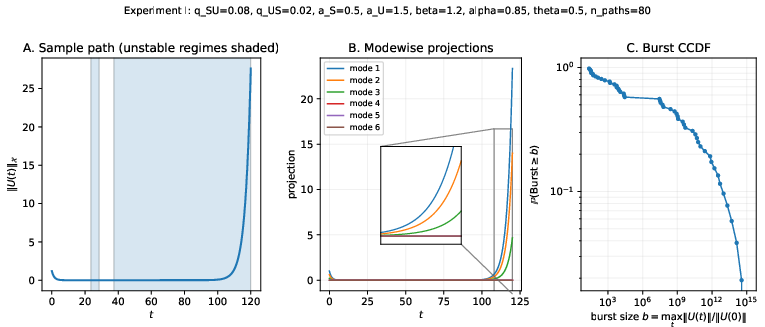
Figure 1: Representative path of state norm under two-regime switching, with burst amplification localized to long unstable sojourns.
Numerical Experiments and Mechanistic Insights
The paper provides an extensive suite of numerical experiments, using Monte Carlo simulations of discretized Volterra evolution on networks with varying topology, kernel memory, and switching statistics.
Memory-Driven Intermittency and Parameter Dependence
By varying the memory exponent U′(t)=BU(t)+∫0tGZ(t)(t−s)U(s)ds+FZ(t),U(0)=U0.5 (fractional order) and tempering parameter U′(t)=BU(t)+∫0tGZ(t)(t−s)U(s)ds+FZ(t),U(0)=U0.6 of the kernel, the experiments demonstrate that stronger memory and weaker tempering broaden burst tails and increase typical growth rates, even when mean trajectories remain moderate, confirming the theoretical prediction of intermittency windows.
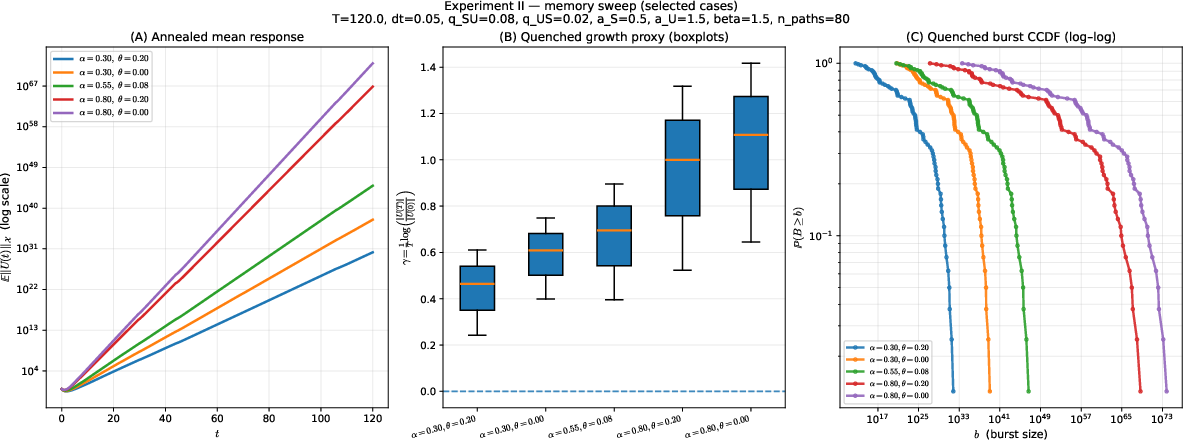
Figure 2: Heavier memory increases burst probability and growth, shifting the distribution of finite-horizon growth proxies to positive values, even when annealed responses are bounded.
A phase diagram sweeping the switching rates U′(t)=BU(t)+∫0tGZ(t)(t−s)U(s)ds+FZ(t),U(0)=U0.7 reveals a band structure: a region where moments are bounded yet the probability of large bursts remains nontrivial.
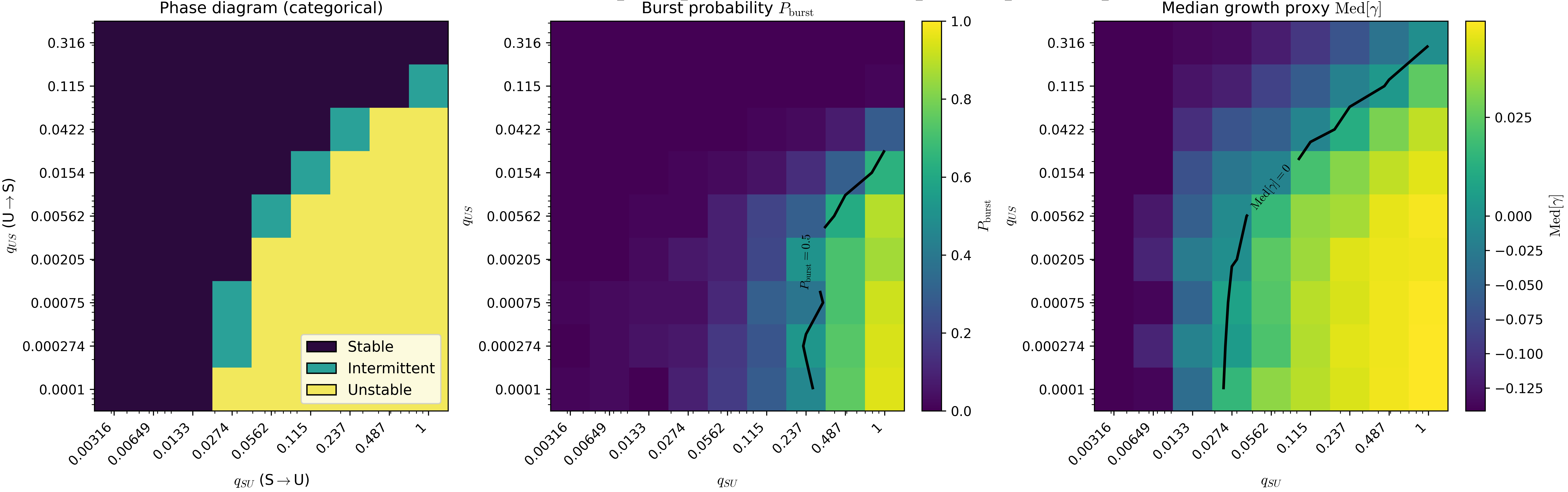
Figure 3: Switching-rate phase diagram: the intermittent regime appears where annealed summaries remain bounded, but burst probabilities and growth proxies are positive—a direct signature of the annealed–quenched separation.
Effect of Network Structure and Noncommutativity
The effect of operator noncommutativity is analysed: even when the excitation operators do not commute with the network Laplacian or each other, burst amplification persists, but the modal structure of bursts is altered—bursts are no longer aligned with a single Laplacian mode but remain concentrated in a low-dimensional subspace.
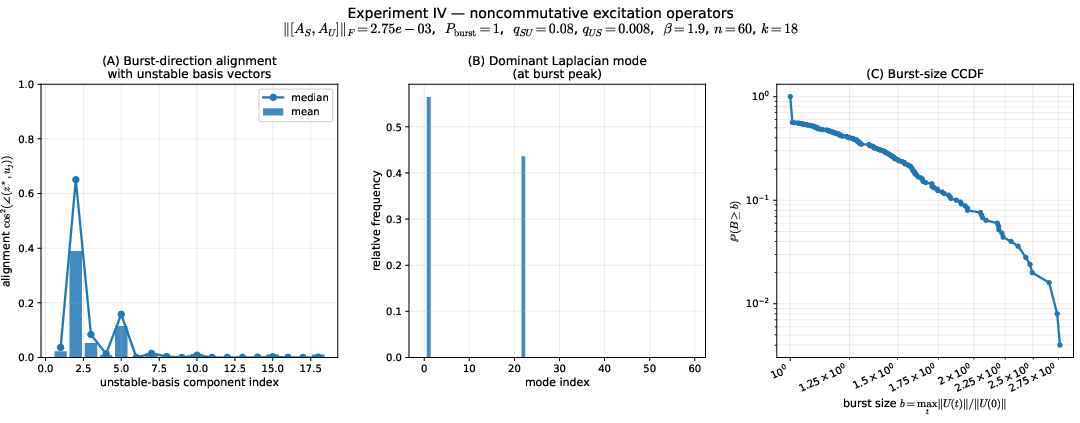
Figure 4: When excitation operators are noncommuting, mode mixing occurs, yet burst directions remain concentrated and heavy-tailed dynamics persist.
A systematic investigation of network geometries (ring, star, Erdős–Rényi, small-world) and sizes shows that network topology primarily modulates the spatial concentration of bursts (IPR scaling), with dominant spectral activation typically in intermediate bands.
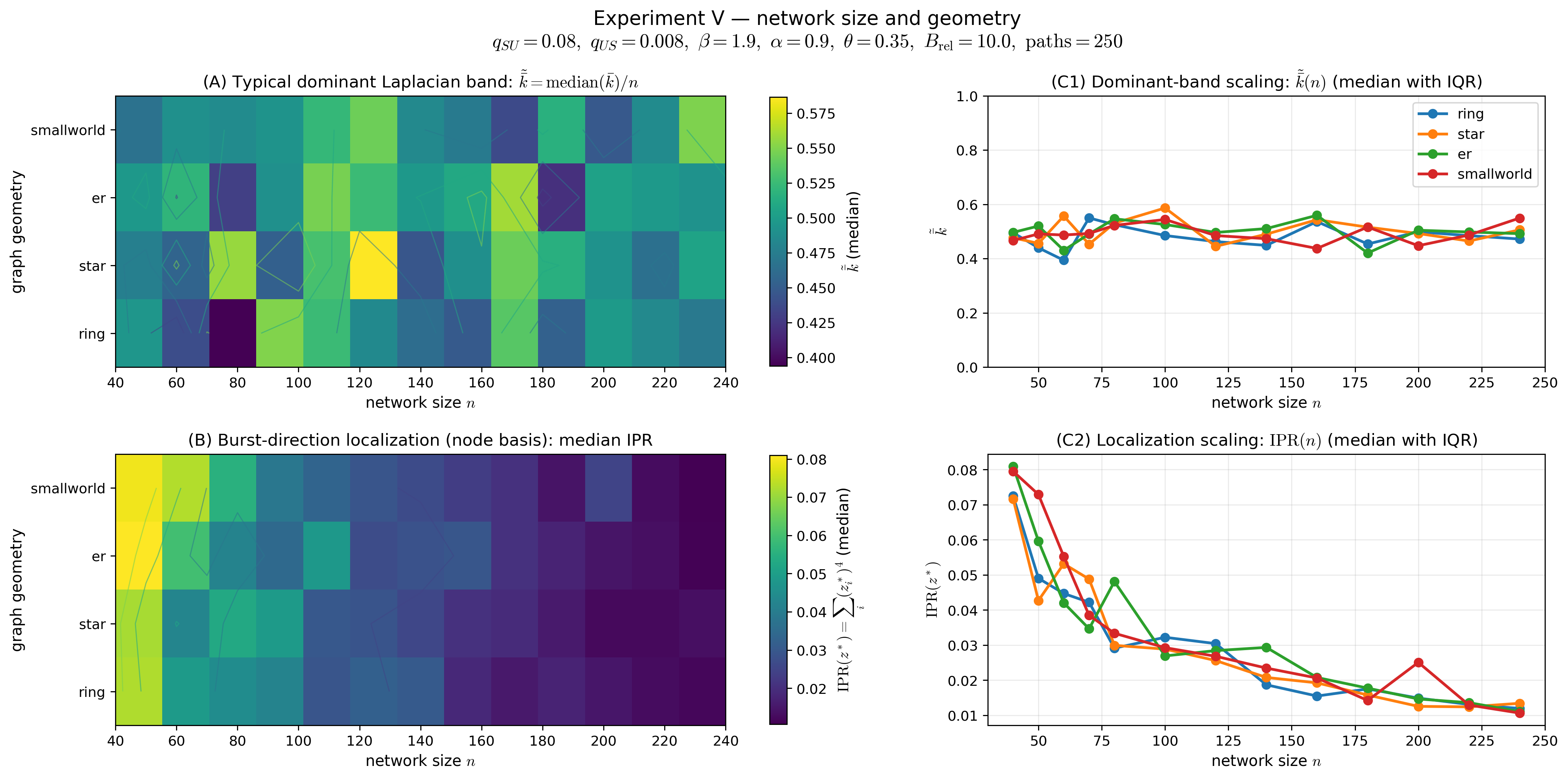
Figure 5: Network topology modulates spatial burst localization, with dominant spectral activation in intermediate Laplacian bands.
Microscopic–Macroscopic Correspondence under Switching
An essential part of the framework is showing that the macroscopic Volterra limit considered arises as the limit of a population of regime-modulated self-exciting Hawkes processes (with the parameters also driven by U′(t)=BU(t)+∫0tGZ(t)(t−s)U(s)ds+FZ(t),U(0)=U0.8). Both annealed and quenched convergence hold: heavy-tailed burst amplification is faithfully inherited from the microscopic process to the macroscopic Volterra evolution, even along rare environment paths where bursts are pronounced.
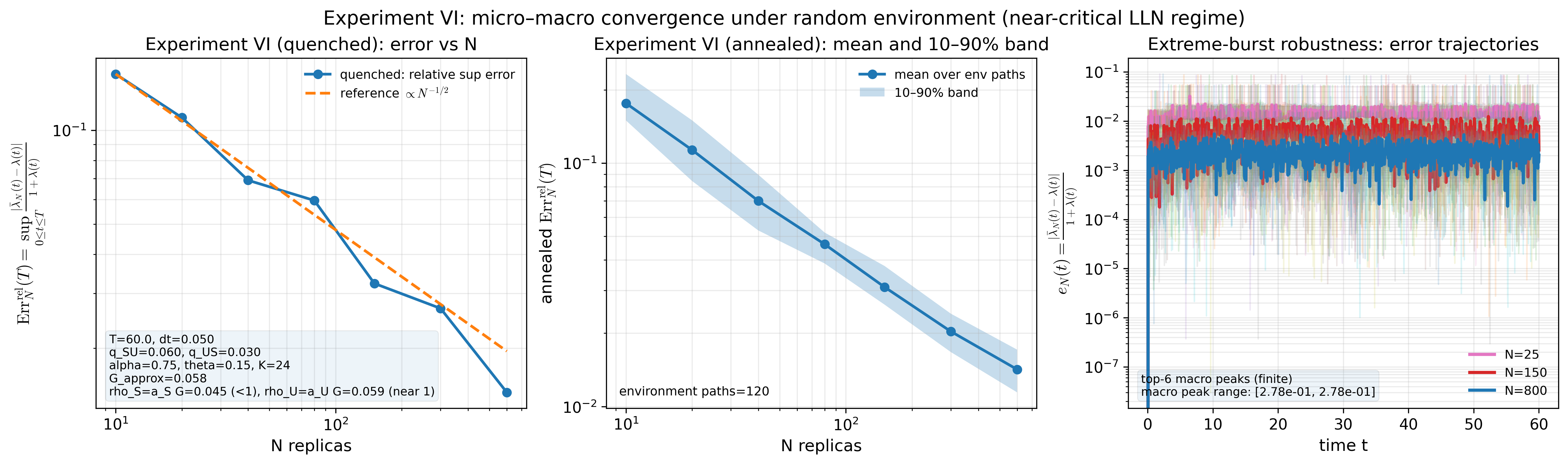
Figure 6: Relative discrepancy between empirical Hawkes mean and Volterra limit diminishes with system size, validating the quenched and annealed micro–macro correspondence even during strong bursts.
Practical and Theoretical Implications
This analysis has significant implications for risk assessment and modeling in high-dimensional and networked systems with heterogeneous, random environments. The demonstration that annealed summaries fail to capture the true sample-path risk profile indicates that expectation-based criteria (e.g., for stability or safety) may be non-conservative in systems with strong memory and switching. These findings warrant a dual approach, where both annealed and quenched metrics are employed in assessing dynamical risk.
From a theoretical perspective, the results motivate further investigations into:
- Sharper characterization of intermittency thresholds via large-deviation approaches and occupation-measure statistics.
- Extension to nonlinear feedbacks, state-dependent switching, or non-Markovian environments.
- Data-driven identification of fractional gains and risk windows in empirical settings.
Conclusion
This work establishes a rigorous analytical and experimental foundation for understanding how the interplay of long-range memory and stochastic switching creates fundamental instability mechanisms in networked dynamical systems. By quantifying the sharp separation between annealed stability and quenched intermittency, and showing its inheritance from microscopic Hawkes dynamics to macroscopic Volterra flows, the paper elucidates both the necessity of memory-aware stability metrics and the generic emergence of heavy-tailed burst amplification in complex, regime-driven dynamical networks.

