- The paper introduces PILIR, a hybrid framework that decouples discrete grid encoding from continuous feature synthesis to overcome spectral bias in PDE solving.
- It employs a neural operator to fuse local latent vectors with spatial offsets, effectively reconstructing high-frequency and multi-scale field details.
- Experimental results demonstrate significant L2 error reduction, improved spectral fidelity, and robustness to coarse grid resolutions across diverse PDE benchmarks.
Motivation and Context
Physics-Informed Neural Networks (PINNs) have emerged as a mesh-free paradigm for solving partial differential equations (PDEs) using deep learning. Yet, one of the most significant architectural limitations of PINNs is their pronounced spectral bias: standard MLPs converge more rapidly to low-frequency solution components, typically failing to resolve high-frequency or multi-scale features efficiently. This frequency principle restricts fidelity in scientific computing tasks where fine detail is essential, such as in oscillatory or turbulent systems.
Efforts to mitigate spectral bias have included coordinate embeddings (e.g., Fourier transforms), modified activations (e.g., wavelet functions), and architecture innovations (e.g., Kolmogorov-Arnold Networks). Grid-embedded methods, which encode local context at discretized grid points, have also been proposed. However, these overwhelmingly use deterministic interpolation (e.g., bilinear), which enforces convex hull constraints and introduces artificial numerical viscosity, limiting their ability to recover sub-grid-scale high-frequency phenomena.
PILIR Architecture: Discrete-Continuous Synthesis
The Physics-Informed Local Implicit Representation (PILIR) framework consists of three principal stages: domain discrete encoding, continuous feature synthesis, and physical decoding. The workflow divides the input domain into a coarse but learnable grid of feature vectors, which are subsequently synthesized into continuous field representations via a neural operator.
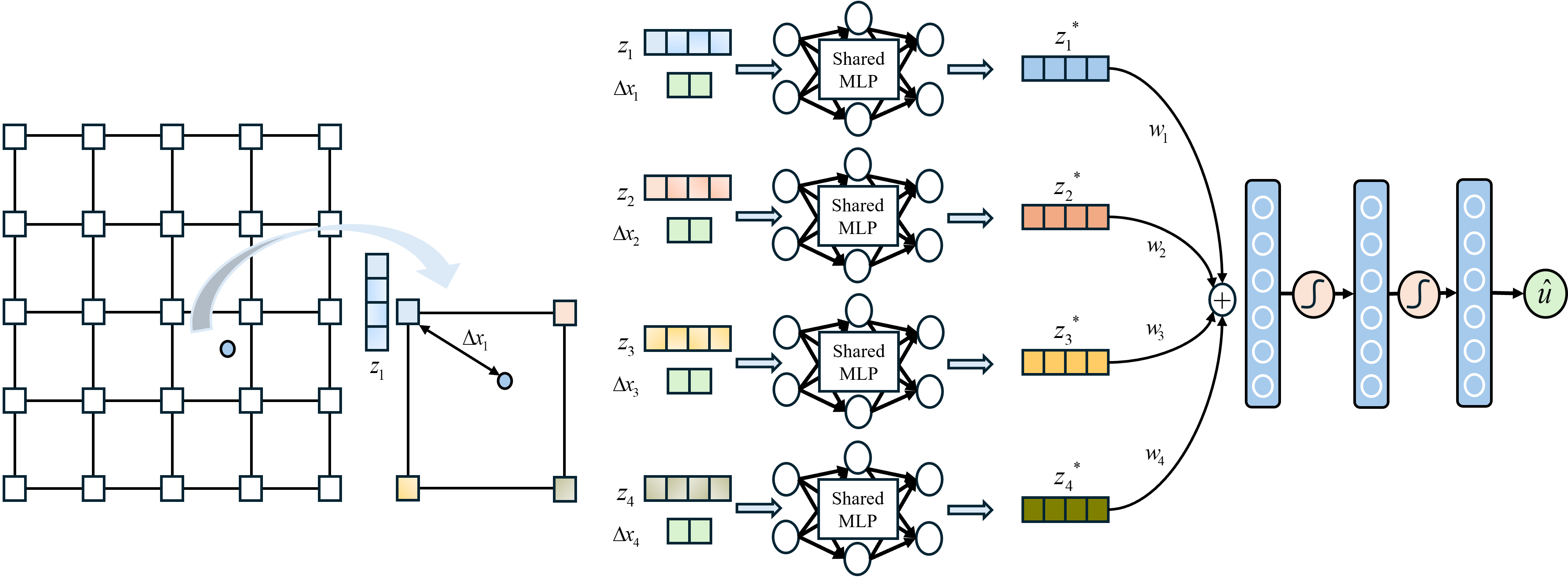
Figure 1: The architectural workflow of PILIR, including discrete grid encoding, neural feature synthesis, and physical decoding for continuous field recovery.
Domain Discrete Encoding
The physical domain is partitioned into a structured grid, with each vertex parameterized by a latent vector. These feature vectors capture local context and are optimized jointly with the rest of the network. Unlike multiresolution approaches, PILIR utilizes a single-resolution grid, relying on its subsequent synthesis stage to reconstruct sub-grid variations and thus limit parameter bloat.
Continuous Feature Synthesis
For any query coordinate x, the system locates the enclosing grid voxel and collects latent descriptors from its 2d neighbor vertices. It computes relative offsets to allow translation invariance. Each neighboring feature vector, together with this offset, is decoded via a local MLP-based neural operator, yielding feature contributions specific to the local geometric context.
These contributions are then fused using spatial weights (e.g., bilinear or cosine-based for C∞ continuity across voxel boundaries). Crucially, PILIR applies these weights to nonlinearly decoded features, not raw latent vectors, shifting away from the convex hull limitation of deterministic interpolation and allowing reconstruction to escape linear artifacts and recover high-frequency, nonlinear field structure.
Physical Decoding
The synthesized continuous representation is mapped into the target physical field (e.g., velocity, pressure) through a shallow task-specific MLP. This final prediction is used in the standard physics-informed PDE loss, as in traditional PINN, and the entire model—including both discrete features and neural operators—is trained end-to-end via gradient descent.
Experimental Evaluation
PILIR is benchmarked against canonical and state-of-the-art PINN variants, including PINN (vanilla), PINN-Wavelet, PIXEL, PIG, MSPINN, and PIKAN, across a spectrum of challenging PDEs: oscillatory Helmholtz equations (2D/3D), multi-scale Allen–Cahn, convection, reaction–diffusion, and incompressible Navier–Stokes.
The primary metric is the relative L2 error of the predicted solution with respect to the ground truth field.
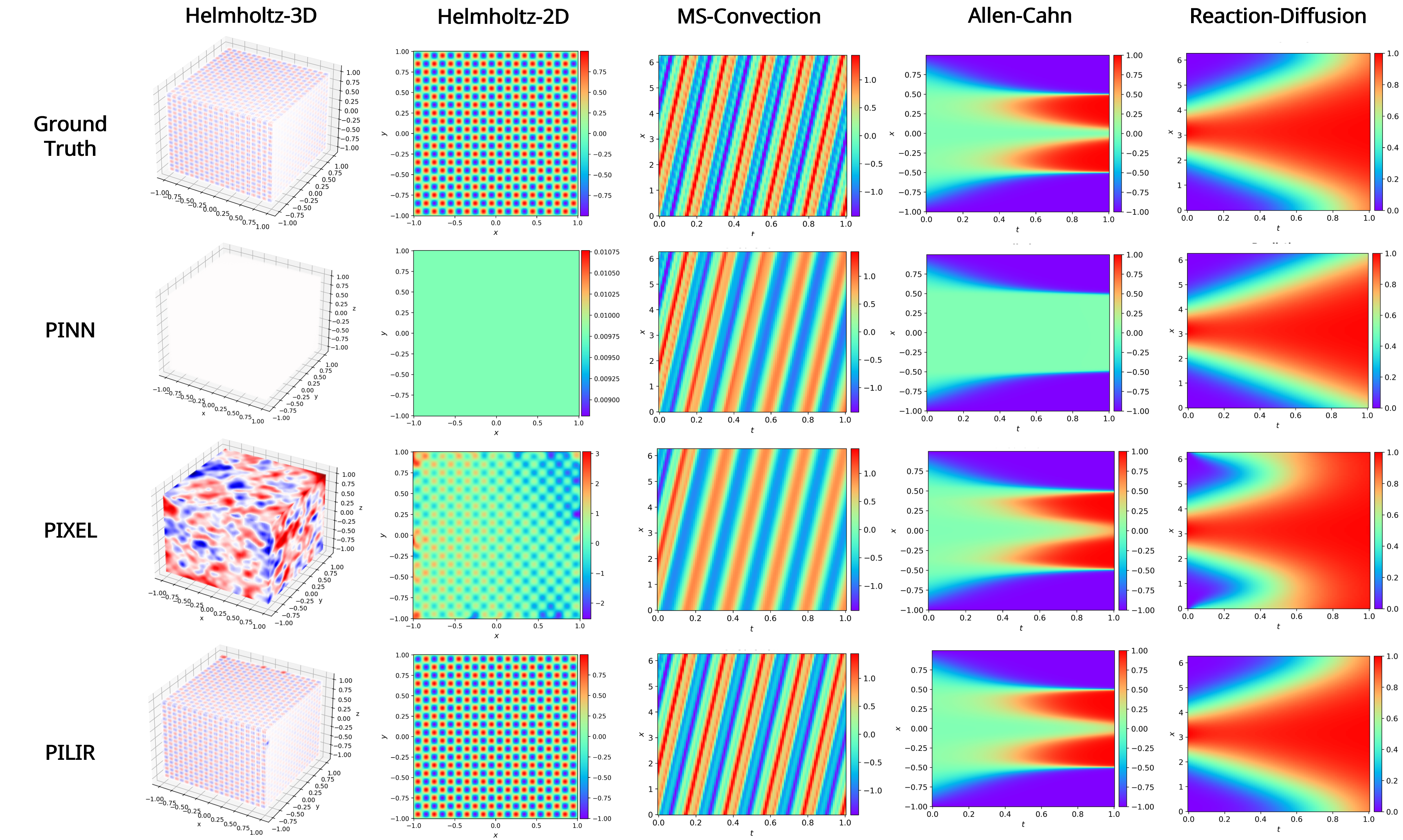
Figure 2: Visual comparison of field reconstructions for the ground truth, standard PINN, PIXEL, and PILIR under diverse PDE settings.
Spectral and Spatial Fidelity
PILIR consistently demonstrates lower L2 error on both forward and inverse PDE problems, with especially pronounced improvements for equations exhibiting high-frequency or multi-scale behavior.
Spectral analyses (using FFT) confirm that PILIR recovers high-frequency solution components that are often absent or incorrectly scaled in traditional PINN, PIXEL, or wavelet-augmented models.
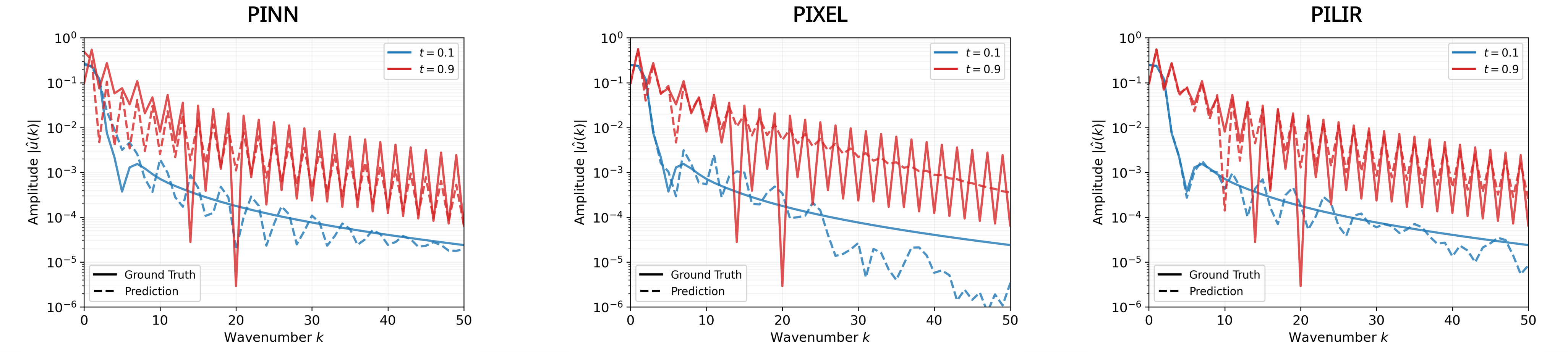
Figure 3: Spectrum analysis for the Allen–Cahn equation, showing PILIR's superior recovery of high-frequency solution modes.
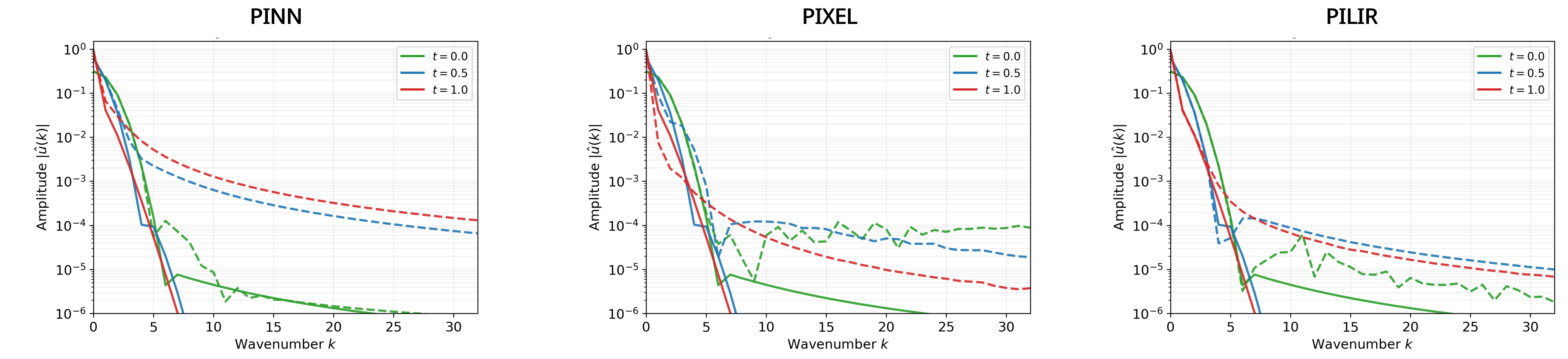
Figure 4: Spectrum analysis for the reaction–diffusion equation, highlighting PILIR's ability to avoid false high-frequency artifact generation present in baseline methods.
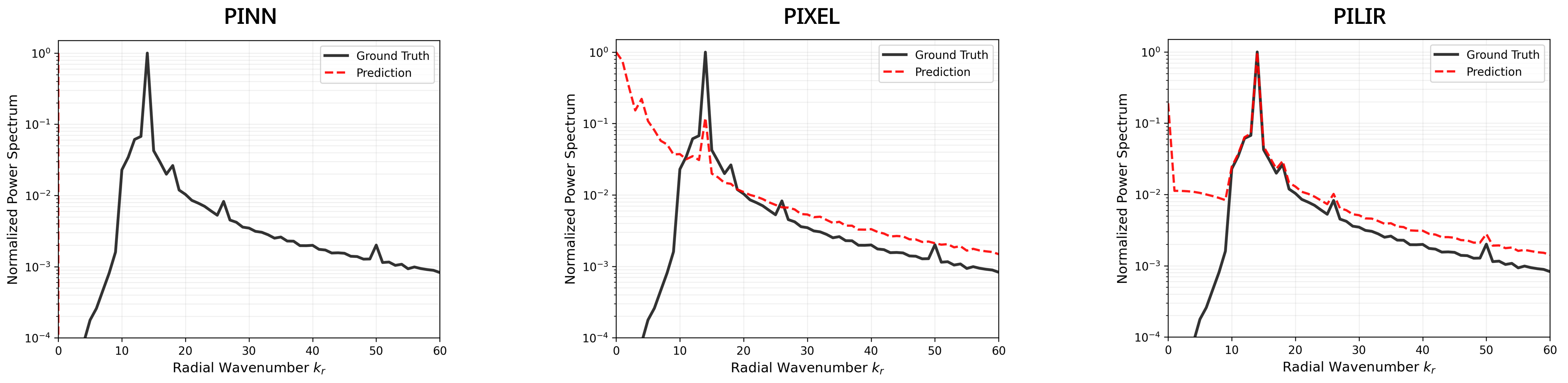
Figure 5: Spectral decomposition on the Helmholtz equation, further evidencing PILIR's superior accuracy in dominant high-frequency regions.
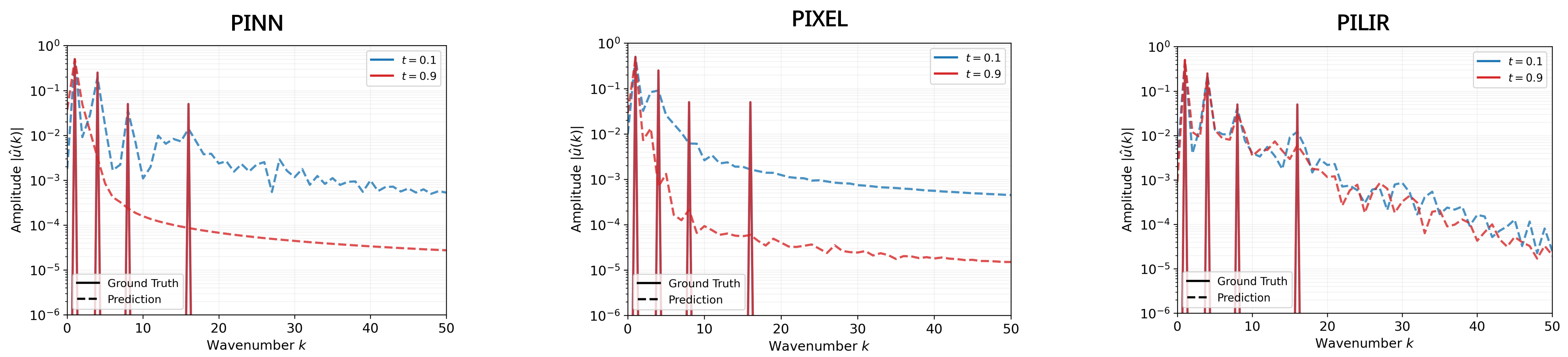
Figure 6: Spectral analysis on the multi-scale convection equation, showing faithful retention of multi-scale frequency details at late simulation times.
Inverse Problems and Physics Consistency
For inverse PDE problems, such as the 2D incompressible Navier-Stokes equation, PILIR reconstructs both flow fields and unknown coefficients with enhanced precision relative to baselines. Importantly, derived quantities like pressure gradients and vorticity manifest considerably more accurate spatial structure, with PILIR capturing finer features absent from other methods.
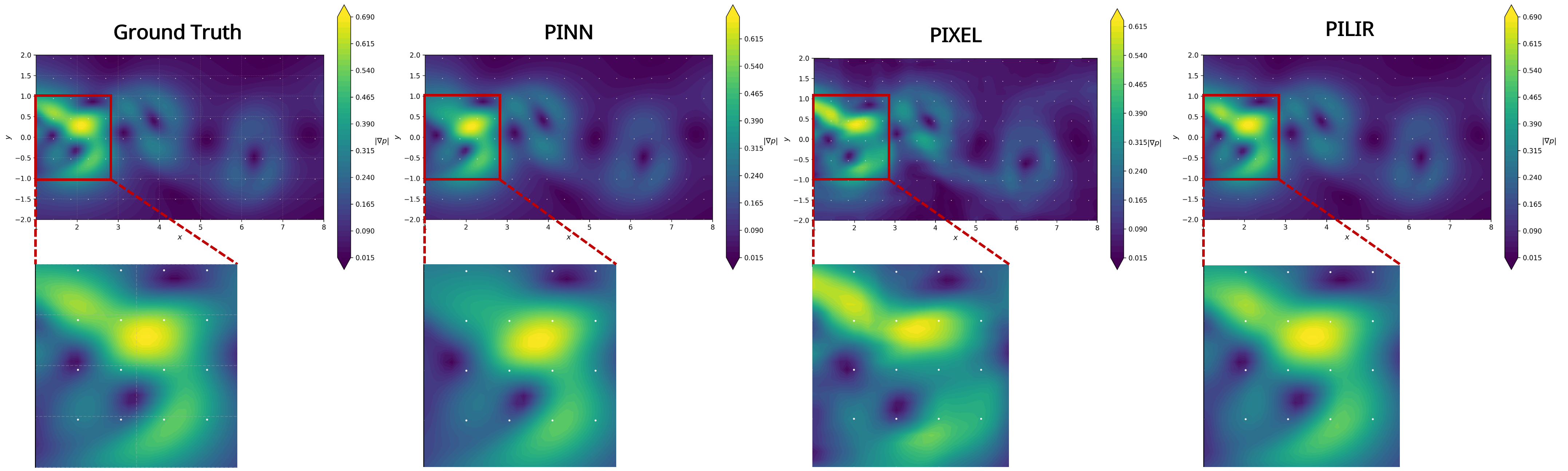
Figure 7: Comparison of pressure gradient magnitudes for Navier–Stokes solutions, with PILIR capturing intricate pressure structures.
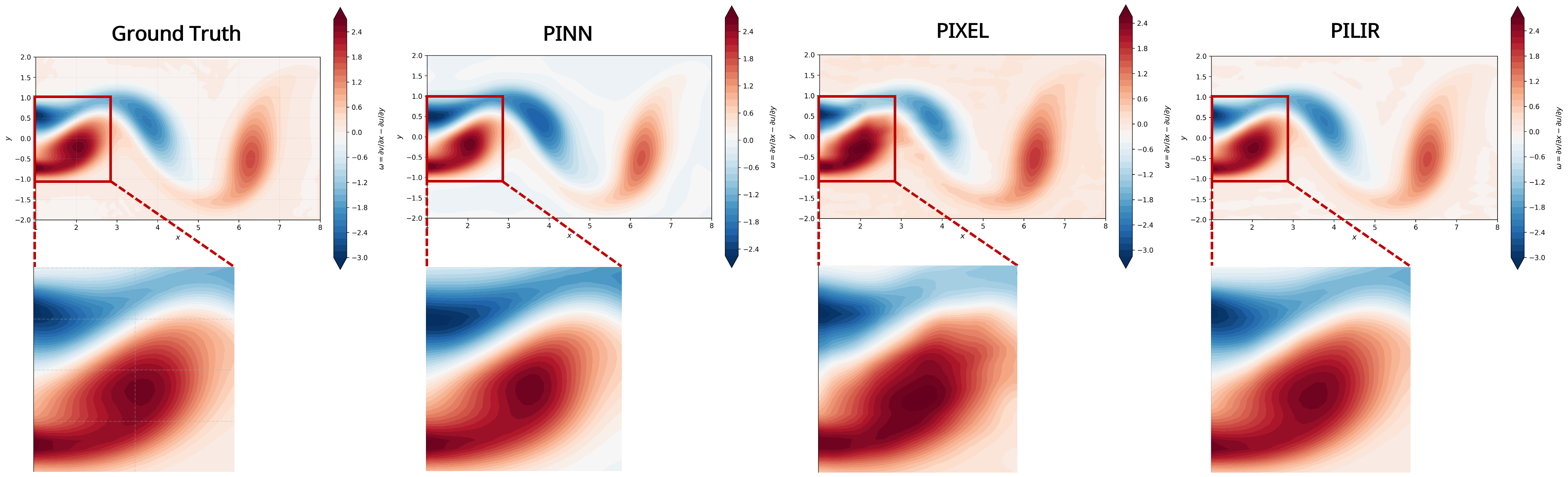
Figure 8: Comparison of vorticity fields for Navier–Stokes, illustrating PILIR's improved recovery of velocity gradient-based physics.
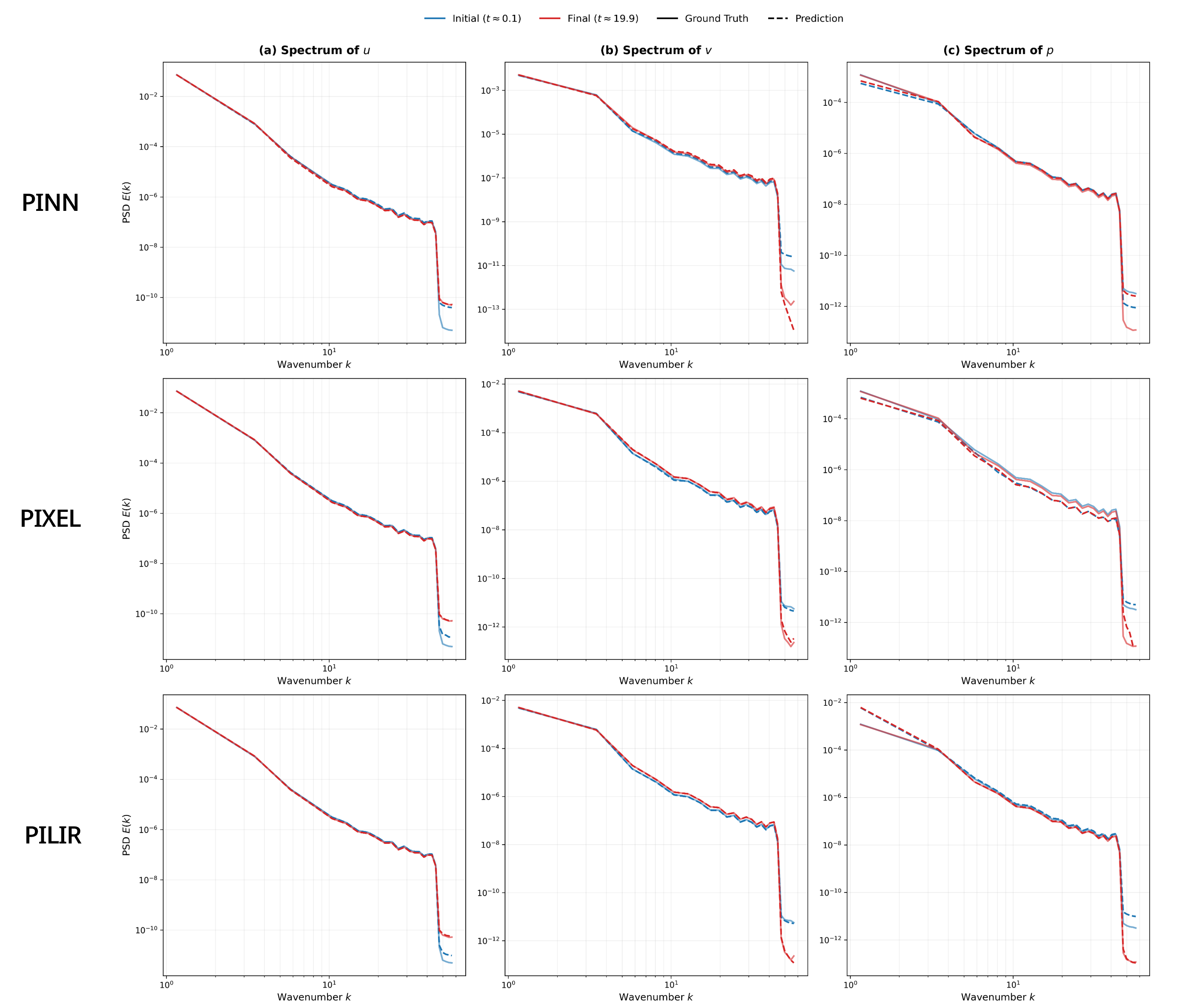
Figure 9: Spectral analysis on velocity and pressure fields for Navier–Stokes, confirming preservation of physical frequency content.
Robustness to Grid Resolution
PILIR's reconstruction quality is less sensitive to the grid resolution than conventional grid-based methods. Even at coarse grid resolutions (e.g., 8×8), PILIR outperforms multi-grid baseline methods at higher densities, underscoring the efficacy of its neural generative synthesis at enabling sub-grid accuracy.
Efficiency and Resource Consumption
While PILIR sometimes requires more compute than simple interpolation schemes, it is consistently more efficient than adaptively meshed approaches like PIG, which often exhaust memory on 3D settings. The neural operator enables avoidance of expensive high-resolution grids, striking a balance between memory/computational requirements and representational power.
Implications and Future Directions
PILIR challenges the prevailing paradigm of deterministic interpolation in grid-based PINNs by introducing a generative, neural synthesis mechanism. Its key implication is that high-fidelity PDE solutions—especially those featuring localized or oscillatory physics—can be achieved through a hybrid architecture that fuses local information adaptively. This architecture allows for precise sub-grid feature synthesis and decouples modeling fidelity from both grid resolution and input encoding heuristics.
Numerical results reveal order-of-magnitude improvements in L2 error and superior frequency recovery compared to both classical and contemporary alternatives. PILIR's ability to recover fine-grained dynamical details with fewer grid points holds substantial implications for simulation efficiency and scalability, particularly for high-dimensional or resource-limited PDE contexts.
Theoretically, PILIR hints at a wider class of discrete-continuous neural field models that explicitly encode local context—but rely on learned generative decoders—to unify sampling efficiency, frequency expressivity, and smoothness guarantees. Practically, this line of research enables robust physics simulation and parameter inference for complex scientific and engineering systems.
Promising speculative directions include:
- Integration of neural synthesis with adaptive grid refinement, enabling even more flexible computational trade-offs.
- Incorporation of advanced generative operator modules, such as transformers or attention-based decoders, for highly nonlocal phenomena.
- Joint parameter learning for data-driven PDE discovery, leveraging the modularity of the discrete/continuous separation.
Conclusion
PILIR provides a principled hybrid framework for physics-informed modeling that resolves the entrenched spectral bias of standard MLPs and deterministic grid interpolation. By decoupling grid encoding from continuous field reconstruction—with adaptively learned neural operators—PILIR achieves markedly superior accuracy and spectral fidelity across a suite of challenging PDEs. The approach establishes a new modular foundation for high-fidelity, mesh-free scientific computing, with broad implications for future neural field architectures in physics and engineering.