- The paper introduces an efficient SHAP adaptation for TSFMs, enabling exact, scalable explainability for load forecasting in energy systems.
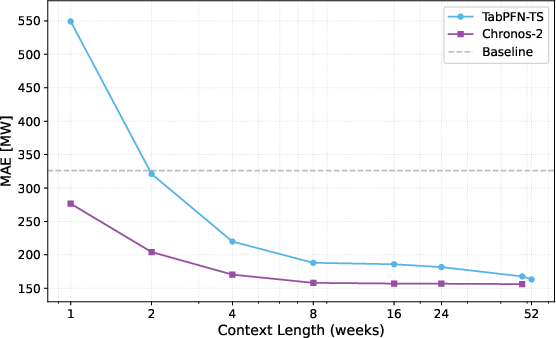
- It demonstrates covariate-informed TSFMs, Chronos-2 and TabPFN-TS, outperforming baselines with significant MAE improvements in a zero-shot setting.
- Results validate the models' interpretability and trustworthiness under regulatory frameworks, highlighting the impact of temporal and covariate masking.
Introduction and Motivation
The application of Time Series Foundation Models (TSFMs) in high-stakes energy system forecasting settings has encountered key barriers related to model explainability and data efficiency. While TSFMs—particularly those based on large Transformer or tabular architectures—have established state-of-the-art performance across diverse time series domains, their adoption in power system operations is constrained by the opacity of their decision mechanisms. This opacity is especially problematic under regulatory frameworks (e.g., EU AI Act) that require transparency, accountability, and domain expert trust for algorithmic decision support in critical infrastructure.
The work of Hertel et al. addresses these challenges by presenting an efficient adaptation of SHapley Additive exPlanations (SHAP) for TSFMs, specifically targeting covariate-informed models with variable context-length inputs, and demonstrates their practical application to load forecasting for a German transmission system operator (TSO) (2604.28149). The study contrasts two prominent TSFM paradigms: Chronos-2, a state-of-the-art foundation model for structured time series, and TabPFN-TS, a transformer-based model evolved from strong tabular data priors. The approach is evaluated in a zero-shot context—i.e., without any domain-specific fine-tuning—against both traditional baselines and domain-adapted Transformers, with an extensive focus on local and global model interpretability.
Methodology: SHAP Adaptation for TSFMs
Classical SHAP computation requires evaluation over all 2n feature coalitions, which is intractable for high-dimensional time series inputs, especially when features are time steps or covariates observed over long horizons. The core advance of this work is a scalable SHAP computation method tailored for TSFMs that leverages:
- Temporal and Covariate Masking: Instead of background data sampling (as in traditional SHAP), TSFMs are exploited for their flexibility in context length and covariate selection. Temporal masking is implemented by either reducing context length or imputing masked time steps with easily distinguishable
NaN tokens (Chronos-2), or by row deletion (TabPFN-TS). Covariate masking involves removal of entire input channels.
- Feature Grouping: Temporal input windows are grouped into semantically meaningful blocks (e.g., last day, short-term, intermediate, long-term), along with grouped covariate channels (e.g., temperature, solar irradiance, holiday indicator). SHAP is computed over these groups, substantially reducing combinatorial complexity.
- Exact SHAP for Grouped Features: TSFMs are evaluated for all combinations of group presence/absence (e.g., 27=128 coalitions for four temporal and three covariate groups), enabling efficient, exact SHAP attribution at both global and local (per-prediction) levels without resorting to approximate or sampling-based methods.
Schematic Overview
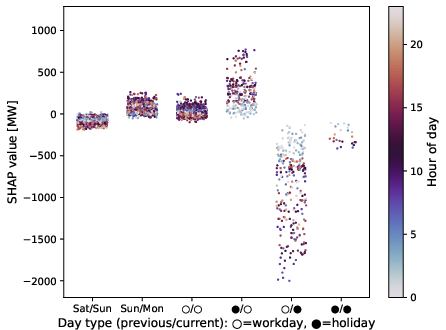
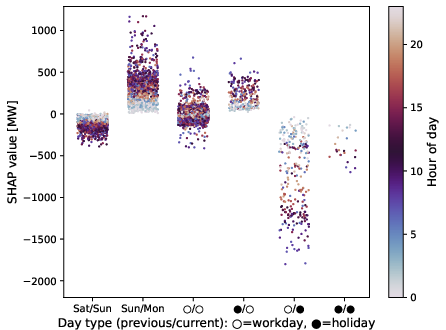
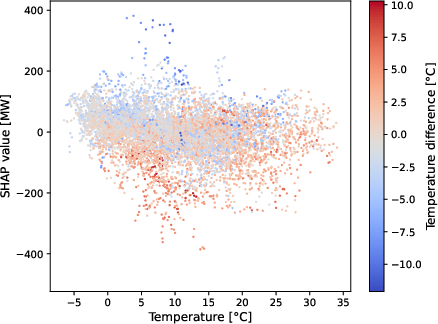
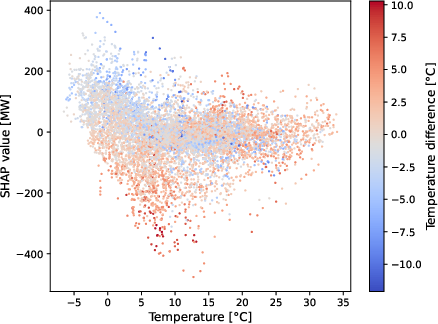
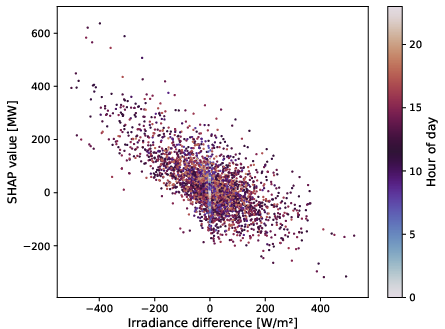
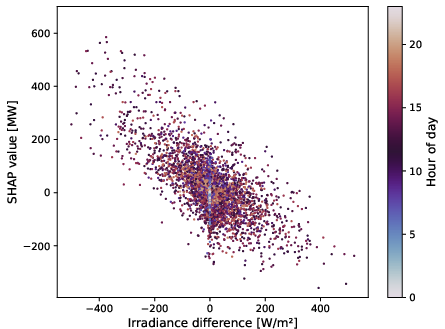
Figure 1: Conceptual workflow for masking input groups (temporal and covariate) in TSFMs, enabling computationally efficient exact Shapley value attribution for load forecasts.
The figure illustrates the process: input data passes through selective masking, is evaluated through Chronos-2 and TabPFN-TS, and SHAP values are derived by prediction differences across input coalitions.
Benchmarking TSFMs for Load Forecasting
The comparative study targets 24-hour-ahead operational load forecasts for the German TSO TransnetBW, using 10 years of load and covariate (weather, calendar) data. Metrics include MAE, RMSE, and MAPE. Models benchmarked include:
- Chronos-2: Covariate-informed and univariate, zero-shot
- TabPFN-TS: Same settings as above
- Transformer: Trained from scratch with one and 8.75 years of data
- Type-of-day Baseline
Results Summary
Explainability Analysis: SHAP Explanations for TSFMs
Global Attributions: Importance of Past Loads vs. Covariates
SHAP-derived global attributions indicate that past load values constitute the dominant predictive signal (≈89% for Chronos-2, 87% for TabPFN-TS). Covariates, while less important in the aggregate, display structure aligned with physical reality: holiday indicators are most influential among covariates, followed by temperature and irradiance. Chronos-2 distributes importance more evenly across temporal groups than TabPFN-TS, reflecting differences in pretraining and temporal inductive bias.
Covariate Dependencies: Functional Alignment with Domain Knowledge
Through dependence plots and SHAP value visualizations, the following consistent effects are observed:
- Holidays: Both models suppress load predictions on holidays, with strong recovery effects on post-holiday workdays.
- Temperature: Lower temperatures and negative temperature deltas (relative to the prior day) drive up load forecasts in winter, reflecting electric heating load.
- Irradiance: Drops in irradiance (proxy for decreased PV generation) are associated with increased net load, especially during daytime hours.
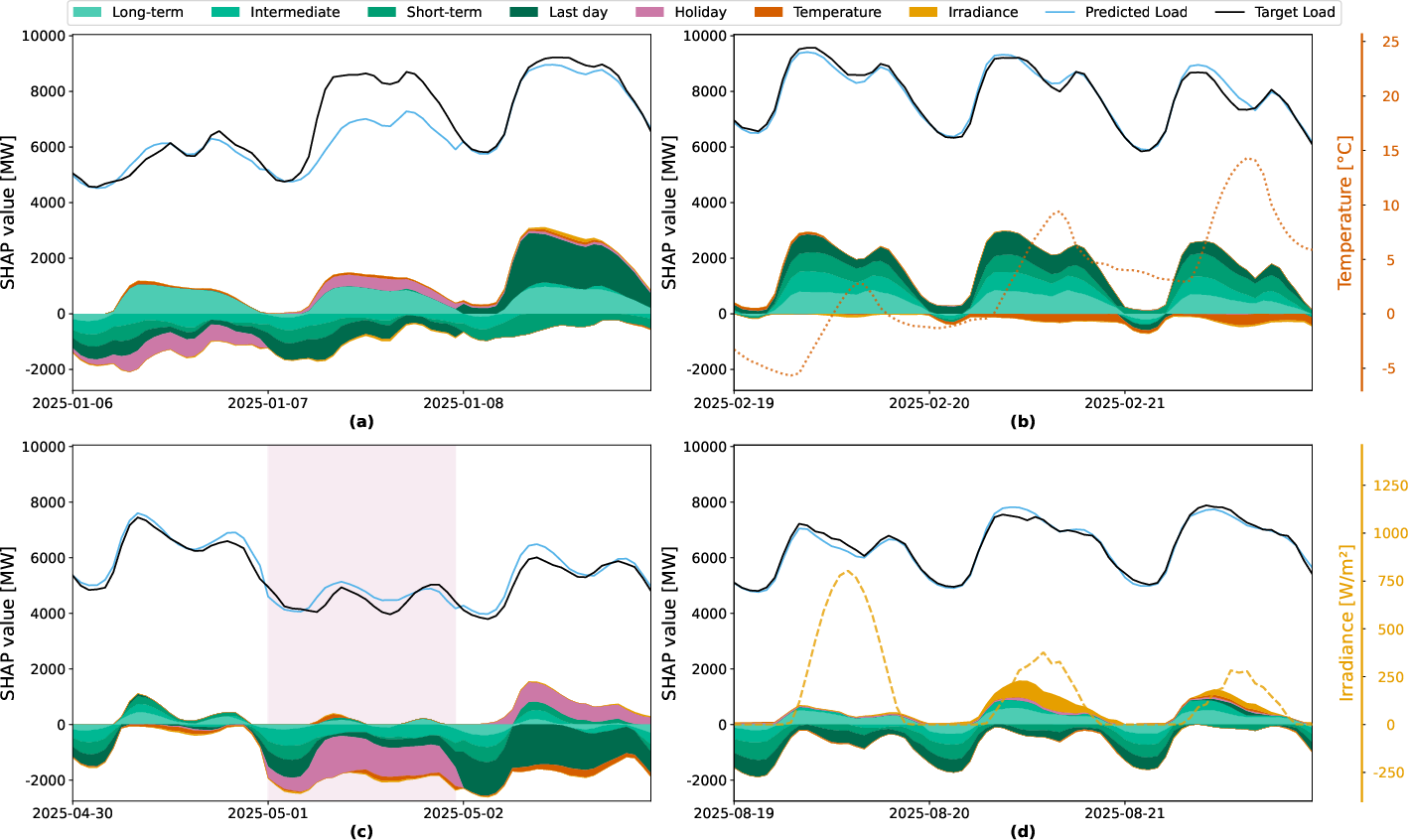
Figure 3: Local (per-hour) SHAP explanations for Chronos-2 predictions on key days, highlighting the contribution dynamics for (a) holiday transitions, (b) temperature signals, (c) holiday patterns, and (d) irradiance changes.
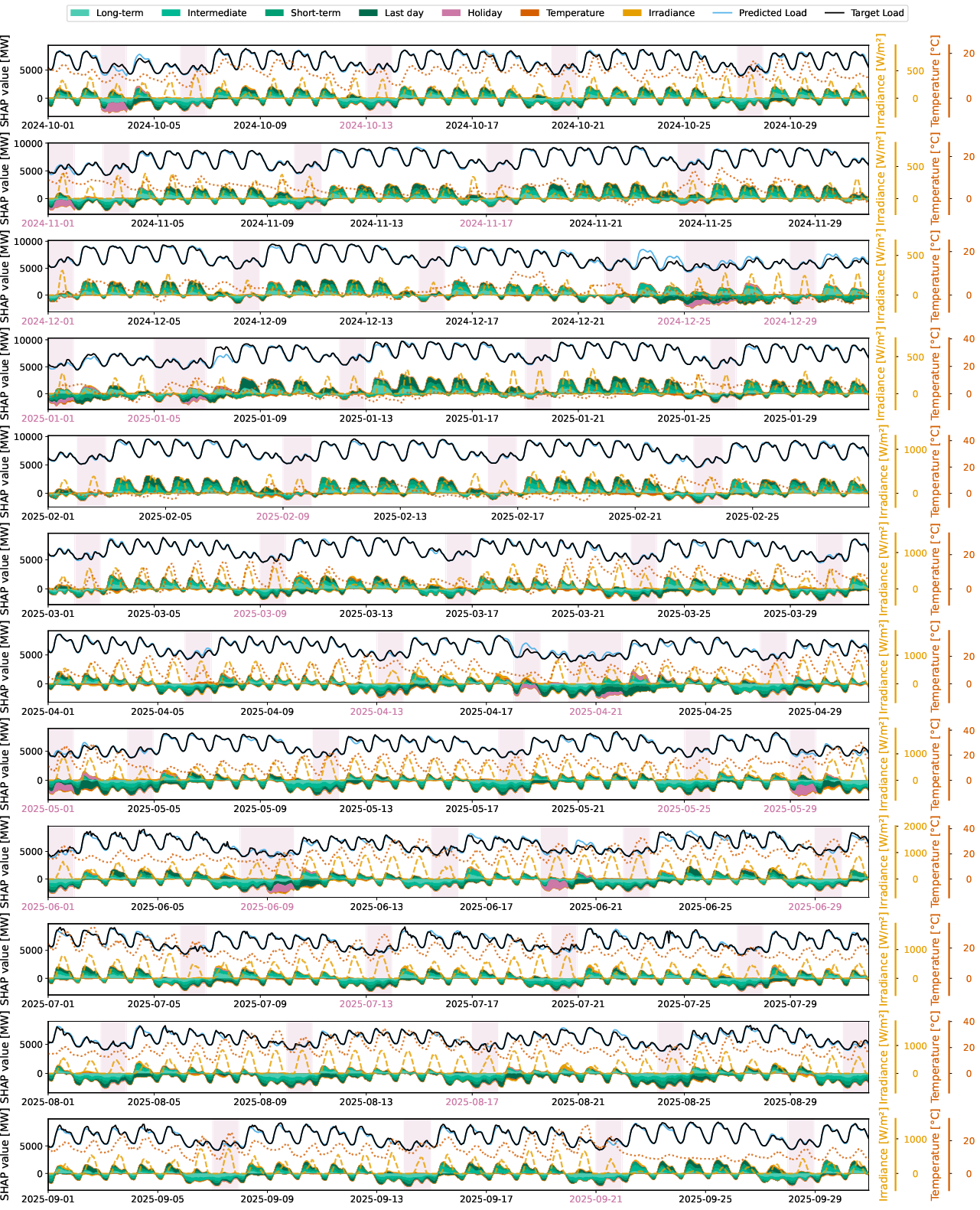
Figure 4: Chronos-2 predictions and SHAP attributions over the annual test set, showing temporal alignment between systematic load deviations and feature attributions, with explicit marking of holidays and weather covariates.
Local Explanations: Case Studies
Extensive per-prediction SHAP analysis confirms that TSFM predictions are locally dominated by recent load history under regular conditions but switch to heavy covariate reliance on anomalous days (holidays, heat waves, PV ramps). This sensitivity is crucial for operational trust: models do not simply memorize the past but adjust outputs coherently based on contextual signals.
Theoretical and Practical Implications
Foundation Models for Critical Infrastructure
This work establishes that TSFMs, when paired with efficient SHAP-based XAI approaches, are not only accurate but can deliver transparent, interpretable predictions. This combination is vital for deployment in safety- and mission-critical infrastructure where black-boxing is unacceptable. The elimination of background sampling by direct exploitation of TSFM input flexibility differentiates this approach from prior XAI methods, enabling feasible, faithful post-hoc explanations even for very large models.
Mode-Agnostic Explainability
The masking-based SHAP procedure is largely model-agnostic and immediately extensible to other TSFM architectures that can accept arbitrary input masks, both for univariate and multivariate, as well as covariate-informed and exogenous-input settings. This provides a path toward standardized, domain-independent XAI protocols for TSFMs in critical applications.
Broader Relevance and Limitations
The results emphasize the data efficiency and rapid deployment advantage of TSFMs for domains with limited or rapidly evolving local data. However, there is a persistent (if small) performance delta relative to specialized models when extensive in-domain history is available. Also, local and global SHAP attributions, while valuable, are ultimately descriptive: further work is needed to connect SHAP signals with causality, uncertainty, and counterfactual robustness, especially under non-stationarity and regime shifts.
Future Directions
- Generalization to other operational forecasting tasks: Extending the XAI protocol to probabilistic TSFM outputs, price forecasting, renewable output, and low-voltage demand.
- Scalability and fine-grained attributions: More efficient SHAP approximation leveraging sub-coalition sampling or hierarchical grouping for high-dimensional inputs.
- Causal and uncertainty-aware XAI: Integration with uncertainty quantification frameworks and causal modeling to distinguish genuine feature influence from statistical association [lopez_saboya_2009, watson_ohara_2023a].
- Fine-tuning and domain adaptation explainability: Investigating the impact of domain-specific adaptation on SHAP patterns and operational trust.
Conclusion
The proposed SHAP adaptation enables direct, high-fidelity explainability for general-purpose TSFMs in load forecasting. Chronos-2 and TabPFN-TS deliver competitive accuracy in zero-shot settings and their SHAP attributions align with physical and operational expectations, supporting both the trust and regulatory acceptability of modern black-box models in power systems. The methods here define a scalable blueprint for explainable, practical TSFM deployment across domains where transparency is mandatory.