- The paper introduces an innovative ensemble incorporating CNN and Transformer architectures with physics-based loss constraints to enhance forecasting accuracy during extreme events.
- It employs a SHAP-based explanation layer to attribute predictions transparently and ensure physical plausibility aligned with ERCOT's temperature–demand profile.
- The approach achieves significant improvements, including a 14.7% reduction in extreme-event RMSE, thereby bolstering grid resilience.
Introduction
Accurate short-term electricity load forecasting is critical for grid resilience, especially within the operational context of the United States, where load dynamics are increasingly influenced by electrification, renewable integration, and the prevalence of extreme weather. Conventional deep learning (DL) models such as LSTM, CNN-LSTM, and Transformer-based architectures have shown strong numerical performance but are generally regarded as "black-box" predictors. This opacity hinders operator trust, particularly during tail-regime events where interpretability and physical plausibility are paramount.
The paper "Interpretable Physics-Informed Load Forecasting for U.S. Grid Resilience: SHAP-Guided Ensemble Validation in Hybrid Deep Learning Under Extreme Weather" (2604.23500) introduces an end-to-end interpretable, physics-regularized ensemble that fuses architectural diversity (CNN and Transformer), a physics-informed loss reflecting the empirically validated piecewise parabolic temperature–demand relationship of the ERCOT system, and SHAP-based explainability for both global and event-level attributions. The unified framework is empirically validated on eight years of hourly ERCOT load data (2018–2025), including the critical evaluation on events such as Winter Storm Uri and the 2024 heat dome.
Framework Architecture and Workflow
The core architecture is a dual-branch hybrid: a CNN branch for extracting local multivariate features and a Transformer branch for capturing long-range temporal dependencies. The physics-informed layer regularizes predictions toward ERCOT's piecewise parabolic temperature–demand profile and penalizes forecasts with physically implausible hour-over-hour ramps. The final network prediction is a weighted ensemble, with weights determined analytically via validation-set error minimization. The architecture is extended with a post-hoc SHAP layer using DeepExplainer for operator-facing interpretability.
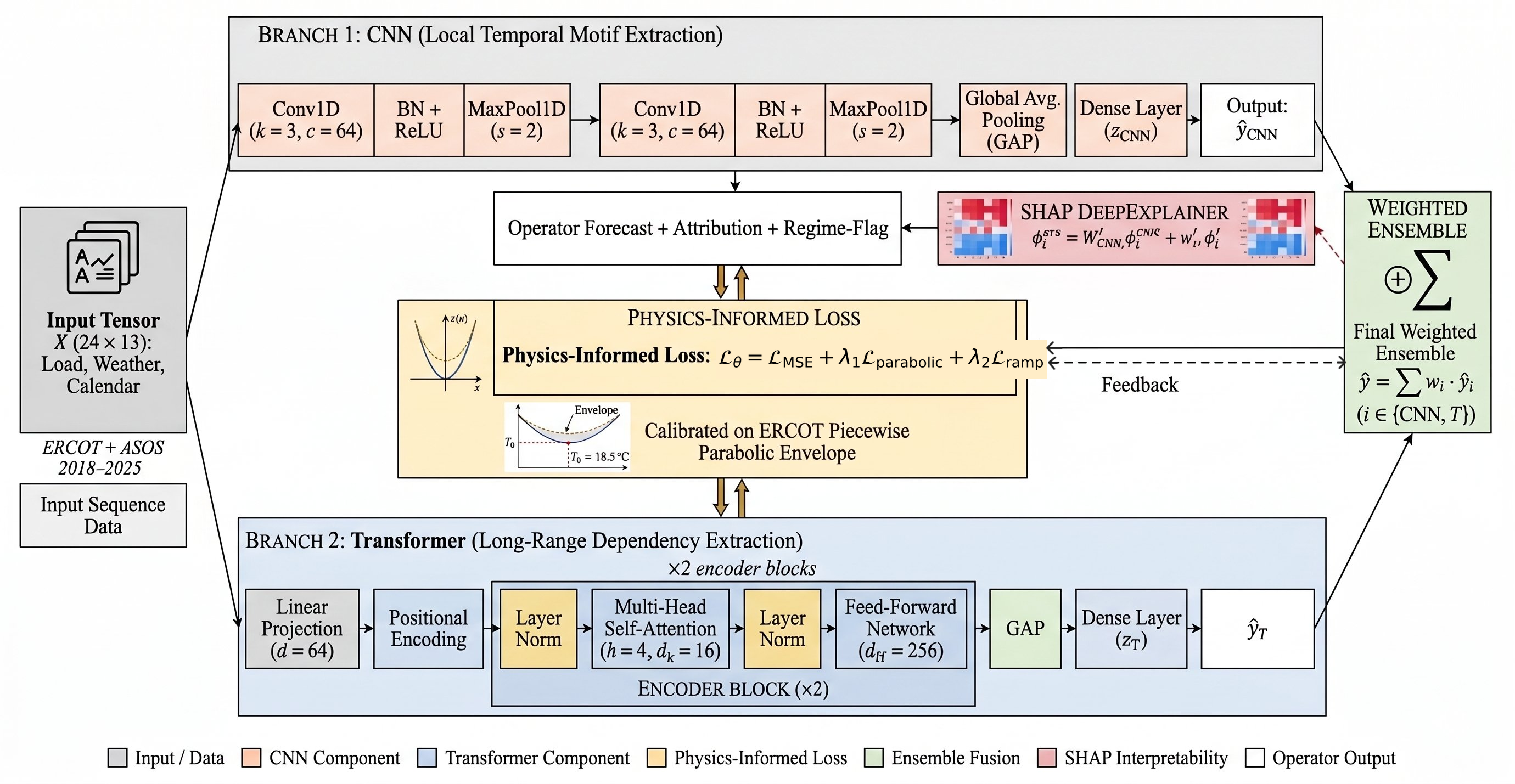
Figure 1: Overall architecture of the proposed physics-informed interpretable ensemble framework.
The operational workflow proceeds from data ingestion and preprocessing (merging ERCOT load with ASOS meteorological data), through modeling, ensemble fusion, and SHAP-guided explanation, culminating in actionable operator-facing attributions.
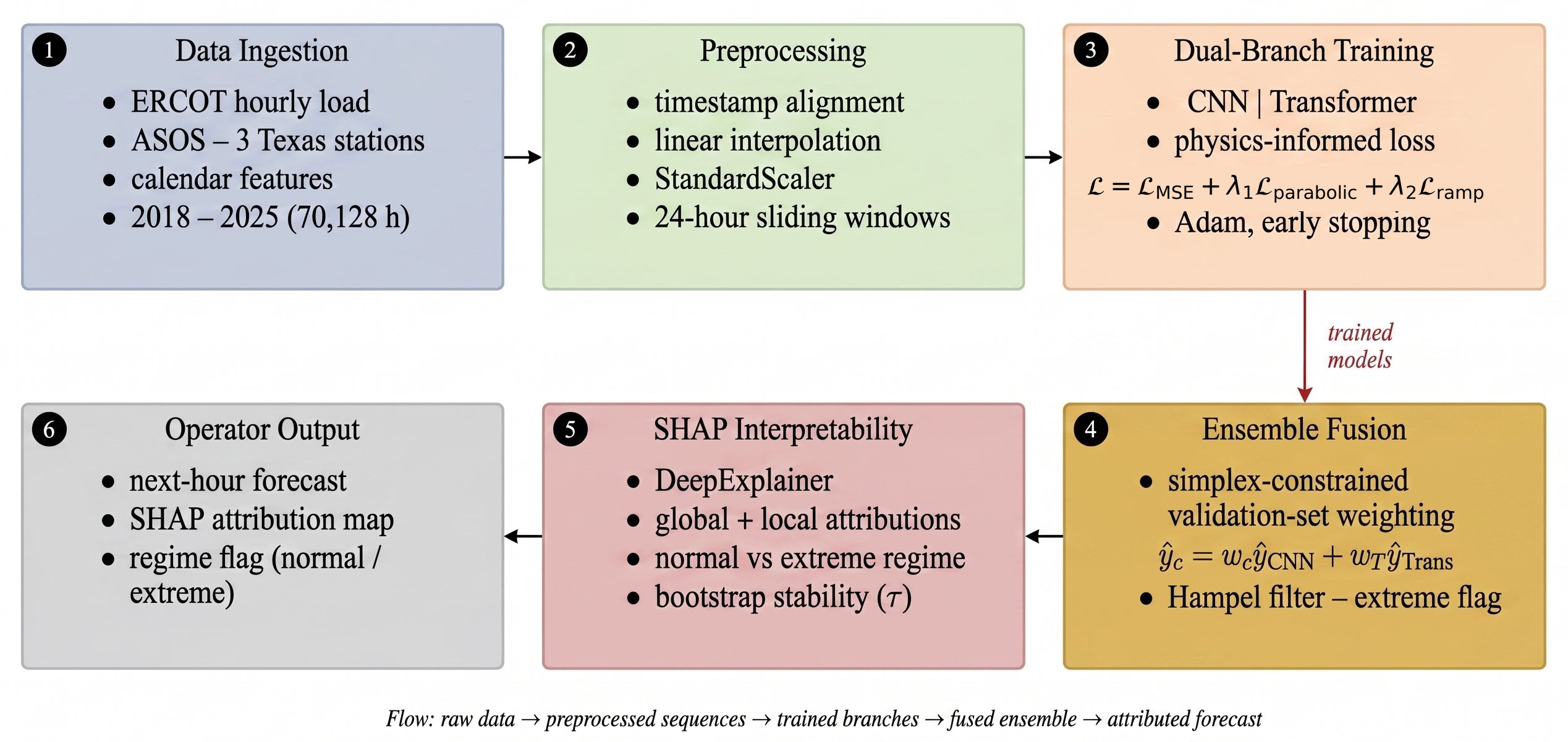
Figure 2: Workflow diagram from data ingestion to operator-facing attribution-enriched forecast.
Dataset and Domain-Specific Constraints
The modeling pipeline is grounded in ERCOT operational data and three ASOS stations spanning 2018–2025, totaling over 70,000 hourly samples. The physical constraint leverages the observed ERCOT demand–temperature relationship, parametrized as a two-segment parabolic function with a tolerance band reflecting ±2σ in-sample residuals. The inflection at T0=18.5∘C separates heating from cooling regimes. Additional calendar and meteorological features are incorporated as independent variables.
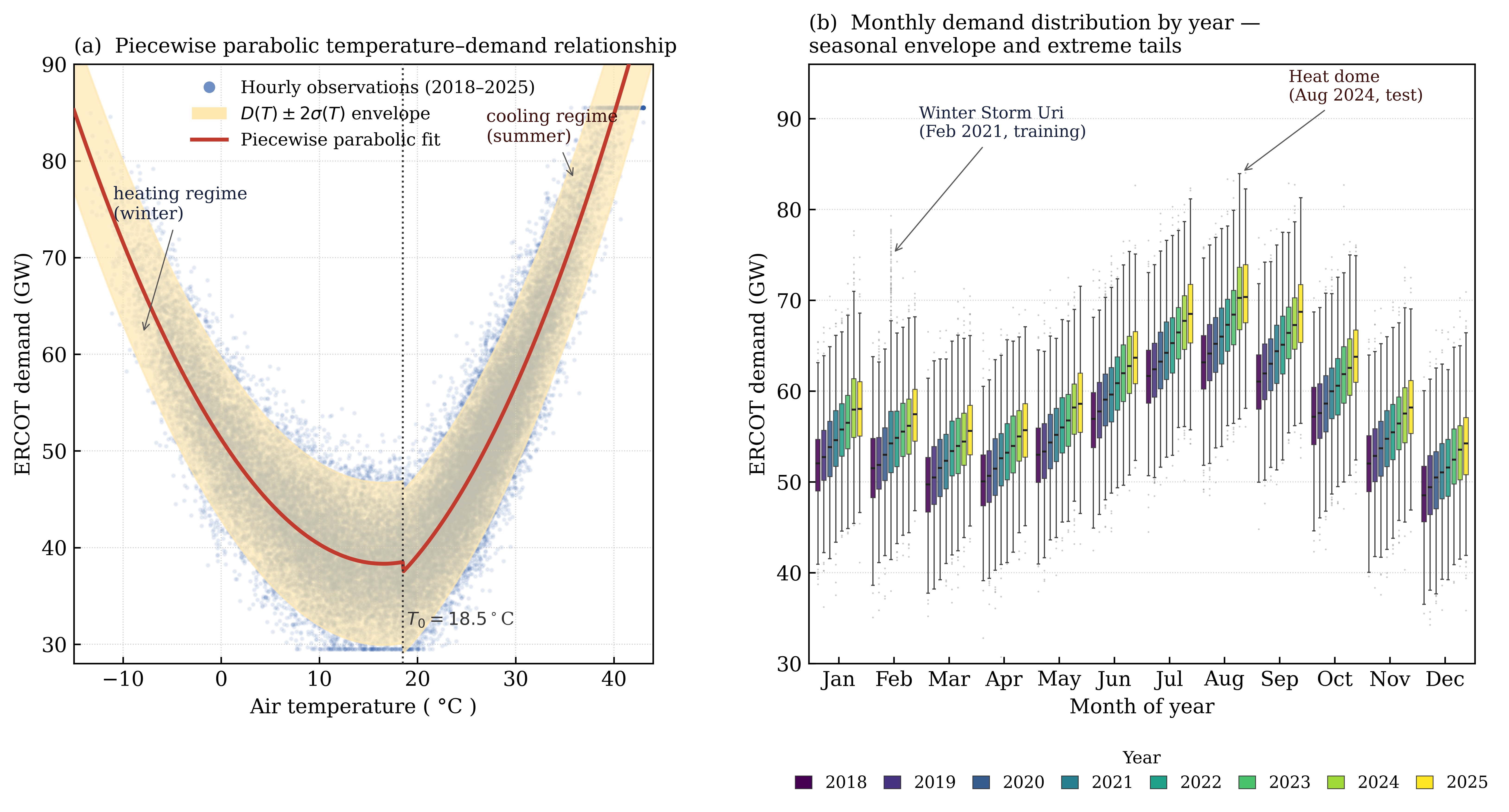
Figure 3: ERCOT demand characterization (2018–2025), showing the dominant temperature–demand envelope and the manifestation of extreme-event tails.
- CNN branch: Deep 1D convolutions learn local motifs, providing robustness for regimes where immediate past values dominate.
- Transformer branch: Captures long-range dependencies and complex autoregressive patterns without vanishing-gradient pathology.
- Physics-informed loss: The composite loss combines standard MSE, a parabolic penalty ensuring predictions are physically consistent with the historical temperature–demand curve, and a ramp penalty limiting hour-over-hour rate-of-change to empirically observed maxima.
- Ensemble fusion: The convex combination of branch predictions is validation-tuned, allowing the aggregate model to leverage complementary architectural strengths.
The physics-informed ensemble sets state-of-the-art test-window error metrics: 713 MW MAE, 812 MW RMSE, and 1.18% MAPE. Strong numerical performance is demonstrated both for the full 2024–2025 test period and for Hampel-filtered extreme events (enhanced by 20.7% vs. the best Transformer—PI branch, and by 40.5% over the CNN—PI branch baseline). The inclusion of physics-based regularization lowers extreme-event RMSE by 14.7% compared to unconstrained deep ensembles.
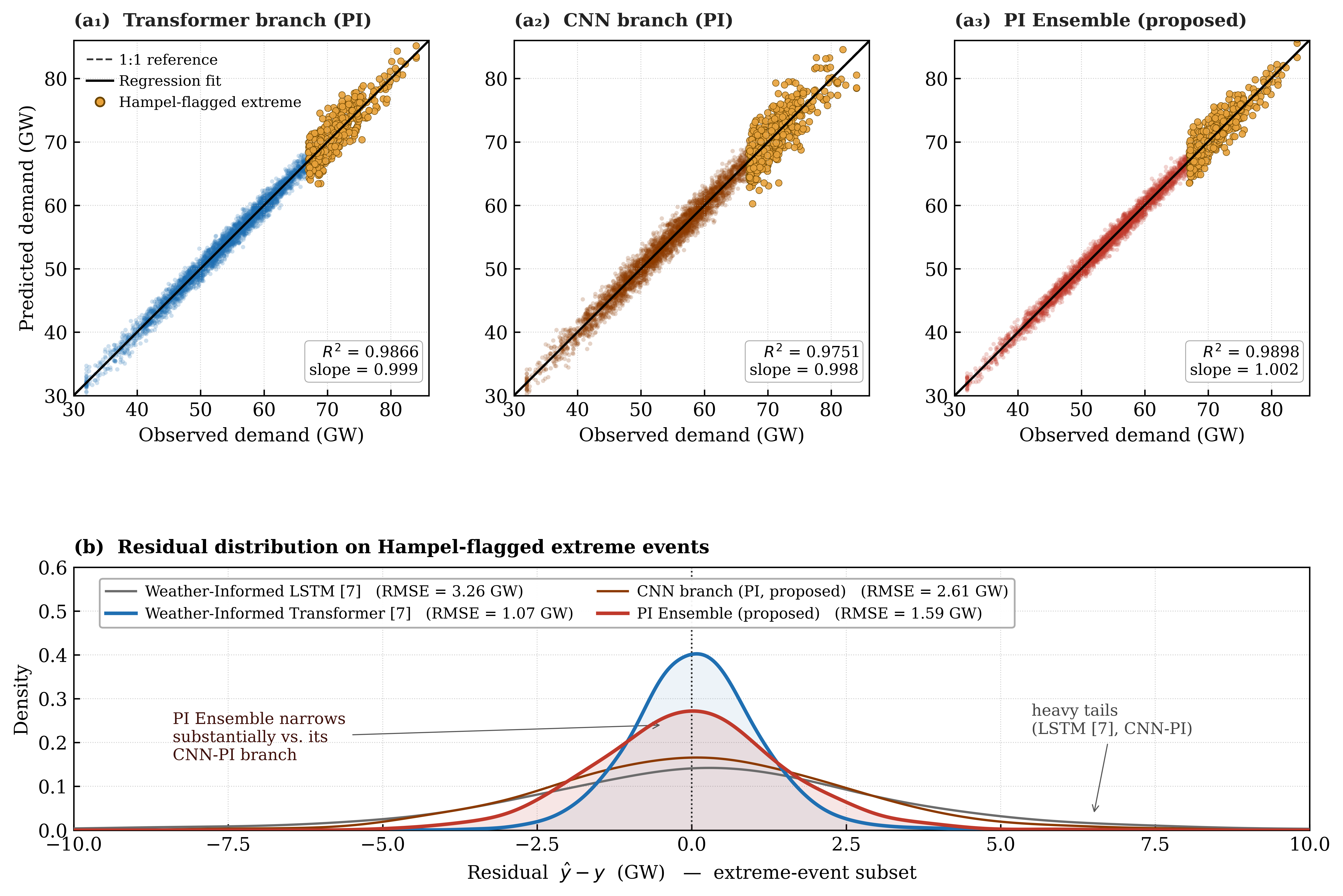
Figure 4: Error diagnostics including observed-versus-predicted scatter and residual density analysis for the 2024–2025 test window with a focus on extreme events.
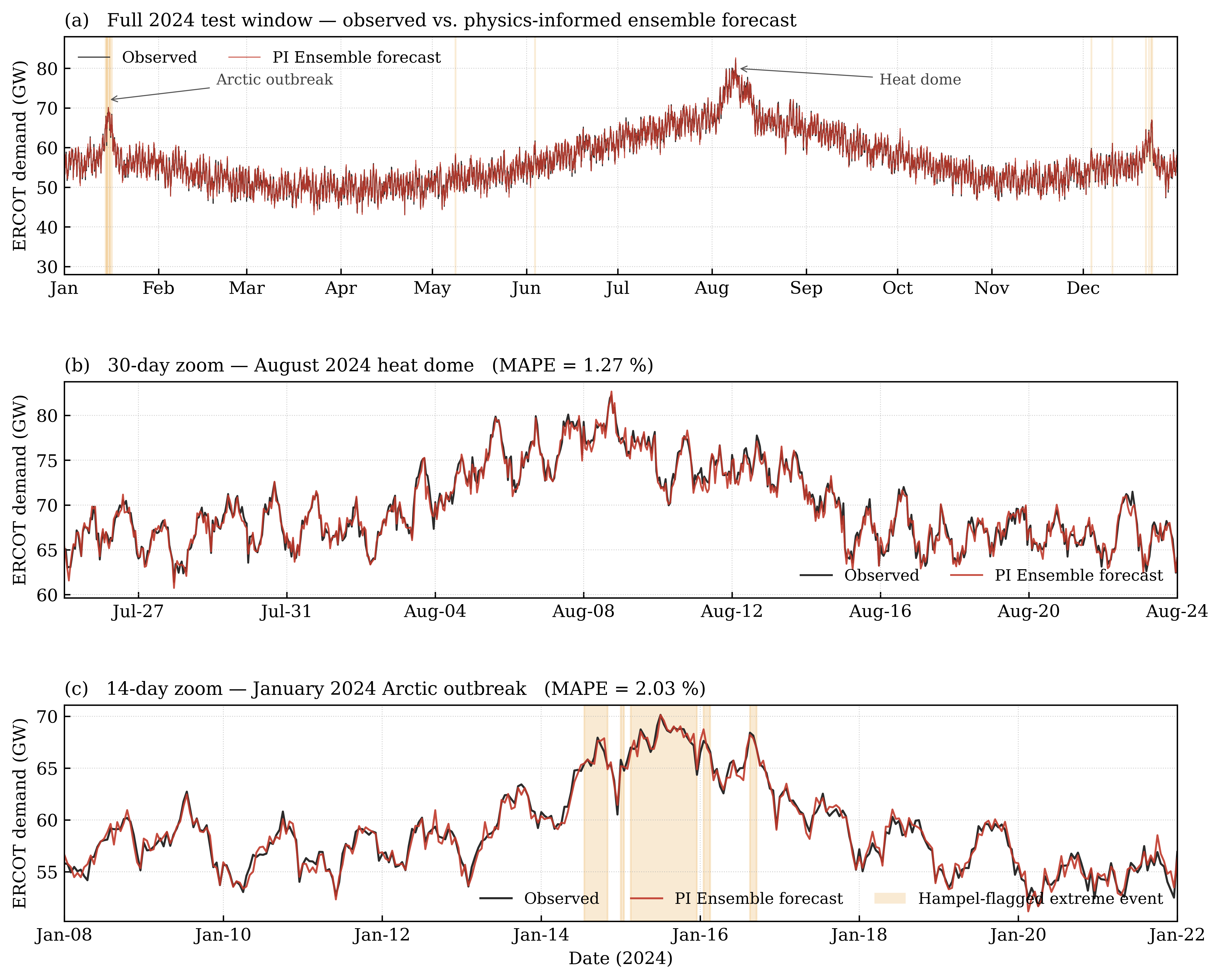
Figure 5: Observed vs. predicted ERCOT load for the full test year and representative extremes, evidencing robust tracking during high-stress intervals.
Ablation studies confirm the parabolic and ramp terms provide complementary gains: the parabolic loss enforces global physical plausibility, while the ramp penalty addresses local, transient artifacts—the latter critical for avoiding spurious load excursions under sharp meteorological transitions.
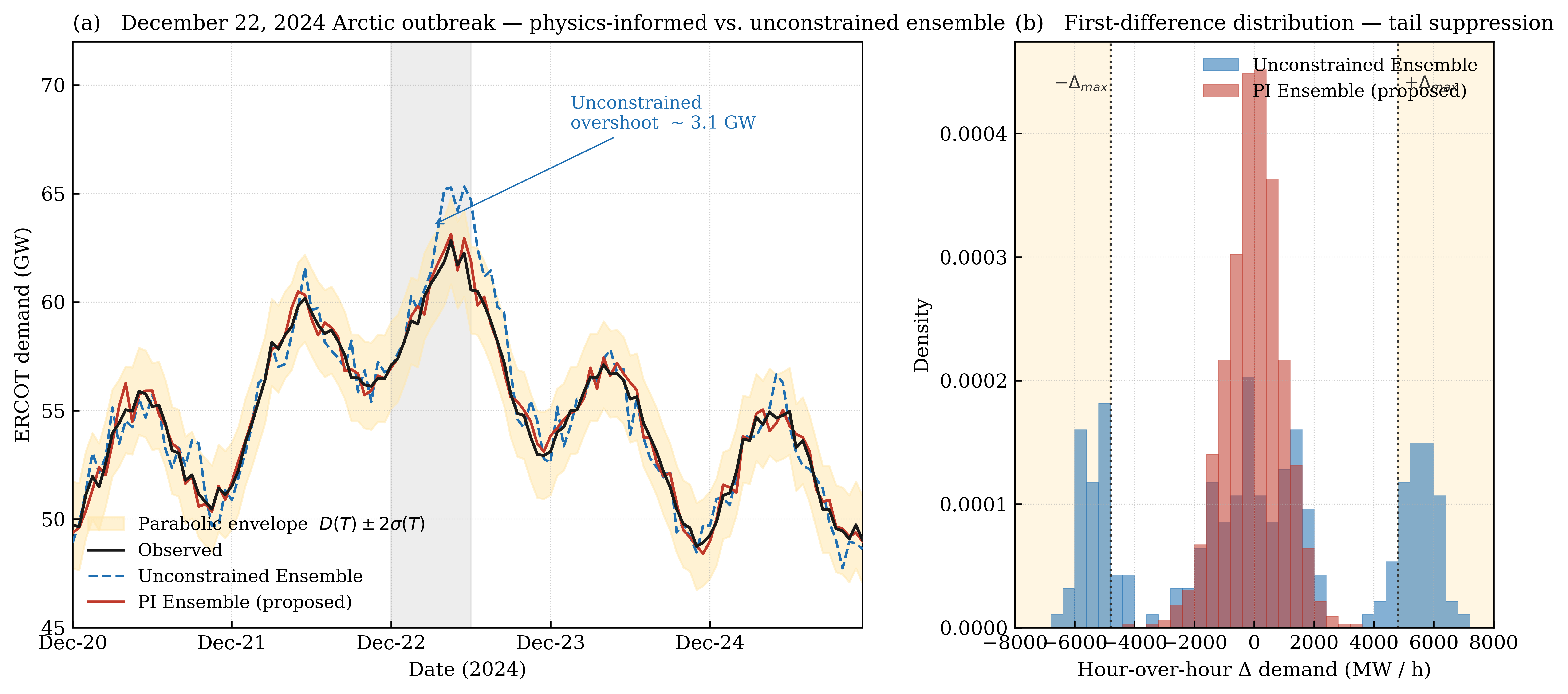
Figure 6: Comparison of ensemble prediction dynamics with and without the physics-informed loss during a major cold snap, highlighting improved tracking and the suppression of unphysical overshoots.
Interpretability: SHAP Attribution and Regime Analysis
The SHAP-based post-hoc explainability layer attributes prediction deviations to specific input features and quantifies attribution stability (Kendall τ = 0.91 over bootstrap resamples). Across the operational regime, lagged load and air temperature see maximum influence, but during Hampel-flagged extremes, the system evidences a clear shift: air temperature, wind speed, and precipitation surging in importance while periodic calendar features diminish.
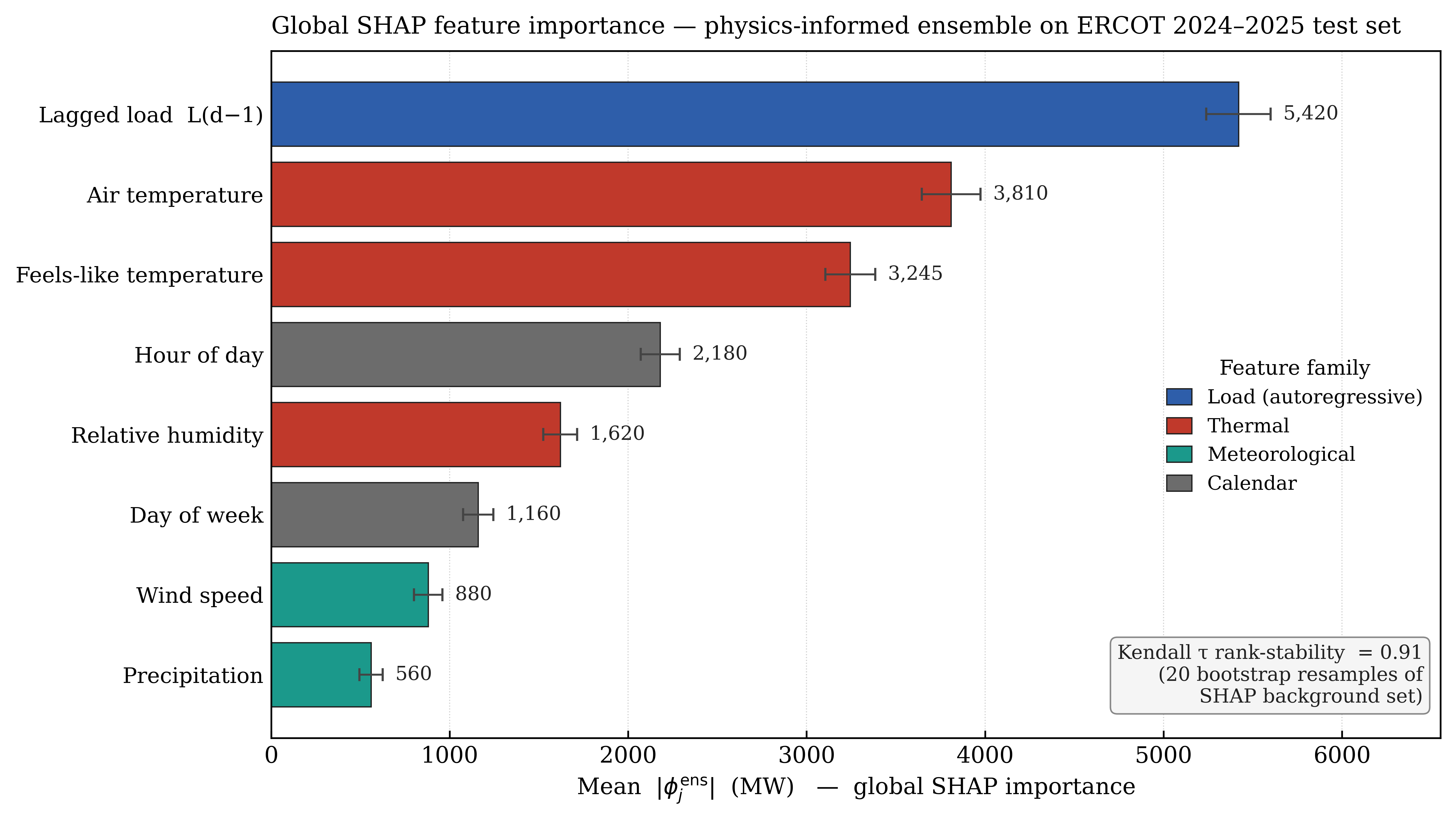
Figure 7: Global SHAP feature importance for the ensemble model, confirming the centrality of temperature and lagged load across the full testing horizon.
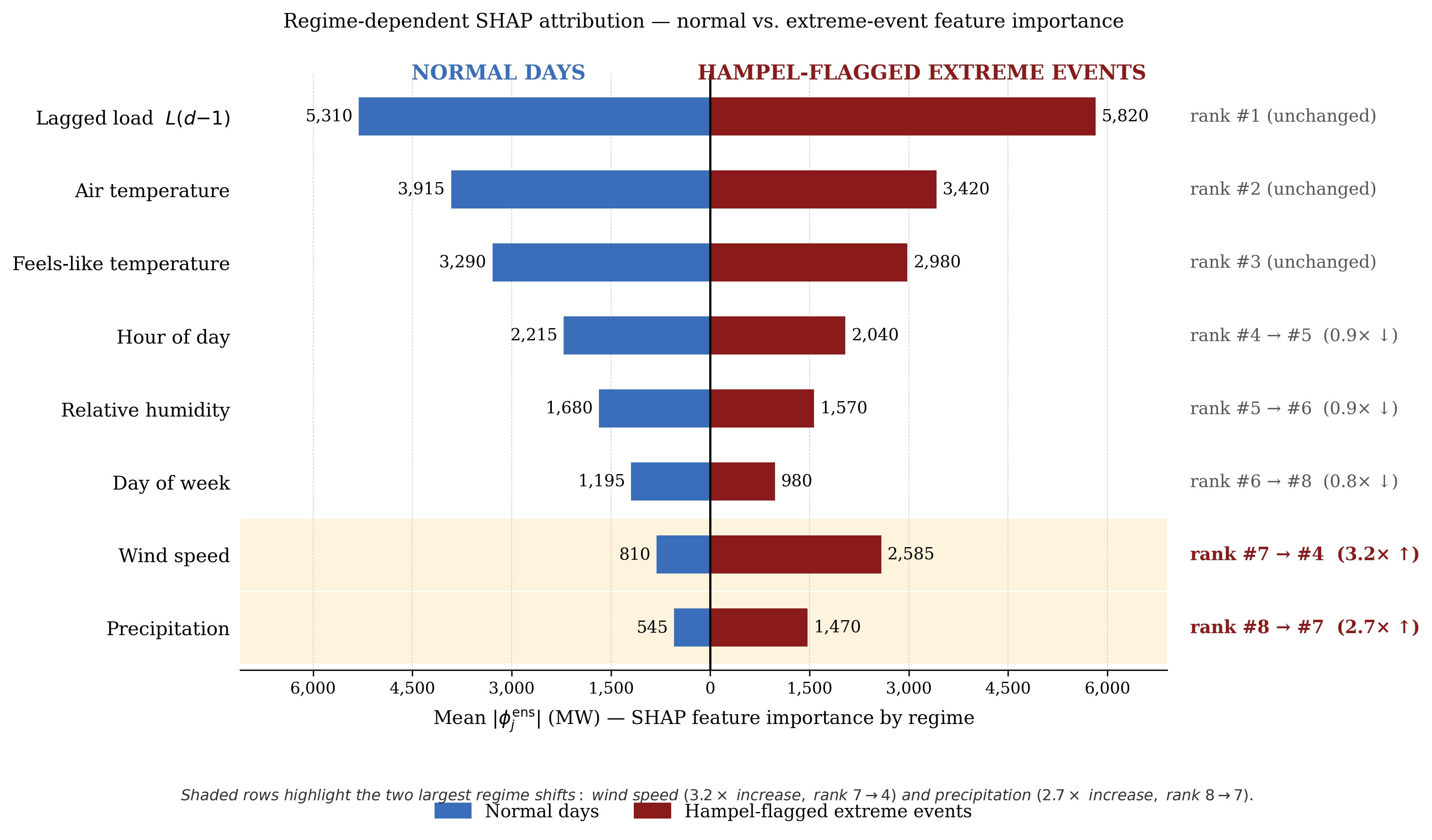
Figure 8: Differential SHAP feature attribution profiles for normal vs. extreme events, revealing escalation in weather feature influence (especially air temperature and wind speed) during system stress.
This regime-adaptive attribution directly supports operational decision-making: for cold fronts or heat domes, operators receive both forecast and a quantified assessment that the surge is meteorologically driven, with local wind or precipitation flagged as key uncertainty contributors.
Implications and Prospects
From a practical standpoint, this work supplies dispatchers and market participants with transparent, physically plausible, and numerically reliable forecasts—crucial for real-time operational risk management and reserve procurement (especially in large-scale events where existing black-box models have historically failed). Theoretically, it advances the PINN paradigm by extending physics-informed regularization to empirical, data-driven constraints—not simply fundamental PDEs. The marriage of diverse DL architectures within a validated, interpretable ensemble sets an explicit benchmark for future forecasting platforms in power systems.
Key future research directions are outlined:
- Validation across additional ISOs (CAISO, PJM, etc.) to confirm model portability and resilience to institutional and climatological variance.
- Extension to uncertainty-quantified ensembles (e.g., conformal prediction or deep Bayesian methods) for calibrated probabilistic guidance to operators.
- Real-world pilot integrations to empirically assess the effect of SHAP-guided explainability on operational efficacy during extreme events.
Conclusion
The study demonstrates that integrating physics-based constraints into ensemble deep learning models, coupled with rigorous SHAP explainability, achieves both higher accuracy and much-needed model transparency for extreme-event grid load forecasting. The proposed approach sets a formal baseline for interpretable, operator-facing ML systems in critical infrastructure, directly supporting both reliable dispatch and data-informed contingency planning.

