- The paper presents a novel hardware-software platform that simultaneously records 3D digit forces and EMG signals with high precision.
- It employs custom, cross-calibrated three-axis force sensors with a decoupling matrix, reducing crosstalk by over 92% to achieve excellent measurement accuracy.
- The framework supports digit-specific coordinate mapping and flexible protocols, advancing neuromechanical studies and prosthetics research.
MyoKin3X: A Myoelectric Framework for Full-Hand 3D Force Recording
Introduction
MyoKin3X presents a comprehensive hardware-software framework for simultaneous 3D force measurement across all five digits of the human hand, synchronously acquired with both surface and intramuscular electromyography (EMG). The platform is designed to address persistent limitations in hand kinetics research, specifically the trade-off between the number of measurable digits, force direction dimensionality, anatomical adaptability, and calibration robustness seen in extant systems. The integration of anatomically adjustable five-digit force sensors, cross-calibrated for inter-axis decoupling, and open-protocol software for full-stack acquisition and feedback constitutes the core innovation of this framework.
System Architecture and Calibration
MyoKin3X comprises five custom-integrated, three-axis load cells, each supporting a nominal ±50 N range and offering a digital resolution down to 2.8 mN. The mechanical design emphasizes adaptability, featuring adjustable 3D-printed digit inlets, modular aluminum profiles, and ergonomic fixation of the distal hand and forearm. The architecture facilitates fast reconfiguration and repeatable positioning, essential for both cross-sectional studies and longitudinal tracking.
The force sensors are subject to in-place, axis-wise calibration routines utilizing an external reference sensor and a precision linear stage. Each channel undergoes offset correction and force-voltage curve linearization, with results showing a mean coefficient of variation of 0.04% and maximal force errors of ±0.06 N at 50 N, surpassing the accuracy standards prevalent in clinical and research-grade hand measurement systems.
A sensor-specific 3×3 decoupling matrix, derived from multivariate linear regression, addresses cross-axis crosstalk. The decoupling achieves a mean crosstalk reduction of 92.71%, with final inter-axis coupling typically below 0.02% post-correction, as corroborated by independent validation (R2≥0.99). This is a marked improvement over traditional multi-axis calibration (see (Figure 1)).
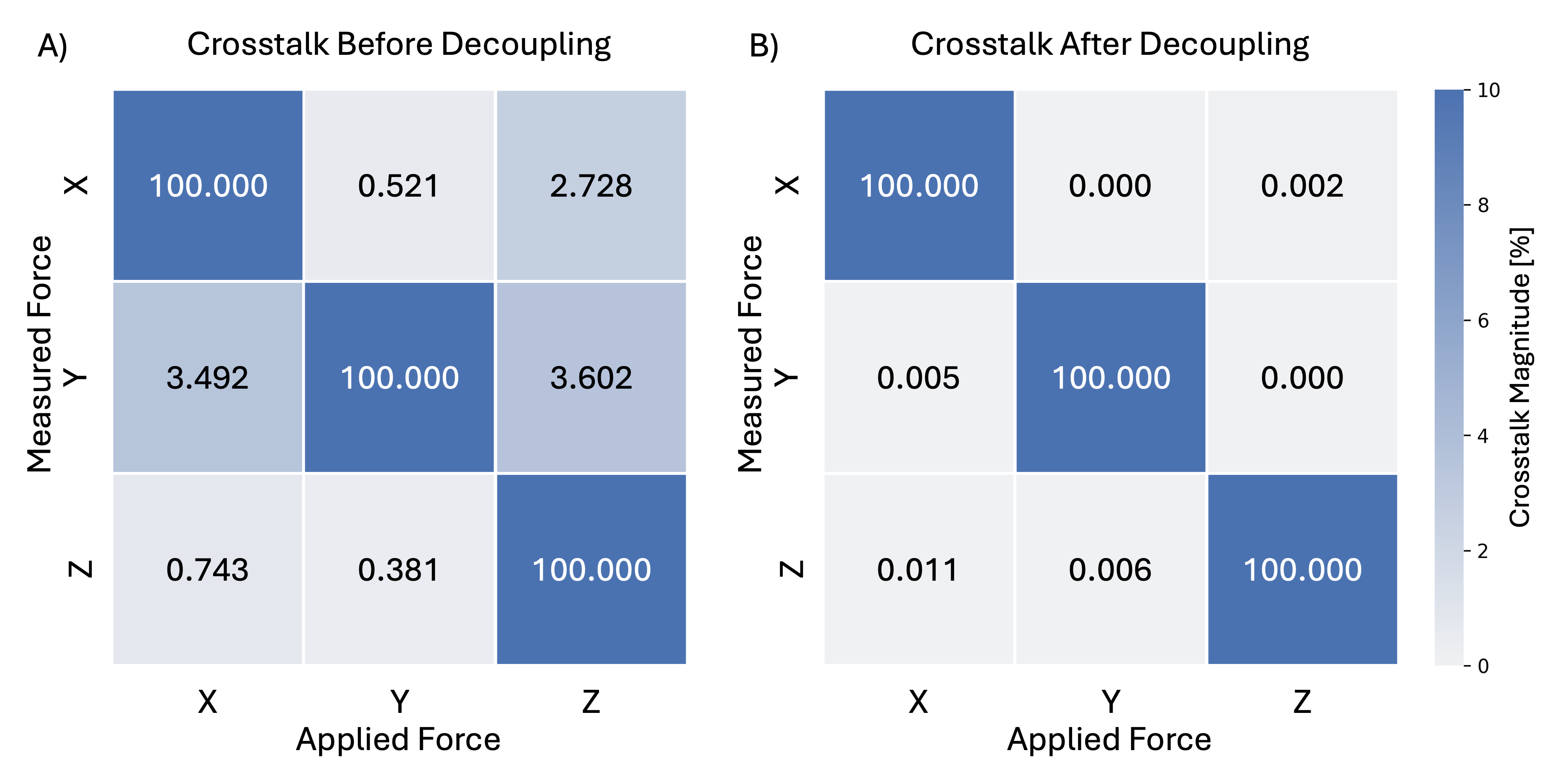
Figure 1: Sensor decoupling reduces inter-axis crosstalk from up to 3.6% to below 0.02% for most axis pairs across sensors, enhancing true 3D digit force specificity.
Digit-Specific Force Representation and Protocol Design
For standardized and anatomically meaningful analysis, the system estimates a digit-specific coordinate system (flexion, abduction, push) for each subject via maximal voluntary contraction (MVC) recordings. Raw 15-dimensional force signals are mapped into these local 3D bases using a projection tensor W∈R5×3×15, yielding expression-invariant metrics suitable for inter-individual and cross-session comparison. The protocol also captures multi-digit synergies (e.g., pinching, closed-fist), supporting complex coordination studies.
Software and Feedback Interfaces
The included software implements a PySide6-based GUI that seamlessly handles device communication, synchronized EMG/AUX recording, calibration, MVC capture, and experiment control. Protocols are specified in JSON, and real-time visual feedback is offered through four Force Feedback Interfaces (FFIs):
- FFI 1 (1D Ramp): Scalar force control for ramp-following, with per-digit decomposition.
- FFI 2 (Fatigue): Single digit-DOF fatigue tracking against sustained targets.
- FFI 3 (2D Vector): Digit-by-digit trajectory following in local 2D flexion-abduction planes.
- FFI 4 (2D Exploration): Unconstrained, heatmap-based mapping of force space visitation.
These visualizations permit both constrained and exploratory protocols essential for characterizing motor synergies, training myoelectric control algorithms, and assessing compensatory strategies (see (Figure 2)).
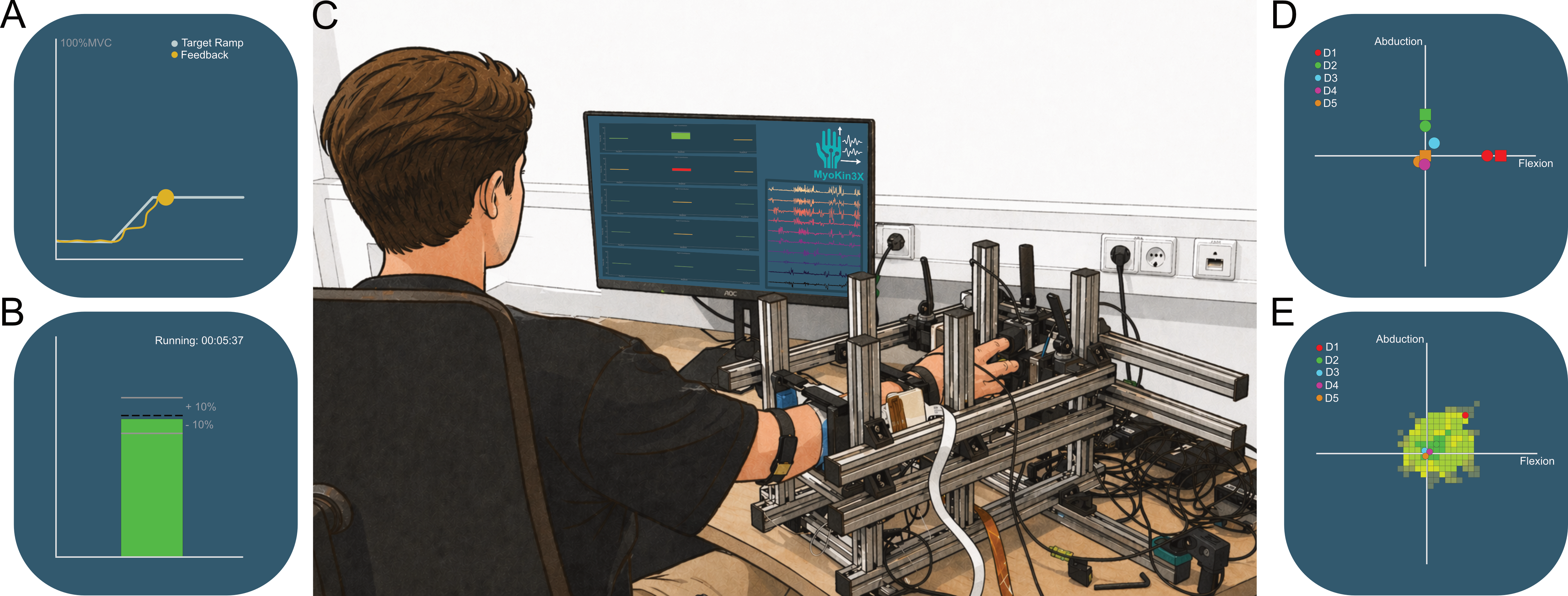
Figure 2: Visualization of MyoKin3X outputs: 1D/2D force ramp and fatigue tasks, anatomical setup, and exploratory force mapping interface.
Mechanical and Experimental Implementation
The modular hardware is engineered for rapid subject adaptation without compromising on digit alignment or mechanical stability. Quick-release mounts and custom inlets ensure sensor axis alignment to anatomical DOF, while forearm supports minimize compensation artifacts. Figure 3 provides a comprehensive depiction of the structural and CAD aspects of the complete setup.
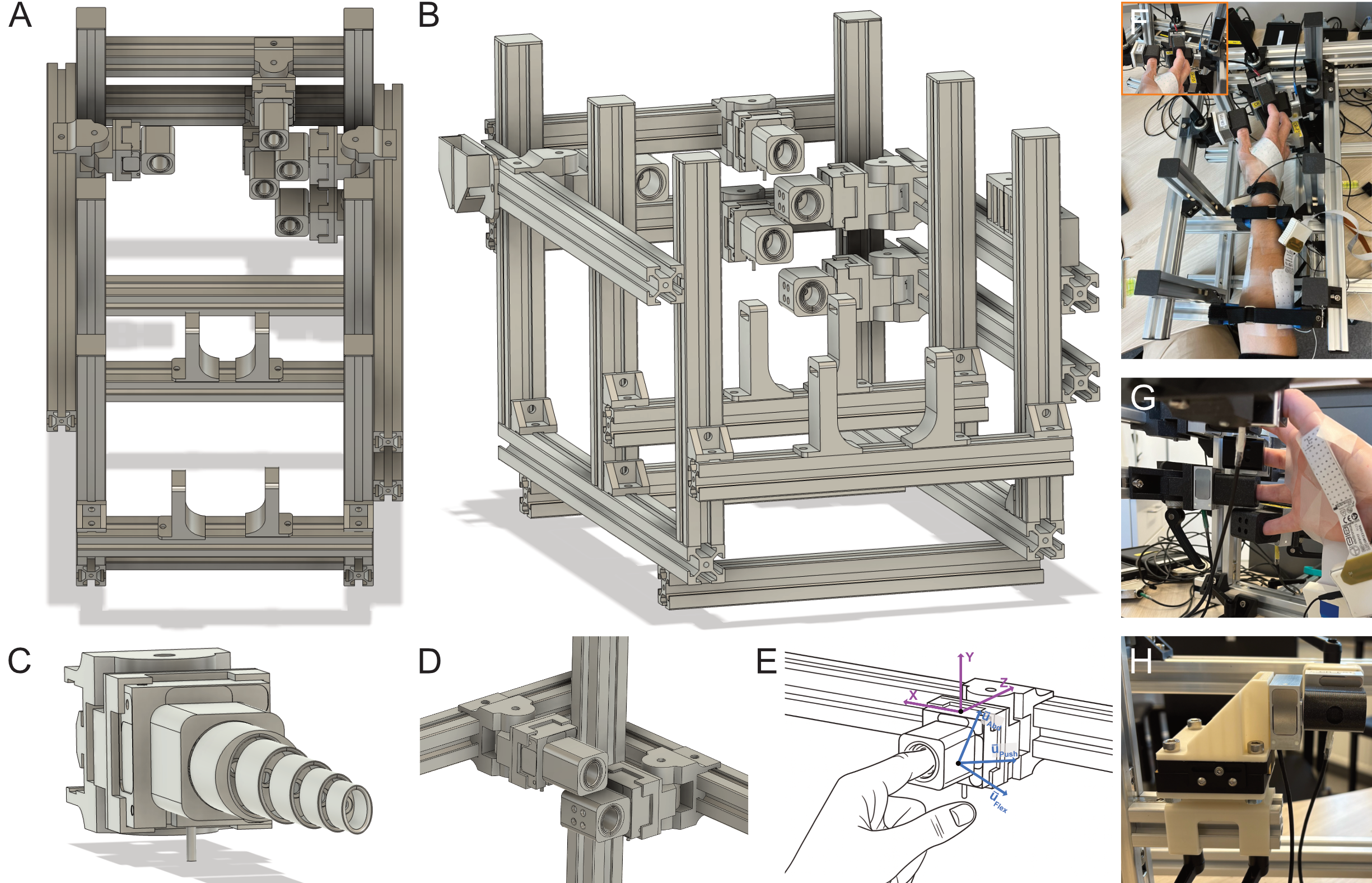
Figure 3: CAD views and real-participant configuration illustrate the mechanical flexibility of MyoKin3X, with focus on sensor mounting options and anatomical fit.
Numerical validation confirms the system's precision. The calibration protocol yields:
- Mean coefficient of variation <0.04%
- Maximum force error ±0.06 N (at 50 N)
- System digital resolution of ~2.8 mN
- Crosstalk reduction of 92.71% on average, with worst-case post-decoupling residual of only 0.175%
Force predictions from decoupled sensors exhibit R2≥0.9997, indicating highly linear, accurate force reconstruction across all force and digit axes.
Implications and Future Directions
MyoKin3X establishes a baseline for high-fidelity, full-hand, multidirectional kinetic data acquisition, facilitating advanced investigations into digit coordination, compensatory force generation, and neural-force mapping. The compact sensors and robust decoupling strategy are directly applicable to motor neuroscience, clinical rehabilitation, and myoelectric interface prototyping.
Future deployments may focus on evaluating the temporal stability of calibration factors longitudinally under repeated use, extending dynamic compensation for proximal movements, and integrating higher-capacity or alternative multiaxial sensors. The acquisition software’s protocol abstraction and data structuring in zarr format support scalable machine learning analysis, fostering integration with EMG-based force estimation via neural or deep learning approaches, as suggested in recent studies (Grison et al., 2024, Rahimi et al., 2024).
Particularly, the ability to align force and EMG signals across repeated studies and across diverse subject populations paves the way for standardized benchmarking in neural decoding, prosthetics evaluation, and disambiguation of redundancy in hand synergies [10182328, 3472063]. The comprehensive open-architecture approach of MyoKin3X supports wide-ranging comparative research in hand sensorimotor control.
Conclusion
MyoKin3X delivers a validated framework for simultaneous, high-resolution 3D force and EMG recording across all five digits, with precise in-place calibration, digit-specific coordinate transformation, and flexible protocol support. The platform advances the state of the art in hand motor research and myoelectric interface development, providing a stable and extensible toolchain for human-machine interface studies and advanced neuromechanical modeling.