- The paper introduces a 21-DOF modular robotic hand with remote tendon-driven actuation to decouple actuator constraints from sensing and control.
- The paper details comprehensive friction modeling and closed-loop PID control that achieves sub-0.1° steady-state errors despite transmission nonlinearity.
- The paper integrates tactile, proprioceptive, and stereo vision sensors within a modular design, supporting scalable, maintainable research in dexterous manipulation.
MM-Hand: A 21-DOF Multi-modal Modular Dexterous Robotic Hand with Remote Actuation
System Overview and Motivation
MM-Hand is a modular, 21-DOF dexterous robotic hand system employing remote tendon-driven actuation and comprehensive multimodal sensing. The motivation centers on advancing dexterous manipulation while relaxing palm- and finger-side size, thermal, and integration constraints typical of fully or proximally-actuated hands. Through spatial decoupling of actuators from the hand, the system increases sensing density, simplifies mechanics, and upgrades maintainability at the cost of increased transmission nonlinearity and friction.
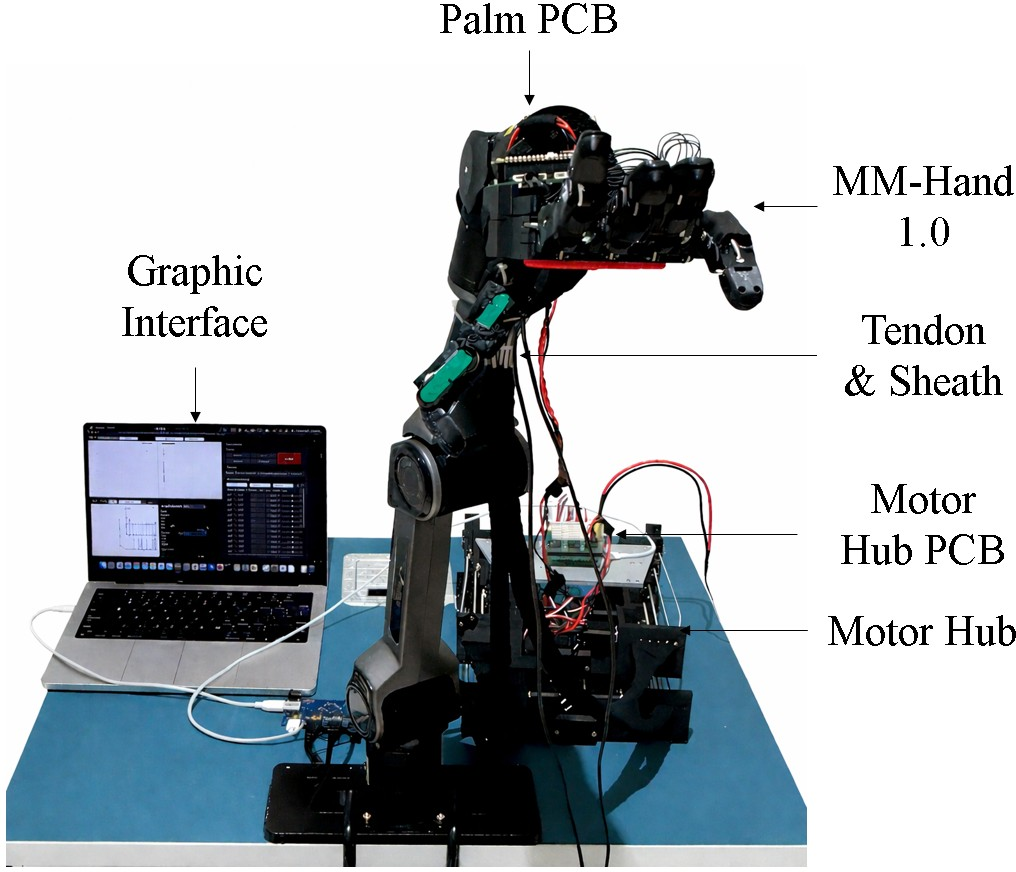
Figure 1: Overview of the MM-Hand system and its main remote tendon-driven components.
MM-Hand integrates modular, 3D-printed phalangeal architectures with embedded tactile, proprioceptive, and visual sensing. The palm structure reserves internal volume for sensor placement, cable management, and rapid disengagement, creating a platform for scalable research in dexterous manipulation.
Mechanical and Structural Design
The hand achieves 21 DoFs, implemented with a combination of modular long-finger architecture, an anthropomorphic thumb, and spring-return or antagonistic tendon routing as appropriate for each joint. The majority of joints employ single-tendon actuation with a spring providing extension/retraction forces, while the thumb's CMC1 employs antagonistic tendons to manage increased parasitic torque.
The long fingers are constructed using vertically split phalanges with internal routing channels, optimizing 3D printability, cable installation, and sensor wire placement.
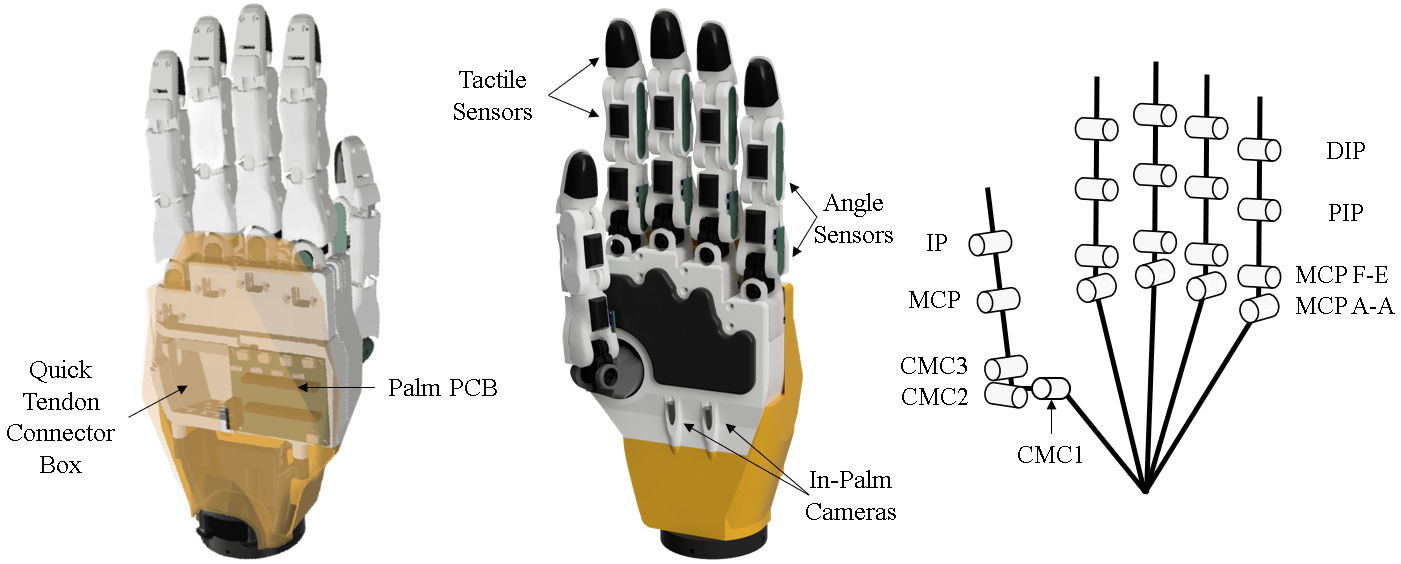
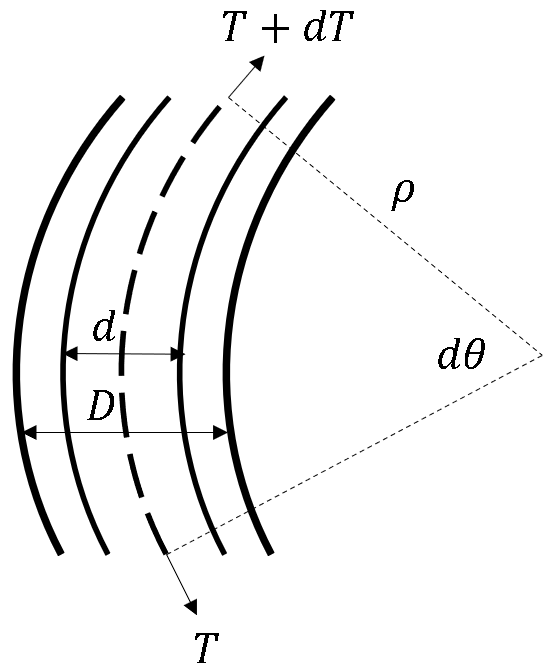
Figure 2: Left panel: MM-Hand mechanical structure, sensor placement, and DoF distribution. Right panel: Analytical results for sheath-tendon path length and friction variation.
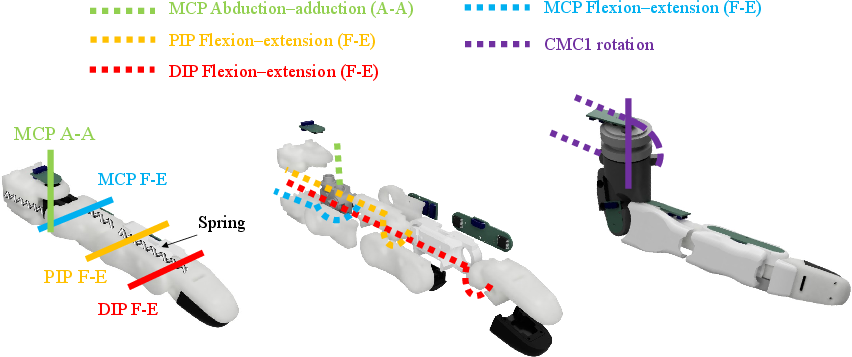
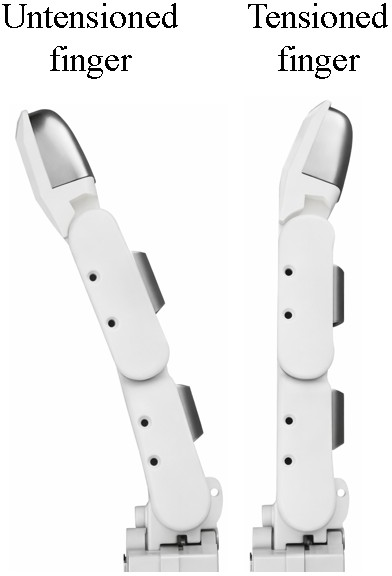
Figure 3: Left panel: Exploded and annotated views of the modular finger design, tendon routing, and thumb structure. Right panel: Software-based tendon pretensioning scheme for spring-return actuation.
The palm houses a two-part enclosure featuring a rapid-disconnect tendon hub. This enables finger or sheath segment replacement independently, with minimal disassembly. The sheath-tendon routing is designed to minimize curvature and friction while ensuring platform compatibility; modular quick-connect interfaces further enhance system maintainability.
Remote Tendon-Driven Actuation: Modeling and Implementation
MM-Hand adopts a Bowden-type cable transmission, with tendons routed via sheaths along the robot's arm exterior. Theoretical analysis quantifies the effect of sheath curvature and friction on transmission and force delivery. The system models tendon length variation as a function of the accumulated sheath curvature angle, with frictional loss predicted exponentially with respect to total bending angle ϕ and the friction coefficient μ.
Key relationships are:
- Path-dependent tendon stretch introduces configuration-dependent errors in joint actuation.
- Transmission friction follows a capstan equation exponential in μϕ, significantly constraining force delivery over long, curved paths.
The palm-side tendon connection and motor hub are explicitly designed to minimize additional friction and resistive elements. The hand implements software-based tendon pretensioning, avoiding discrete mechanical tensioners and further reducing hardware footprint and complexity.
Multimodal Sensing and Electronic System Architecture
MM-Hand integrates high-resolution joint encoders (AMS AS5047P), tactile sensor arrays (PaXini Elite), and in-palm stereo vision. The tactile sensing includes both fingertip and phalangeal coverage, crucial for measuring distributed contact and surface interactions.
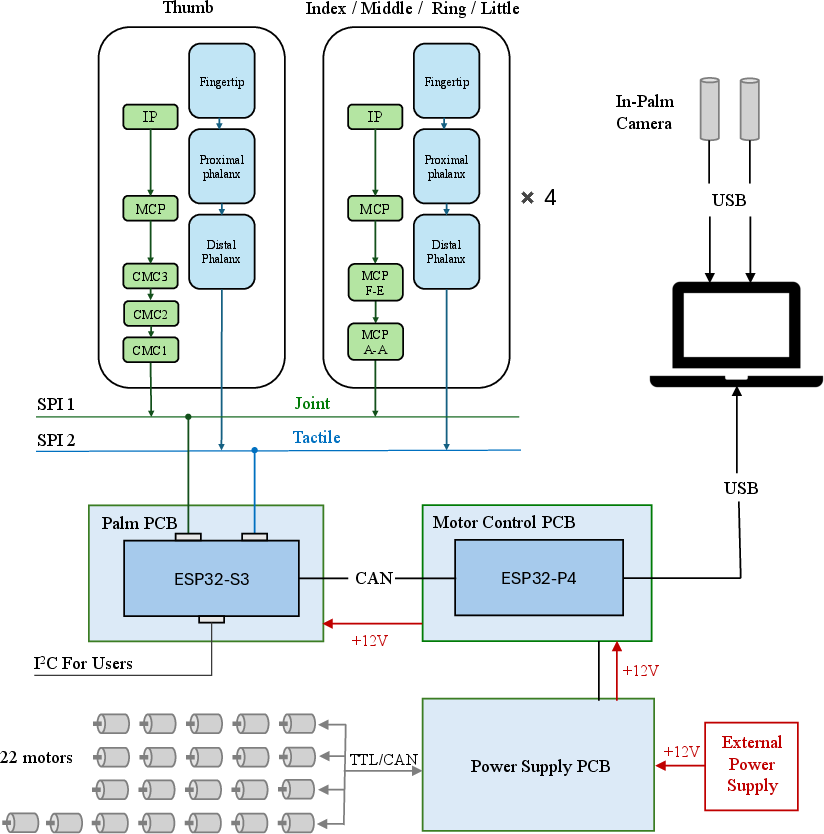
Figure 4: Electronics architecture diagram for MM-Hand showing sensor, controller, and communication subsystem layout.
Sensors are organized along shared SPI buses and aggregated at the palm PCB, which relays all sensing and actuator data via CAN/USB to the main computer. Firmware design allows for scalable expansion and low wiring density, addressing a major challenge for high-DoF hands.
Experimental Validation
Transmission Friction Characterization
A quantitative friction measurement protocol evaluates tendon friction versus sheath type, curvature, and length, benchmarking four sheath materials. The metal spring tube and high-quality PTFE-based Bambu feeder tube exhibited the lowest kinetic friction, with friction increasing exponentially with wrap angle as predicted. Notably, a remote actuation configuration of 1m sheath length resulted in an 8N force penalty relative to a short (0.1\,m) sheath, confirming the model's predictions.
Output Force Capability
Under 1m Bowden transmission, a single finger's proximal joint delivers up to 25N of fingertip force, demonstrating practical load capacity for in-hand manipulation tasks despite the remote actuation penalty.
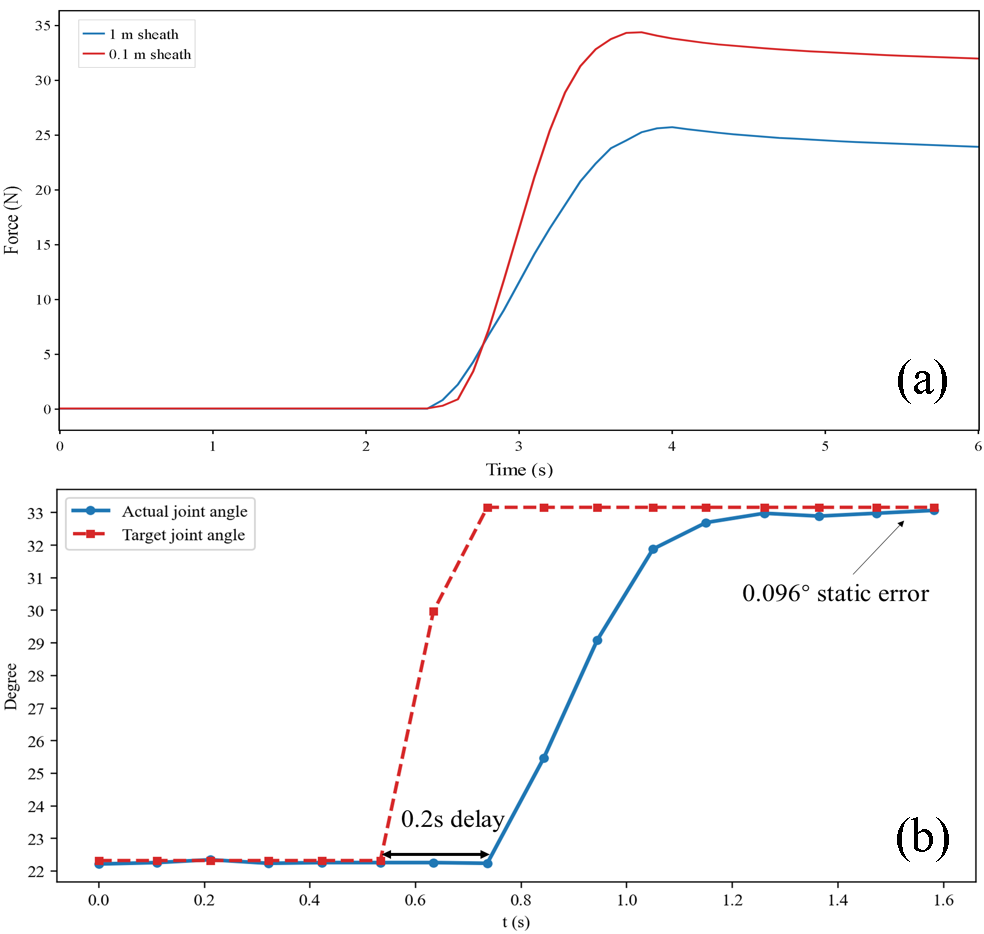
Figure 5: Left panel: Fingertip force measurement setup and results for short and long sheaths. Right panel: Static joint positioning error on step response.
Each DoF utilizes closed-loop PID control based on joint-centric encoders, compensating for nonlinear losses, slack, and external disturbances. Step and dynamic tracking experiments reveal steady-state errors <0.1∘—limited by friction-induced delay (~0.2s at actuation onset), which dominates over disturbance from manipulator motion.
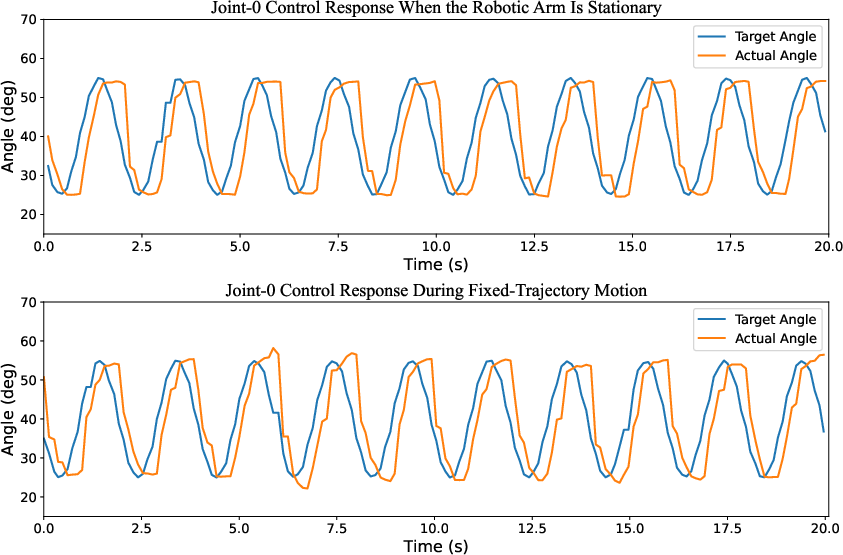
Figure 6: Time-series tracking of joint command and measured angle under reference input for stationary and moving manipulator settings.
In-Palm Visual Sensing
Stereo cameras with a pretrained RAFT-Stereo model yield dense metric depth maps for scene understanding and closed-loop visual manipulation, completing the hand's multimodal sensing stack.
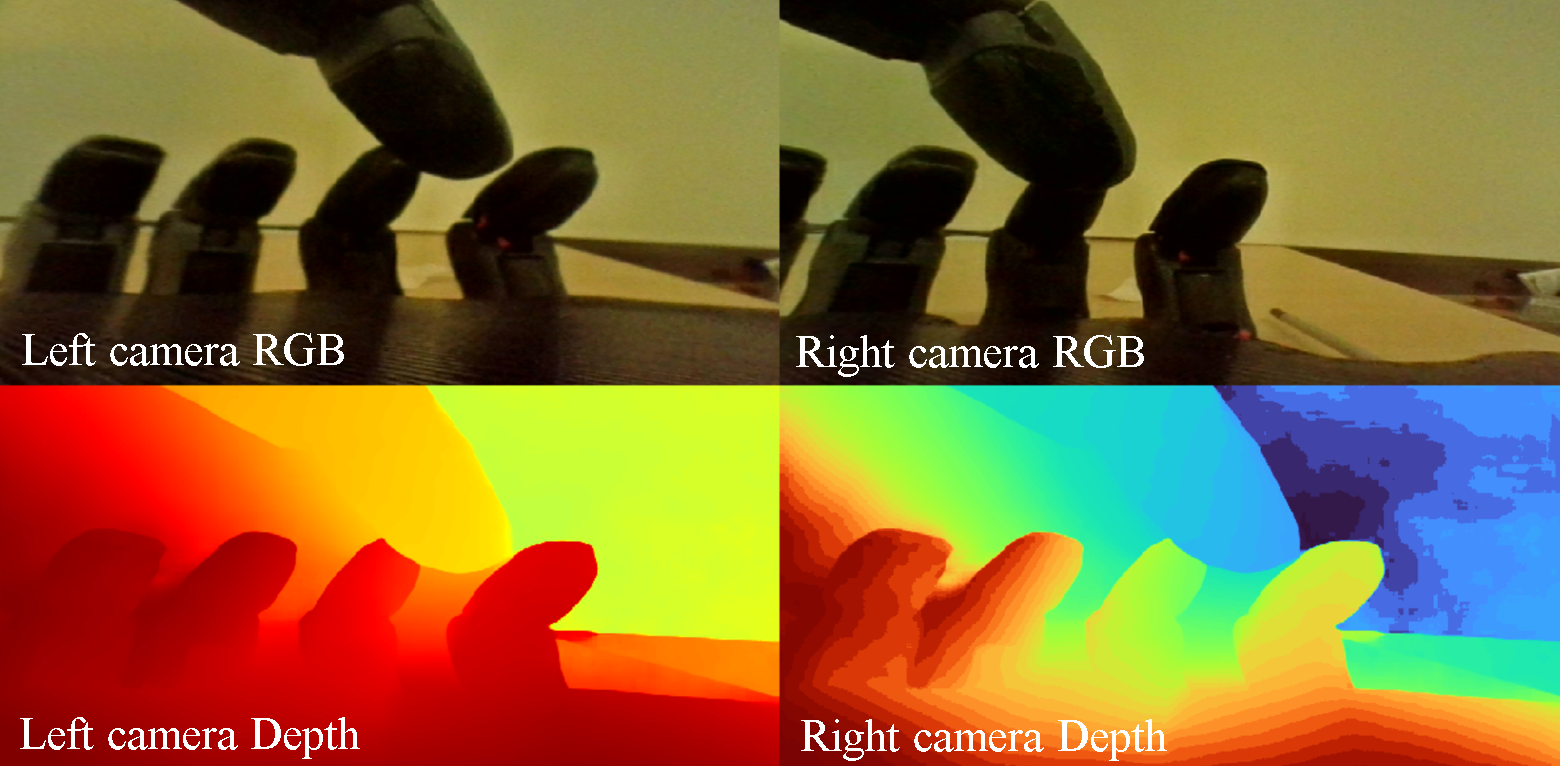
Figure 7: Depth estimation output from the in-palm stereo vision system during active grasping.
Practical and Theoretical Implications
MM-Hand addresses size, mass, and thermal limitations constraining classic anthropomorphic hands, enabling integration of richer visuohaptic modules. The open and modular platform facilitates comparative manipulation research, reproducibility, and extensibility. The comprehensive analysis of tendon friction and routing provides design rules applicable to future remote actuator hands. Experimentally, MM-Hand demonstrates that high dexterity and force are attainable despite transmission penalties associated with long-run Bowden-actuated systems.
On the practical front, MM-Hand's architecture supports rapid maintenance, component upgrades (e.g., improved tactile arrays or vision modules), and seamless integration into varied robotic platforms. The electronic and mechanical modularity directly supports community-driven adaptation and benchmarking, which is essential for iterative hardware/software co-design and high-throughput manipulation research.
Theoretically, the closed-form friction and kinematic coupling models serve as a foundation for advanced compensation schemes or learning-based adaptive controllers. Future work toward improving tendon material durability, minimizing delay, and increasing spring force for abduction-adduction will enhance the platform's capabilities.
Conclusion
MM-Hand establishes a scalable, maintainable framework for dexterous robotic hands, systematically addressing the actuation, sensing, and integration challenges in high-DoF systems (2604.17245). By combining modular remote actuation, compact mechanics, and dense multimodal perception, the platform supports further research into tactile and visuomotor control, sim-to-real transfer, in-hand policy learning, and hardware-in-the-loop teleoperation. MM-Hand's open-source release and validated experimental suite substantiate its value as a robust baseline for dexterous manipulation studies.