- The paper introduces a pioneering protocol for preparing magnonic GKP states using a hybrid magnon-transmon-cavity system to realize error-corrected logical qubits.
- The paper details using ellipsoidal magnetic crystals for intrinsic magnon squeezing and cavity-mediated conditional displacement to perform precise state manipulations.
- The paper demonstrates high-fidelity state generation with logical fidelities around 87% and highlights applications in quantum sensing and fault-tolerant computation.
Magnonic Gottesman-Kitaev-Preskill States: Protocols, Implementation, and Implications
Introduction
Bosonic codes, which encode logical qubits in continuous-variable (CV) oscillators rather than discrete multi-qubit registers, have motivated extensive research into robust quantum error correction (QEC). Among such codes, the Gottesman-Kitaev-Preskill (GKP) code exhibits superior resilience against both phase- and amplitude-shift errors, thanks to its grid-like structure in phase space. While GKP states have been studied and produced in a select number of platforms (notably trapped ions, superconducting resonators, and optical fields), the extension of these codes to magnonic systems represents a notable advancement in hybrid quantum technologies.
This paper introduces and analyzes the first protocol for preparing magnonic GKP states, utilizing an ellipsoidal magnetic crystal coupled to a superconducting qubit via a microwave cavity. The approach leverages intrinsic geometric anisotropy-induced magnon squeezing and a cavity-mediated conditional displacement (CD) interaction controllable by the superconducting qubit. The paper includes explicit characterization of the generated states through Wigner functions, logical operator expectation values, and fidelity metrics, demonstrating the magnonic system as a promising platform for bosonic QEC, fault-tolerant quantum computation, and quantum sensing (2604.27565).
GKP Code Structure and Phase-Space Representation
The GKP code protects a logical qubit by structuring its logical ∣0⟩L and ∣1⟩L states as periodic grids in the oscillator's phase space. The square lattice construction is defined by two commuting displacement (stabilizer) operators SX=D(u) and SZ=D(v), corresponding to translations along two orthogonal axes, satisfying the symplectic commutation Φ=Im(vu∗)=2π. Logical Pauli operations XL, YL, and ZL are realized by half-lattice displacements.
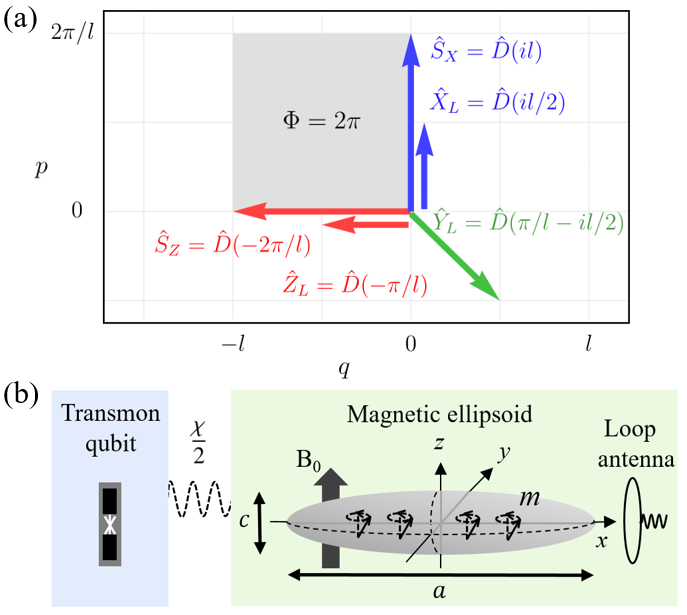
Figure 1: (a) The phase-space construction of stabilizers and logical Pauli operators, encoding the algebraic structure of the GKP code. (b) Schematic of a squeezed magnon mode in a magnetic ellipsoid coupled to a superconducting transmon qubit via a microwave cavity.
Physical GKP states are approximated via finite superpositions of displaced squeezed states, due to the inherent non-normalizability and energy divergence of ideal grid states. The protocol designed in this paper is tailored to the accessible laboratory regime, where only a few lattice components with strong squeezing can be physically realized but still support error correction for realistically bounded displacement errors.
System Architecture: Magnon-Transmon-Cavity Coupling
The protocol utilizes a hybrid system comprising:
- Squeezed magnon mode: Generated by geometric anisotropy of the ellipsoidal magnetic crystal.
- Transmon superconducting qubit: Provides nonlinear control for the magnon mode.
- Microwave cavity: Mediates strong, tunable interaction between the magnon and transmon via virtual photon exchange.
After quantizing the magnetization using Holstein-Primakoff transformations, the Kittel mode Hamiltonian incorporates both the oscillator energy and intrinsic magnon squeezing. The effective magnon-qubit Hamiltonian is derived through adiabatic elimination of the cavity, resulting in a CD interaction: Hmq/ℏ=−2χ(ms+ms†)σx,
where ms is the squeezed (Bogoliubov) magnon annihilation operator and ∣1⟩L0 is the controllable coupling. This interaction applies a coherent displacement of the magnon mode conditional on the qubit state along the phase axis.
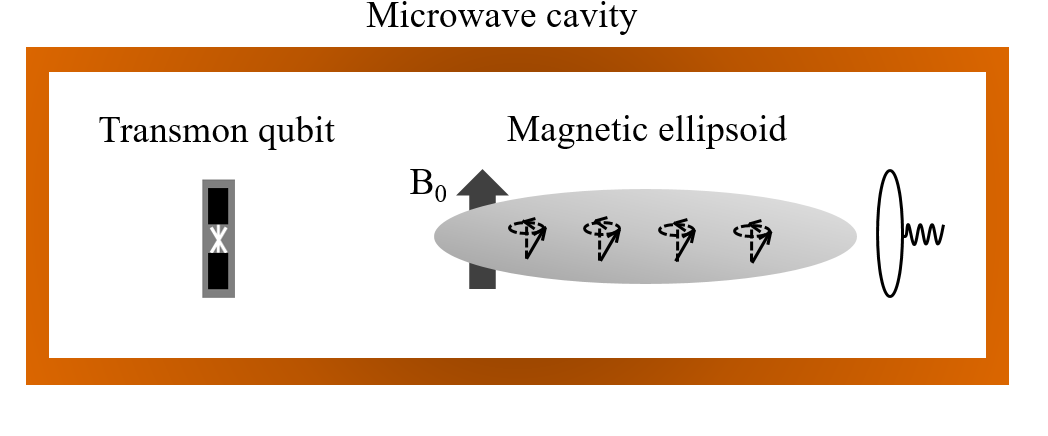
Figure 2: Diagram of the cavity-bridged hybrid coupling between the magnon mode in an ellipsoid and the superconducting qubit.
Protocol for Magnonic GKP State Preparation
State generation proceeds as follows:
- Initialization: Place the magnon in its squeezed vacuum and the transmon in its ground state.
- First CD interaction: Under the effective Hamiltonian, evolve the joint system, yielding conditional magnon displacements entangled with the qubit.
- First projective measurement: Project the qubit onto its ground state, which leaves the magnon in a superposition of two displaced squeezed states.
- Second CD interaction: Repeat the conditional displacement-entanglement process, potentially with a different interaction duration.
- Second projective measurement: Another qubit measurement results in a magnon state consisting of three or four displaced squeezed vacuum components, forming the finite GKP grid.
Tailoring the interaction durations enables precise control over the superposition structure—equal durations for three components, or a 2:1 ratio for four components.
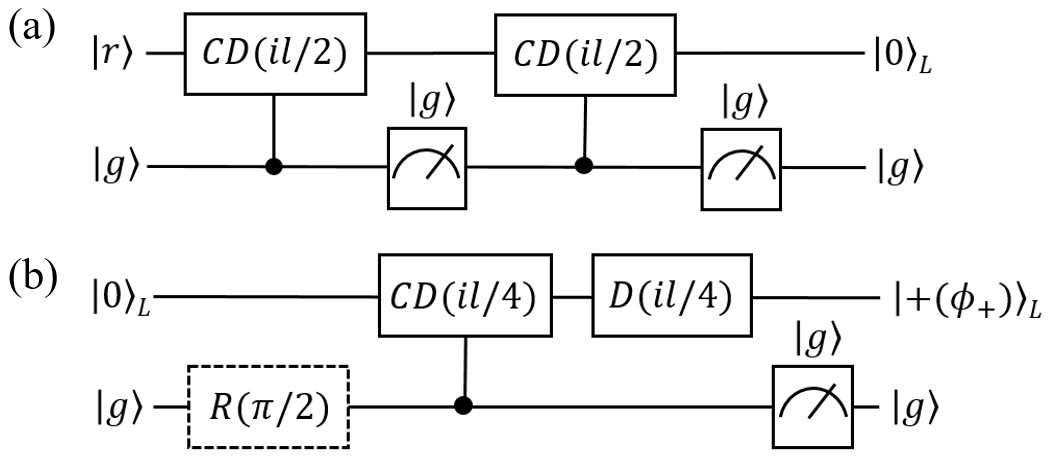
Figure 3: Operation sequence for magnonic GKP state generation and logical gate implementation; each sequence alternates CD interaction, projective measurement, and (as needed) magnon displacements and qubit rotations.
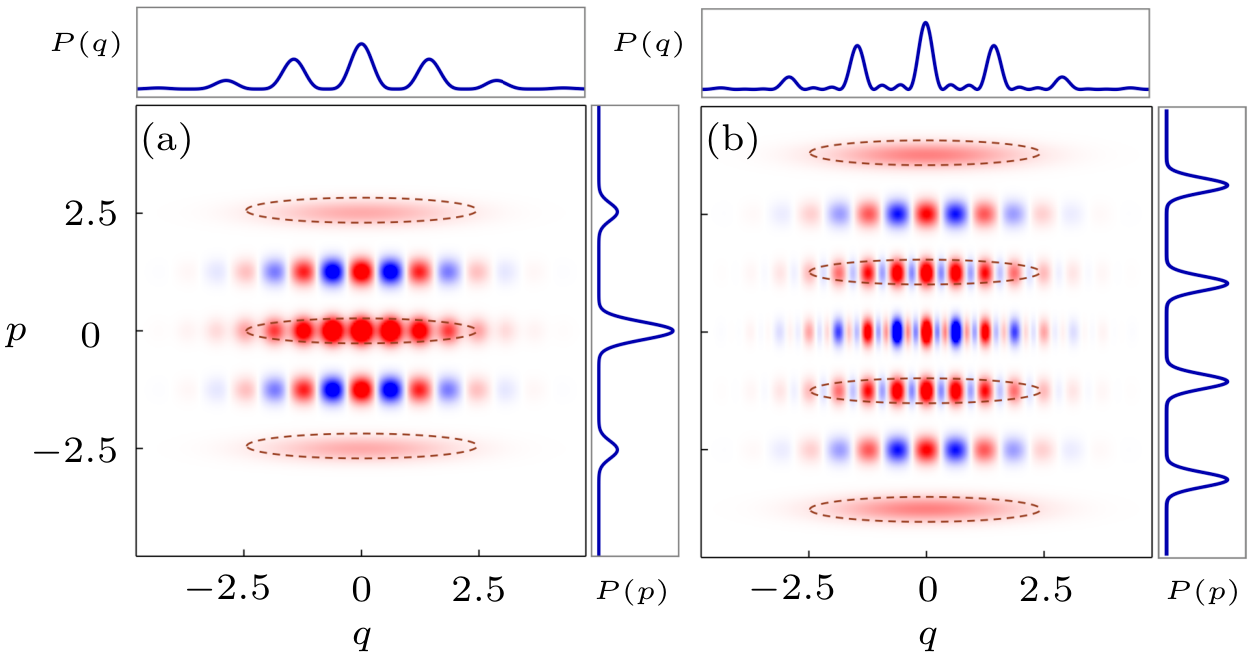
Figure 4: Wigner functions of the three- and four-component magnonic superposition states, visualizing their approximate grid structure in phase space as required for the GKP code.
The protocol is robust to laboratory frame corrections: inverse transformations due to the cavity elimination, Bogoliubov squeezing, and rotating frames are accounted for, ensuring accurate realization of magnon GKP states.
Logical Encoding, Gate Operations, and State Characterization
The generated three-component magnon state is selected as the logical ∣1⟩L1, with ∣1⟩L2 synthesized by a half-lattice displacement (Pauli ∣1⟩L3 operation via resonant drive). Single-qubit logical gates are implemented via controlled displacements, projective measurements, and additional qubit rotations.
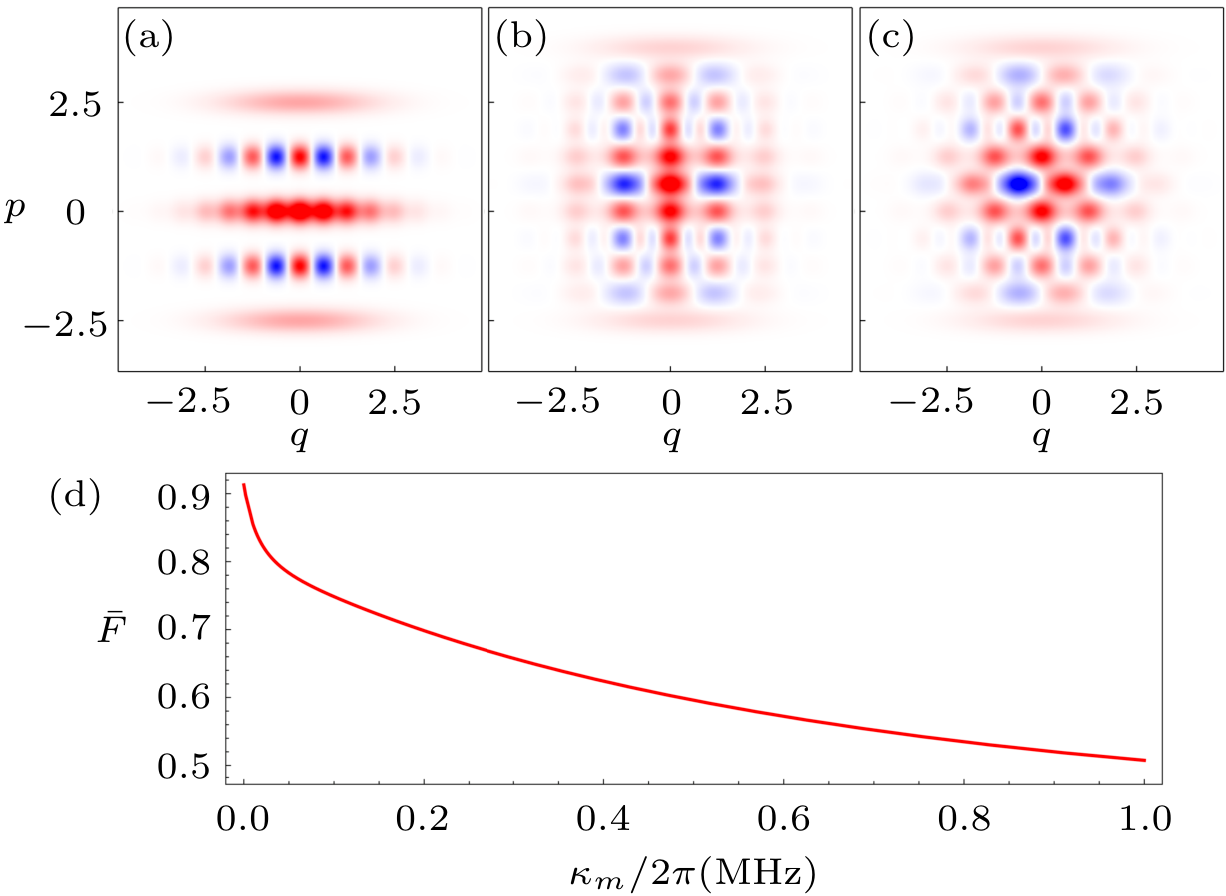
Figure 5: Wigner functions of logical Pauli basis states (∣1⟩L4, ∣1⟩L5, ∣1⟩L6) under realistic dissipative and dephasing conditions, alongside fidelity versus magnon loss rate.
Numerical simulations incorporating experimental dissipation (∣1⟩L7 mK; ∣1⟩L8) yield:
- Average fidelity of logical Pauli eigenstates: ∣1⟩L9 (the intrinsic finite-component limit is SX=D(u)0).
- Effective squeezing: Stabilizer expectation values correspond to SX=D(u)1 (SX=D(u)2) and SX=D(u)3 (SX=D(u)4).
- High-fidelity regime: Achievable through reduced magnon dissipation rates by improving material purity and cooling.
The protocol naturally completes the logical Pauli basis and supports Hadamard and phase gates using only local controls and projective qubit measurements.
Practical and Theoretical Implications
This work has several key implications:
- Magnonic QEC: Establishes the feasibility of implementing bosonic codes in magnetic excitations, linking quantum error correction with spintronic and magnonic device engineering.
- Hybrid quantum architectures: Demonstrates strong nonlinear couplings and state engineering in magnon–superconductor–cavity systems, broadening the toolbox for modular, hybrid QIP platforms.
- Quantum sensing: Squeezed magnon GKP states exhibit high sensitivity to displacement, enabling their use as resources for quantum-limited detection of weak magnetic fields or axion dark matter.
- Extensions: The same CD interaction protocols can in principle generate other non-Gaussian magnonic states (cat, squeezed Fock states) and facilitate direct characteristic-function tomography of magnon states.
The theoretical design aligns closely with present-day capabilities as exemplified by system parameters and realistic decoherence models. This robust platform invites exploration of error-corrected magnonic quantum memories, quantum networking, and scalable quantum sensors.
Conclusion
The paper presents a blueprint for the deterministic preparation of magnonic GKP states, leveraging intrinsic geometric squeezing and cavity-mediated conditional-displacement dynamics. Strong logical fidelities and squeezing, combined with compatibility with superconducting and spintronic architectures, confirm the applicability of magnonic systems to bosonic QEC, fault-tolerant quantum computation, and quantum metrology. Future directions include experimental realization, scaling to multi-mode and multimagnon encodings, error-corrected magnonic memories, and integration into hybrid quantum-classical computing networks.

