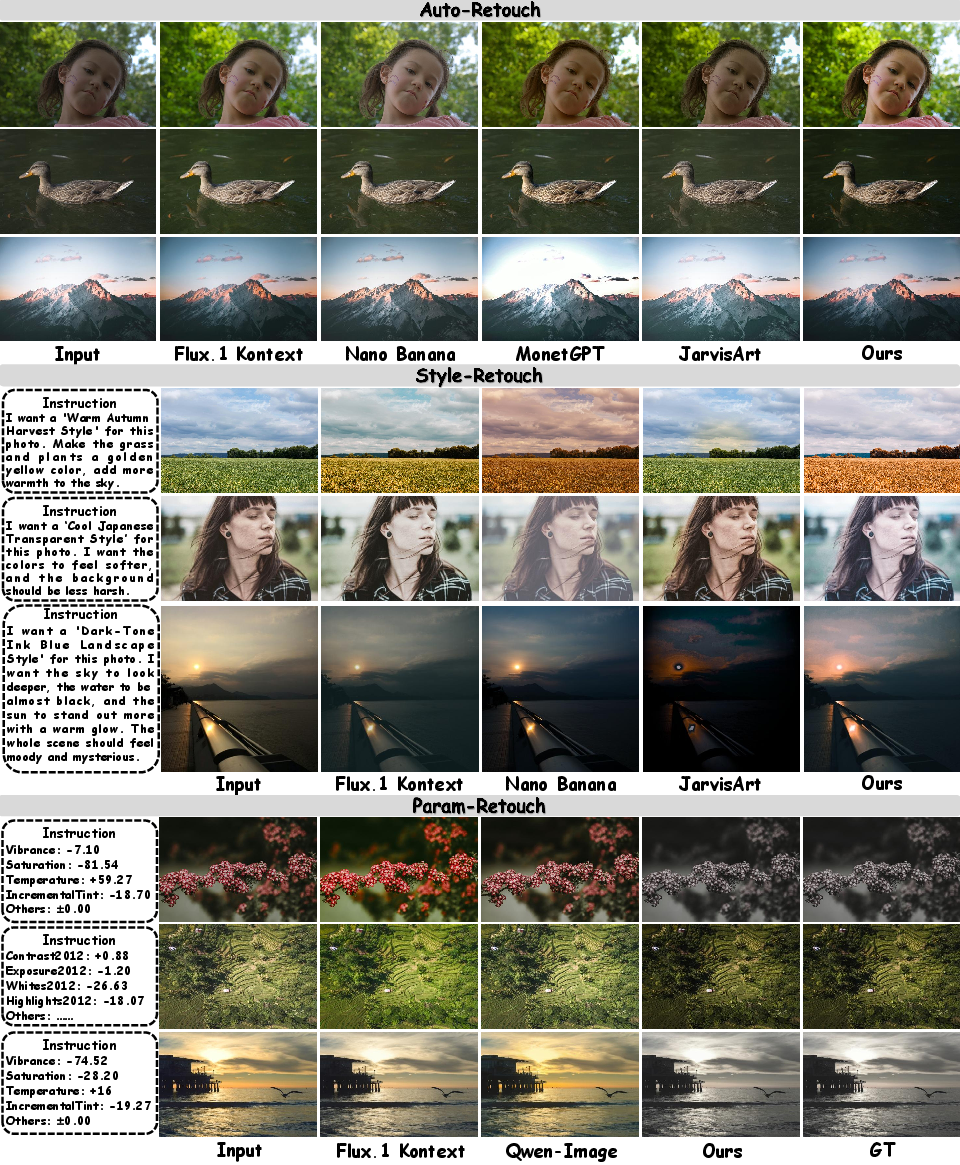
- The paper introduces VeraRetouch, a fully differentiable framework enabling multi-task photo retouching with a structured reasoning approach using a 0.5B Vision-Language Model.
- It leverages a two-stage architecture with a Retouch Encoder and Renderer to extract disentangled latents for pixel-level enhancements, achieving superior PSNR and fidelity.
- The framework utilizes a million-scale synthetic dataset and reinforcement post-training to deliver state-of-the-art quality and efficient mobile deployment.
VeraRetouch: Technical Overview and Analysis
Motivation and Background
Photo retouching is integral to digital post-processing, requiring nuanced adjustments to tone and color while maintaining structural fidelity. Existing machine learning solutions often depend on non-differentiable external software (e.g., LightRoom, Photoshop), hindering gradient-based optimization and direct end-to-end training. Additionally, prior approaches exhibit parameter redundancy, suboptimal generalization, and limited dataset coverage. The VeraRetouch framework addresses these constraints by presenting a fully differentiable, lightweight solution for multi-task reasoning photo retouching, powered by a 0.5B Vision-LLM (VLM) and grounded in structured pixel-level training.
Architecture: Retouch Encoder and Retouch Renderer
VeraRetouch is built on a two-stage architecture: the Retouch Encoder and Retouch Renderer. The encoder, based on a ResNet backbone, extracts three disentangled control latents—lighting (L), global color (GC), and specific color (SC)—from reference input-target pairs, leveraging binary masks for selective activation.
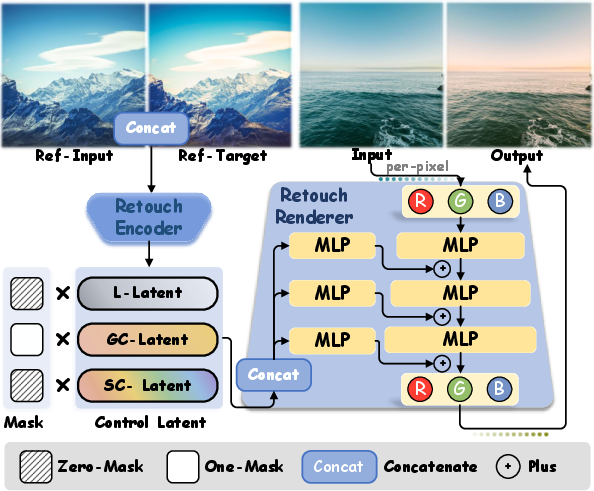
Figure 1: Retouch Encoder and Retouch Renderer structure, showing control latent extraction and per-pixel mapping through stacked MLP modules.
The Retouch Renderer is a lightweight MLP that translates the composite latent vector into per-pixel color adjustments, maintaining high-frequency texture and content invariance. This differentiable design enables direct gradient backpropagation during training, contrasting with the discretization gap imposed by legacy API-driven approaches.
Training Data: AetherRetouch-1M+ Dataset
Generalization in real-world scenarios is limited by small datasets (e.g., MIT-Adobe FiveK, PPR10K). VeraRetouch introduces AetherRetouch-1M+, a million-scale retouching dataset tailored to three operational workflows:
- Auto-Retouch: Inverse degradation generates pseudo unretouched images by inverting expert retouch logic.
- Style-Retouch: 5,030 style presets applied via rule-based category matching, with semantic instruction perturbations.
- Param-Retouch: Gaussian-random LightRoom parameter combinations synthetically applied.
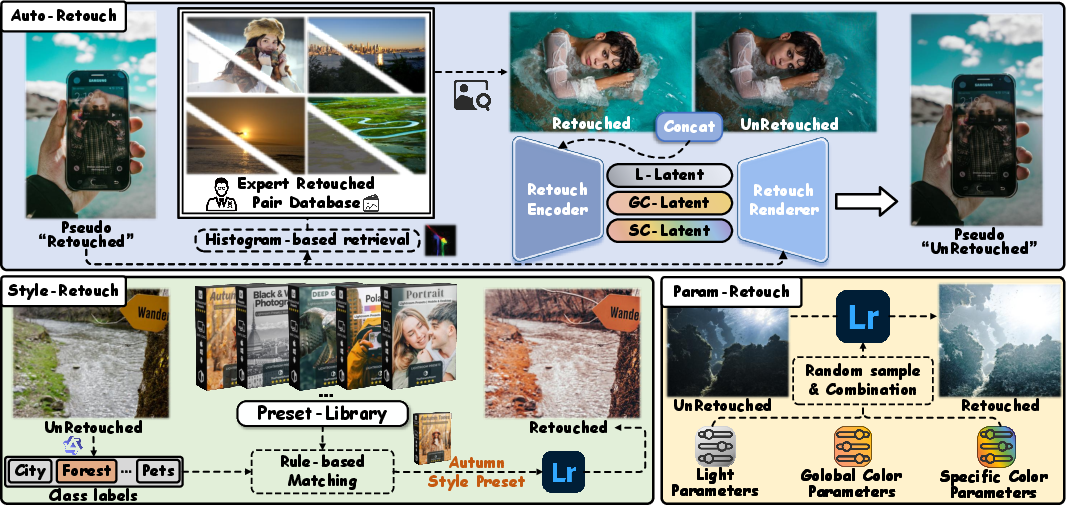
Figure 2: Data synthesis pipelines for AetherRetouch-1M+, covering auto, style, and parametric workflows.
The dataset is enriched with structured reasoning chains generated by VLMs, enabling models to learn the causal relationships of adjustments and robustly generalize across diverse image types.
Core Framework: Multi-Task Reasoning with VLM
VeraRetouch utilizes FastVLM-0.5B as its backbone for efficiency. The architecture integrates a FastViTHD Vision Encoder, Text Encoder, Multi-Modal LLM, MLP Retouch Adaptor, and Retouch Renderer. User instructions are tokenized for task selection, and the VLM generates structured reasoning completions that are mapped to disentangled latents via the adaptor.
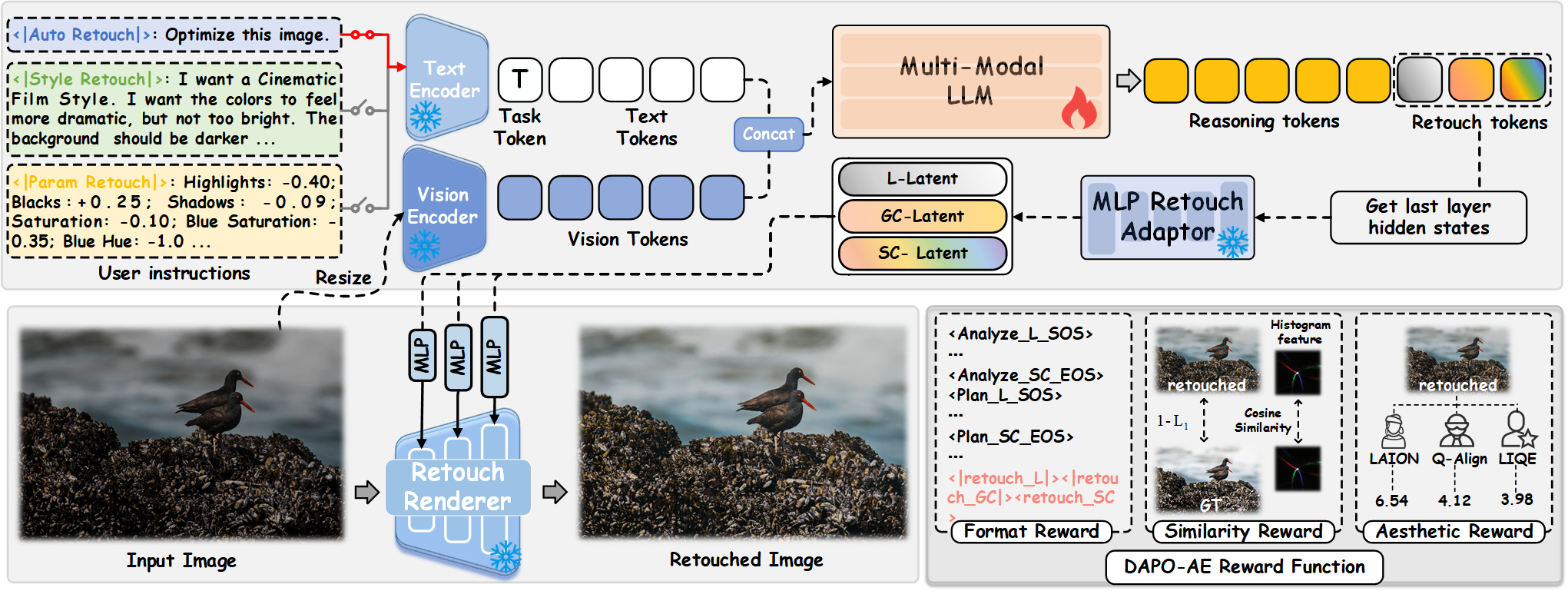
Figure 3: Overview of VeraRetouch’s pipeline: image plus optional prompt processed through VLM, yielding structured reasoning, retouch latents, and pixel-level enhancements.
To resolve feature-space mismatch between LLM outputs and renderer latents, an alignment pre-training procedure via a bottleneck MLP ensures synchronized distributions.
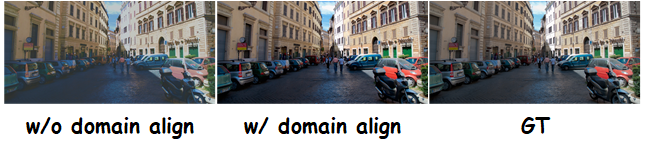
Figure 4: Domain alignment resolves latent mismatch, improving output fidelity.
Reinforcement Post-Training: DAPO-AE
Beyond supervised fine-tuning, VeraRetouch introduces DAPO-AE—a reinforcement learning post-processing phase using dynamic sampling and decoupled rewards for format, retouching similarity, and aesthetics. This stage incrementally refines the model's output to maximize perceptual appeal and logical consistency, particularly in challenging samples.
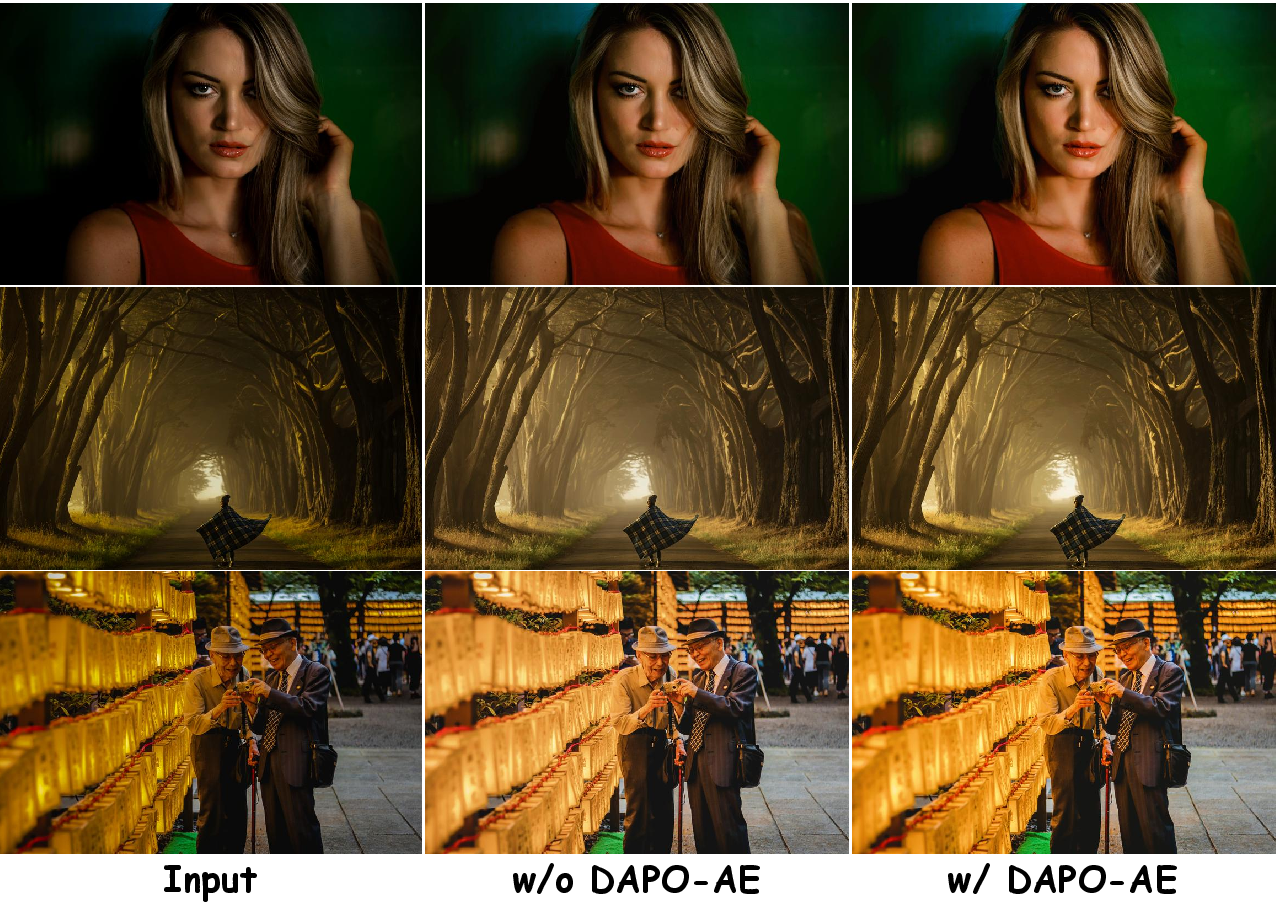
Figure 5: DAPO-AE enhances reasoning and aesthetic quality for complex cases.
Quantitative and Qualitative Evaluation
VeraRetouch achieves state-of-the-art results in all major benchmarks:
User studies corroborate the quantitative superiority, showing highest scores in prompt fidelity, aesthetics, and texture consistency.
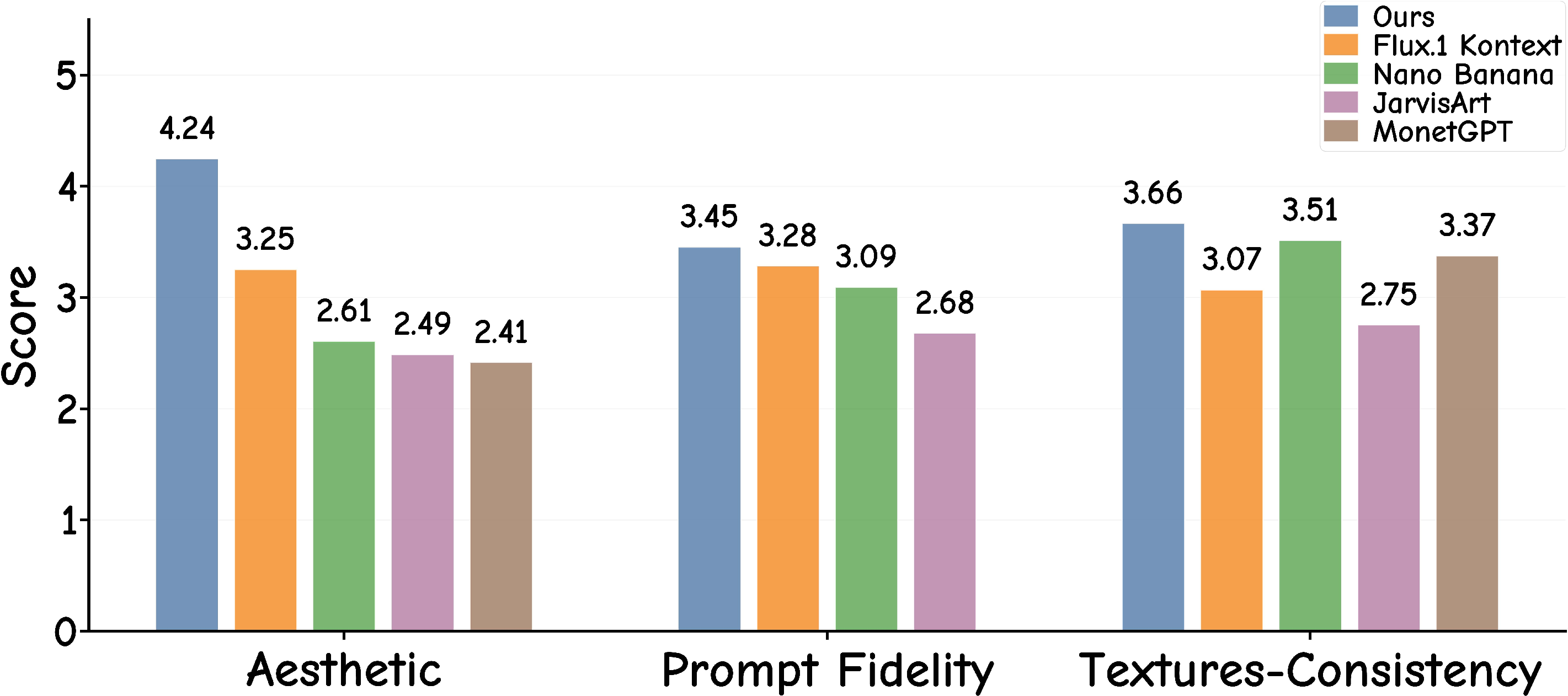
Figure 7: User study results confirm VeraRetouch’s alignment with human preferences on aesthetics and instruction fidelity.
Disentanglement and Operational Decoupling
Extensive ablation confirms that retouching latents for L, GC, and SC are effectively decoupled: masking any combination of latents yields outputs with high PSNR and structural similarity, validating the independence of control signals.
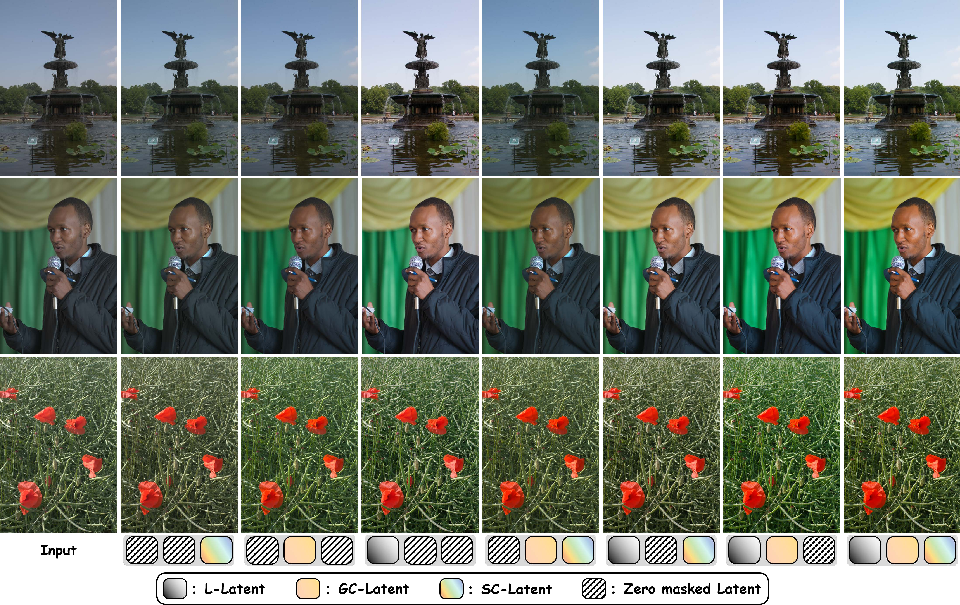
Figure 8: Visualization of masking individual latents, demonstrating independent impact on illumination, global, and specific color.
Efficiency and Deployment Potential
VeraRetouch operates at 6.9 seconds/image (H20 GPU) and demonstrates robust inference times on MacBook M4 (7.4s) and iPhone 16 Pro (13.5s), enabling practical mobile and edge deployment. This efficiency is achieved with ∼0.63B parameters, substantially below current agent- or diffusion-model baselines.
Dataset Visualization and Task Scope
AetherRetouch-1M+ contains diverse scenes and retouching requirements, with structured instruction distributions and semantic coverage.
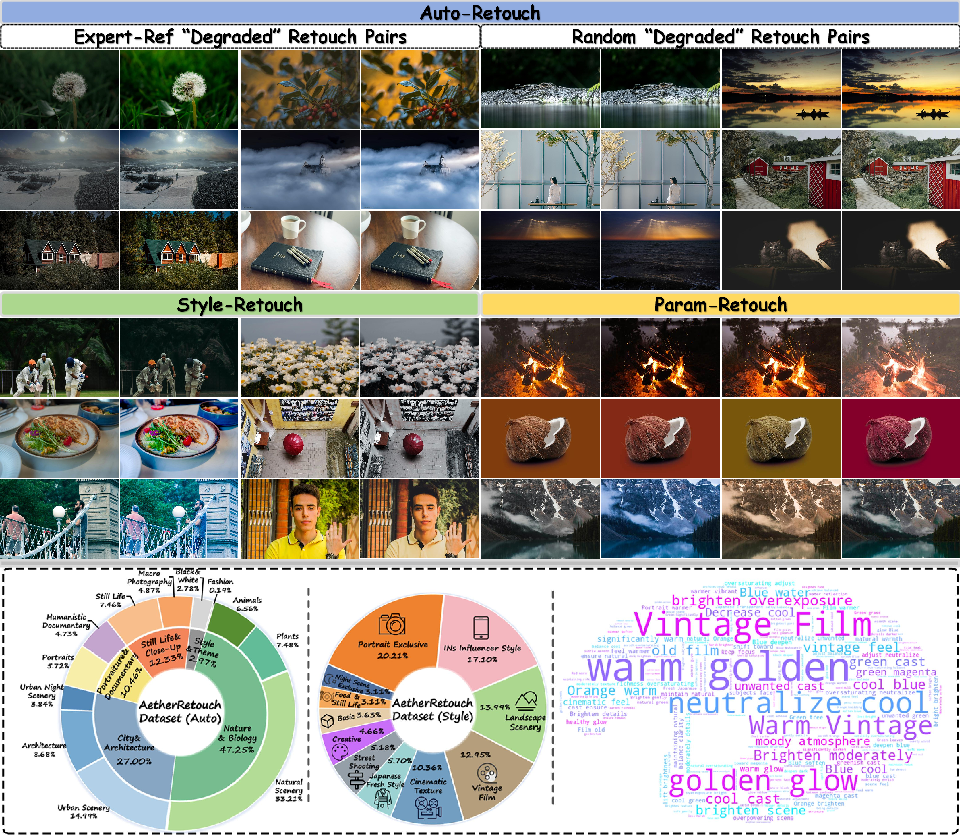
Figure 9: Dataset visualization shows category and instruction diversity, facilitating comprehensive training.
Multi-Round and Video Retouching
VeraRetouch supports iterative inference, enabling successive rounds of enhancements and consistent video retouching via latent transfer.
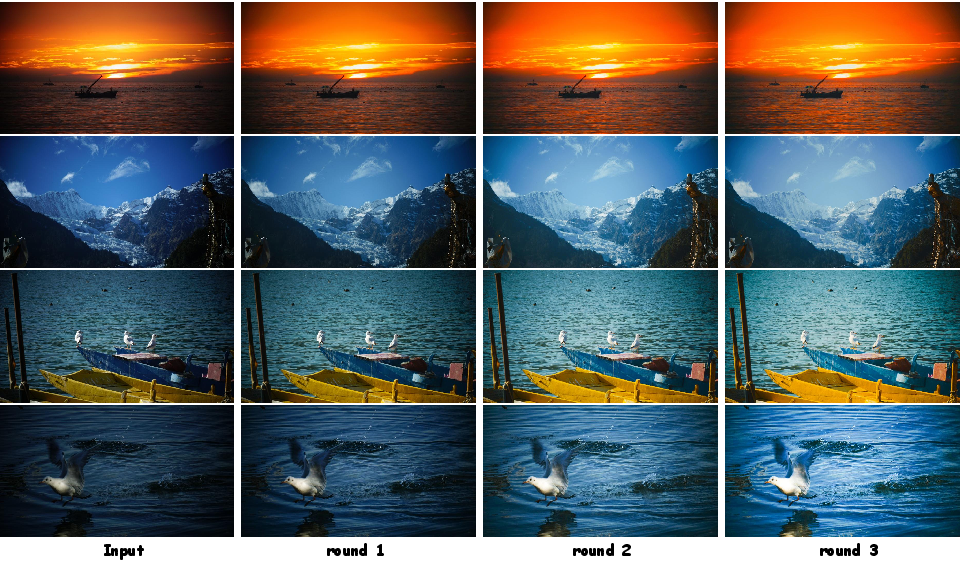
Figure 10: Multi-round inference demonstrates progressive improvements.
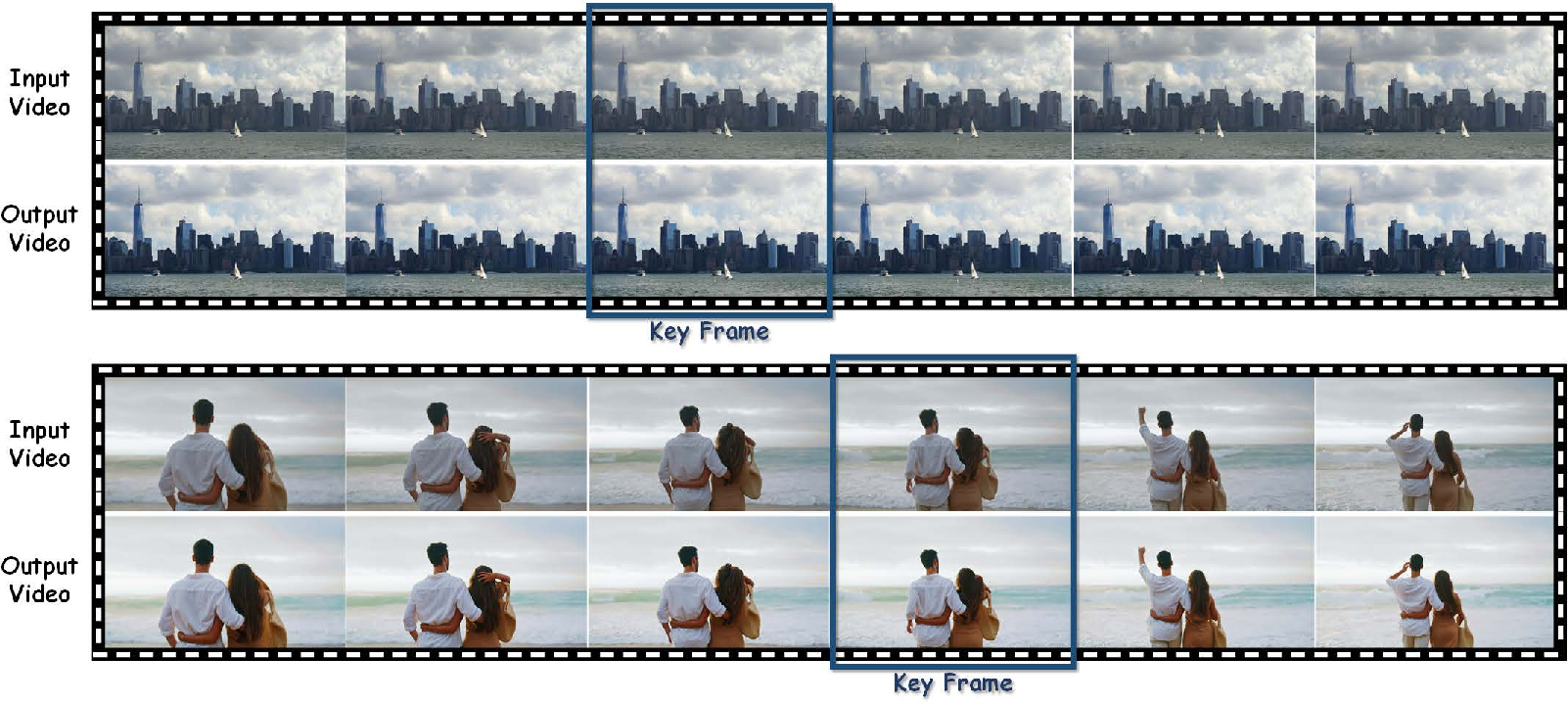
Figure 11: Video retouching achieves artifact-free, temporally consistent enhancements across frames.
Tests on 6000×3376 images confirm VeraRetouch’s efficacy for UHR scenarios, preserving content and enhancing aesthetics without degrading visual detail.
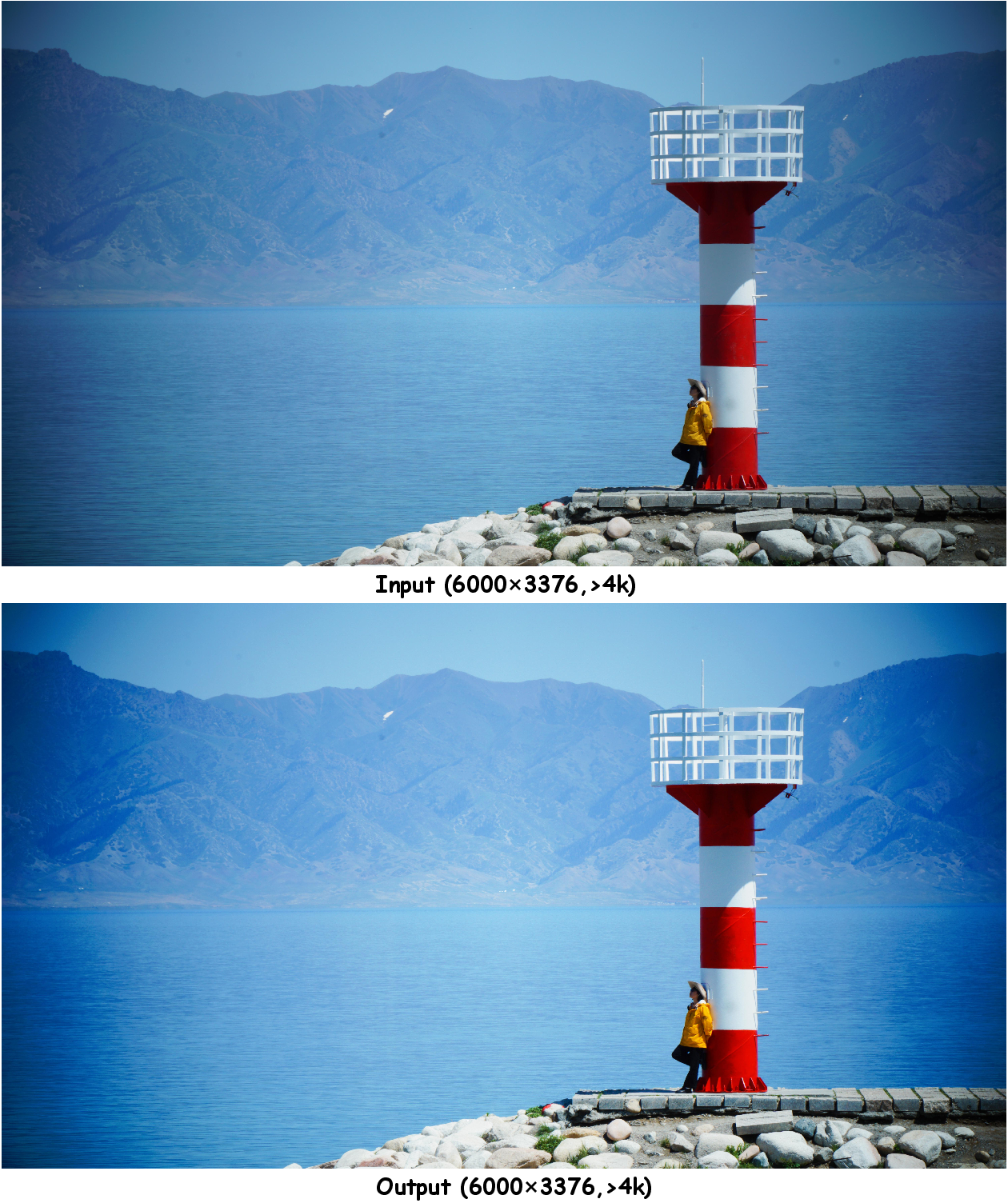
Figure 12: Ultra-HD retouching preserves texture and achieves high visual quality.
Implications and Future Directions
The VeraRetouch framework establishes a strong foundation for differentiable, reasoning-driven photo enhancement. The combination of lightweight VLMs, interpretable reasoning, structured latents, and large-scale synthetic data enables efficient mobile deployment and broad generalization. The research highlights the benefits of disentangled latent control and direct pixel-level optimization, contradicting prior claims that only large-scale, API-driven models can achieve high-quality retouching.
Moving forward, the integration of pixel-wise mask mechanisms and local region-specific editing promises greater precision for professional workflows. The robust structure of VeraRetouch’s reasoning chain suggests potential for broader chain-of-thought modeling in other image editing domains.
Conclusion
VeraRetouch (2604.27375) delivers a comprehensive solution for multi-task reasoning photo retouching, integrating a compact VLM, fully differentiable renderer, and large-scale reasoning dataset. Extensive quantitative and qualitative evaluations demonstrate state-of-the-art fidelity, efficiency, and aesthetic quality, fundamentally advancing automated photo enhancement and opening new prospects for interpretable, mobile-ready AI image processing.