- The paper introduces a differentiable framework that integrates a recurrent neural network dynamics model with a neural control policy for robust control of tendon-driven continuum robots.
- It demonstrates significant improvements in tracking accuracy and error suppression compared to traditional controllers under payload disturbances and temporal drift.
- The approach leverages bidirectional multi-channel GRUs and backpropagation through time to enhance temporal prediction and control robustness in real-world experiments.
Learning-Based Dynamics Modeling and Robust Control for Tendon-Driven Continuum Robots
Introduction
Tendon-Driven Continuum Robots (TDCRs) exhibit complex nonlinear dynamics due to frictional hysteresis, viscoelasticity, and transmission compliance, which significantly challenge accurate modeling and robust control. Conventional modeling approaches, such as Piecewise Constant Curvature (PCC) and Cosserat rod models, face limitations regarding fidelity, parameter identifiability, and computational efficiency. Standard Jacobian-based and Model Predictive Control (MPC) strategies are inadequate for real-time, high-fidelity control under uncertainties inherent to TDCRs.
This paper presents a differentiable learning-based framework that integrates a high-fidelity, recurrent neural network (RNN) dynamics model with a robust, neural policy for closed-loop control. The approach couples bidirectional, multi-channel gated recurrent units (GRUs) to capture temporal dependencies and nonlinearities and proposes an end-to-end differentiable training pipeline for policy optimization via backpropagation through time. Experimental validation on a three-section physical TDCR platform demonstrates strong tracking precision and substantial robustness advantages under payload disturbances and dynamical drift.
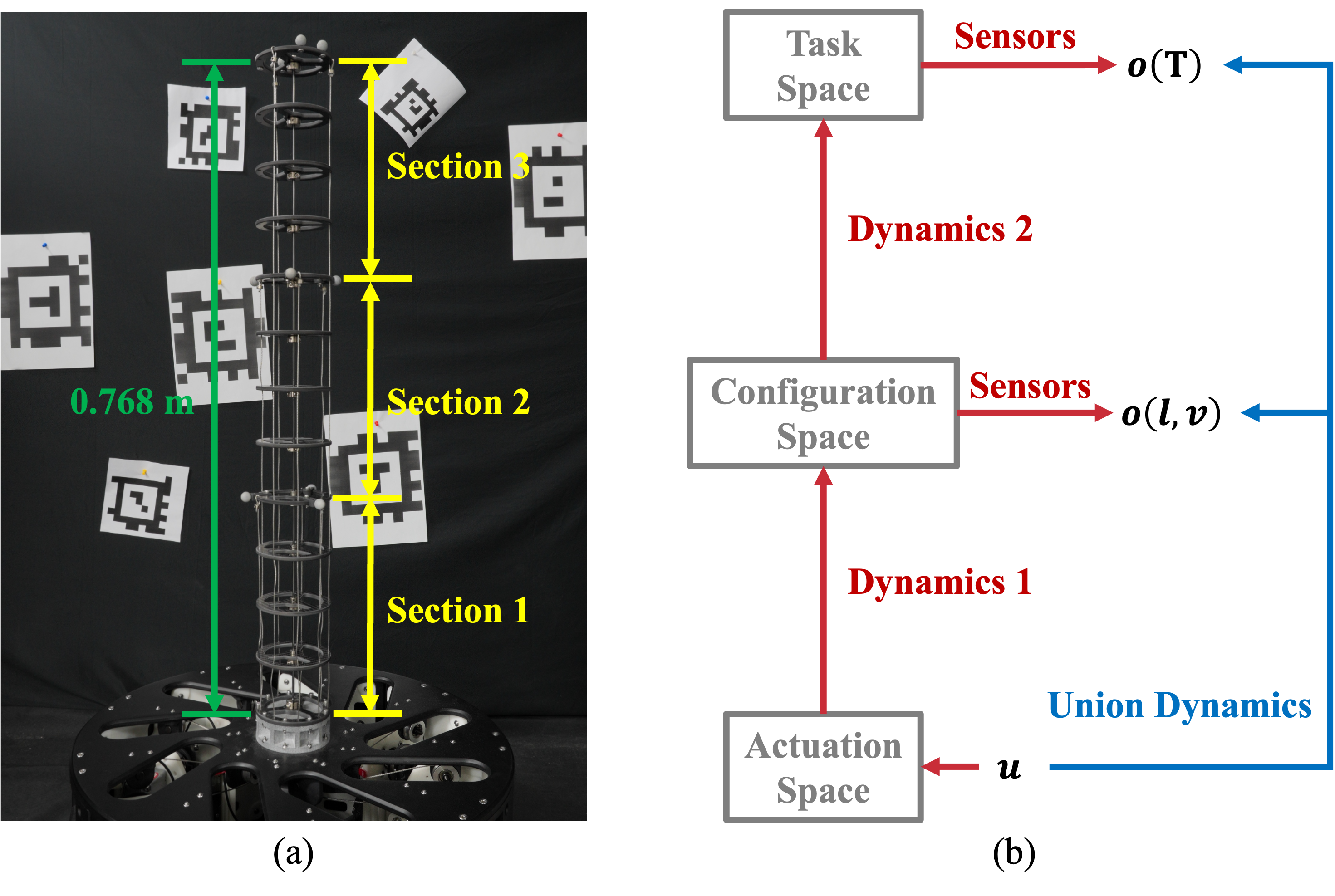
Figure 1: (a) The 0.768m tall three-section TDCR platform used in this study. (b) The system dynamics from control inputs to sensory outputs.
Architecture and Model Pipeline
The proposed framework consists of two primary modules: a recurrent dynamics model and an RNN-based neural control policy. The dynamics model uses GRUs augmented with bidirectional multi-channel connectivity and residual prediction, substantially improving gradient propagation over long time horizons and mitigating compounding error propagation prevalent in auto-regressive inference settings.
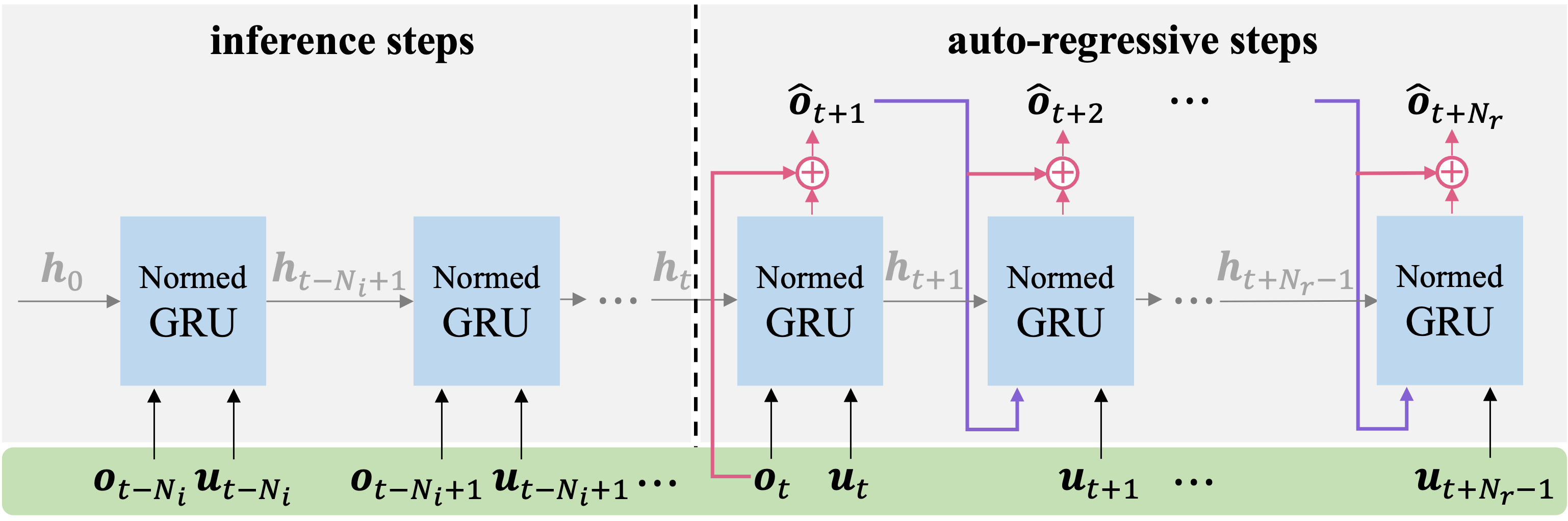
Figure 2: Training pipeline of the dynamics model. During inference steps, the hidden state h is updated recurrently to incorporate historical context.
The neural control policy leverages the learned hidden states and temporal context from the dynamics model and is optimized via backpropagation through differentiable rollouts. During both warm-up and auto-regressive phases, the pipeline couples hidden state evolution with residual observation/action predictions, enforcing temporal continuity and control smoothness.
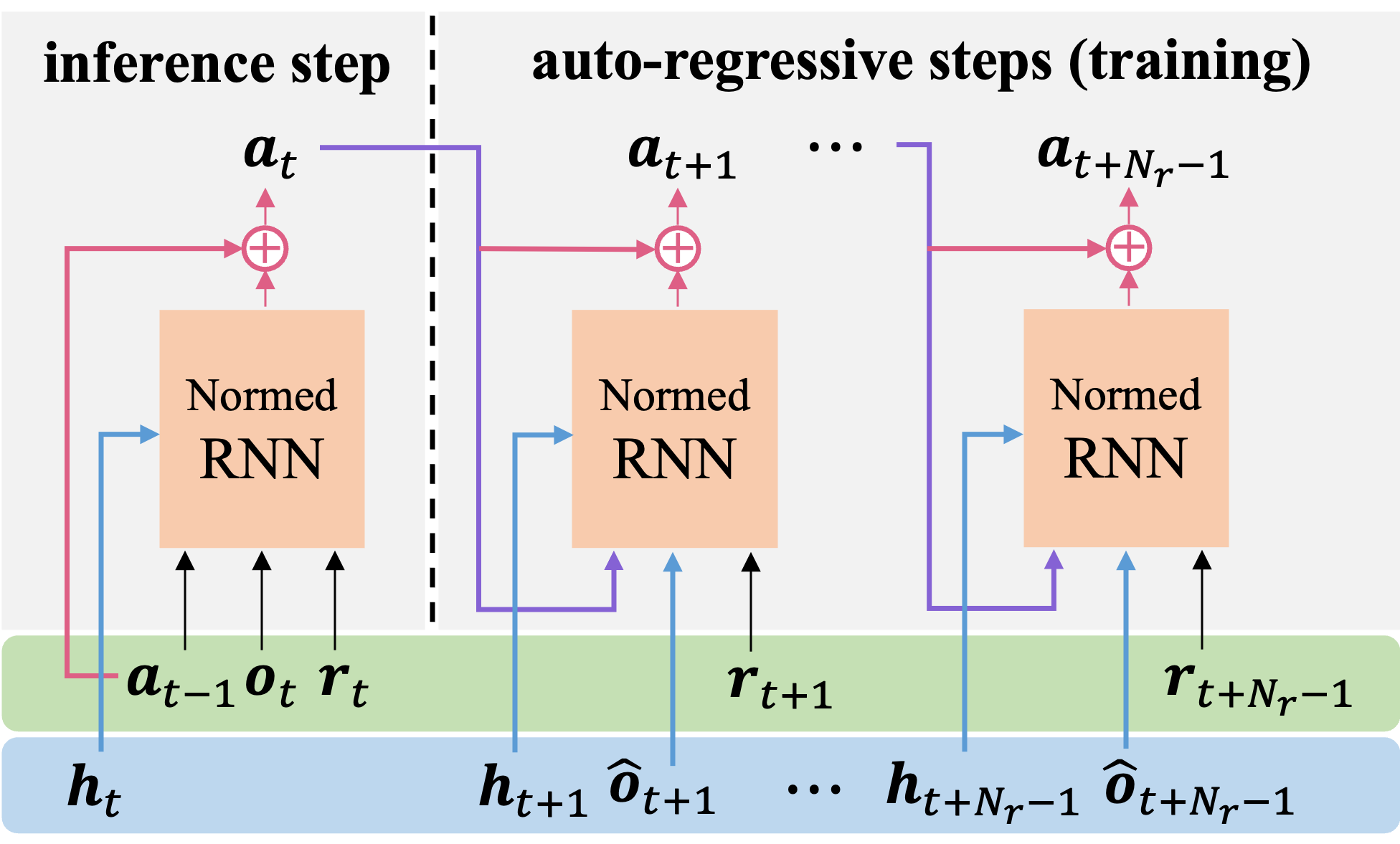
Figure 3: Training pipeline of the neural control policy. During auto-regressive steps, policy recursively incorporates hidden states and predicted observations from the dynamics model, generating residual actions fed back into the pipeline.
The network backbone consists of a 4-layer RNN with LayerNorm and dropout regularization, supporting high-capacity modeling of non-Markovian, history-dependent robot dynamics.
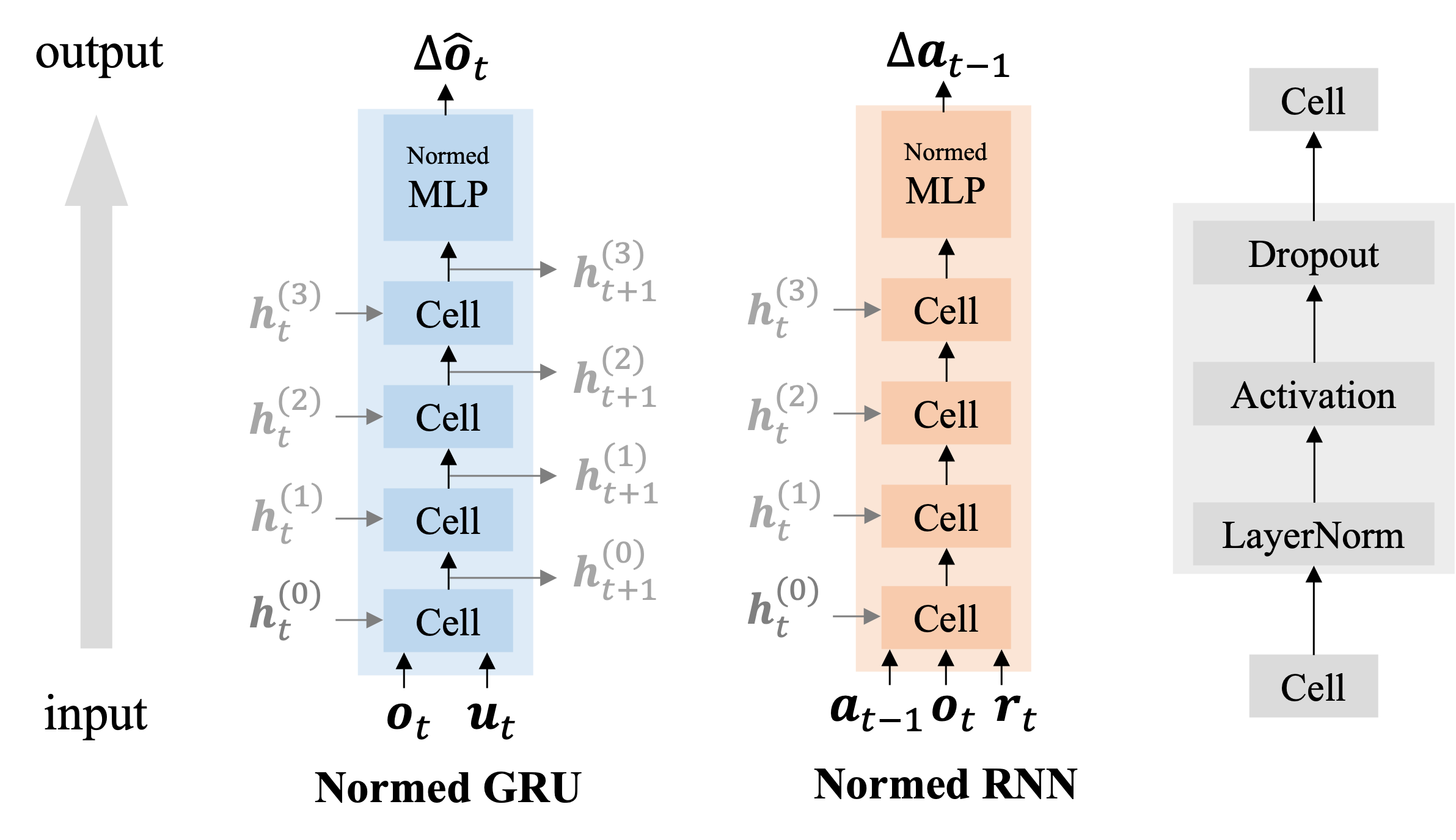
Figure 4: Architecture of the 4-layer RNNs used in the model; LayerNorm and dropout applied after each hidden layer.
Model evaluation considered prediction accuracy, generalization, and long-term stability over multiple datasets covering diverse trajectories, temporal drift, and disturbance regimes. Subsets targeted analysis of training data scale, temporal diversity, and noise profile impact on multi-step prediction fidelity.
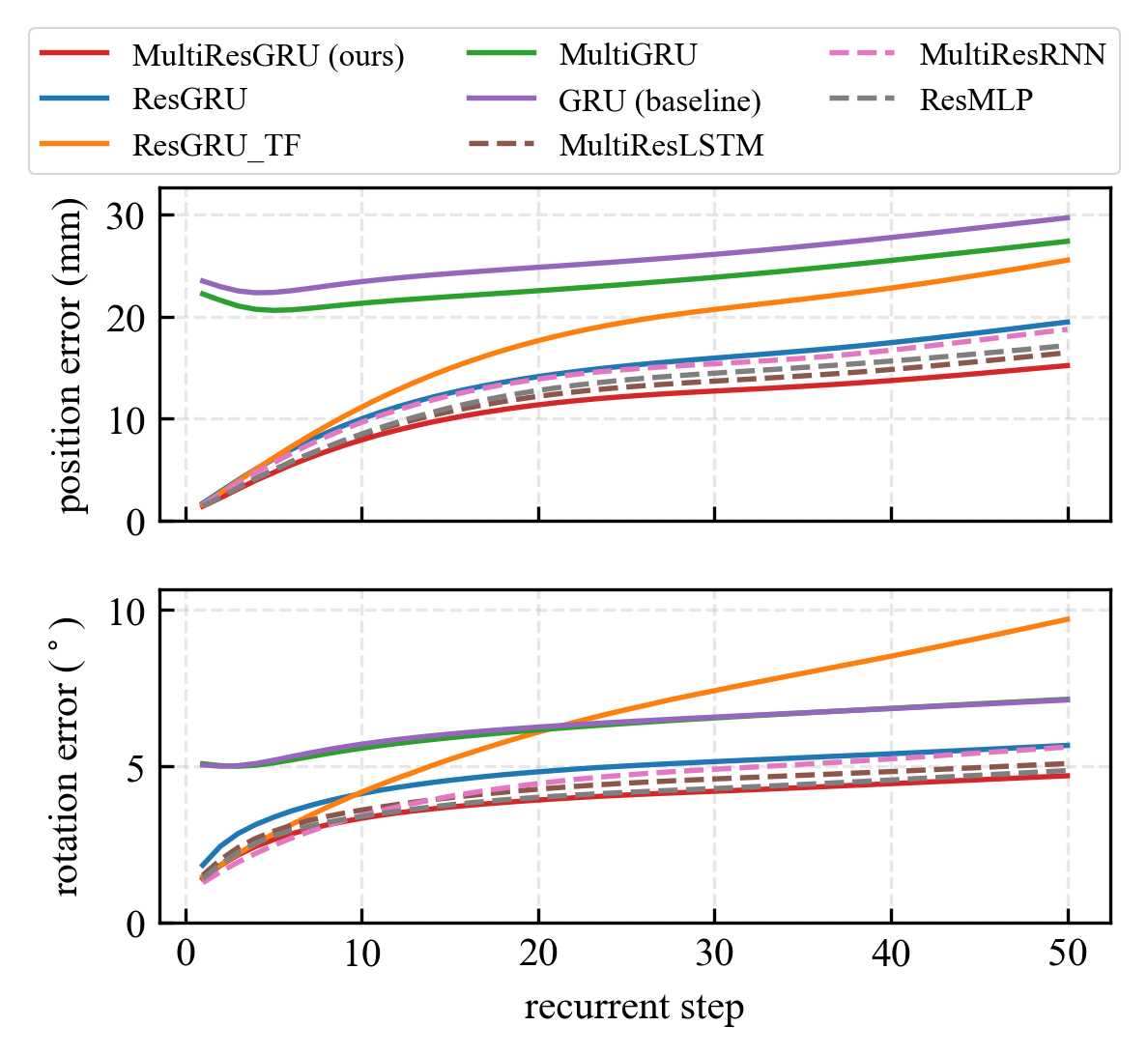
Figure 5: Average position and rotation errors of different model configurations relative to auto-regressive prediction steps; the proposed method achieves lowest prediction error and slowest error accumulation.
The experimental results indicate that:
- Residual prediction significantly suppresses both initial and accumulated prediction errors compared to non-residual architectures.
- Feeding back predicted observations during auto-regressive rollouts, while maintaining gradient flow through this path, is critical for temporal stability over long horizons.
- The GRU backbone with bidirectional multi-connectivity consistently outperforms LSTM and MLP-based alternatives in both tracking mean errors and suppressing peak divergence.
- Data scale and diversity are necessary for robust generalization; models trained on limited datasets or with reduced high-frequency excitation (control noise) failed to extrapolate to unseen trajectories or temporal drift conditions.
Extended auto-regressive experiments over minutes-long random trajectories further substantiate the superiority of the approach in maintaining low prediction error and trajectory fidelity, with baseline models diverging rapidly or losing fine-grain resolution in extremal regimes.
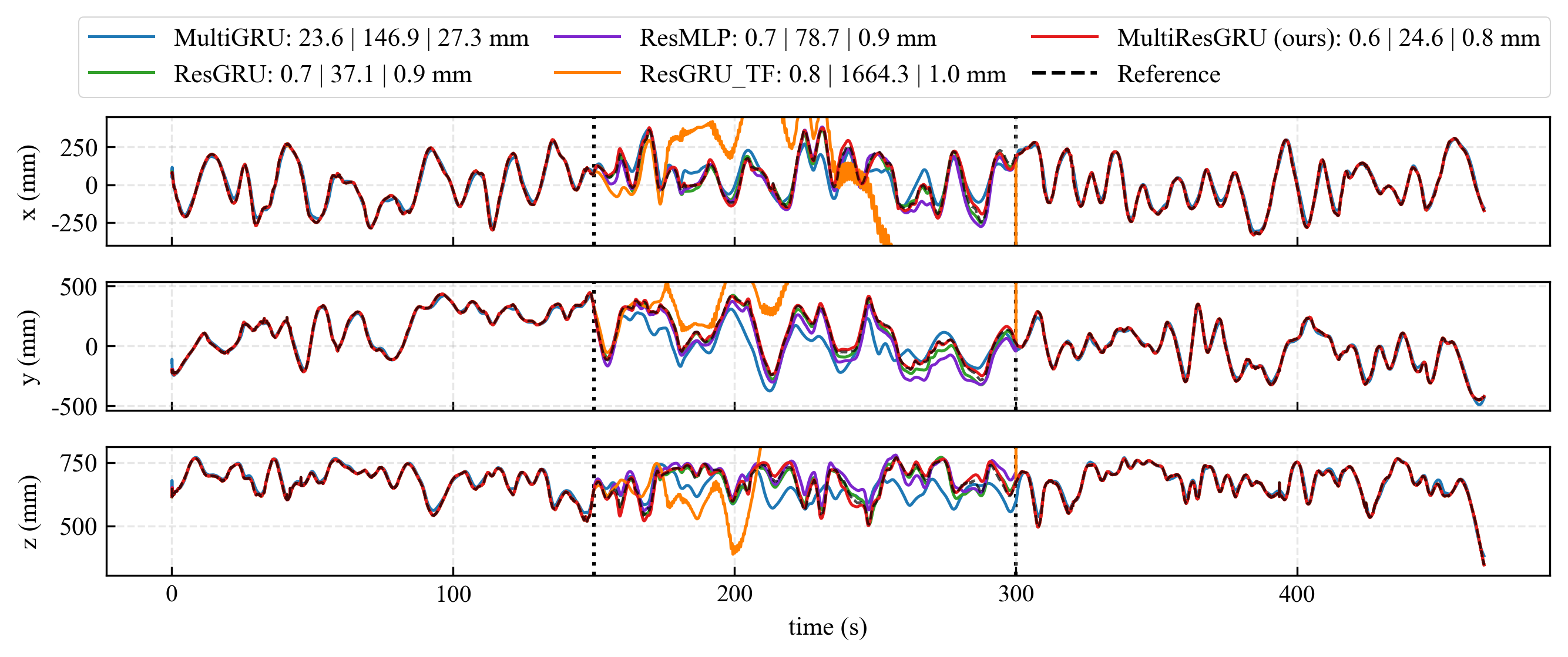
Figure 6: Position prediction performance of different model configurations across a long random trajectory—evaluation phases include one-step, auto-regressive, and post-horizon prediction.
Policy Tracking Accuracy and Robustness
The policy was compared against standard Jacobian-based Feedback, Feedforward, and Hybrid controllers across various speeds and payload disturbance scenarios. The differentiable neural policy yields centimeter-level position error and significant reduction in orientation error relative to the best traditional schemes, especially at high speeds, indicating enhanced learning of high-frequency dynamics neglected by quasi-static kinematic controllers.
Robustness under unseen end-effector payloads demonstrates a core advantage: while Feedback and Hybrid baselines exhibited large-scale self-excited oscillations (which increased with disturbance magnitude), the neural policy maintained stable and accurate trajectory tracking without oscillatory instability. The Feedforward baseline failed with steady-state deviations, further highlighting the neural policy's ability to internalize nonlinear compensation.
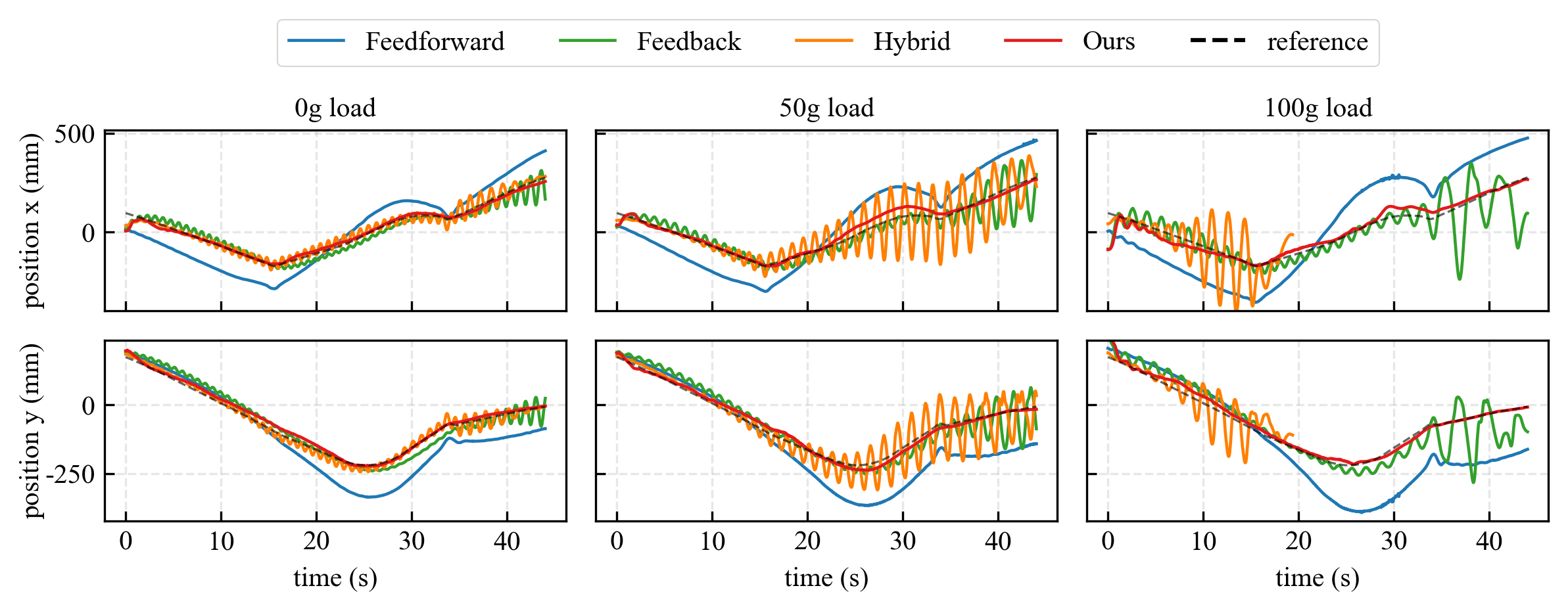
Figure 7: Tracking performance under varying payload disturbances (0g, 50g, 100g). Baseline Feedback and Hybrid controllers exhibit self-excited oscillations under increasing load; Feedforward has large steady-state errors. The neural policy maintains robust, accurate tracking.
Theoretical and Practical Implications
The differentiable recurrent approach enables the latent state to implicitly encode non-Markovian physical effects—such as frictional hysteresis, viscoelastic drift, and compliance—that are otherwise challenging to enumerate or identify from first-principles models. By leveraging direct backpropagation through the dynamics landscape, the control policy is optimized to anticipate and counteract multi-step error accumulation, allowing high-frequency, robust, real-time control without the overhead of full-horizon optimal control at inference.
Practically, this enables deployment on physical hardware even under unmodeled disturbances and dynamical shifts, broadening application viability for continuum robots in complex environments or under time-varying physical properties. The approach is extendable to other classes of soft or underactuated robots with unknown or highly nonlinear dynamics and suggests a general paradigm for robust differentiable policy learning beyond black-box RL or model-predictive schemes.
Conclusion
This work establishes a differentiable learning framework for high-fidelity TDCR modeling and robust real-time control. The architecture delivers strong empirical tracking performance, substantial resilience under payload disturbances, and suppresses instability phenomena endemic to linear controllers. The results provide a basis for future research into modular neural physics and end-to-end differentiable policy architectures for soft robotics and complex mechatronic systems, and point toward the prospect of further integration with online adaptation and meta-learning strategies for in situ dynamic compensation.

