- The paper presents a novel reference-augmented offline learning method integrating an RNN-based dynamics surrogate for precise tracking in tendon-driven continuum robots.
- It employs multi-scale stochastic reference augmentation to mitigate overfitting, achieving a 50.9% reduction in tip position error and significant orientation improvements.
- The approach unifies model-driven and data-driven control principles, providing robust, sample-efficient performance for complex trajectory tracking in soft robotic applications.
Reference-Augmented Learning for Precise Tracking Policy of Tendon-Driven Continuum Robots
Introduction
This paper introduces a reference-augmented offline learning framework for the high-precision 6-DOF control of Tendon-Driven Continuum Robots (TDCRs). Owing to their compliant morphology and rich maneuvering capabilities, TDCRs are emerging platforms for tasks in minimally invasive surgery and confined-space manipulation. However, their intrinsic non-Markovian, highly nonlinear, and path-dependent dynamics impose formidable challenges for robust and precise tracking. Traditional Jacobian-based controllers, which impose quasi-static and locally linear approximations, are ill-suited to compensate for significant hysteresis, dead-zone, and frictional effects observed in practical TDCR deployments. Likewise, standard learning-based policies, even when leveraging advanced function approximations, are prone to overfitting and exhibit poor generalization beyond the support of their training demonstration trajectories.
Reference-Augmented Offline Learning Framework
The core methodological advance is the integration of a differentiable RNN-based dynamics surrogate with a reference augmentation process for trajectory tracking. This architecture couples model-based and data-driven control principles. The dynamics surrogate is trained offline with diverse physical rollouts to encode the periodic, compliant, and history-rich responses of the physical platform. The chosen RNN model serves as a high-order temporal aggregator; its hidden state acts as a latent summary of long-range actuation histories required to accurately predict future robot observations.
The tracking policy is realized as a neural network that recursively outputs incremental control actions, taking as input the current observation, past action, latent state, and a future look-ahead reference window. Training is performed via direct differentiation through the surrogate model in an auto-regressive fashion using backpropagation through time, thus circumventing high-variance estimators typical of RL and enabling high sample efficiency.
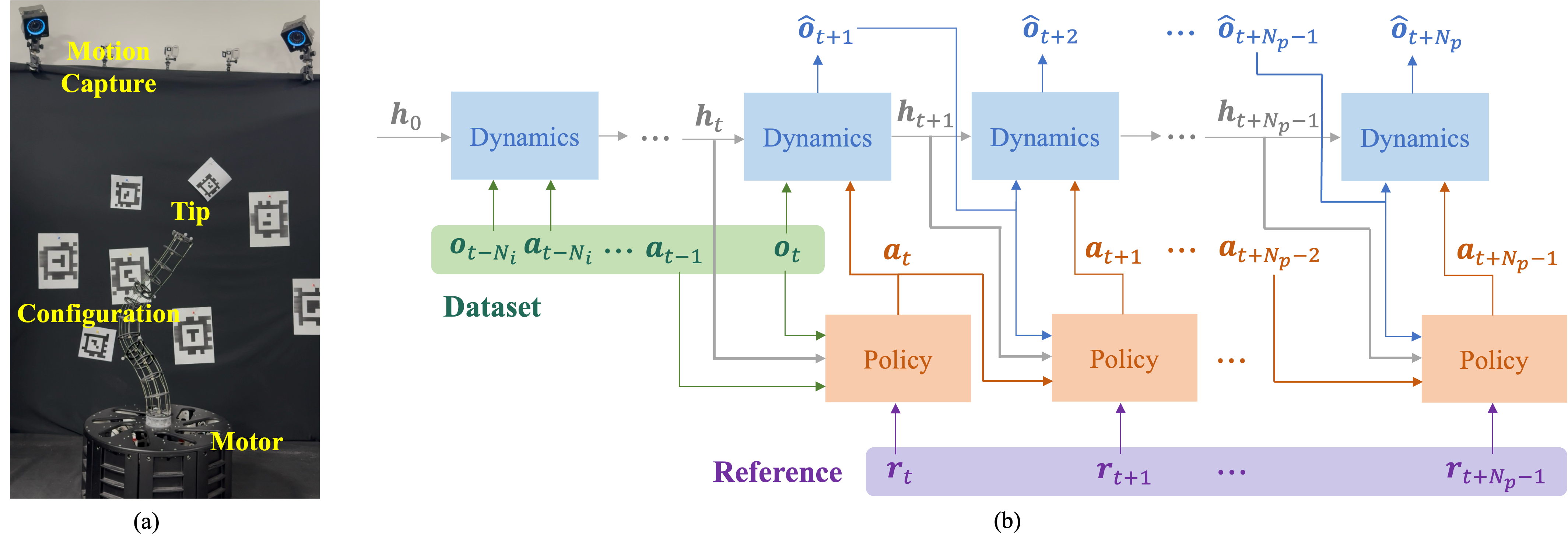
Figure 1: The experimental three-section TDCR platform and the training pipeline leveraging state initialization, look-ahead reference conditioning, and an RNN-based differentiable dynamics model.
Stochastic and Multi-Scale Reference Augmentation
To address the chronic overfitting and poor OOD generalization affecting offline RL and imitation learning for TDCRs, the framework employs a structured reference augmentation scheme. During training, ground-truth future state sequences are perturbed by additive and compositional processes:
- Constant bias: Simulates global drift and offset scenarios.
- Harmonic (sine) perturbations: Emulate smooth temporal oscillations necessitating compensation for dynamic lag and delayed compliance.
- Random walks: Introduce non-smooth, abrupt setpoint changes mimicking unforeseen disturbances.
A binary mask mechanism is employed to randomly alternate between time-varying tracking and static setpoint reaching, compelling the policy to internalize recoveries from distributional shifts and configuration deviations, not simply the nominal path-following problem.
This approach ensures that the learned policy encounters a dense and structured manifold of tracking errors during simulated optimization, substantially increasing robustness and generalization without additional physical data collection.
Experimental Results
Extensive hardware evaluations are conducted on a custom three-section TDCR actuation testbed with high-fidelity motion capture. The reference-augmented policy is benchmarked against both a baseline neural network trained on unperturbed trajectories and a Jacobian-based kinematic controller.
Empirically, the augmented policy consistently achieves a 50.9% reduction in average tip position error relative to the non-augmented neural baseline, with mean orientation error reduced by over 28%. Against the Jacobian-based controller, improvements are even more pronounced: the model-based approach exhibits severe degradation and oscillatory path tracking, particularly in orientation, where errors reach 22.3°, compared to just 5.8° for the proposed method.
Tracking across complex patterns (e.g., letter-shaped and straight-line reference paths) at various speeds further demonstrates that the policy robustly controls both smooth and sharp profile transitions with high temporal consistency and negligible overshoot.
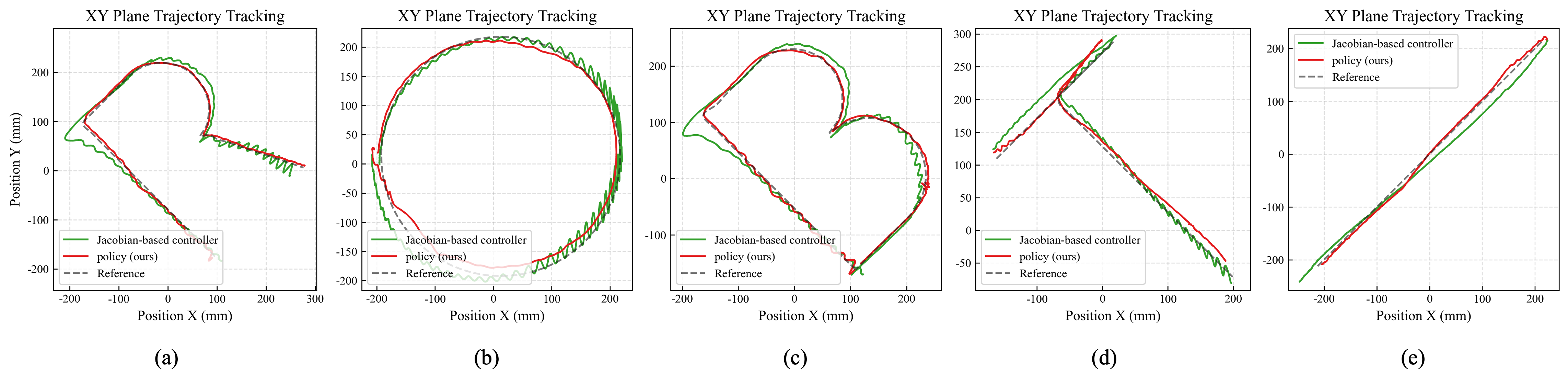
Figure 2: Empirical tracking performance on real-world TDCR across diverse trajectories; the proposed method (red) sharply reduces oscillation and path deviation relative to the Jacobian controller (green).
Correlation and Surrogate-Based Policy Analysis
To efficiently validate architectural and hyperparameter configurability, the RNN-based surrogate is leveraged for full-trajectory closed-loop rollouts in silico. A linear correlation (y≈0.45x) is observed between surrogate-predicted errors and real-world errors across multiple trained policies, indicating that the surrogate is a reliable proxy for safe ablation studies.
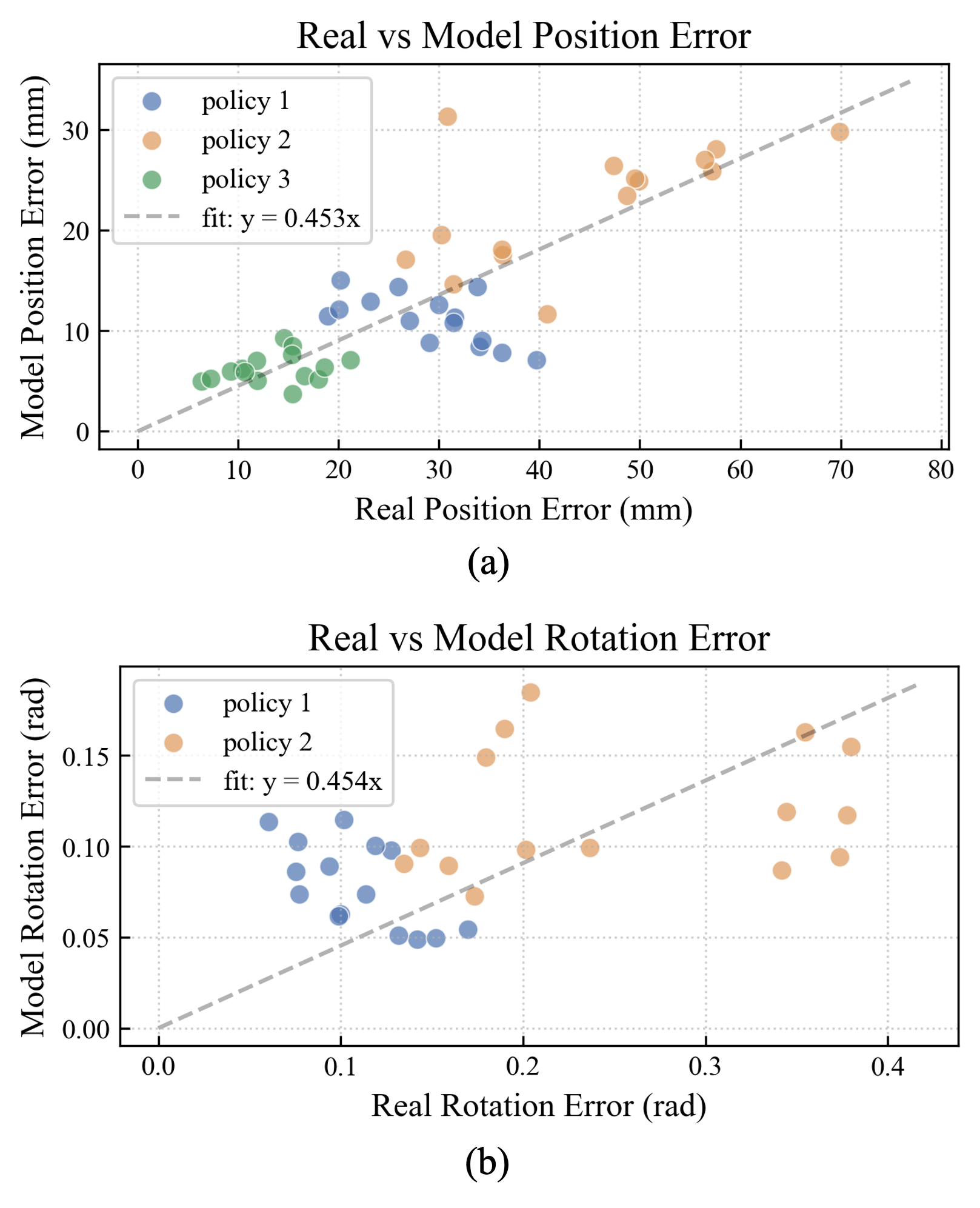
Figure 3: Error correlation between surrogate and real robot for both position and orientation.
Horizon Sensitivity and Policy Ablation
Sensitivity analysis exposes critical dependencies on reference look-ahead (Nr) and optimization horizon (Np). Increasing Nr consistently reduces errors, but with diminishing returns beyond a 1-second window. Np is particularly influential: horizons below 100 steps (2 seconds) precipitate unstable, high-error policies that cannot adequately model or plan over the hysteretic, compliant dynamics of the platform. Optimal settings, balancing computational burden and performance, are found at Nr=50, Np=250.
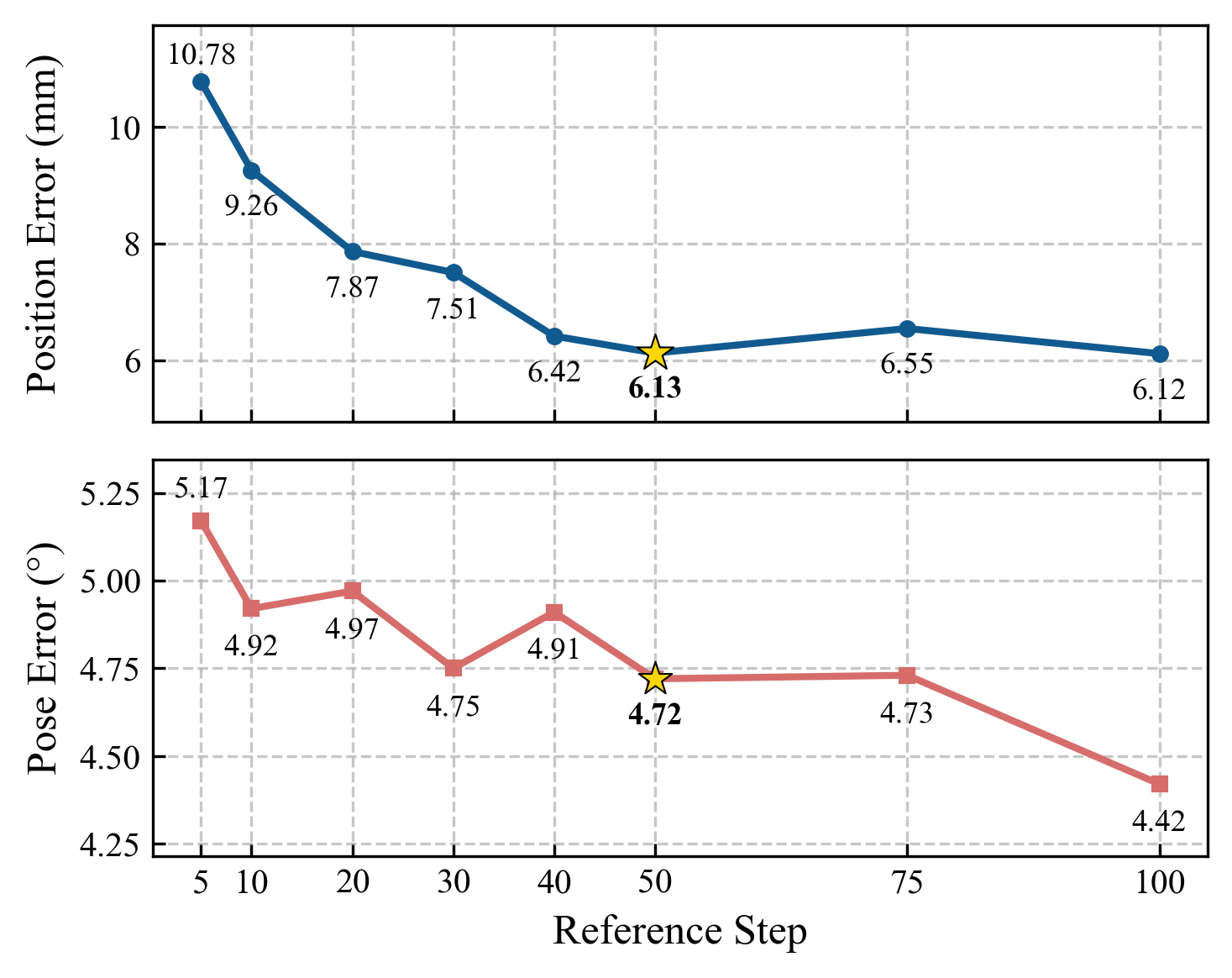
Figure 4: Reducing tracking error as reference horizon increases; marginal gains plateau for Nr>50.
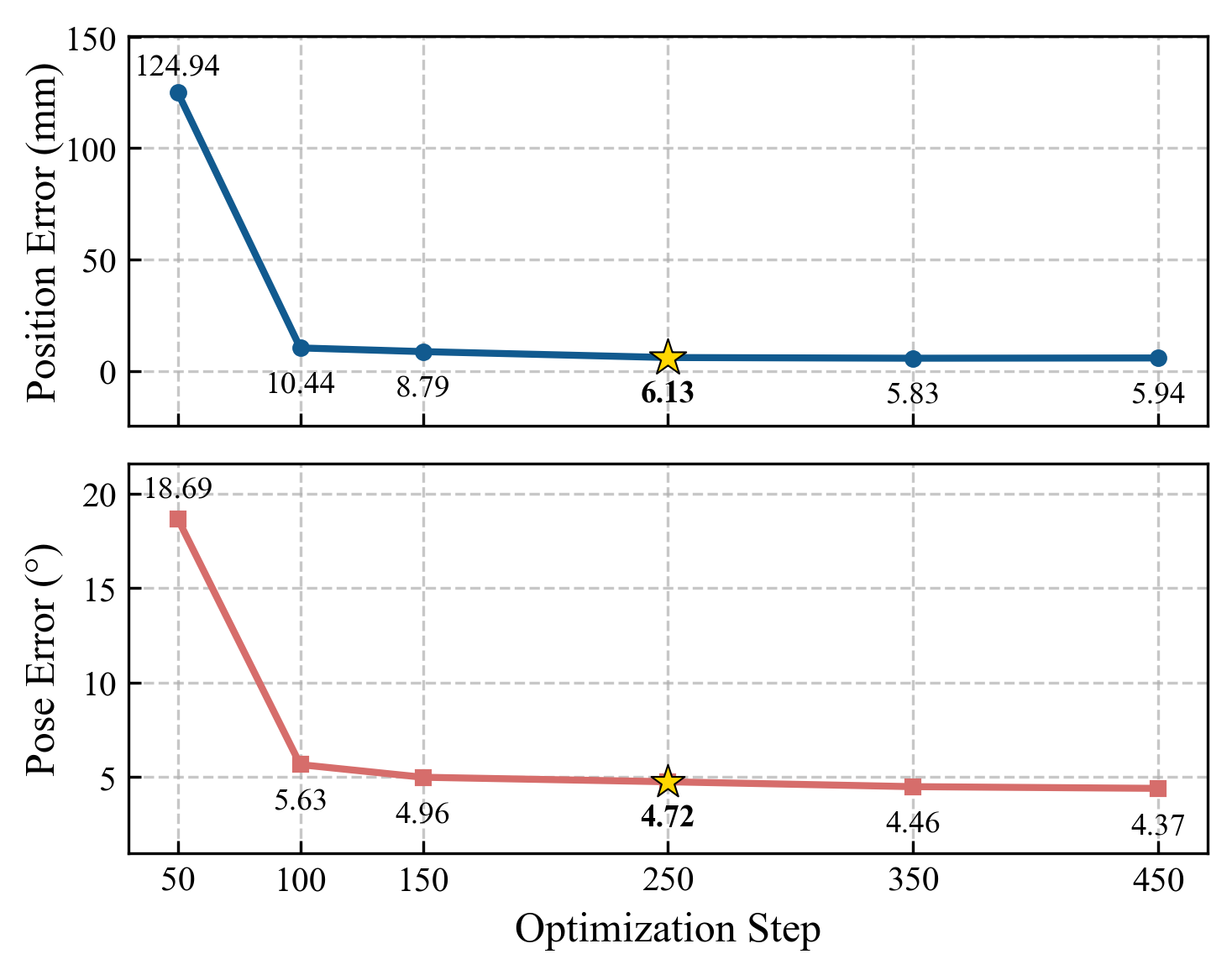
Figure 5: Effect of optimization horizon; short horizons catastrophically degrade closed-loop tracking due to undercompensation of long-range dynamics.
Theoretical and Practical Implications
The approach demonstrates that structured reference augmentation during model-based offline policy optimization significantly improves robustness and precision for non-Markovian, tendon-driven soft robots. This method enables safe, sample-efficient training of precise tracking controllers without impractical levels of real-world interaction or risk to hardware. The end-to-end differentiability of the platform further enables future extensions, including:
- Scaling to multi-task and variable-morphology continuum systems.
- Coordinated learning of disturbance observers and model-predictive components.
- Integration with vision-based or tactile sensors for environment-aware manipulation.
- Generalization to other classes of non-Markovian soft robotic manipulators.
The theoretical contribution is the systematic leveraging of model-driven, reference-randomized training in offline settings to achieve policies that internalize complex, physically realistic recovery mechanisms and broad generalization ability, in contrast to both classical model-based and pure data-driven baselines.
Conclusion
This work provides an effective and theoretically justified methodology for high-precision trajectory tracking in TDCRs via reference-augmented offline learning. By integrating a differentiable, history-rich dynamics surrogate with multi-scale stochastic augmentation, the method enables robust closed-loop control in the presence of severe nonlinearities and long-range temporal dependencies, outperforming both conventional analytical baselines and non-augmented neural controllers. The technical insights provided extend to the broader domain of model-based RL for compliant, underactuated soft robots, setting a foundation for further advances in autonomous surgical robotics, dexterous manipulation, and robust policy transfer in real-world physical systems.
Citation: "Reference-Augmented Learning for Precise Tracking Policy of Tendon-Driven Continuum Robots" (2604.25698)

