- The paper develops a multiparameter quantum estimation framework that quantifies how treating interrogation time as a quantum nuisance parameter degrades gravitational sensitivity.
- The analysis introduces a universal retention law describing the residual Fisher information for gravity after profiling out time uncertainty in various quantum sensor architectures.
- Application to freely falling wavepackets, atom interferometers, and optomechanical sensors reveals practical limits and the need for external timing channels to achieve optimal sensitivity.
Quantum Gravimetry under Intrinsic Quantum Time Uncertainty
Introduction and Problem Context
"Quantum gravimetry with intrinsic quantum time uncertainty" (2604.24792) systematically investigates quantum parameter estimation of the gravitational field strength when the interrogation time is treated as an intrinsically uncertain—i.e., quantum—nuisance parameter, motivated by the energy--time uncertainty relation and the limits it imposes on time-resolved quantum metrology. Standard treatments of quantum gravimetry, typified by atom interferometers and optomechanical sensors, generally consider the interrogation time as a perfectly controlled parameter. However, temporal uncertainty is an inescapable consequence of quantum mechanics, and in advanced quantum sensors, interrogation time must be understood as a parameter entwined with the dynamics and not always accessible as a classical control.
This work employs a multiparameter quantum estimation framework, focusing on the joint estimation of gravitational acceleration g and interrogation time t, but with only g as a parameter of interest and t as a quantum nuisance parameter. The primary technical questions addressed are: (i) how much of the nominal Fisher information for g survives when interrogational timing is profiled out, and (ii) what is the structural impact of this uncertainty on various quantum gravimeter architectures, including freely falling wavepacket probes, Kasevich–Chu atom interferometers, and optomechanical sensors.
The authors commence with a general pure-state unitary evolution under a Hamiltonian H(g)=H0+λgQ, considering the encoded state ∣ψ(g,t)⟩=U(g,t)∣ψ0⟩, with U(g,t)=exp(−iH(g)t/ℏ). Both g and t are treated as quantum parameters on equal footing, and their local generators are computed accordingly. The Quantum Fisher Information Matrix (QFIM), central to multiparameter estimation, is explicitly constructed in terms of symmetrized covariances of these generators.
Elimination of the nuisance parameter t0 is handled via Schur complementation, yielding the effective Fisher information for t1:
t2
where t3, t4, and t5 denote the gravity–gravity, gravity–time, and time–time blocks of the QFIM, respectively. This formalism directly quantifies the impact of time parameter uncertainty on the attainable sensitivity to t6.
Universal Retention Law for Linearly Gravity-Coupled Systems
A central result is the identification of a universal normalized structure for the information retention t7 after timing profiling, for any quantum sensor with Hamiltonian linear in t8 and subject to a background ‘weak commutator’ restriction. The key findings are:
- The time–time block t9 is always quadratic in g0: g1.
- The gravity–time cross term g2 is affine in g3: g4.
- The gravity–gravity block g5 is independent of g6 under the aforementioned commutator condition.
These structures lead to the universal retention law:
g7
where g8 is a normalized offset variable and g9 are model-specific but time-dependent. The denominator is Lorentzian and the numerator affine-quadratic, structurally universal for this sensor class.
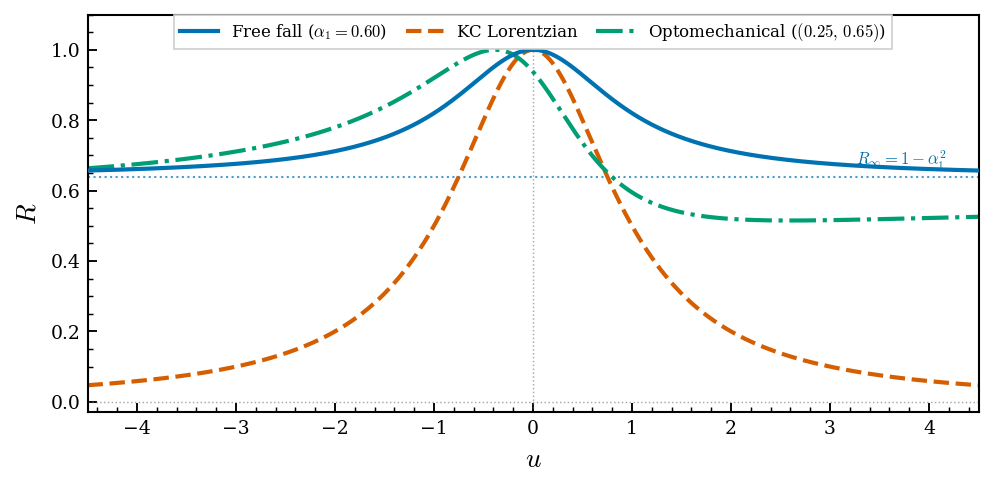
Figure 1: Universal normalized nuisance-time retention classes illustrating differing kernel shapes for representative quantum gravimetry platforms.
Application to Benchmark Quantum Gravimetry Models
Freely Falling Gaussian Wavepackets
For a standard quantum gravimetry scenario—a minimum-uncertainty Gaussian wavepacket in free fall—the universal law is realized exactly. The time-profiling suppresses the part of the QFI scaling as t0, while the t1 scaling is exactly retained, provided the initial wavepacket possesses nonzero momentum spread. Explicit formulas are provided:
t2
with t3 a scale set by t4, the position width. In the plane-wave (delocalized) limit, all gravity information collapses (t5) due to perfect degeneracy between t6 and t7.
Kasevich–Chu Atom Interferometer: Readout Dependence
The Kasevich–Chu atom interferometer is unique in that the observed Fisher information depends crucially on the measurement modality:
- Internal State Readout Only: The QFIM is rank-deficient because only the composite phase t8 is measurable; thus, the information about t9 vanishes unless external timing information is supplied (i.e., prior/timing resource regularization). The regularized retention law becomes a Lorentzian in an offset variable set by the timing prior's variance.
- Full-State (Internal and Motional) Readout: The motional sector provides an independent timing channel. Gravity–time identifiability is restored, and the retained Fisher information is
g0
where g1 is the longitudinal velocity variance. The g2 scaling survives time profiling iff the initial momentum spread is sufficiently large, leading to tradeoffs with atom localization, velocity selection, and interferometer contrast.
Optomechanical Benchmark
The universal retention structure also applies to closed-unitary optomechanical gravimetry models, for instance in the parameter regime of levitated micro-object experiments. At certain times (mechanical periods), the gravity–time cross term disappears and maximal gravity information is revivable, with the structure controlled by underlying commutator geometry.
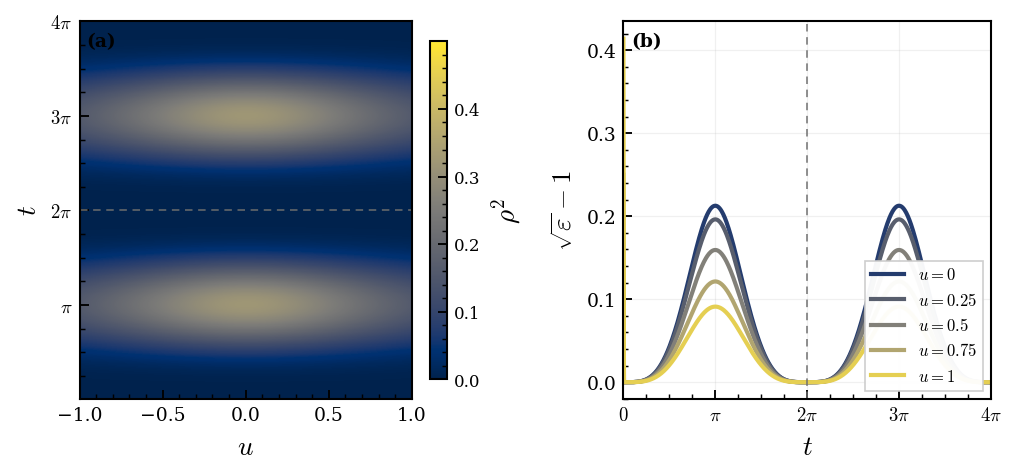
Figure 2: Exact closed-unitary optomechanical benchmark in normalized coordinates, displaying revival of Fisher information at integer multiples of the mechanical period.
Experimental Regimes, Constraints, and Practical Implications
The analytical framework is connected to realistic parameter regimes of atom interferometers used in state-of-the-art gravimetry. For current platforms with microkelvin temperatures and g3–g4, the motional information alone cannot adequately distinguish g5 from g6; the retention ratio g7 falls well below g8 purely from the quantum record, a decisive limitation unless auxiliary timing or phase references are employed. Achieving strong retention (g9) within the bare quantum record would require unrealistically large velocity spreads (hundreds of times larger than thermal scales), incompatible with high-contrast interferometry.
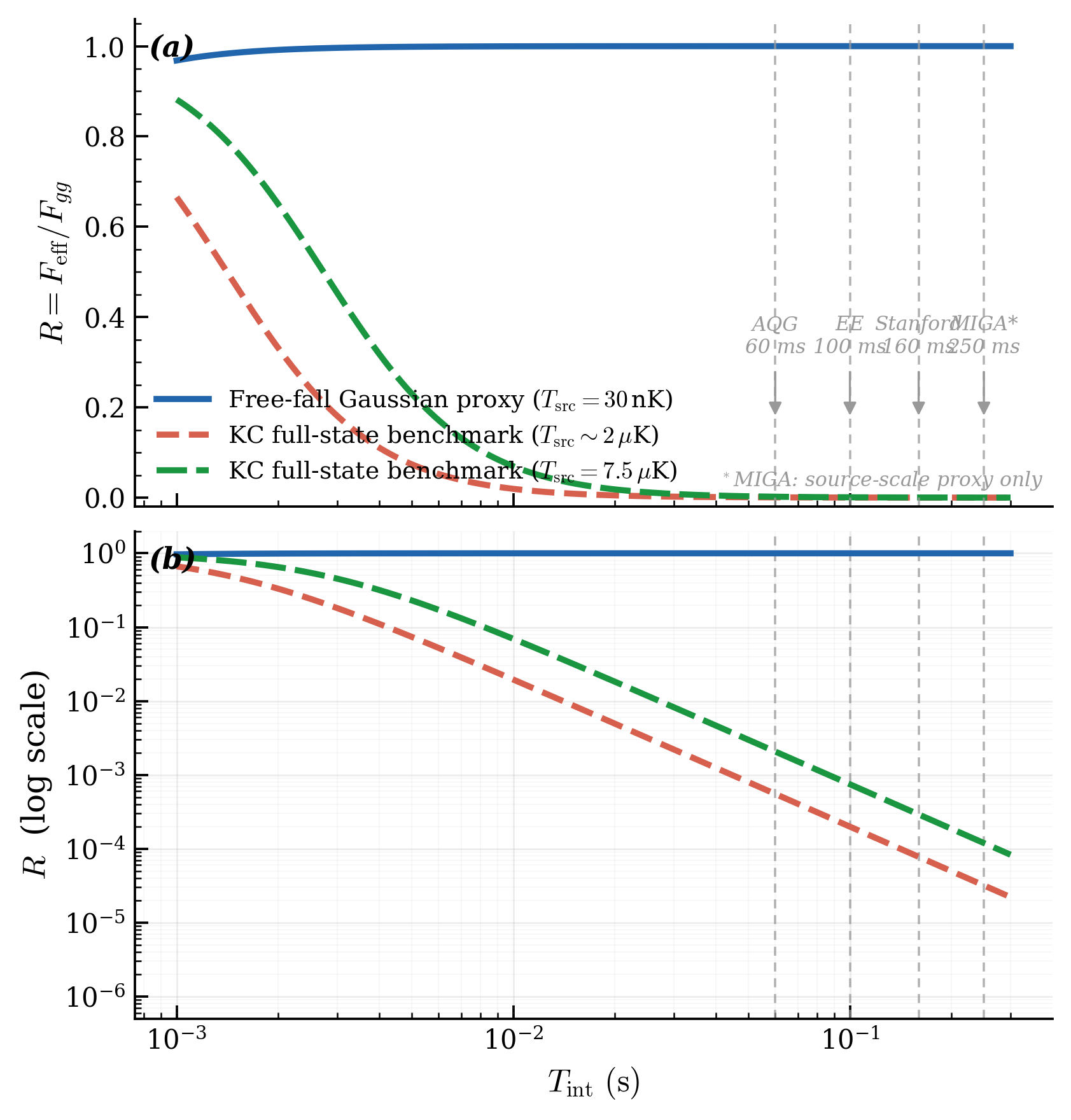
Figure 3: Literature-anchored constrained regime for atom-based H(g)=H0+λgQ0Rb gravimetry; curves map experimental source temperatures and interrogation times to theoretical Fisher information retention.
These findings clarify that practical quantum gravimetry is protected from quantum time uncertainty by elaborate reference resources—e.g., independent clocks and classical timing channels—rather than by the quantum record alone. Notably, increasing interrogation time without increasing velocity spread can actually decrease the retained gravity Fisher information.
Broader Theoretical and Practical Implications
Conceptually, this study demonstrates that the widely cited H(g)=H0+λgQ1 enhancement law in atom-interferometric gravimetry assumes away an identifiability penalty due to temporal uncertainty. Once time becomes a quantum parameter, the true metrological limit is governed by the presence or absence of independent timing channels—either kinematically (e.g., via motional spread) or via external priors (timing resources, auxiliary clocks, or phase references).
This separation between nominal sensitivity (single-parameter QFI) and identifiability-limited sensitivity sharply delineates the criteria for quantum advantage in gravity estimation, especially as architectures scale to longer baselines and colder sources. The analysis techniques also generalize to other multiparameter quantum sensing scenarios with nuisance parameters and can inform the design of optimal architectures in fundamental and applied metrology.
Possible directions for further development include extension to open-system (decohering) dynamics, realistic models of auxiliary clock resources, and explicit quantum–classical interface protocols for timing.
Conclusion
This work provides an exact, model-universal description of Fisher information degradation in quantum gravimetry with intrinsic time uncertainty, based on a structural analysis of the multiparameter QFIM for linearly gravity-coupled quantum sensors. The universal retention law, established for both atomic and optomechanical platforms, exposes the essential tradeoff between gravity sensitivity and time identifiability. Results demonstrate that physical architectures must incorporate and manage time information resources to maintain optimal sensitivity, and that commonly cited scaling laws do not automatically extend to the quantum multiparameter setting. The framework provides both a rigorous analytic toolkit and concrete experimental mapping for the design and interpretation of quantum-enhanced gravimation.
Cited article:
- "Quantum gravimetry with intrinsic quantum time uncertainty" (2604.24792)