Time uncertainty and fundamental sensitivity limits in quantum sensing: application to optomechanical gravimetry
Published 20 Feb 2026 in quant-ph | (2602.18524v1)
Abstract: High-sensitivity accelerometers and gravimeters, achieving the ultimate limits of measurement sensitivity are key tools for advancing both fundamental and applied physics. While numerous platforms have been proposed to achieve this goal, from atom interferometers to optomechanical systems, all of these studies neglect the effects of intrinsic quantum uncertainty in time estimation. Starting from the Hamiltonian of a generic linear quantum sensor, we derive the two-parameter quantum Fisher information matrix and establish the corresponding Cram'er-Rao bound, treating time as an uncertain (nuisance) parameter. Our analysis reveals a fundamental coupling between time and signal estimation that inherently degrades measurement sensitivity, with the standard single-parameter quantum limit recovered only at specific interrogation times or under special decoupling conditions. We then apply these results to an optomechanical gravimeter and explicitly derive an optimal decoupling condition under which the effects of time uncertainty are averaged out in a continuous measurement scheme. Our approach is general and can be readily extended to a broad class of quantum sensors.
The paper introduces a multiparameter quantum Fisher information framework that treats time as a quantum nuisance parameter affecting sensitivity.
It quantifies how time uncertainty in an optomechanical model degrades gravitational acceleration measurement precision.
Findings show that optimal stroboscopic interrogation restores sensitivity limits, guiding improved design of quantum sensors.
Time Uncertainty and Fundamental Sensitivity Limits in Quantum Sensing: Optomechanical Gravimetry
Introduction and Motivation
Quantum sensors, especially those leveraging entanglement and squeezing, offer precision measurements for metrological applications such as gravimetry, with potential to reach or surpass the Heisenberg limit. However, conventional treatments typically neglect quantum-induced uncertainty in the interrogation time, treating time as a classical parameter. This paper rigorously develops a formalism wherein time is treated as a quantum nuisance parameter, highlighting its fundamental effect on the achievable sensitivity.
The authors derive a multiparameter quantum Fisher information (QFI) framework where both the parameter of interest (a, e.g., gravitational acceleration g) and time (τ) are considered on equal footing, quantifying the loss in the accessible information about a due to quantum fluctuations in τ. The implications are explored for an optomechanical gravimeter, elucidating both the theoretical and practical impacts of time uncertainty on quantum-limited precision in gravity measurement.
Multiparameter Quantum Estimation Formalism
The generic quantum sensor is modeled by a linear Hamiltonian of the form H^(a)=H^0+λaQ^, where λ is a coupling constant and Q^ an observable encoding the parameter a (gravitational acceleration in gravimetry). The time evolution is governed by the unitary U(a,τ)=exp[−iH^(a)τ/ℏ]. The key advancement is the explicit treatment of τ as a nuisance parameter in the QFI matrix, leading to the effective Fisher information:
Faeff=Faa−FττFaτ2
where Faa is the QFI for a, Fττ for τ, and Faτ their covariance.
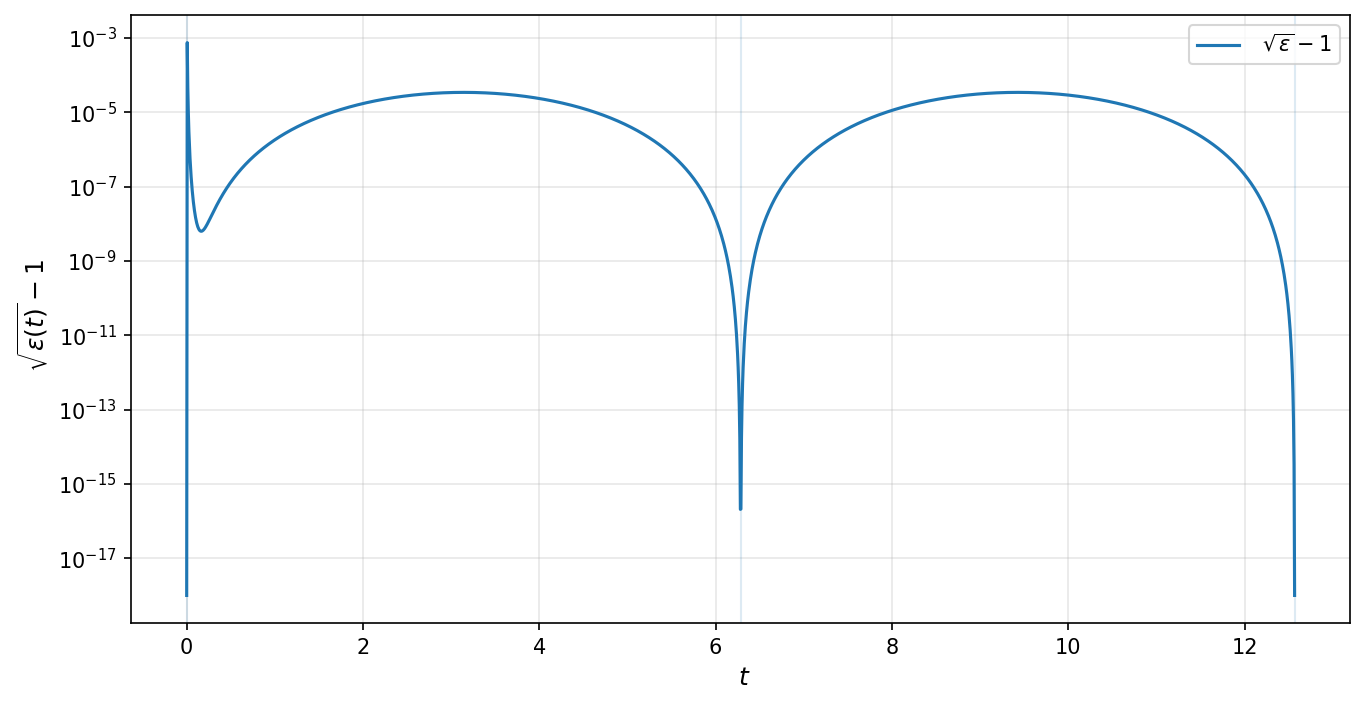
This Schur complement structure formalizes the loss of information about a due to its statistical correlation with time (τ). The corresponding Cramér-Rao bound (QCRB) on the variance of an unbiased estimator for a is always inflated relative to the ideal single-parameter case, with the inflation factor ε=[1−ρ2]−1, where ρ2 is the squared correlation coefficient:
Var(a^)≥NFaeff1
with N the number of independent probes.
The analysis reveals that only at special “decoupling” interrogation times where Cov(∫0τQ(s)ds,H(a))=0, the inflation vanishes and the single-parameter quantum limit is recovered.
Figure 1: Relative degradation in sensitivity caused by the correlation with the nuisance parameter t: ε(t)−1.
Application to Optomechanical Gravimetry
Model and QFI Analysis
The optomechanical gravimeter is composed of a mechanical oscillator (mass m, frequency ωm) and a single-mode cavity field, coupled by a radiation-pressure term and sensitive to gravitational acceleration g. The exact system Hamiltonian is:
The authors provide explicit analytic forms for the QFI matrix elements for both g and the time t, as well as their covariance, under general initial conditions. For physical parameters typical of levitated optomechanical platforms, they show that the degradation in sensitivity due to time uncertainty is time-dependent and reaches a minimum (zero) at “stroboscopic” times t=2πℓ, where the oscillator returns to its initial state and the information on g maps entirely to the cavity phase, nullifying Fgt.
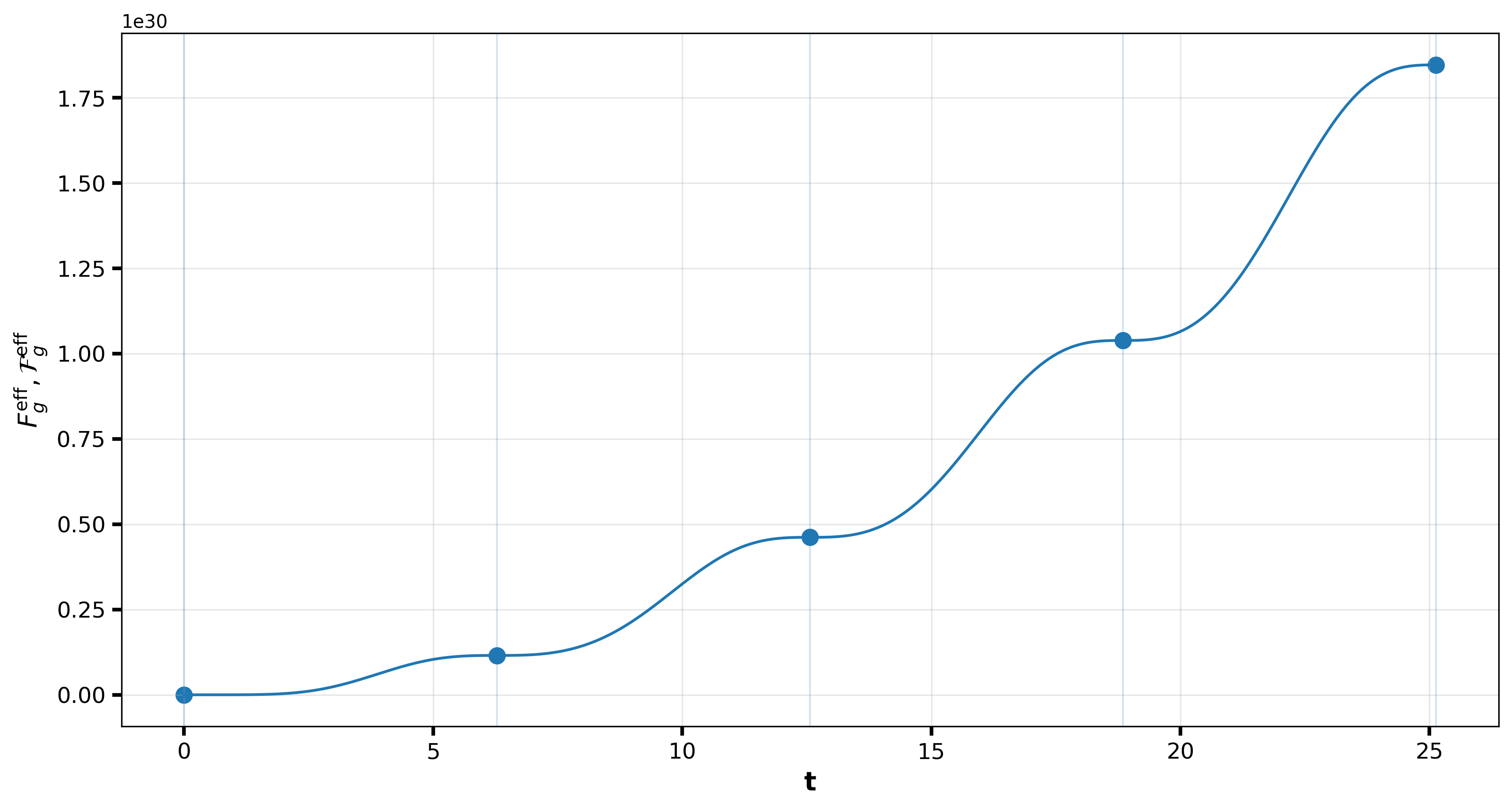
Numerical analysis finds that the maximally attainable sensitivity for gravitational acceleration in a realistic configuration (single phonon regime, m=10−14 kg, ωm=100 rad/s, large photon number, optimal coupling) is Δg∼3×10⁻¹⁵ m/s2, achieved at these decoupling points.
Averaged Decoupling and Parameter Engineering
In practical continuous measurement, complete decoupling at a single interrogation time is not experimentally realizable due to finite detection duration. The authors demonstrate that, for long-running measurements, the average correlation between g and t can be engineered to vanish by tuning the initial oscillator’s phase and the measurement interval, thus asymptotically restoring the Heisenberg limit for the estimation of g. Ground-state preparation (β=0) is optimal for decoupling on average.
Classical Fisher Information and Homodyne Detection
The study quantifies the performance of realistic measurement strategies using the classical Fisher information (CFI), focusing on homodyne detection of the optical quadrature. Detailed analytical expressions are provided for the homodyne outcome probability density and its derivatives with respect to g and t, allowing direct calculation of the CFI matrix and the corresponding inverse bound.
Figure 2: Comparison between CFI at stroboscopic times and QFI for the optomechanical parameters listed in Figure 1.
The results indicate that homodyne detection is optimal — saturating the quantum Cramér-Rao bound even in the presence of time uncertainty — at the stroboscopic, decoupling times. Away from these optimal points, there remains a discrepancy due to residual parameter-time coupling not eliminated by a single quadrature measurement. The analysis reveals that advanced or adaptive measurement schemes (possibly involving dynamic adjustment of the quadrature phase) would be required to maintain optimality at generic times.
Practical and Theoretical Implications
Strong claims include:
The Heisenberg limit in quantum sensing is in general unachievable when quantum time uncertainty is present; only under decoupling conditions does the traditional scaling remain valid.
Time uncertainty’s impact is not an extrinsic experimental imperfection but arises fundamentally from the Mandelstam-Tamm quantum speed limit, connecting energetic fluctuations and time resolution.
For state-of-the-art optomechanical gravimeters, the relative loss in achievable sensitivity from time being a quantum nuisance parameter is small (<10−5) for optimal protocols, but potentially more significant in less optimized or non-stroboscopic schemes.
Practically, these results set precise requirements for the timing and engineering of quantum sensing protocols to saturate fundamental bounds and clarify the necessity of ground-state cooling and phase control for large-scale sensor deployments. The formalism is directly extensible to a broad class of quantum sensors beyond gravimetry, including electromechanical, spin-based, and atomic interferometric devices.
Future Directions
The rigorous quantification of parameter-time coupling opens new directions for quantum estimation with intrinsic nuisance parameters. It motivates both experimental investigation of the predicted sensitivity degradation and theoretical work on adaptive measurement protocols that can nullify nuisance parameter effects in real-time. Further research is needed to analyze the role of dissipative and mixed-state dynamics, especially in the long-time regime and in the presence of unavoidable noise sources.
Conclusion
This work establishes a systematic framework for incorporating quantum time uncertainty into the estimation of signals with quantum sensors, revealing a definitive, physically interpretable limitation on sensitivity that goes beyond the standard single-parameter bounds. For optomechanical gravimetry, the formalism precisely locates sensitivity minima and achievable precision, both in ideal and realistic measurement scenarios. These insights are crucial for the future design and operation of quantum-enhanced precision sensors that aim to exploit or approach the true quantum limits.
Reference: "Time uncertainty and fundamental sensitivity limits in quantum sensing: application to optomechanical gravimetry" (2602.18524)