Published 16 Apr 2026 in quant-ph | (2604.14950v1)
Abstract: Levitated mesoscopic particles hold the promise of revolutionizing gravity sensing by using quantum effects. However, conventional quantum gravimeters based on such systems fail to harness the intrinsic large-mass advantage of the particles, because their commonly utilized auxiliary quantum systems counteract the role of mass as a resource. To overcome this limitation, we propose a quantum gravimetry by directly using the mechanical qubit (QM) formed by a levitated particle as the gravity sensor. Without resorting to the auxiliary quantum system, our scheme enables a straightforward readout of the particle's motion under gravitational influence. The obtained sensitivity behaves as a $m{-1/2}$-scaling with the mass $m$. We also generalize our scheme to the \textit{mechanical cat qubit} as the gravity sensor. The sensitivity further scales as $N{-1/2}$ with the mean phonon number $N$. In the experimentally realizable parameter regime, a sensitivity on the order of $0.1~ \text{\textmu}\text{Gal}/\sqrt{\text{Hz}}$ can be achieved, which outperforms the traditional schemes by two orders of magnitude. Reaching the \textit{double standard quantum limits} with $m$ and $N$ simultaneously, our scheme provides a feasible route toward compact high-sensitivity quantum gravimetry.
The paper presents a quantum gravimeter that exploits mechanical qubits, demonstrating optimal sensitivity scaling via precision Hamiltonian engineering.
It employs a Duffing oscillator to create mechanical cat qubits with enhanced anharmonicity, ensuring robust suppression of leakage and phase-flip errors.
The study rigorously analyzes dissipation sources, confirming that high vacuum quality and non-free-falling operation enable ultra-sensitive gravitational measurements.
Quantum Gravimetry Utilizing Mechanical Qubits and Mechanical Cat Qubits
Mechanical Qubit Gravimetry: Hamiltonian and Precision Analysis
The paper presents a quantum gravimeter exploiting mechanical qubits (MQ), realized via a levitated mesoscopic particle in the presence of a Duffing nonlinearity. Within the computational subspace defined by the ground ∣0⟩ and first excited ∣1⟩ states, the effective Hamiltonian under gravity becomes $\hat{\mathcal{H}^{g}_{1} = \hbar\frac{\omega}{2}\hat{\sigma}_{1}^{z}+\hbar\Omega_{1}\hat{\sigma}_{1}^{x}$, where Ω1 encodes the gravitational information.
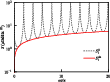
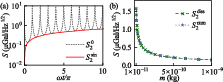
Quantum Fisher information (QFI) and sensitivity analyses establish the optimal limits for gravitational measurement. For the MQ gravimeter, the sensitivity S1 at optimal sensing time t1=π/ω is given by S1=ω8mℏπ, revealing that the metrological performance improves with increasing particle mass, thus maximizing the gain from levitated mesoscopic particles. The QFI calculated is F1g=ℏω38m, matching the sensitivity and confirming the scheme's optimality.
Figure 1: Temporal evolution of MQ sensitivity S1 and its envelope, exhibiting periodic oscillations and revealing optimal sensing time at the envelope minima.
Mechanical Cat Qubit: Quantum Properties, Leakage, and Error Suppression
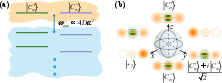
The authors introduce the mechanical cat qubit (MCQ) via a parametrically driven Duffing oscillator. The MCQ framework utilizes the cat-state subspace, with orthogonal even/odd cat states ∣Cα±⟩ separated from higher states by a substantial anharmonicity ∣1⟩0, much larger than in the conventional MQ (∣1⟩1).
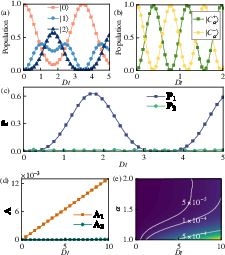
This higher anharmonicity ensures robust protection from leakage outside the encoded subspace, which is confirmed by comparing population dynamics for MQ and MCQ under identical resonant driving. MCQ maintains population within the cat-state manifold, while MQ suffers significant leakage.
Figure 2: MCQ energy spectrum and Wigner function distributions, displaying parity manifolds and cat-state localization on the Bloch sphere.
Figure 3: Side-by-side comparison of population dynamics and leakage probabilities for MQ (blue) and MCQ (green), establishing MCQ’s superiority in leakage suppression and phase-flip error mitigation.
Master-equation analyses under single-phonon dissipation demonstrate that phase-flip errors in MCQ are exponentially suppressed in ∣1⟩2, and remain subdominant even for moderate ∣1⟩3 and extended timescales, a critical advantage for quantum metrology.
MCQ Gravimeter: Hamiltonian, Optimal Sensing, and Sensitivity
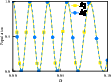
Projection onto the cat-state subspace yields an effective sensing Hamiltonian for MCQ gravimetry: ∣1⟩4, with ∣1⟩5. The dynamical evolution generated by this Hamiltonian matches that of the full system, confirming validity.
Figure 4: Comparison of dynamics from the original and effective MCQ gravimeter Hamiltonians, validating the projected qubit model.
Analytical solutions yield QFI ∣1⟩6 (at optimal sensing time ∣1⟩7), and sensitivity ∣1⟩8, with ∣1⟩9 as the cat-state quantum resource number. Compared to MQ, MCQ achieves an enhancement factor of $\hat{\mathcal{H}^{g}_{1} = \hbar\frac{\omega}{2}\hat{\sigma}_{1}^{z}+\hbar\Omega_{1}\hat{\sigma}_{1}^{x}$0, fully utilizing both mass and cat-state resources.
Figure 5: Time evolution and envelope of MCQ gravimeter sensitivity, with numerical and analytical results under white-noise dissipation, illustrating mass dependence and robustness.
Extensions to scenarios with single-phonon loss and thermal white noise demonstrate the persistence of sensitivity enhancement, with only minor degradation and sensitivity approaching ideal-case performance for large $\hat{\mathcal{H}^{g}_{1} = \hbar\frac{\omega}{2}\hat{\sigma}_{1}^{z}+\hbar\Omega_{1}\hat{\sigma}_{1}^{x}$1.
Dissipation Analysis: Gas Damping and Blackbody Radiation
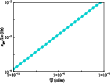
The paper rigorously quantifies dissipation in levitated mesoscopic particles, focusing on gas damping and blackbody radiation. Gas damping is identified as the dominant source in high-vacuum regimes. Calculations for diamond particles with experimental parameters (mass $\hat{\mathcal{H}^{g}_{1} = \hbar\frac{\omega}{2}\hat{\sigma}_{1}^{z}+\hbar\Omega_{1}\hat{\sigma}_{1}^{x}$2 kg, density $\hat{\mathcal{H}^{g}_{1} = \hbar\frac{\omega}{2}\hat{\sigma}_{1}^{z}+\hbar\Omega_{1}\hat{\sigma}_{1}^{x}$3 kg/m$\hat{\mathcal{H}^{g}_{1} = \hbar\frac{\omega}{2}\hat{\sigma}_{1}^{z}+\hbar\Omega_{1}\hat{\sigma}_{1}^{x}$4) yield a dissipation rate $\hat{\mathcal{H}^{g}_{1} = \hbar\frac{\omega}{2}\hat{\sigma}_{1}^{z}+\hbar\Omega_{1}\hat{\sigma}_{1}^{x}$5 Hz, supporting feasible quality factors $\hat{\mathcal{H}^{g}_{1} = \hbar\frac{\omega}{2}\hat{\sigma}_{1}^{z}+\hbar\Omega_{1}\hat{\sigma}_{1}^{x}$6.
Figure 6: Gas damping rate $\hat{\mathcal{H}^{g}_{1} = \hbar\frac{\omega}{2}\hat{\sigma}_{1}^{z}+\hbar\Omega_{1}\hat{\sigma}_{1}^{x}$7 vs. pressure, confirming ultra-high quality factor regimes are experimentally accessible.
Blackbody radiation contributions are negligible, with dissipation rates $\hat{\mathcal{H}^{g}_{1} = \hbar\frac{\omega}{2}\hat{\sigma}_{1}^{z}+\hbar\Omega_{1}\hat{\sigma}_{1}^{x}$8 Hz, several orders below gas damping. These analyses validate the adopted dissipative models and underpin the realistic sensitivity estimates.
Practical and Theoretical Implications
The MQ and MCQ gravimetry schemes enable ultra-compact, non-free-falling quantum gravity sensors, achieving optimal sensitivity scaling with particle mass and quantum resource number. The MCQ paradigm delivers an additional order-of-magnitude improvement and renders robustness to leakage and dissipation, addressing critical challenges in practical quantum metrology.
Direct comparison with prior levitated-particle gravimetry approaches establishes that the MQ and MCQ approaches achieve the best sensitivities in the single-particle regime, without requiring free-falling operation, thus significantly reducing device footprint and supporting integration.
These advances have implications for the development of highly sensitive, scalable quantum sensors based on mechanical systems. Future directions include exploiting larger cat-state resource numbers, integrating arrayed sensor architectures, and exploring extensions to other force-sensing modalities under quantum error suppression frameworks.
Conclusion
Quantum gravimetry based on mechanical qubits and cat qubits demonstrates optimal metrological performance under realistic dissipation, providing robust suppression of leakage and phase-flip errors. The MCQ scheme achieves sensitivity enhancement through quantum resource scaling, outperforming preceding levitated-particle gravimeters. The theoretical models and dissipation analyses support the practical feasibility of these quantum sensors, marking substantial progress in the precision measurement of gravity via quantum mechanical platforms.
“Emergent Mind helps me see which AI papers have caught fire online.”
Philip
Creator, AI Explained on YouTube
Sign up for free to explore the frontiers of research
Discover trending papers, chat with arXiv, and track the latest research shaping the future of science and technology.Discover trending papers, chat with arXiv, and more.