- The paper introduces and compares amplitude, basis, and hybrid encoding methods for quantum-enhanced CFD simulations.
- It details technical trade-offs in state preparation, measurement, and nonlinearity management critical for simulating fluid dynamics.
- The study highlights practical challenges such as gate depth and qubit scaling while offering insights for co-design in quantum CFD.
Encoding Strategies in Quantum-Enhanced Fluid Simulations: A Technical Overview
Introduction and Motivation
Efficient simulation of fluid dynamics remains a critical computational challenge, with applications in aerodynamics, turbulence modeling, and process design. Quantum computing offers the potential for significant computational acceleration, especially for high-dimensional, nonlinear, and multiscale systems ubiquitous in computational fluid dynamics (CFD). Achieving practical quantum advantage, however, is intrinsically contingent on information encoding: how classical field data, boundary conditions, and temporal dynamics are mapped to quantum hardware. This review (2604.24694) details a method-agnostic examination of encoding paradigms in quantum-enhanced fluid simulation, emphasizing technical trade-offs in state preparation, measurement, nonlinearity, boundary treatment, and temporal evolution.
Requirements and Constraints for Quantum Representation in CFD
Classical CFD is dominated by the need to efficiently model the evolution of high-dimensional, time-dependent field variables, often governed by nonlinear PDEs such as the Navier-Stokes equations. When ported to quantum computing, two principal technical hurdles arise:
- State Preparation Complexity: The cost of embedding an arbitrary high-dimensional classical field into a quantum state is exponential in the worst-case, dominated by two-qubit (CNOT) gate count, unless an application-specific or structured encoding is exploited.
- Quantum Readout Bottleneck: Extracting useful observable data from a quantum state for CFD prediction often requires quantum state tomography (QST), itself an exponential-cost process for generic states, nullifying any notional quantum speedup unless only a few global properties are required.
Treatment of boundary conditions and nonlinearity—especially the vortex-stretching and dissipative terms in practical CFD—pose additional algorithmic challenges due to the inherently linear and unitary nature of quantum evolution.
Core Encoding Paradigms
Amplitude Encoding
Amplitude encoding represents multidimensional field data in the amplitudes of a quantum register, thereby achieving exponential storage compression: n qubits can encode 2n real or complex values. This approach underpins many linear-algebraic quantum algorithms and is central to aspirations for exponential quantum speedup.
- Advantages: Maximal representational compression; seamless for linear operations and compatible with QSVT-based primitives.
- Bottlenecks: State preparation for arbitrary input requires either impractical circuit depth or QRAM, which is not yet available at scale. Measurement is infeasible for full wavefunction reconstruction, so only global observables or projections that admit efficient shadow tomography are practical.
- Nonlinearity: Quantum mechanics prohibits direct nonlinear operations in amplitudes (beyond NP), so workarounds invoke multiple register copies or classical-quantum hybrid delegation (see below).
Basis Encoding
Basis (computational basis) encoding stores each classical datum as a pattern of qubits (e.g., binary or unary/unary-one-hot), sacrificing exponential compression in exchange for simplified arithmetic operations and measurement.
- Advantages: Reduced cost for classical arithmetic and local operation; simplified implementation of discrete optimization algorithms, such as quantum annealing.
- Disadvantages: Linear (or worse) scaling in qubit count for dense fields; less suitable for leveraging inherent Hilbert space exponentiality.
Block Encoding and Hybrid Schemes
Block encoding and hybrid approaches (basis-amplitude conversion, e.g., in HHL) allow more flexible algorithm design by mapping structured dense or sparse matrices into principal subblocks of larger unitary operators.
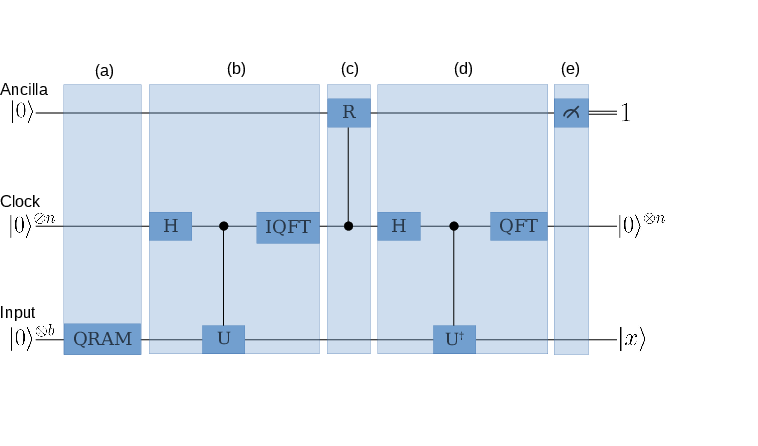
Figure 1: Summary circuit diagram for the HHL algorithm, illustrating the movement of information between amplitude and basis encodings.
Temporal Encoding
Temporal evolution can be implemented by iterating quantum circuits (one per timestep), or by encoding time in clock registers and constructing history states for parallel-in-time evolution. The latter offers a path to temporal compression but at a significant gate depth and circuit complexity cost.
Algorithmic Developments Exploiting Encoding Paradigms
Quantum Integration and PDE Solvers via Amplitude Estimation
Quantum amplitude estimation (QAE) and variants are foundational for quantum integration-based solvers of linear and nonlinear PDEs in CFD. The QAE algorithm leverages Grover-style rotations and phase estimation to estimate the mean (integral) of a real function, providing a quadratic query advantage.
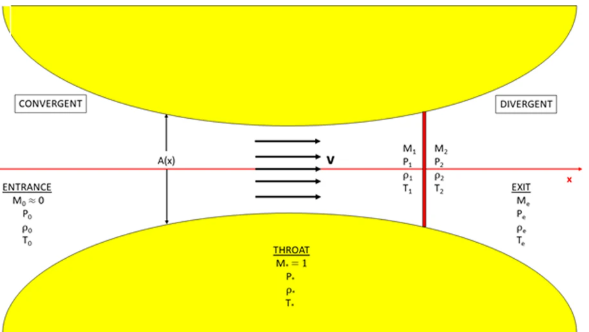
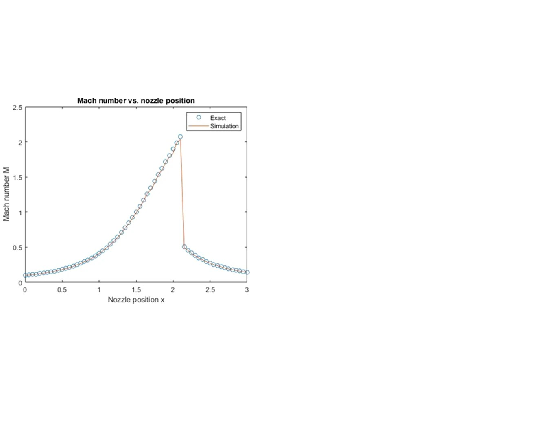
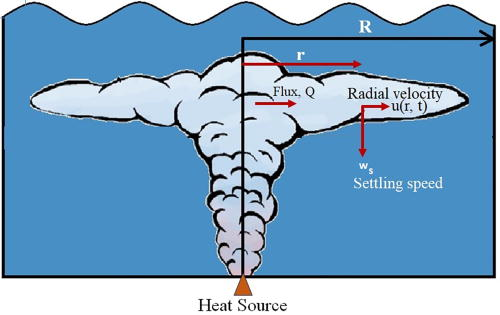
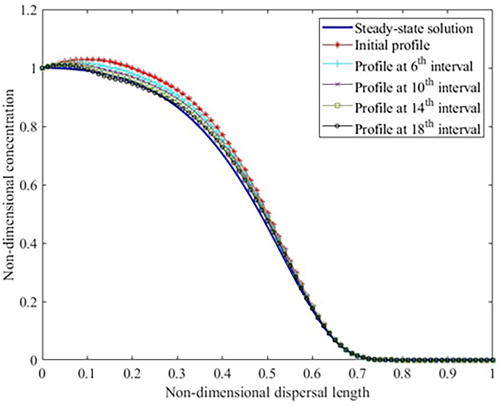
Figure 2: Quantum integration algorithm applied to nonlinear PDEs, with application to gas dynamics (nozzle flow) and tephra transport.
- The quantum circuit is only responsible for the integral evaluation at each grid point, which can be fully parallelized across points.
- Encoding leverage: The quantum states are prepared per grid point (localized), avoiding entanglement overhead.
- Speedup regime: Quadratic in query complexity for Hölder-class functions; in practice, dependent on both state preparation and oracle implementation cost.
Simulation of Strong Nonlinearities via Multicopy Interactions
True nonlinear amplitude dynamics are unphysical, so effective nonlinearity is simulated by operating on tensor products of multiple identically prepared quantum registers. Techniques due to Leyton & Osborne and Lloyd et al. use operator constructions that, upon post-selection, emulate quadratic or higher nonlinearities, at the cost of exponential scaling in the number of registers per integration time or degree of nonlinearity.
- This approach is only practical for weakly nonlinear systems or moderate integration times due to copy scaling.
- For anti-Hermitian dynamics, simulation reduces to efficient Hamiltonian evolution; more general dynamics require embedding into saddle-point or linear-system frameworks, with associated increases in circuit overhead and stability issues.
Optimization-Driven Approaches with Quantum Annealers
Quantum annealing provides a route for recasting PDEs and CFD problems into discrete binary optimization tasks (QUBO or Ising formulation). The "Qade" framework, for instance, encodes the solution of coupled PDEs in a quadratic loss function, then encodes continuous variables for annealing via bitstrings.
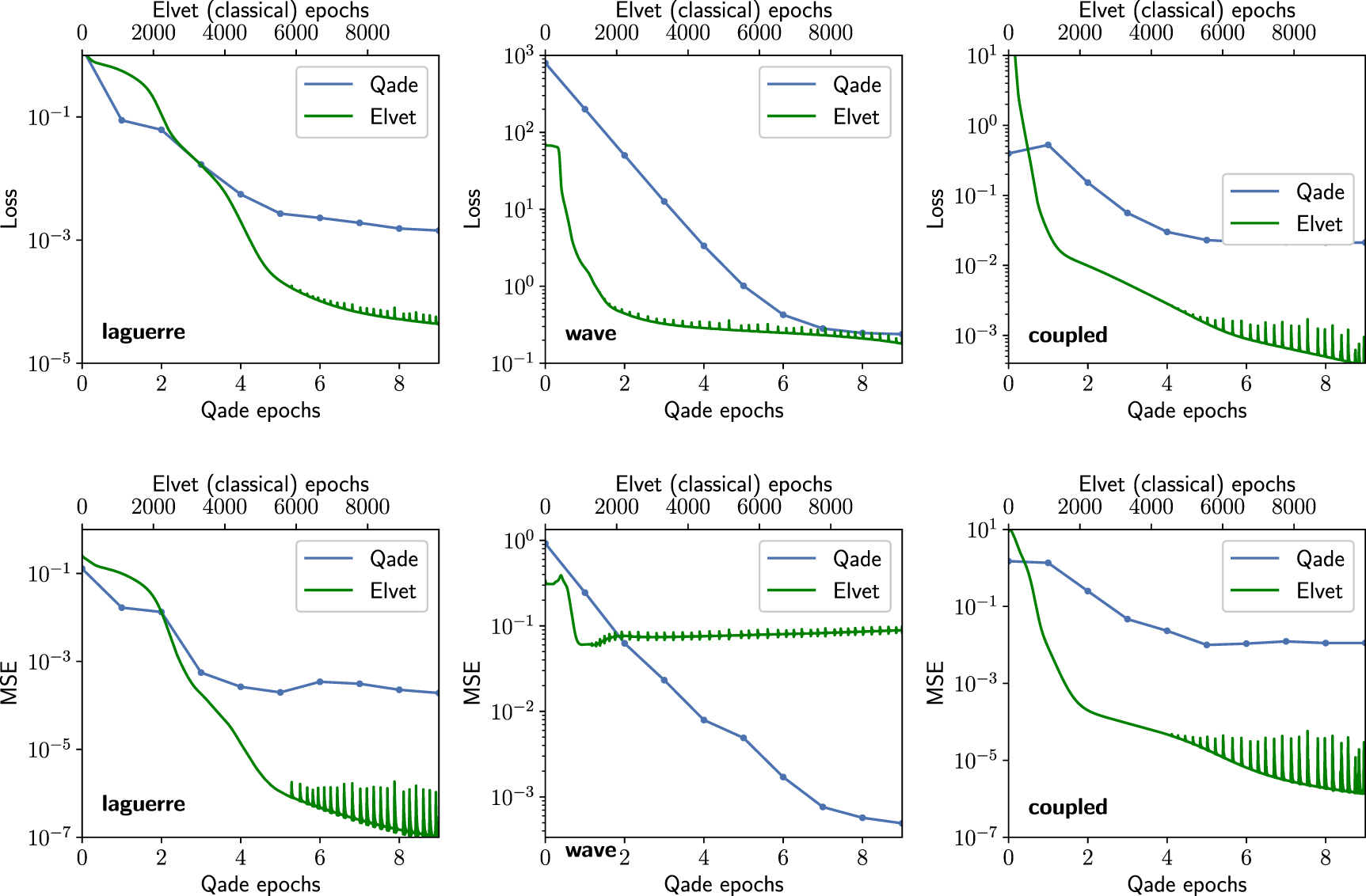
Figure 3: Empirical comparison between Qade (quantum annealer) and Elvet (classical neural solver) for several PDEs, illustrating favorable performance for some cases (e.g., wave equation).
- Encoding strengths: Simple state preparation; ease of readout (bitstring sampling).
- Limitations: Scaling in the number of spins (variables), difficulty for nonlinearity or complex constraints, absence of guaranteed global optimum due to heuristic nature of annealing.
- Hybridization: Variants employ adaptive bit windowing or iterative refinement to balance bit depth and connectivity constraints.
Quantum Lattice Boltzmann and Streaming
Adapting Lattice Boltzmann Methods (LBM) to quantum circuits ("QLBM") leverages amplitude encoding for the mesoscopic distribution function; linear streaming and local collision dynamics map naturally to gate sequences, realizing exponential memory compression.
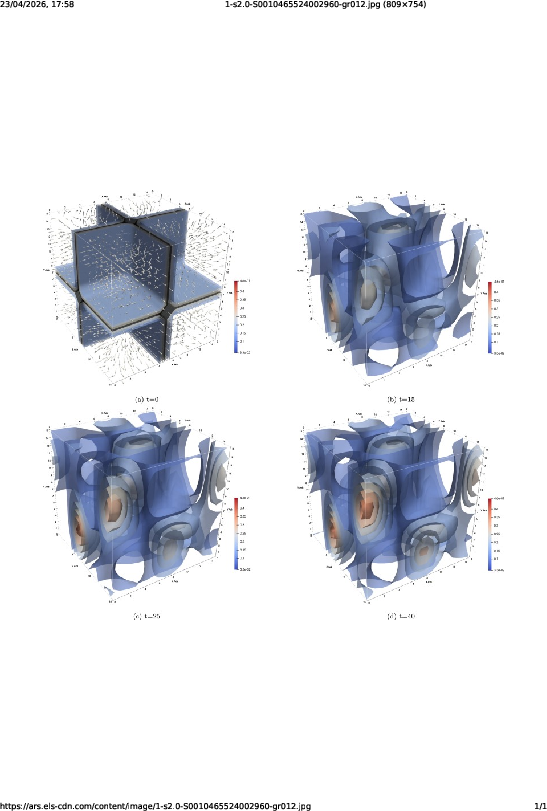
Figure 4: Taylor-Green vortex evolution with a quantum D3Q27 LBM, highlighting small discrepancies attributable to finite precision.
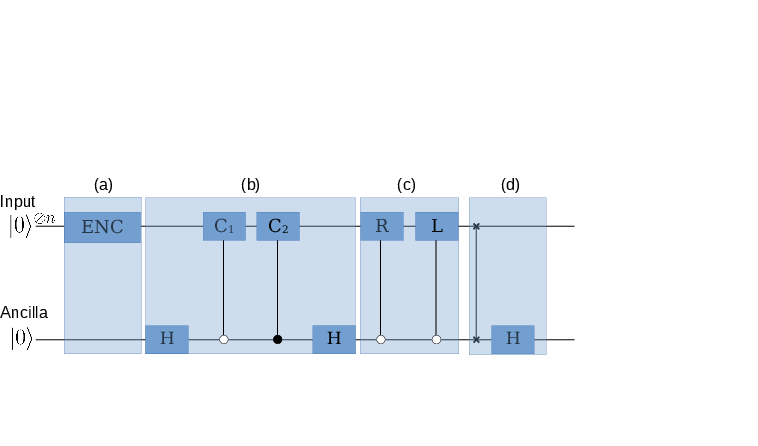
Figure 5: Quantum circuit diagram for the D1Q2 lattice Boltzmann implementation, detailing encoding, collision, streaming, and readout steps.
- For linear collision models (e.g., advection-diffusion), efficient LCU-based circuit designs with amplitude encoding approach feasibility; for nonlinear collision (Navier-Stokes), technical challenges abound.
- Hybrid encoding: Some authors suggest combining amplitude encoding for streaming with basis encoding for local nonlinear collision handling.
Encoding-Driven Opportunities and Technical Bottlenecks
Compacted amplitude encoding is attractive for asymptotic scaling, but may invert the computational bottleneck from storage to measurement or state preparation.
- Efficient classical-quantum interfaces and tailored oracles are key.
- Measurement-efficient algorithms that work with sufficient (as opposed to full) observables—e.g., global integrals, moments, or selected projections—offer enhanced feasibility for amplitude encoding.
Basis/binary/unary encodings lower the burden of logical and arithmetic operation construction, especially for optimization and annealing paradigms, at the cost of linear (in field size or variable count) hardware scaling.
- Adaptive and domain wall encoding can help reduce connectivity or embedding complexity.
Nonlinearity in CFD fundamentally challenges all encoding approaches. Simulated nonlinearity via multiple quantum copies only extends to moderate system sizes or weak nonlinear regimes before scaling or decoherence losses become prohibitive.
- Carleman linearization advances (via embedding into a larger linear space) shift nonlocality and complexity from one component to another, potentially breaking interaction-locality advantages of certain encodings.
Boundary condition enforcement is often encoding-specific, with some encodings facilitating natural treatment of periodic or reflective boundaries but complicating others; robust handling of general boundaries remains open.
Hardware-aware encoding is essential: native gate set, qubit connectivity, coherence, and measurement fidelities all interact with the optimal encoding strategy.
Numerical Results and Methodological Insights
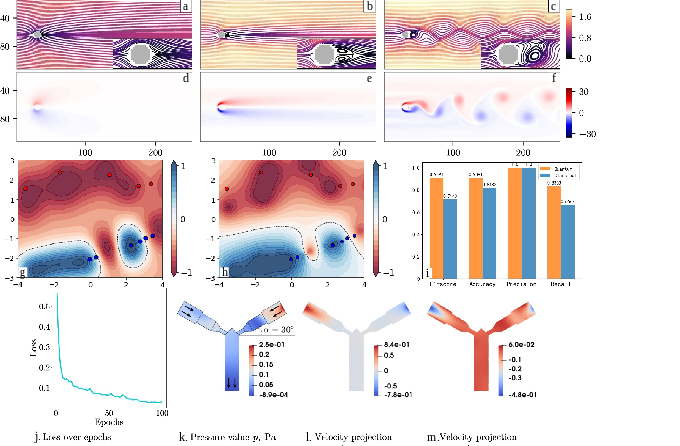
Figure 6: Spectrum of quantum and quantum-inspired fluid modelling applications: matrix-product-state simulation of flow past a cylinder, quantum SVMs for aerodynamic classification, and hybrid quantum physics-informed neural networks for 3D mixing.
- Empirical benchmarks (e.g., Qade vs. Elvet, QLBM for 3D vortices) illustrate problem-dependent performance. For certain PDEs and observables, quantum or annealer-based techniques are competitive or superior, especially for problems with favorable encoding and observability structure.
- Variational quantum circuits and hybrid quantum-classical algorithms (e.g., physics-informed neural networks with quantum components) showcase early application-level impact, with encoding strategy observed to impact convergence and accuracy.
Implications and Future Prospects
Practical and theoretical implications of encoding choices are profound. While formal quantum speedup is possible in principle for select problems/formulations, realization in fluid mechanics is conditional and case-dependent.
- For practical CFD: Encoding must be matched not only to problem structure and algorithm paradigm, but also to hardware capabilities and the nature of target observables.
- No single encoding paradigm is universally optimal. Adaptive, hybrid, or problem-driven encoding designs—possibly moving between amplitude and basis encodings within workflow stages—are likely to be necessary.
- Nonlinearity, boundary enforcement, and data loading/extraction remain open frontiers for encoding-aware quantum algorithm development in CFD and related applications.
Conclusion
Encoding is a central engineering and theoretical design variable in quantum CFD algorithm development. The review establishes that encoding decisions impact not just asymptotic resource scaling, but circuit depth, arithmetic feasibility, measurement cost, and hardware compatibility. Moving forward, domain-specific co-design—iterating between problem decomposition, encoding choice, algorithm selectivity, and hardware implementation—is crucial for extracting genuine advantage from quantum computing in fluid simulation. Future work will need to resolve outstanding issues in nonlinear operator simulation, efficient boundary specification, and state-of-the-art quantum-classical interfacing to fully realize the promise of quantum-enhanced CFD simulations (2604.24694).
References:
See (2604.24694) for an exhaustive, up-to-date reference list and further technical details.

