Quantum Lattice Boltzmann with Denoising Collision Operators
Published 11 Apr 2026 in quant-ph | (2604.09997v1)
Abstract: The Lattice Boltzmann method (LBM) is a well-established mesoscopic approach for simulating fluid dynamics by evolving particle distribution functions on discrete lattices. While the LBM is highly parallelizable on classical hardware, its translation to quantum algorithms is impeded by the collision process, which is intrinsically nonlinear and irreversible. Several existing quantum formulations implement this process through repeated quantum tomography and state preparation at every timestep, leading to significant overheads. We introduce a quantum LBM based on a denoising-type collision operator that avoids tomography-based updates. The collision dynamics are reformulated as an orthogonal projection onto the linearized manifold of equilibrium distributions around a reference state. This geometric approach filters non-equilibrium components while preserving lattice symmetries and approximating nonlinear terms needed to recover hydrodynamic behavior. A complete pipeline is presented with efficient gate-level realizations, incorporating encoding of distributions, collision, streaming, boundary conditions, and measurement of physical quantities such as hydrodynamic forces. In addition, we outline an approach for implementing projector-based operators deterministically without postselection, paving the way to fully coherent multi-timestep LBM simulations. Numerical experiments for advection-diffusion and flow problems demonstrate that the method reproduces macroscopic behaviors with high accuracy, with performance depending on the choice of reference state.
The paper introduces a denoising collision operator that replaces the nonlinear collision with an orthogonal projection onto the equilibrium manifold’s tangent space.
It details a quantum circuit realization using block encoding, Givens rotations, and ancilla-based postselection to achieve fully coherent evolution.
Numerical results confirm high accuracy (error <1%) in simulating Fourier modes, Taylor-Green vortices, and flow around cylinders, demonstrating practical quantum CFD.
Quantum Lattice Boltzmann with Denoising Collision Operators: A Detailed Analysis
Introduction and Motivation
The Lattice Boltzmann Method (LBM) is a mesoscopic computational framework pivotal for simulating a wide spectrum of fluid dynamics phenomena. Although highly parallelizable on classical architectures, its collision step—nonlinear and irreversible—creates a fundamental bottleneck in quantum implementations. Existing quantum LBM (QLBM) approaches struggle with this collision step, often resorting to tomography and measurement-heavy protocols, which compromise coherence and scalability across timesteps. The paper “Quantum Lattice Boltzmann with Denoising Collision Operators” (2604.09997) introduces a fundamentally distinct formulation: it replaces the nonlinear collision process with an orthogonal projector onto a local tangent space of the equilibrium manifold, akin to a denoising operation, thereby mapping the collision dynamics into a linear, measurement-free quantum operation compatible with multi-timestep evolution.
Classical LBM and Quantum Obstacles
Classical LBM simulates the dynamics of discrete particle populations fi(x,t) on a lattice via a two-step evolve-update scheme: non-linear collision, and linear streaming. The BGK collision step explicitly relaxes populations towards a local equilibrium fieq(x,t)—nonlinearly dependent on macroscopic moments. The streaming step is an index shift. The collision term's quadratic velocity dependence is essential, enabling recovery of Navier-Stokes nonlinearity at the macroscopic level.
Quantum algorithms can efficiently realize the linear streaming step as quantum walks or shift operators. However, the nonunitary and nonlinear nature of the collision updating precludes a direct quantum translation, since quantum operations are fundamentally linear and unitary.
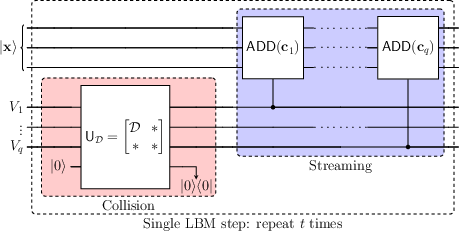
Figure 1: Diagram for standard QLBM simulations over t timesteps without boundary treatment.
Denoising Collision Operator: Geometric Construction
The paper introduces a geometric and information-theoretic reinterpretation: collision is formulated as an orthogonal projection onto the tangent plane of the equilibrium manifold at a reference state. The state encoding employs amplitude encoding: distributions at each site are encoded in quantum amplitudes as ∣ψx⟩=i=1∑qfi(x)∣ei⟩.
Key aspects of the denoising collision operator D:
Projection Subspace: Defined as the span of density and first derivative directions of the manifold parametrized by ρh(u) (where h is derived from Hermite moments of the equilibrium distribution).
Reference Dependency: Only the reference velocity u^ (not density) determines the projection subspace, due to the conical structure in the encoding.
Implementation: The projector, non-unitary but linear, can be block-encoded in a higher-dimensional Hilbert space, enabling quantum circuit realization with ancillary qubits.
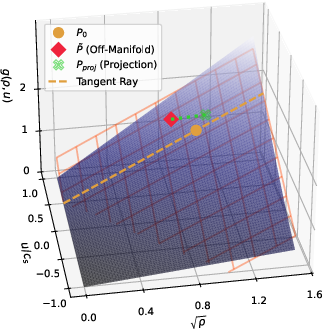
Figure 2: Projection onto the local tangent plane (orange grid) of a smooth surface (blue) in a neighborhood of the reference point P0. Because of the conical structure in ρ, the tangent plane touches the surface along a ray corresponding to a fixed value of fieq(x,t)0.
Quantum Circuit Realization of QLBM
The overall quantum pipeline alternates streaming (conditonal shifts on lattice registers) and denoising collision steps. The collision operator’s implementation follows a gate synthesis strategy:
Block-Encoding of fieq(x,t)1: fieq(x,t)2, being a projector, is block-encoded into a unitary fieq(x,t)3 via the singular value decomposition, utilizing Givens rotations for the nontrivial basis transformations and controlled phase gates for the singular spectrum.
Ancilla-Based Postselection: Each application of the collision unitary requires postselection on ancilla measurement; the paper rigorously proves that amplitude amplification cannot increase the success probability of such a projector-based map.
Fully Coherent Evolution: To bypass the postselection bottleneck for multi-timestep simulations, the authors outline deterministic realizations using the double-bracket formalism and polynomial filtering via imaginary-time evolution, leveraging recent algorithmic advances.
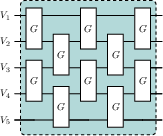
Figure 3: The Clements decomposition of fieq(x,t)4 and fieq(x,t)5 yields a brickwork layout of Givens rotations, with each rotation having a distinct angle. This diagram is shown for fieq(x,t)6.
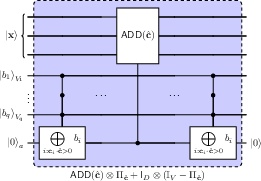
Figure 4: General quantum circuit for streaming along a Cartesian unit direction fieq(x,t)7. The circuit computes and uncomputes the binary value for control with an ancilla.
Boundary Conditions
Practical CFD simulations require careful treatment of boundaries. The paper details quantum circuits for:
Periodic Boundaries: Implemented via modular arithmetic in the streaming step, requiring only standard quantum addition.
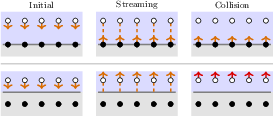
Bounce-Back Schemes: Both full-way and half-way bounce-back are implemented using quantum-controlled swaps and oracles, accurately enforcing no-slip conditions at solid boundaries.
Figure 5: Schematic illustration of the (top) full-way and (bottom) half-way bounce-back schemes. White and black nodes denote fluid and solid nodes, respectively, and the flat plane marks the fluid-solid interface.
Theoretical Properties: Symmetry and Error
The denoising operator fieq(x,t)8 satisfies all the symmetry (equivariance) constraints of the collision term with respect to permutation and orthogonal transformations of the underlying lattice. The two main theorems quantify the accuracy losses:
Collision Error: Bounded in terms of reference velocity misalignment fieq(x,t)9 and local strain tensor, indicating robustness when the reference follows the flow.
Manifold Projection Error: Bounded quadratically in misalignment, with sharper bounds expressed via angle between the projection and true distribution in amplitude space.
Numerical Results
Advection-Diffusion: Fourier Mode and Gaussian Hill
In both 1D Fourier-mode and 2D Gaussian hill test cases, QLBM simulations reproduce macroscopic field advection and temporal evolution with high precision (error t01% for Fourier mode). A subtle underdamping in diffusion is observed for low-Péclet regimes, consistent with the approximation inherent in replacing full collision with tangent-space projection.
Taylor-Green Vortex
For nonlinear flow fields, such as Taylor-Green vortex decay, the QLBM captures overall transient dynamics, with accuracy governed by the distance of the chosen reference velocity t1 from the true field. The velocity field error is initially larger but decays as the system approaches the reference, reflecting error bounds derived analytically.
Flow Around a Cylinder
Complex geometries are handled with geometric boundary operators. The accuracy is highly sensitive to the reference velocity chosen for the denoising operator; selecting t2 approximating the mean steady-state velocity yields stable and accurate results.
Practical and Theoretical Implications
This geometric-projection QLBM approach fundamentally reconfigures the intersection between quantum computing and nonlinear numerical simulation:
Practical Quantum CFD: The method demonstrates, for the first time, a credible path to multi-timestep, measurement-free, fully coherent quantum fluid simulations—eliminating the exponential decoherence bottleneck of previous tomography-reliant QLBM algorithms.
Control of Approximation Error: Theorems rigorously establish how simulation accuracy scales with reference-tracking and flow invariants, enabling quantitative guidance on automated reference selection strategies.
Compatibility with Quantum Hardware: The modular gate synthesis, block-encoding construction, and perspective toward deterministic implementation (via double-bracket formalism) position the approach for structured hardware realization as devices mature.
Generalization: The denoising construction extends trivially to advection-diffusion and potentially to nonlinear, nonequilibrium phenomena by local adaptation of the reference tangent plane.
Future Directions
Immediate research avenues include: (1) adaptive, space-time–dependent reference velocity selection protocols for turbulent or strongly inhomogeneous flows; (2) extending the projection manifold to accommodate nonlinearities corresponding to arbitrary relaxation time t3; (3) compilation and error analysis under circuit-depth and noise constraints for NISQ-era quantum devices; and (4) further generalization of projection-based dynamics to other nonlinear PDEs beyond fluid dynamics.
Conclusion
By recasting the nonlinear, irreversible collision step of LBM as a projection onto the local tangent space of the equilibrium manifold (“denoising”), this work constructs the first QLBM approach enabling scalable, coherent quantum fluid simulation with explicit control over error scaling. The geometric projector satisfies all the correct symmetries and admits efficient quantum circuit realization via block encoding and Givens decomposition, while deterministic, multi-timestep evolution is, in principle, accessible via double-bracket algorithms. The numerical results, theoretical bounds, and circuit-level constructions together establish a promising trajectory for quantum computation in mesoscopic and continuum computational physics.
“Emergent Mind helps me see which AI papers have caught fire online.”
Philip
Creator, AI Explained on YouTube
Sign up for free to explore the frontiers of research
Discover trending papers, chat with arXiv, and track the latest research shaping the future of science and technology.Discover trending papers, chat with arXiv, and more.