- The paper demonstrates that radar odometry pipelines developed for urban settings suffer from significant drift and errors when applied to rugged off-road terrains.
- It evaluates methods such as CFEAR, ORORA, Radar-KISSICP, and Radar-IMU using the Great Outdoors dataset to assess performance under full SE(3) motion.
- The study underscores the need for motion compensation and IMU integration to enhance 3D localization in complex, non-planar off-road environments.
Advancing Radar Odometry in Unstructured Off-road Robotics
Introduction
"Pushing Radar Odometry Beyond the Pavement: Current Capabilities and Challenges" (2604.24674) constitutes a rigorous evaluation of radar odometry pipelines in off-road environments, delineating current limitations and proposing diagnostic baselines to navigate the complexities of full SE(3) vehicle motion and terrain-induced artifacts. The paper particularly assesses the efficacy of CFEAR, ORORA, and introduces two baselines—Radar-KISSICP and Radar-IMU—incorporating motion compensation and IMU preintegration, respectively. All evaluations employ the Great Outdoors (GO) dataset, which is characterized by significant pitch/roll excitation, terrain discontinuities, and variable environmental conditions.
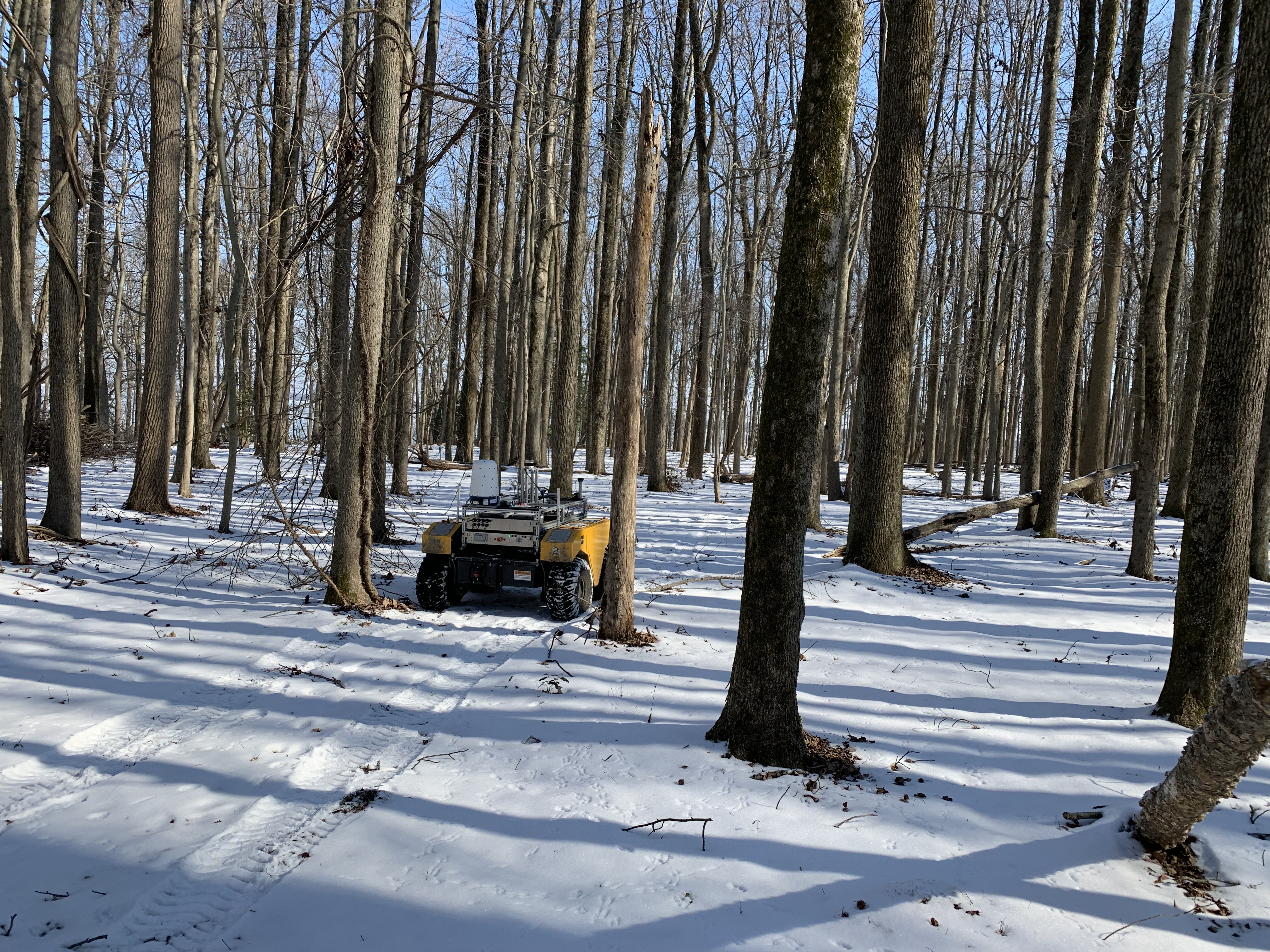
Figure 1: The motivating scenario illustrates use of Navtech radar-equipped Warthog for robust off-road localization in snow-covered forests.
Prior Work and Theoretical Context
Radar odometry has conventionally focused on urban or automotive settings, exploiting robust feature extraction and registration techniques. NDT-based approaches, outlier-robust pipelines (e.g., ORORA), direct methods (e.g., DRO), and deep learning-powered feature selection have advanced the field [adolfsson_lidar_level_2023] [lim_orora_2023], yet predominantly within SE(2) constraints. These paradigms largely assume planar trajectories, moderate excitation, and abundant stable landmarks, all assumptions violated in unstructured, off-road scenarios.
Benchmarking Framework and Datasets
A benchmarking protocol is established across representative automotive datasets (Oxford, MulRan, Boreas) and the GO dataset, the latter encapsulating forest trails, ravines, and snow. GO sequences specifically expose radar odometry algorithms to aggressive 3D motion and feature sparsity. The sensor setup comprises Navtech CTS350-X radar with 270m range, parallel to previously used models, ensuring cross-dataset comparability.
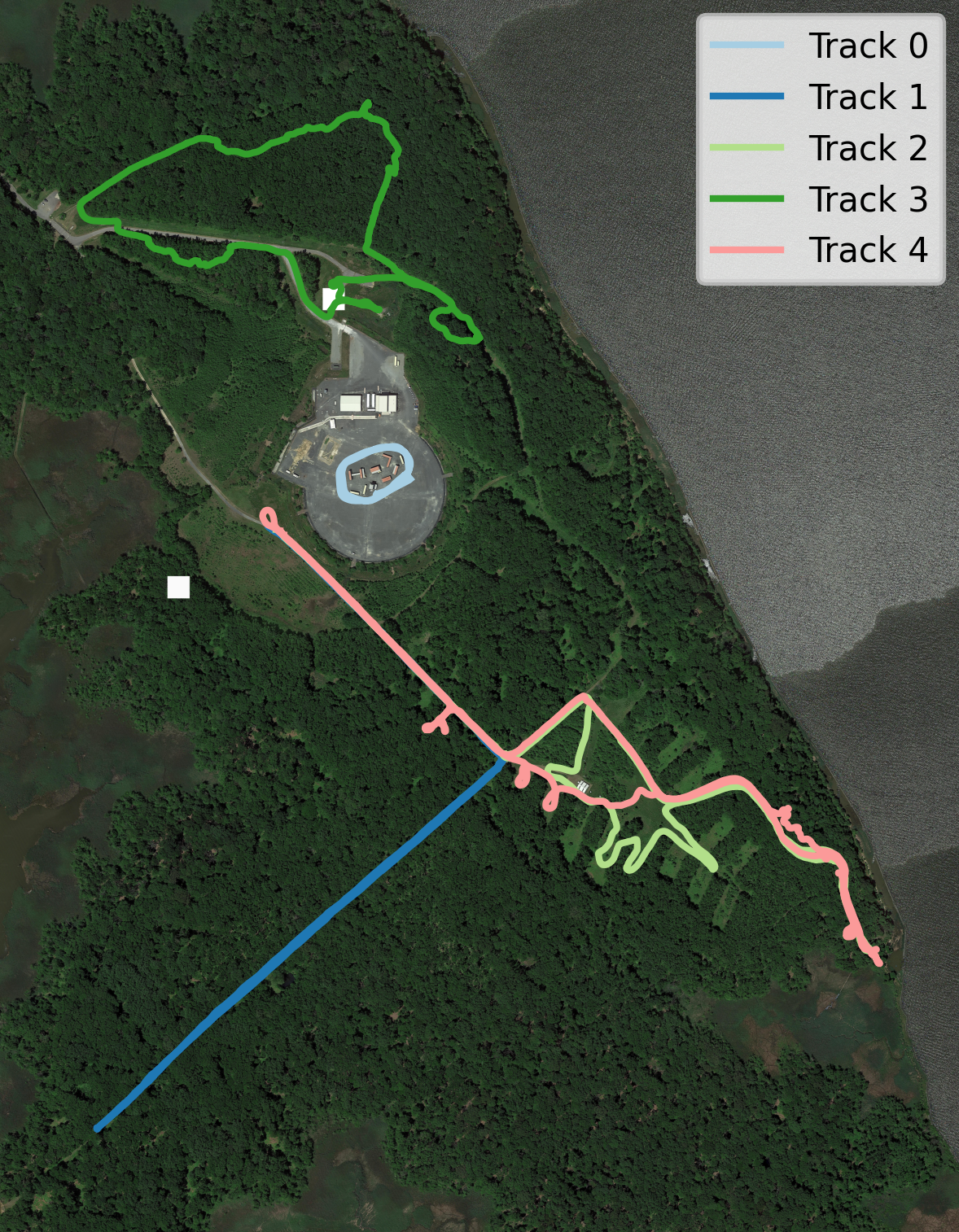
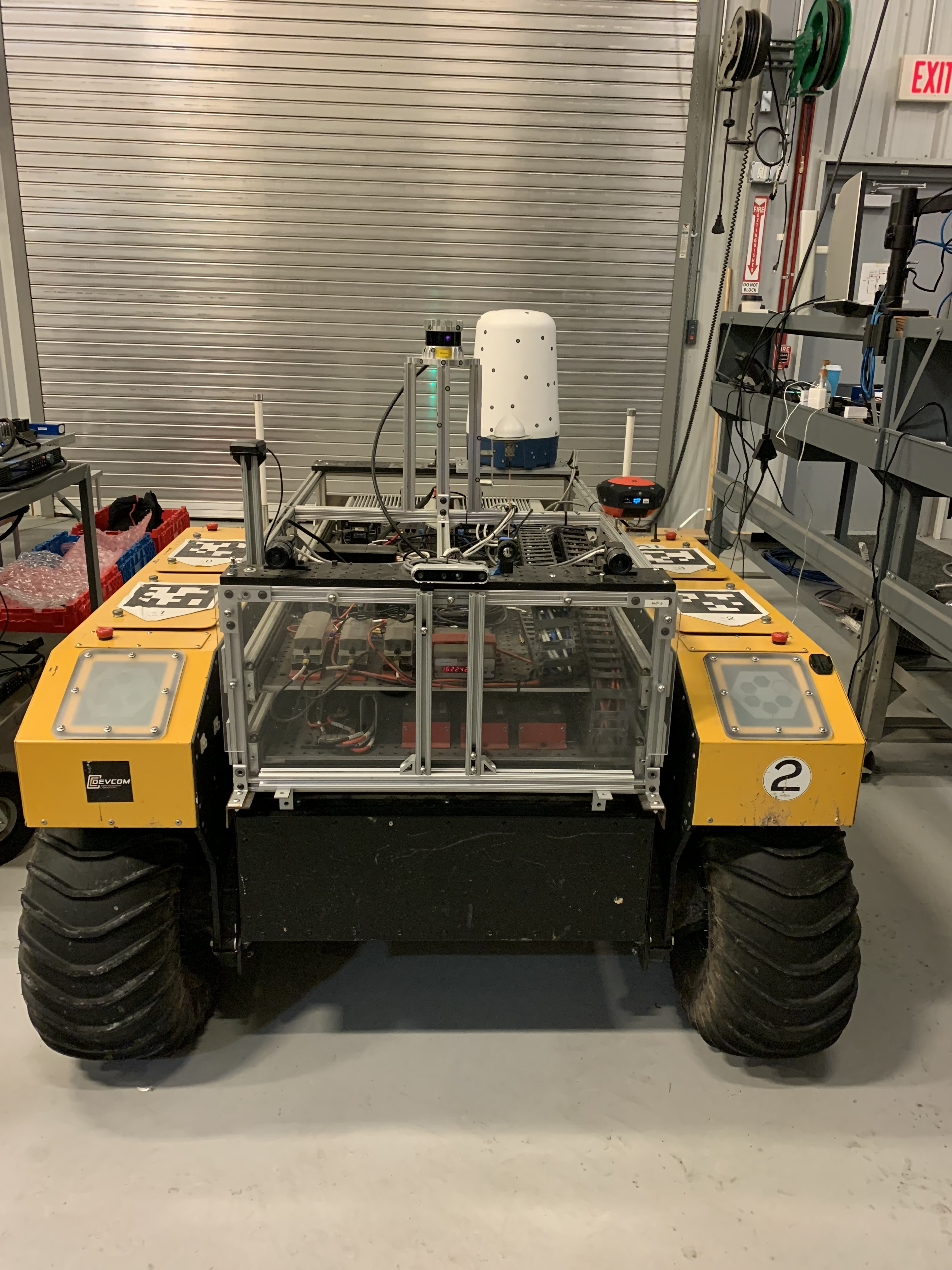
Figure 2: GO dataset routes, sensor platform overview. Off-road trajectories exhibit non-planar motion regimes.
Odometry Engines and Diagnostic Baselines
- CFEAR: Utilizes surfel-based feature extraction, robust point-to-line registration, and scan-to-keyframe matching. It performs well in planar motion but is susceptible to ground returns in off-road domains.
- ORORA: Introduces graduated non-convexity for rotation estimation and maximum clique inlier selection to mitigate outlier effects. However, aggressive pruning may exclude valid correspondences in feature-sparse environments.
- Radar-KISSICP: Employs SO(3) motion compensation for constructing sparse, 3D-aware radar pointclouds. Despite mitigating planar bias, it suffers from ill-conditioned ICP due to feature sparsity and unreliable nearest-neighbor associations.
- Radar-IMU: Extends Radar-KISSICP by preintegrating IMU measurements, supplying an SE(3) prior. This significantly improves trajectory robustness, especially in vertical displacement scenarios (e.g., ravine traversals).
Quantitative Results: Urban vs. Off-road
On automotive datasets, both CFEAR and ORORA achieve competitive relative pose and trajectory accuracy. When tested in GO’s off-road environments, significant degradation occurs, with sharp increases in ATE and local drift, especially on routes with ravines and terrain deviations. Radar-IMU consistently demonstrates superior robustness in these settings, outperforming radar-only pipelines in both translation and rotation errors.
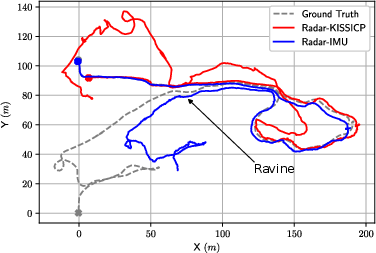
Figure 3: Trajectory segment from GO Route 3, illustrating substantial drift at ravine location (black arrow highlights problematic region).
Failure Modes and Analysis
Off-road conditions challenge radar odometry pipelines in unique ways:
- Ground Returns: Become persistent rather than removable outliers, corrupting feature associations and exacerbating drift.
- Feature Sparsity: In forested or ravine regions, radar returns are dominated by reflections from non-landmark surfaces, breaking ICP assumptions.
- Isolated Errors Propagation: Local failures (e.g., in ravine traversal) propagate to global drift, even when relative pose estimates remain plausible for most of the trajectory.
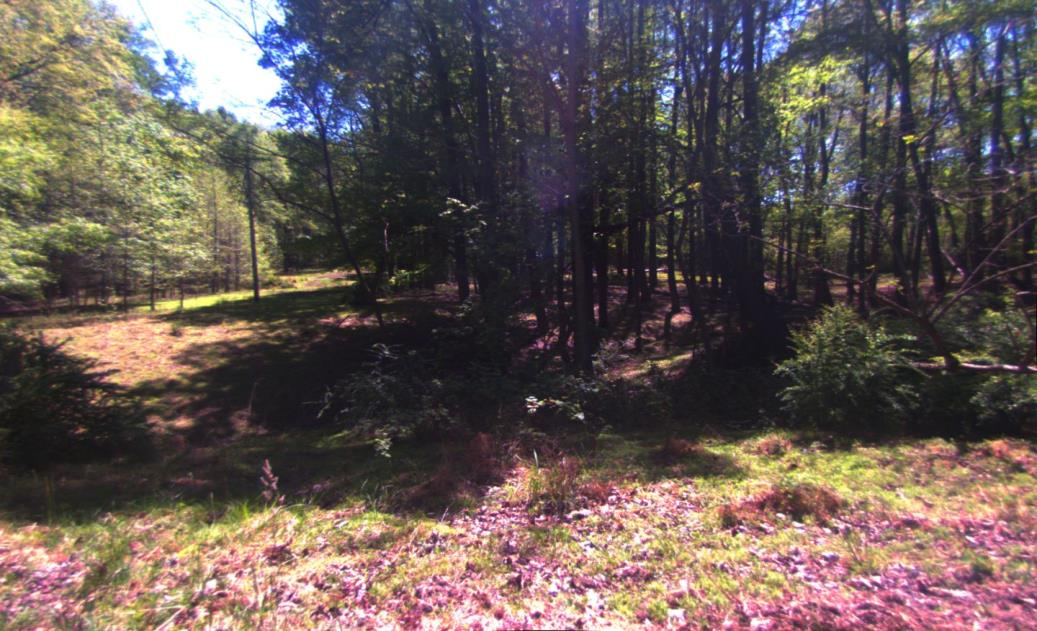
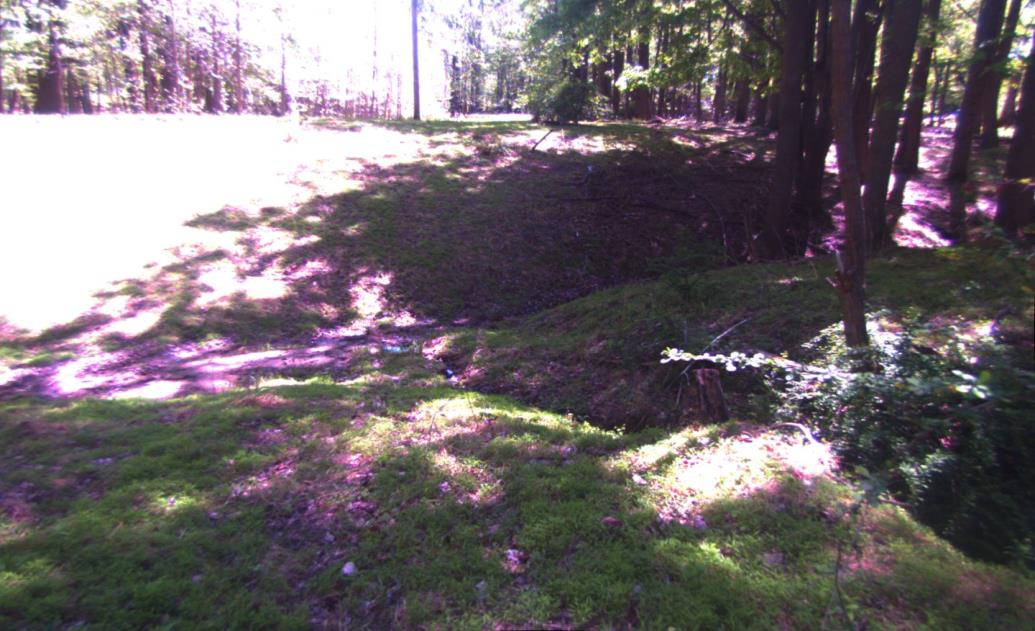
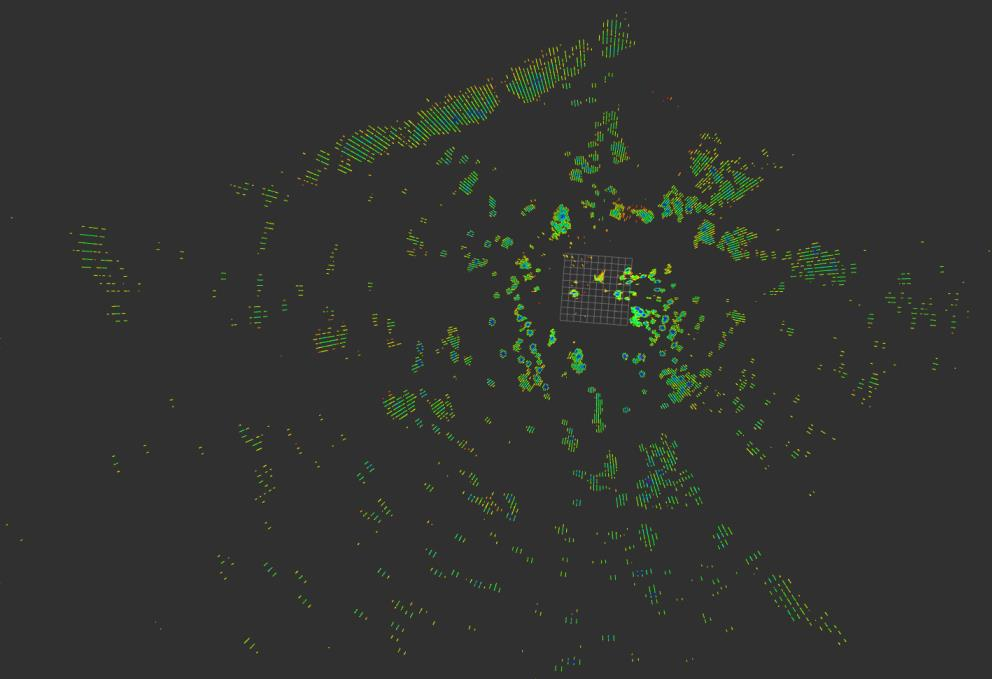
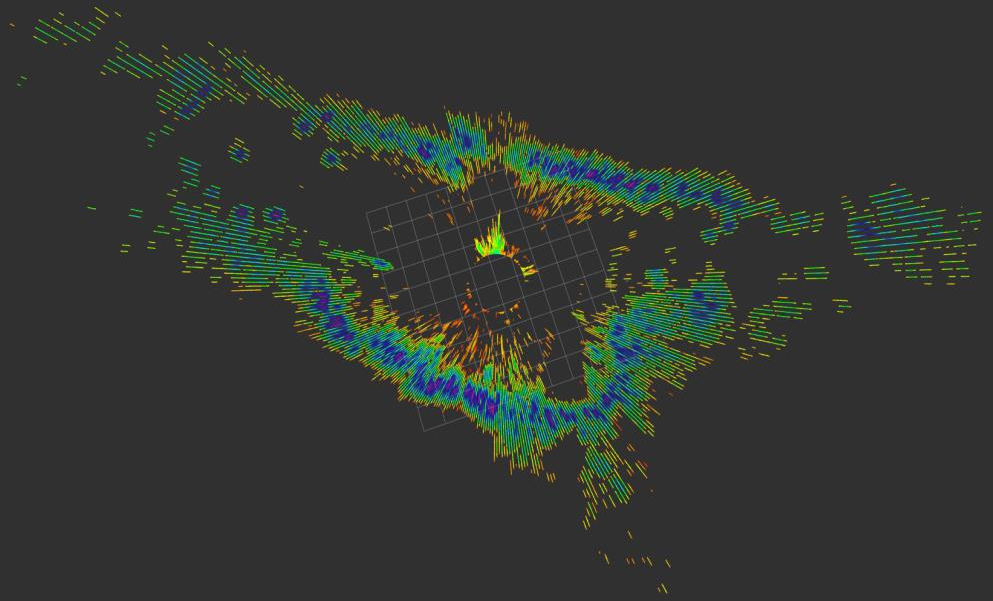
Figure 4: Comparison of camera images and radar pointclouds during Route 3. Left: feature-rich return; Right: ravine entry yields sparse, ambiguous returns dominated by wall reflections.
Mitigation Strategies
Motion compensation (Radar-KISSICP) partially addresses planar bias but does not fundamentally solve spatial inconsistency and map corruption arising from off-road motion. Inertial integration (Radar-IMU) introduces vertical awareness critical for robust localization under full SE(3) excitation, as corroborated by ravine recovery scenarios.
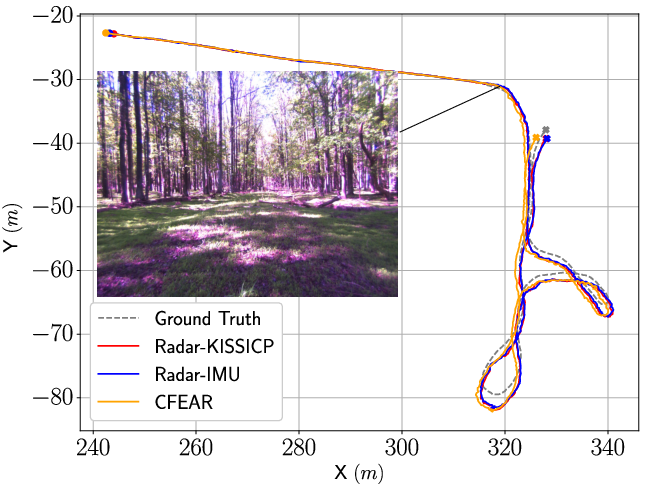
Figure 5: Trajectory plots from Radar-KISSICP, CFEAR, and Radar-IMU compared with groundtruth in an isolated offroad sequence; radar-IMU shows improved fidelity.
Practical and Theoretical Implications
Empirical results demonstrate that radar odometry pipelines robust in SE(2) regimes do not generalize to unstructured terrain without dedicated compensation for 3D motion and ground return artifacts. IMU integration and motion compensation emerge as necessary extensions for off-road deployment. This underscores the need for:
- 3D Radar Systems: Higher fidelity sensing to obviate reliance on sparsity-prone scan matching.
- Tighter Sensor Fusion: Synchronization of radar, IMU, and potentially LiDAR/visual modalities.
- Learned Feature Selection/Correction: Deep learning techniques for robust denoising and landmark extraction in feature-sparse settings.
Future research should focus on fusing richer multimodal sensory inputs, adapting direct and learning-based radar odometry architectures, and leveraging 3D Doppler-capable radar to enable accurate, drift-resistant localization in natural environments.
Conclusion
This paper definitively identifies the operational boundary of urban-centric radar odometry pipelines, demonstrating their susceptibility to drift and catastrophic error in off-road, unstructured environments. Through diagnostic baselines—motion compensation and IMU preintegration—the study reveals critical dependencies and points toward promising directions: sensor fusion, richer radar modalities, and adaptive feature selection are key to unlocking robust, weather-agnostic localization for autonomous robotics in natural terrains. The systematic exploration provides a reference benchmark and lays the analytical groundwork for resilient off-road radar navigation systems.