- The paper introduces AstroVLBench, a benchmark for assessing vision-language models' capability to perform astronomical reasoning tasks using diverse scientific data modalities.
- It explores performance across five modalities, highlighting Gemini 3 Pro as the most consistent model, excelling in radio morphology and optical imaging tasks.
- Findings reveal gaps in model performance, showing bias and mode collapse, particularly in classification tasks and light curve interpretation, advocating for future representation learning advancements.
Systematic Evaluation of Frontier Vision-LLMs in Observational Astronomy with AstroVLBench
Introduction
The evaluation of foundation and multi-modal vision-LLMs (VLMs) on complex, heterogeneous scientific data has immediate consequences for the deployment of AI in research. This paper establishes AstroVLBench, the first comprehensive, expert-verified benchmark for assessing the capacity of six frontier VLMs—GPT-5.2, Claude Opus 4.5, Gemini 3 Pro, Grok-4, Qwen3-235B, Intern-S1-Pro—to execute authentic astronomical reasoning tasks across five distinct modalities: optical imaging, radio interferometry, spectral energy distribution (SED) analysis, time-domain photometric classification, and optical spectroscopy (2604.24589). The authors provide over 4,100 real, modality-diverse test cases targeting core physical distinctions in extragalactic astronomy, with a focus on AGN identification and related phenomena as a unifying cross-modal theme.
Benchmark Structure and Modality-Specific Tasks
AstroVLBench is constructed to dissect both perceptual and conceptual AI reasoning in astronomy. Each task aligns with a distinct data representation: (1) QSO host galaxy discrimination in optical images, (2) Fanaroff–Riley radio morphology in interferometric images, (3) AGN and galaxy classification from multi-wavelength SEDs, (4) five-way classification of time-domain light curves (AGN, SNIa, TDE, RRL, Mira), and (5) hierarchical interpretation of DESI optical spectra (emission line detection, BLAGN identification, BPT classification).
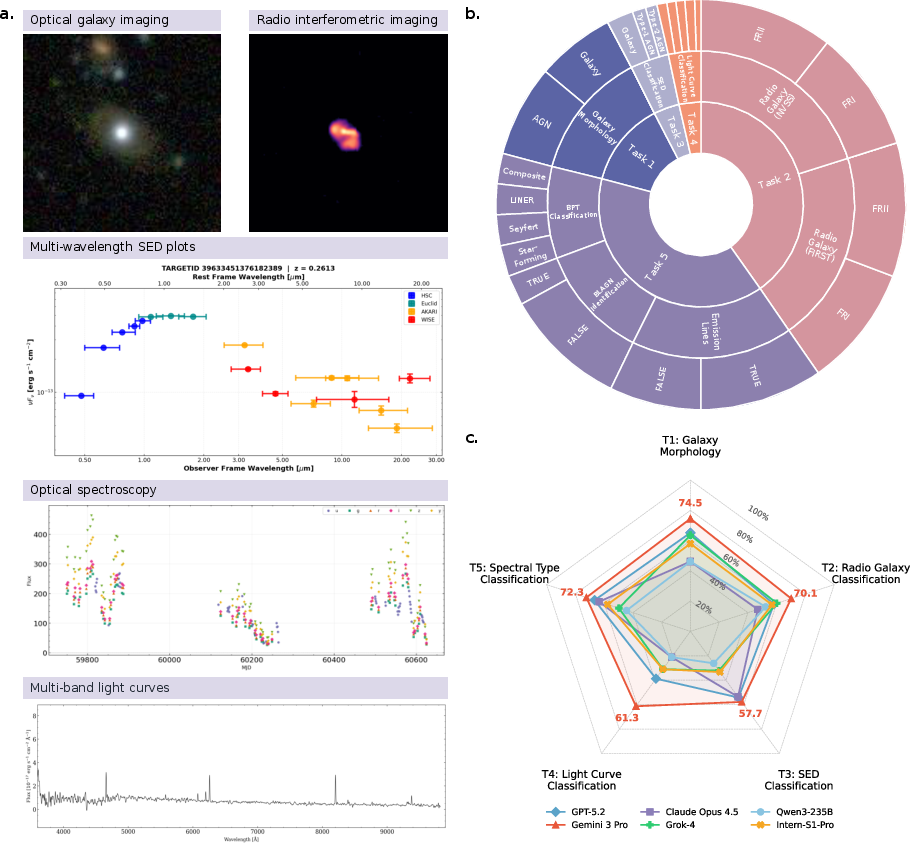
Figure 1: Overview of the five AstroVLBench task modalities, dataset class distributions, and a comparative radar plot of VLM model accuracy across tasks.
Quantitative Model Evaluation
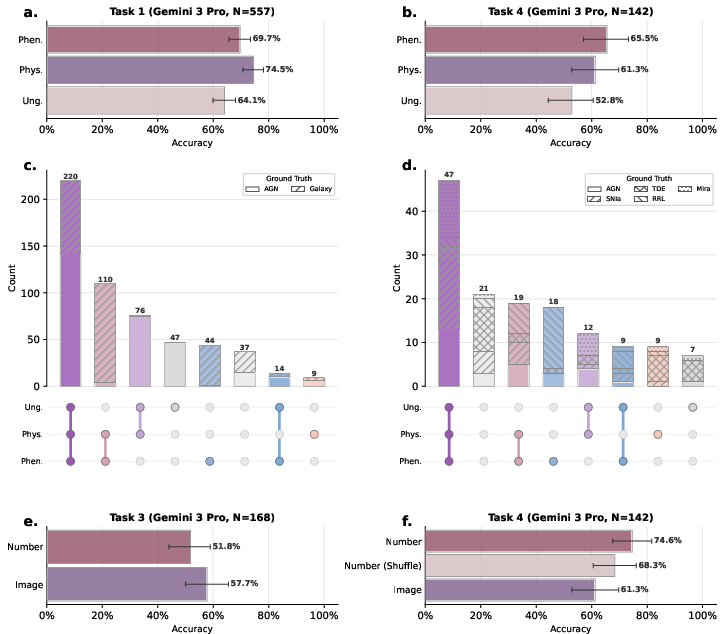
Striking modality-dependent performance characteristics are demonstrated in baseline (guided prompt) evaluations. Gemini 3 Pro emerges as the most consistent, leading four out of five tasks, with notable accuracy on radio morphology (FIRST: 84.6%, NVSS: 55.3%), optical imaging (74.5%), and BPT spectral diagnostics (55.8%) (Figure 2). However, on tasks involving subtle photometric distinctions (e.g., SED shape; Task 3) or numerical temporal reasoning (Task 4), all models are outperformed by specialist astronomical algorithms and show class-specific bias and mode collapse. For instance, on the SED classification task, models achieve high galaxy recall but fail catastrophically for AGN, and on time-domain tasks, only Gemini 3 Pro surpasses 60% accuracy, with others defaulting to single-class predictions.
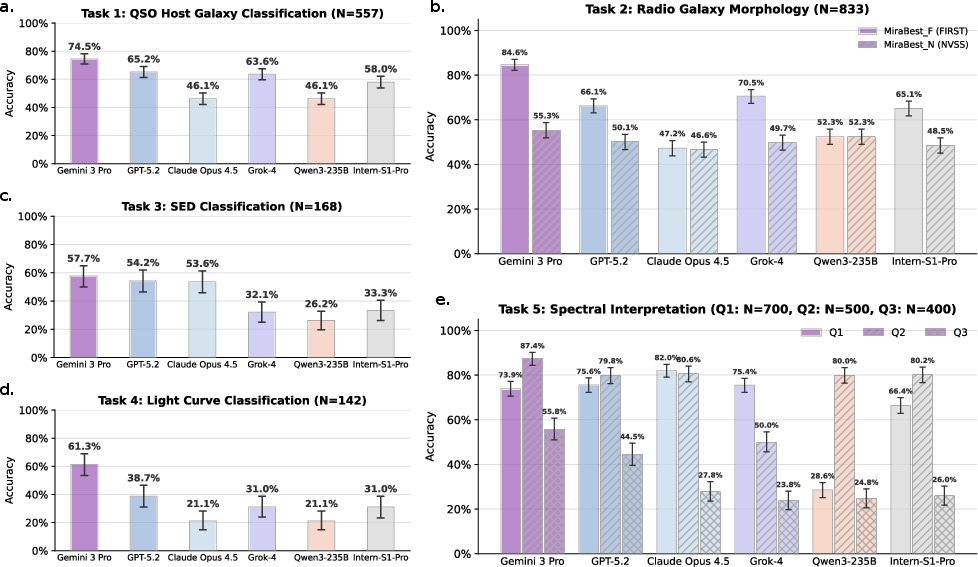
Figure 2: Model accuracy with 95% bootstrap confidence intervals across all five AstroVLBench modalities.
Representation and Prompt Mechanism Ablations
To elucidate the mechanistic sources of model success and failure, the paper performs systematic ablations using Gemini 3 Pro:
Failure Modes and Modal Reasoning Dissection
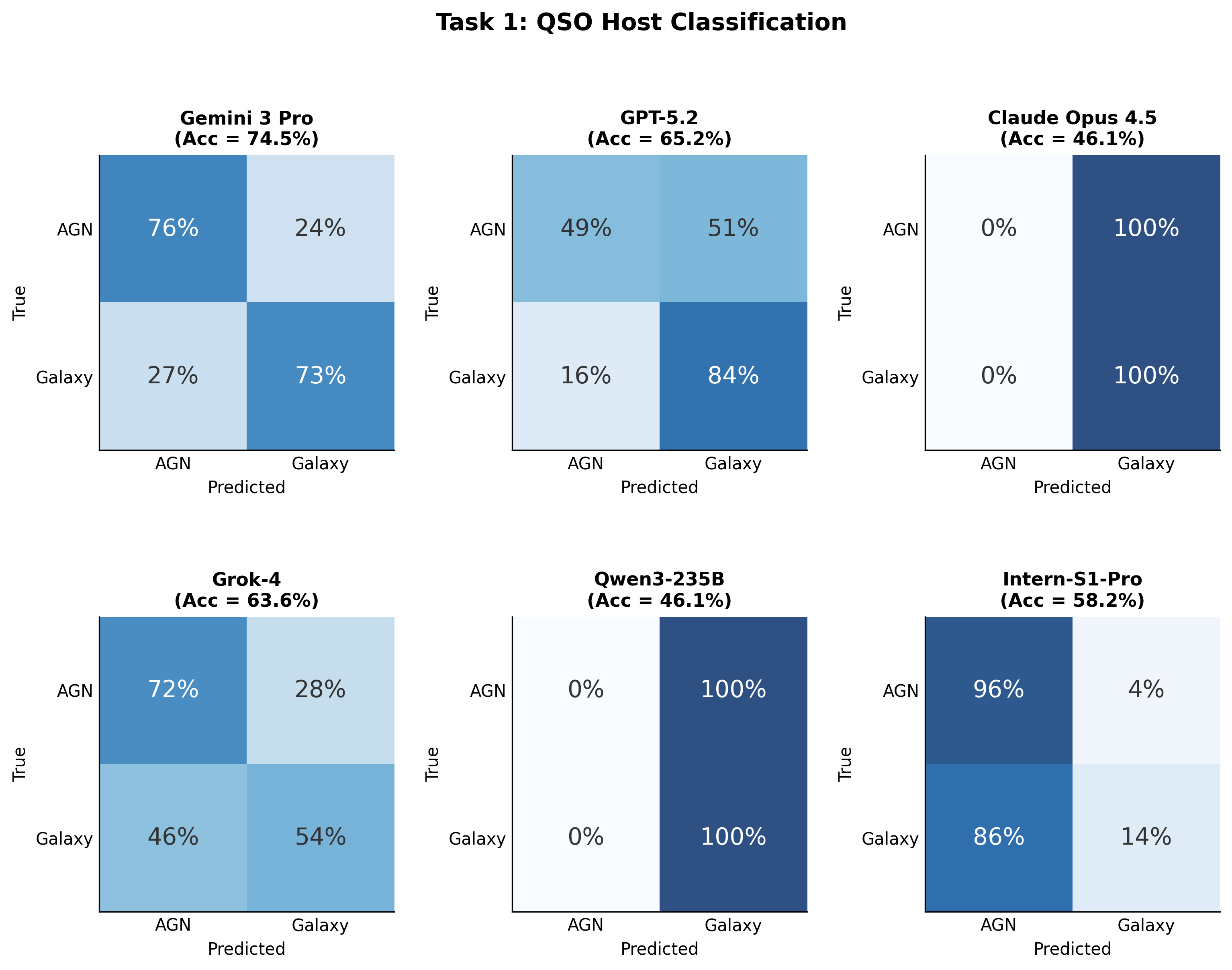
Numerical and qualitative analysis of confusion matrices reveals that performance gaps differ by modality. For example, in high-resolution radio morphology, Gemini 3 Pro displays the best precision/recall trade-off, but all VLMs degrade sharply on lower-resolution images where relevant morphological structure is lost (Figures 7 and 8). SED and spectral tasks expose a strong tendency toward conservative bias—defaults to “galaxy” or “star-forming” in ambiguous regimes—indicative of a failure to extract subtle accretion or excitation signatures.
Confusion matrices for each modality show that:
Few-Shot Instruction and Visual Exemplars
The effect of few-shot visual exemplar prompting is systematically evaluated. Improvements are modest and highly task-dependent: emission line detection in spectra (Task 5, Q1) benefits with a +5% accuracy increase, reflecting the low variance, cue-focused nature of the task. However, radio morphology and BLAGN identification see negligible gains. This suggests that illustrative few-shot context is insufficient when relevant features are inherently diverse or continuous across classes (Figure 5).
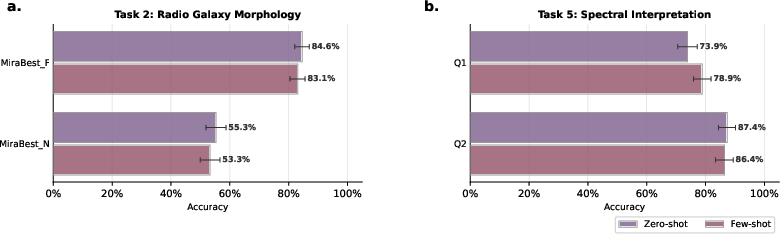
Figure 5: Accuracy comparison for zero-shot and few-shot (exemplar-augmented) guidance in radio morphology and emission line detection tasks.
Logical Validity and the Right-Answer-Wrong-Reason Phenomenon
Qualitative reasoning chain analysis demonstrates that the decoupling of prediction accuracy and sound physical justification is pervasive. Models, including Gemini 3 Pro, can return correct labels while providing physically invalid or imprecise rationales, particularly for spectrum-based tasks. For example, even when emission lines are correctly identified, non-Gemini models frequently confuse rest-frame and observed wavelengths or cite the wrong lines, indicating reliance on phenomenological pattern matching rather than true physical understanding (Figure 6).
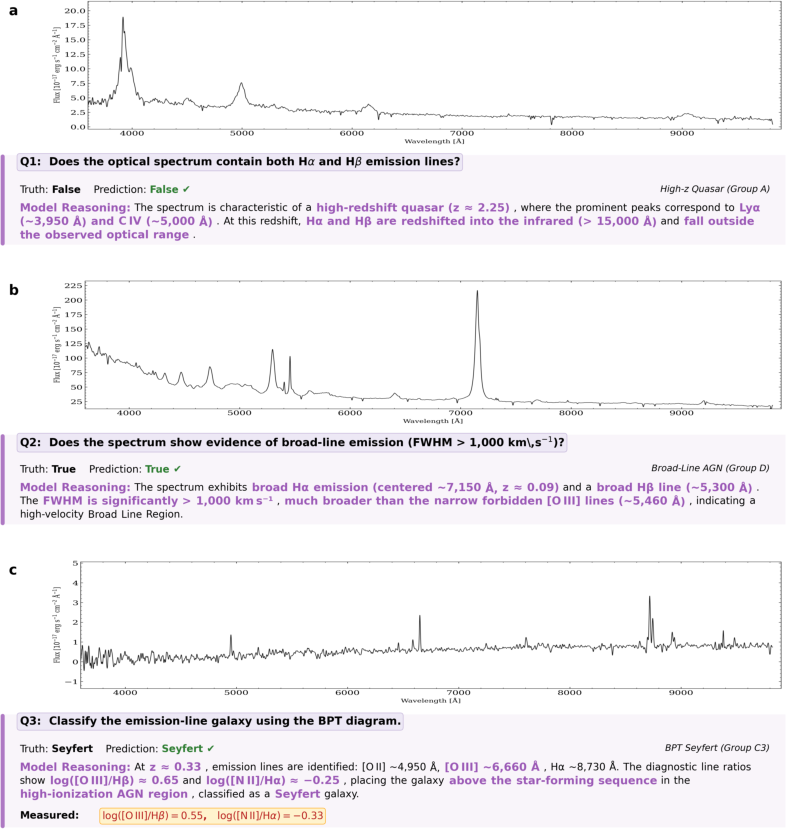
Figure 6: Hierarchical spectral reasoning chains from Gemini 3 Pro, illustrating valid physical logic; competitor models often fail at this level despite correct final labels.
Implications and Prospects for AI in Scientific Discovery
The results suggest that, while state-of-the-art VLMs encode general scientific knowledge and are competitive at broad classification tasks, they lack the precision, robustness, and logical reliability required for unsupervised scientific discovery. Performance ceilings are sharply modality-dependent, with substantial gaps relative to domain-specialist pipelines—especially for tasks rooted in precise quantitative or temporal relationships rather than gross morphological cues.
For practical deployment in astronomy, several axes require focused progress:
- Representation Learning: Enabling models to ingest and reason directly over structured, high-granularity numeric arrays—rather than through secondary visual encodings—will be necessary for science-quality inference in time-domain astrophysics and spectroscopy.
- Prompting and Trustworthiness: Prompts must support physical grounding rather than merely feature focus. Evaluation protocols should rate not only label accuracy but also the logical and physical validity of motivational chains to avoid “right-answer-wrong-reason” failures that undermine scientific trust.
- Domain Adaptation: Purpose-built adapters or retraining on instrument-specific distributions could close the remaining gap with specialist algorithms, but general-purpose VLMs alone are not currently competitive for precision applications.
Conclusion
AstroVLBench establishes the first rigorous, multi-modal baseline for VLM performance on authentic astronomical reasoning. The results reveal substantial challenges in generalizing across modalities, maintaining physically valid reasoning, and handling structured scientific data representations. The field must address these bottlenecks through methodological advances in prompt engineering, data structuring, and model training strategies before VLMs can be reliably trusted in high-stakes scientific workflows.
References
- "A systematic evaluation of vision-LLMs for observational astronomical reasoning tasks" (2604.24589)