- The paper introduces a modular pipeline with reformulate, rewrite, and review steps to break down complex temporal questions.
- It employs a prompt-guided LLM planner to dynamically select reasoning actions, enhancing efficiency and accuracy.
- Empirical results show notable improvements in EM and token-level F1 scores, validating its performance over fixed methods.
Adaptive Temporal Reasoning in LLMs: The AdapTime Framework
Motivation and Limitations of Existing Temporal Reasoning Approaches
LLMs have shown robust performance in generic question answering and reasoning tasks. However, they remain deficient in handling time-sensitive and temporally structured questions: temporal QA requires aligning facts with complex time expressions and event sequences, which is often problematic for LLMs due to their limited explicit modeling of temporal information. Existing pipelines typically rely on external tools (retrievers, knowledge bases, search engines, code execution) or manual intervention (timeline construction, rule-based verification), resulting in constrained adaptability and scalability. Fixed sequential pipelines lead to both unnecessary processing for simple cases and insufficient reasoning for complex cases, hampering generalizability and efficiency.
AdapTime Architecture and Adaptive Reasoning Pipeline
AdapTime introduces a modular, adaptive temporal reasoning pipeline for LLMs, leveraging three core actions: reformulate, rewrite, and review. These actions are orchestrated by a prompt-guided LLM planner, which dynamically determines the necessary reasoning steps based on the input context (question and supporting document), the question's temporal complexity, and the model's intermediate confidence.
- Reformulate: Decomposes complex temporal questions into sub-questions, improving interpretability and focusing inference on relevant temporal variables.
- Rewrite: Recasts raw or implicit temporal information from the document into explicit structured formats (e.g., timelines, temporal graphs), enhancing clarity and accessibility of event orderings and durations.
- Review: Validates predicted answers by retrieving supporting statements and cross-checking factual consistency, performing self-correction in ambiguous or multi-hop cases.
The LLM planner adaptively judges which steps are required per instance, avoiding rigid sequential execution and enabling context- and question-sensitive reasoning trajectories. The entire pipeline operates without external tools or handcrafted rules, relying solely on the in-context capabilities of state-of-the-art LLMs.
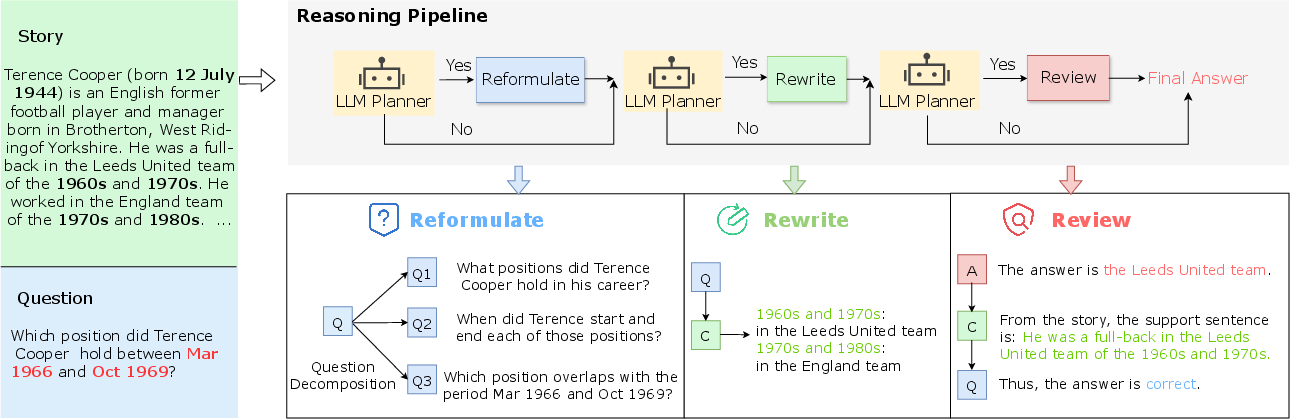
Figure 1: The overall architecture of AdapTime, illustrating adaptive selection of reasoning actions under the control of an LLM planner.
Empirical Evaluation and Ablations
AdapTime is evaluated across multiple datasets, including TimeQA (explicit vs. implicit temporal questions) and TempReason (complex event alignment and temporal relation). AdapTime achieves substantial improvements over both baseline prompting (ICL, CoT) and prior state-of-the-art models (TG-LLM, QAaP), consistently outperforming them in Exact Match (EM) and token-level F1 metrics. Notably, the approach yields strong performance boosts even for lightweight open-source LLMs, confirming model-agnostic generalizability.
- On challenging benchmarks (TempReason-L3), AdapTime surpasses DeepSeek-V3 and previous methods by +5.5 EM and +4.3 F1 absolute, demonstrating efficacy on temporally complex reasoning.
- Qwen-3-8B-AdapTime even exceeds GPT-4 on TimeQA-Easy/Hard, despite the significant parameter gap.
- The framework achieves balanced computational efficiency, with a moderate token overhead relative to iterative refinement methods.
Comprehensive ablation studies show that each action contributes distinctly to performance, with the rewrite step being most critical. Removal of the LLM planner and forced sequential execution leads to consistent performance drops, underscoring the value of adaptive action selection.
Qualitative Analysis and Adaptive Action Distribution
Detailed analyses reveal the planner's ability to tailor reasoning steps to question type. Simple, well-structured questions favor reformulation to sub-questions, while ambiguous, multi-event contexts invoke rewrite and review stages for timeline construction and answer verification. Across all datasets, rewrite is frequently selected, indicating the importance of explicit temporal structuring.
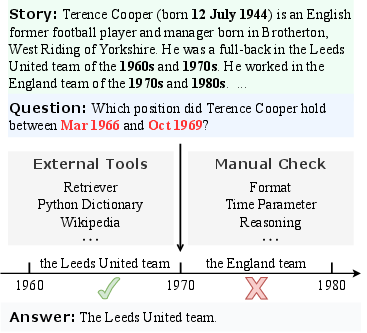
Figure 2: An example of temporal reasoning in question answering that showcases the need for aligning facts with temporal expressions and event sequences.
Action distribution profiling confirms that on the most difficult question types (TempReason-L3), review is heavily used, as the model seeks self-verification to resolve temporal ambiguities.
Integration with Open-Domain Retrieval and Practical Extensions
AdapTime demonstrates compatibility with open-domain QA via retriever integration (e.g., BM25). When applied to retrieval-augmented inputs, AdapTime consistently improves accuracy over base retrieval baselines. Its modular architecture enables effective handling of noisy or incomplete evidence, leveraging adaptive review and timeline reconstruction to maintain robustness.
Theoretical and Practical Implications
AdapTime advances the theoretical understanding of temporal reasoning in LLMs by treating temporal QA as a dynamic, context-driven sequence of adaptive operations, rather than as a fixed pipeline. It validates the effectiveness of internal LLM planning for step selection, and highlights the significance of explicit temporal abstraction for complex QA. Practically, AdapTime offers a toolbox for integrating adaptive temporal reasoning into LLM workflows, supporting QA, information extraction, and event-centric summarization in time-sensitive applications.
The empirical results—a strong improvement in EM/F1 across datasets, competitive performance versus closed-source models, and demonstrable modularity—establish AdapTime as a robust candidate for model-agnostic temporal QA augmentation. Its avoidance of external components streamlines deployment and enhances maintainability.
Future Directions
Potential avenues include expanding the action set to cover granular temporal operations, integrating symbolic reasoning modules (temporal logics, event calculus), and enhancing planner controllability to mitigate stochasticity and improve reliability. Further exploration of hybrid reasoning strategies (combining LLM planning with external tool invocation) could yield additional precision and coverage in real-world deployments. The adaptive pipeline paradigm may be extended to other complex reasoning domains (causal, spatial, relational) requiring structured inference over dynamic constraints.
Conclusion
AdapTime provides a principled adaptive reasoning framework for temporal question answering in LLMs, addressing the limitations of previous externally-dependent and rigid approaches. Its modular architecture, prompt-driven planner, and empirical superiority across datasets underscore both practical utility and theoretical advancement in the domain of temporal reasoning. This work paves the way for future research in adaptive, context-aware reasoning strategies for large-scale AI systems.

