- The paper introduces a dual-axis framework that interleaves vertical supervised fine-tuning with horizontal reinforcement learning for improved step-by-step mathematical reasoning.
- It leverages a multilingual dataset (CL-Math with 29k problems) and staged difficulty progression in English, Hindi, and Marathi to build robust reasoning across languages.
- Empirical results show significant accuracy improvements, particularly in low-resource settings, by using English as a reasoning anchor to stabilize and advance model performance.
Interleaved Reinforcement and Incremental Staged Curriculum: Advancing Multilingual Mathematical Reasoning with IRIS
Introduction and Motivation
The paper "IRIS: Interleaved Reinforcement with Incremental Staged Curriculum for Cross-Lingual Mathematical Reasoning" (2604.24114) targets compositional mathematical reasoning in LLMs, specifically focusing on low-resource multilingual environments. Conventional curriculum learning improves task success rates by gradually increasing complexity, but is insufficient for robust step-by-step reasoning and is especially challenged in languages with limited data. IRIS bridges this gap by introducing a dual-axis approach: vertical supervised fine-tuning (SFT) with task-difficulty escalation and horizontal reinforcement learning (RL) that incrementally removes context to force step-wise generation, thus targeting both depth and stability of reasoning.
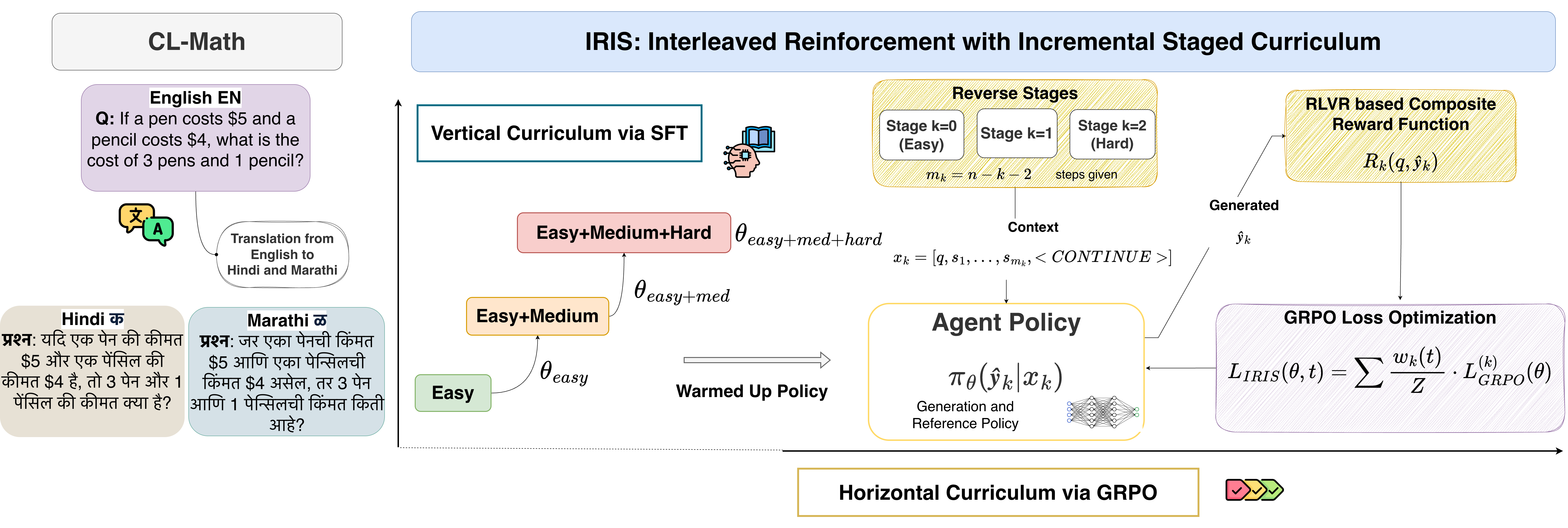
Figure 1: Integrated IRIS pipeline blending vertical SFT and horizontal GRPO-based RL for robust mathematical reasoning.
CL-Math: A Multilingual Curriculum Dataset
The study introduces CL-Math, a dataset of 29k math problems annotated with granular reasoning traces in English, Hindi, and Marathi. Each sample is categorized into Easy, Medium, or Hard tiers, and includes step-level annotations and translations preserving solution integrity across scripts. High-quality translations leverage IndicTrans2, ensuring rigorous cross-lingual alignment.
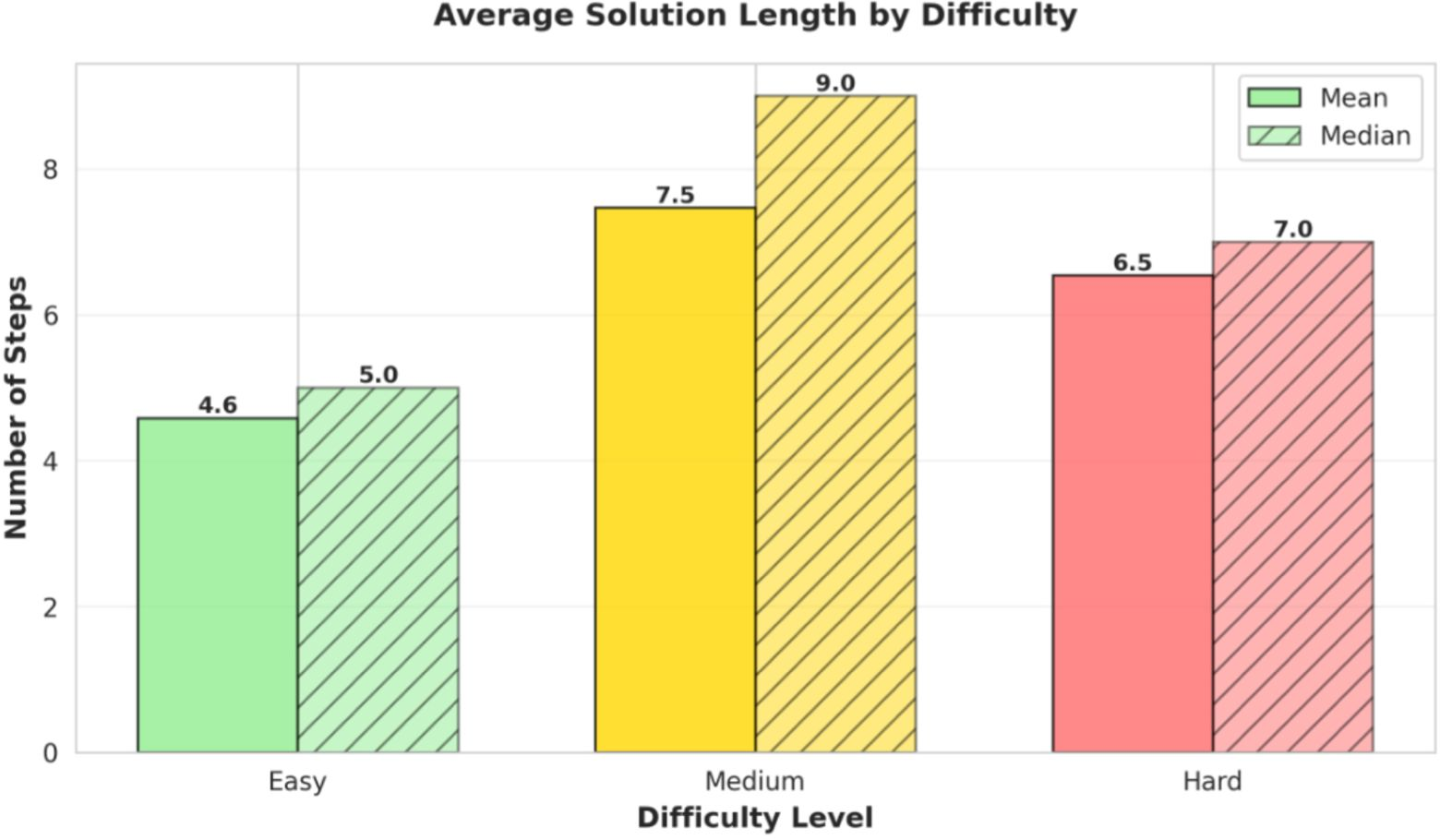
Figure 2: Average number of reasoning steps per difficulty in CL-Math; solution length increases with tier, controlling reasoning depth.
IRIS Framework: Vertical and Horizontal Curriculum Integration
Vertical Axis (Supervised Fine-Tuning by Difficulty)
Models are incrementally trained from Easy-only to Easy+Med, culminating in Easy+Med+Hard. Each SFT checkpoint encapsulates reasoning patterns for progressively longer and more complex solution traces. This axis provides a stable foundation and stepwise structure critical for downstream RL.
Horizontal Axis (Reverse Curriculum Reinforcement via GRPO)
The horizontal curriculum decomposes each problem into instances with shrinking solution prefixes, requiring the model to generate longer suffixes from partial context. This reverse curriculum explicitly schedules reasoning horizon exposure and leverages Group Relative Policy Optimization (GRPO) for RL:
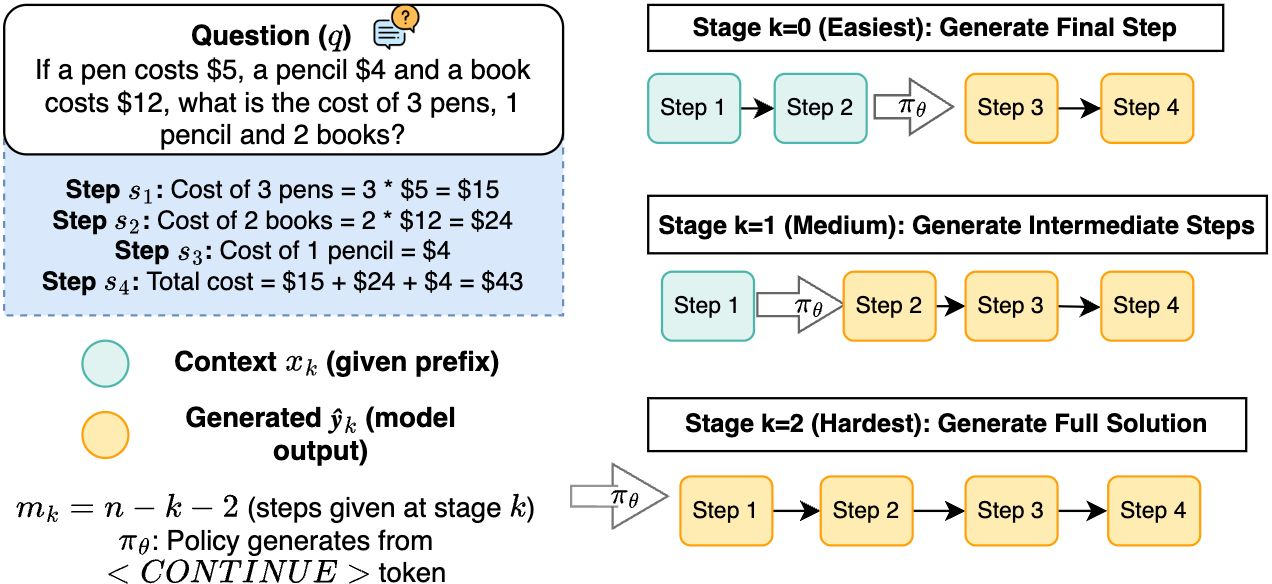
Figure 3: Reverse curriculum staging: context is progressively removed, increasing the length and complexity of the generated reasoning.
A composite reward function is defined, combining answer correctness, semantic alignment (cosine similarity with reference solution), step continuation, and numeric format incentives, with stage-dependent alignment weights decaying as prefix length decreases. GRPO optimizes rollouts by comparing group advantages, stabilizing RL dynamics and balancing exploration/exploitation.
Multilingual and Cross-Lingual Reasoning Dynamics
IRIS extends to monolingual and bilingual setups. In monolingual Hindi/Marathi, models are trained on translated splits. For cross-lingual transfer, mixed datasets (e.g., English+Hindi, English+Marathi) are used. Empirically, English acts as a reasoning anchor: including even a small fraction (20%) of English in the training mix regularizes learning, improves convergence, and prevents reward plateauing prevalent in low-resource settings.
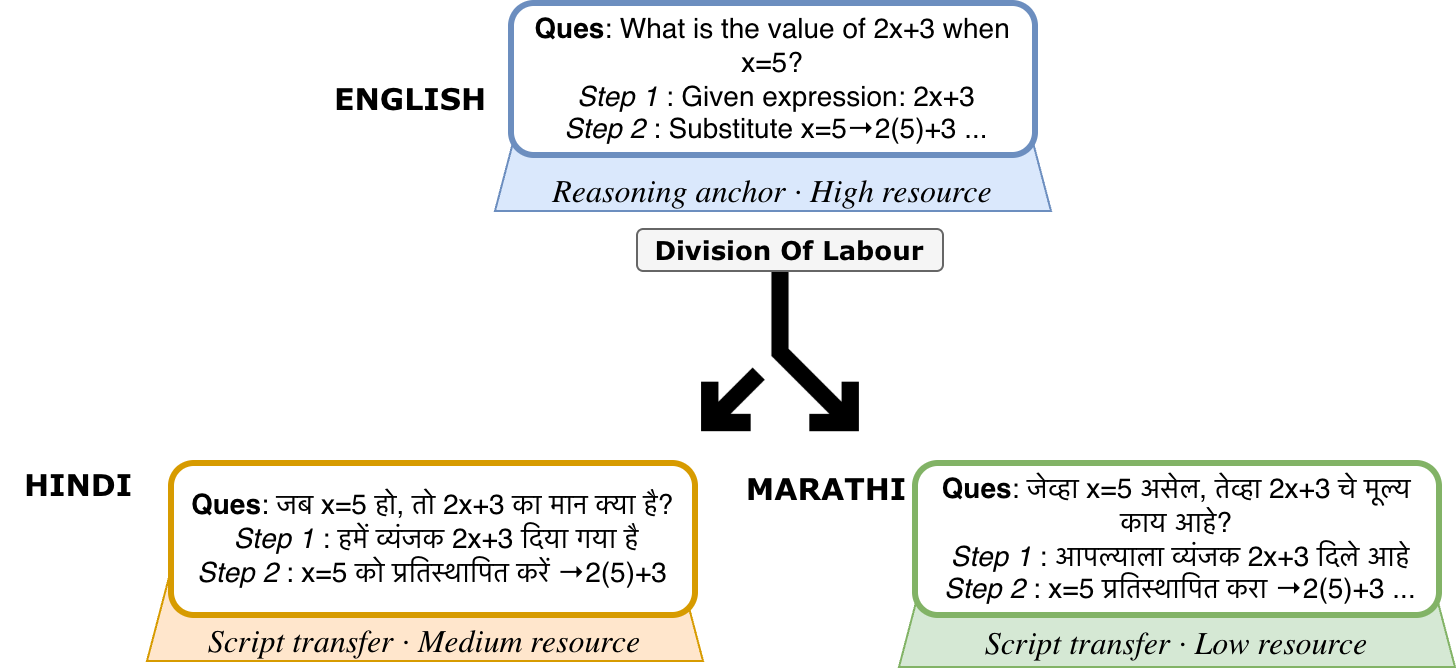
Figure 4: English anchors reasoning, while Hindi/Marathi train expression, facilitating transfer and stability.
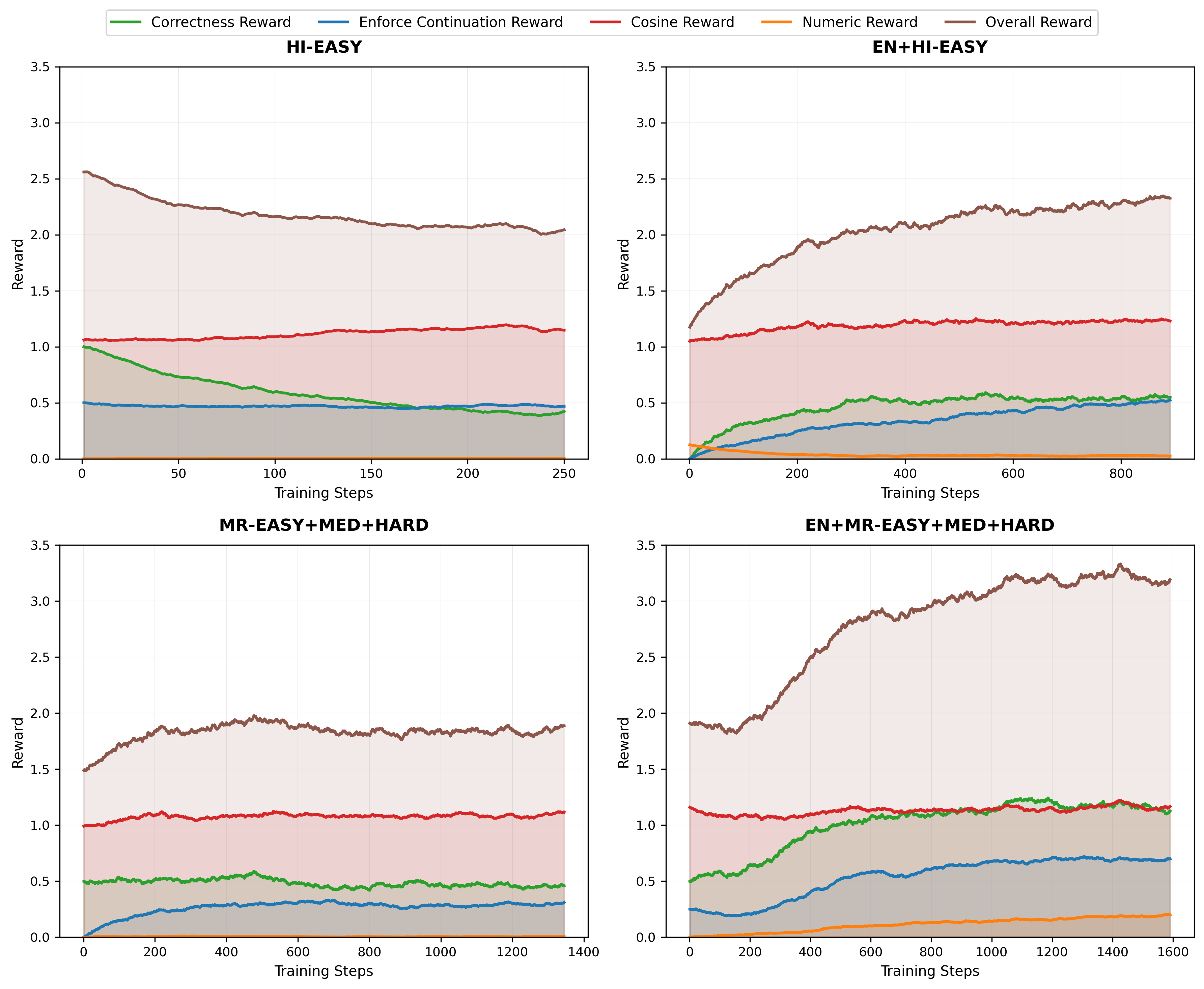
Figure 5: Bilingual curriculum yields higher, more stable rewards; monolingual runs plateau or decline, confirming English’s critical role.
Experimental Results and Ablations
IRIS is evaluated on CL-Math and external benchmarks (SVAMP, GSM8K, MATH) using Qwen2.5-Math-7B and WizardMath-7B. Expanding curriculum stages on the vertical axis consistently raises accuracy: e.g., Easy → Easy+Med → Easy+Med+Hard increases performance in English (85.2→86.3%), Hindi (52.7→57.7%), Marathi (38.3→55.7%). The addition of horizontal GRPO further boosts results, most dramatically in low-resource languages. Bilingual training amplifies this: English-Hindi performance increases from 57.7% to 73.5%.
Ablations confirm that removing SFT warmup or curriculum progression diminishes accuracy; correctness reward alone is insufficient, necessitating the structured composite reward for long-horizon solutions.
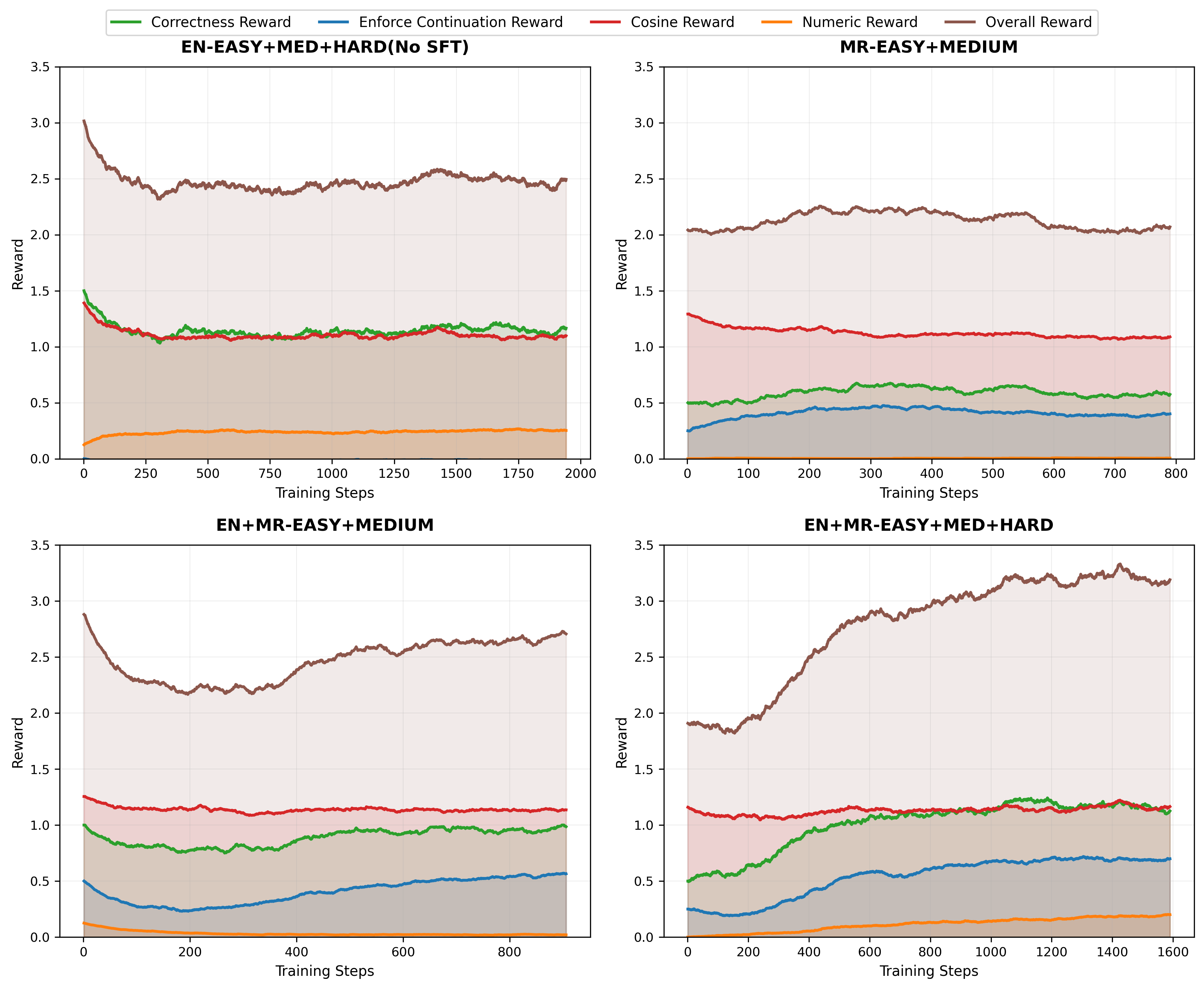
Figure 6: Without SFT warmup, reward plateaus early; full IRIS curriculum sustains reward growth across difficulty tiers.
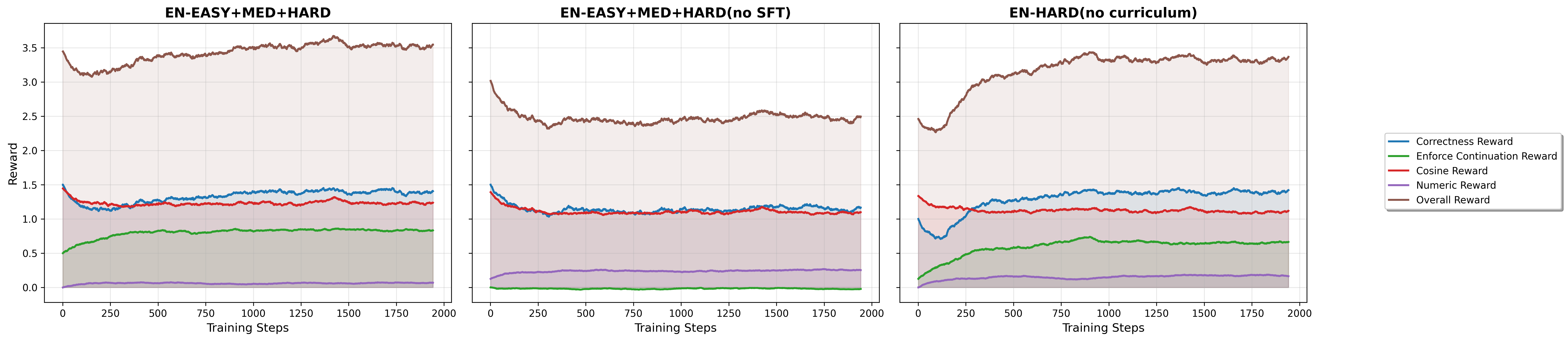
Figure 7: Only full curriculum with SFT achieves highest reward; baselines with no curriculum or hard-only runs plateau or underperform.
IRIS-trained Qwen2.5-Math-7B achieves 90.6% on SVAMP, 83.9% on GSM8K, and 64.6% on MATH, outpacing the base and specialized models in all cases.
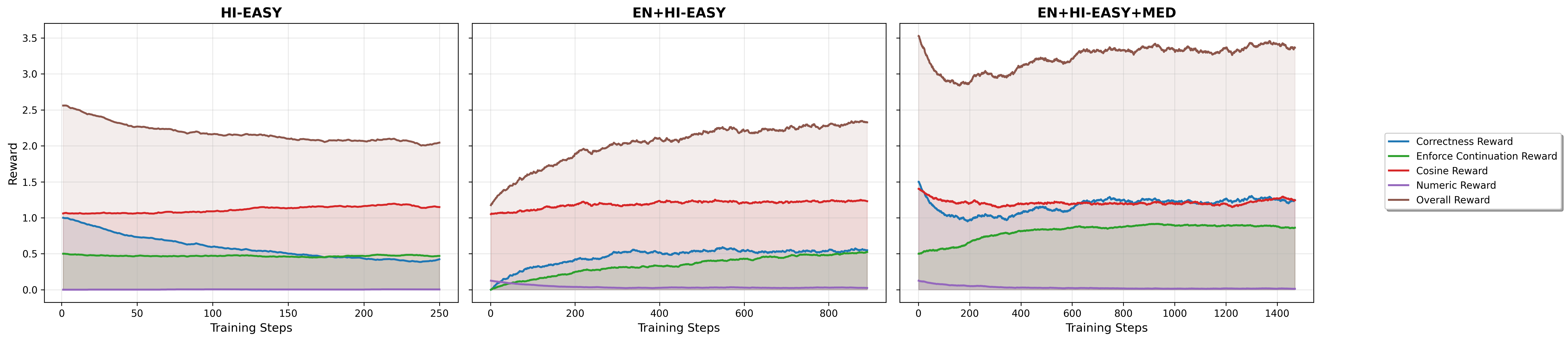
Figure 8: Cross-lingual progression: English+Hindi curriculum substantially outperforms monolingual Hindi, with pronounced improvement from structured progression.
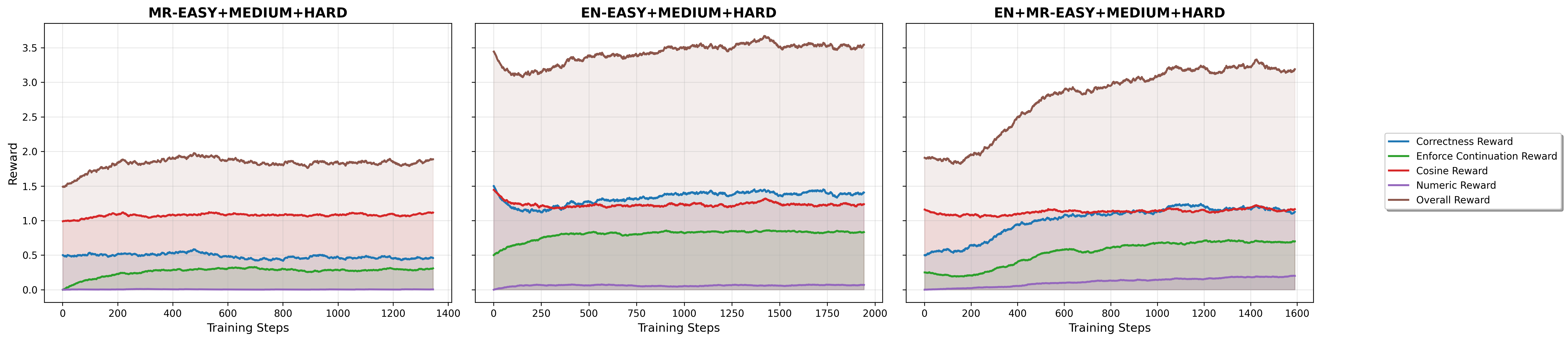
Figure 9: English+Marathi curriculum outperforms Marathi-only, maximizing correctness and reward signal by leveraging multilingual integration.
Analysis of Stepwise Reasoning and Output Quality
Qualitative traces demonstrate that both vertical and horizontal curricula enhance stepwise reasoning, particularly as models progress to harder tiers. GRPO post-training increases solution completeness and coherence, reinforced in both English and translated scripts. Hindi and Marathi generations reveal robust transfer and maintenance of stepwise logical structure.
Practical and Theoretical Implications
IRIS demonstrates that dual-axis curriculum learning, anchored by high-resource English, systematically addresses instability and superficial reasoning in low-resource multilingual settings. Practically, this approach provides a scalable template for enhancing mathematical and structured reasoning in open-source LLMs, facilitating adoption in educational, scientific, and cross-lingual applications.
Theoretically, the results provide evidence for staged curriculum and reward shaping as mechanisms to improve credit assignment in RL for reasoning, and establish English as a lingua franca for knowledge transfer in multilingual models. The empirical claim—that English is not merely regularizing but structurally necessary for effective RL-based reasoning transfer—contradicts naive assumptions that sufficient monolingual data can replace high-resource anchors.
This opens further research on generalizing vertical-horizontal curriculum decomposition to domains beyond math, including logic and code synthesis, and exploring reward functions beyond correctness.
Conclusion
IRIS delivers a systematic, structured curriculum RL framework that interleaves difficulty progression and reasoning horizon scheduling for mathematical reasoning across English and Indian languages. Strong empirical results in multilingual, low-resource, and bilingual setups validate the necessity of high-resource anchors and composite supervision for robust stepwise generation. Future investigations will target domain-agnostic extension, dynamic curriculum scheduling, and scalable integration into larger LLMs to enhance reasoning generalization and transfer.

