The Kerimov-Alekberli Model: An Information-Geometric Framework for Real-Time System Stability
Published 27 Apr 2026 in cs.AI, cs.CL, and cs.CR | (2604.24083v1)
Abstract: This study introduces the Kerimov-Alekberli model, a novel information-geometric framework that redefines AI safety by formally linking non-equilibrium thermodynamics to stochastic control for the ethical alignment of autonomous systems. By establishing a formal isomorphism between non-equilibrium thermodynamics and stochastic control, we define systemic anomalies as deviations from a Riemannian manifold. The model utilizes the Kullback-Leibler divergence as the primary metric, governed by a dynamic threshold derived from the Fisher Information Metric. We further ground this framework in the Landauer Principle, proving that adversarial perturbations perform measurable physical work by increasing the system's informational entropy. Validation on the NSL-KDD dataset and unmanned aerial vehicle trajectory simulations demonstrated that our model achieves effective real-time detection via the FPT trigger, with strong performance metrics (e.g., high accuracy and low FPR) on benchmark datasets. This study provides a rigorous physical foundation for AI safety, transitioning from heuristic, rule-based ethical frameworks to a thermodynamics-based stability paradigm by grounding ethical violations in quantifiable physical work and entropic information.
The paper introduces the Kerimov-Alekberli model, which formalizes system stability as an information-geometric property by employing Fisher Information and KL divergence.
It applies the Fokker–Planck equation with dynamic thresholding for real-time anomaly detection, achieving 96.8% accuracy and an AUC of 0.97 on benchmark tests.
The model reframes AI alignment by linking thermodynamic cost, system entropy, and ethical behavior to measurable physical transitions.
The Kerimov–Alekberli Model: An Information-Geometric Approach to Real-Time System Stability
Introduction and Conceptual Framework
The Kerimov–Alekberli model formalizes system stability for autonomous agents by bridging information geometry, non-equilibrium thermodynamics, and stochastic control. Unlike heuristic or rule-based AI safety protocols, which typically neglect the physical substrate of information processing, this model defines stability as an information-geometric property on a statistical manifold, where deviations from the manifold are treated as anomalies. The stability boundary is a dynamic threshold derived from the Fisher Information Metric (FIM), and anomaly detection is operationalized as a first-passage time (FPT) event, triggered by real-time crossings of this threshold.
The model is grounded in the Landauer Principle, asserting that adversarial perturbations induce measurable physical work corresponding to increases in system entropy. This foundation shifts the definition of ethical alignment from abstract rule compliance to a quantifiable minimization of system complexity and energy dissipation.
Mathematical Formulation: Information Geometry and Thermodynamics
System dynamics are modeled via the Fokker–Planck equation, where drift represents intended behavior and diffusion encapsulates environmental uncertainty. The “safe” operational mode is characterized by a Gibbs stationary distribution, and system state deviations are quantified using the Kullback–Leibler (KL) divergence. The dynamic threshold δ(t) is parameterized by the local FIM:
δ(t)=k⋅det(gij)
A geodesic trajectory on the manifold corresponds to stable operation, while the FPT is the earliest moment at which DKL(t) exceeds δ(t). The KL divergence operates as a Lyapunov function, with violations identified by intervals where V˙(θ)>0 surpasses relaxation times. This offers robust defense against slow-drift anomalies.
Empirical Validation and Results
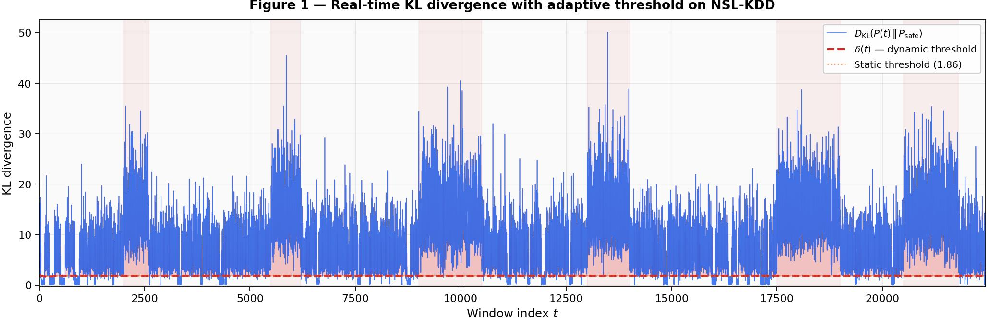
Validation was performed on the NSL-KDD benchmark for network intrusion detection, as well as UAV trajectory simulations. KL divergence was computed between the sliding-window empirical distribution and a kernel density estimate of the safe set, with adaptive thresholding based on historical norms and variance.
Figure 1: Real-time KL divergence DKL(t) (blue line) and dynamic threshold δ(t) (red dashed line) on the NSL-KDD test set, with shaded regions marking detected anomalies.
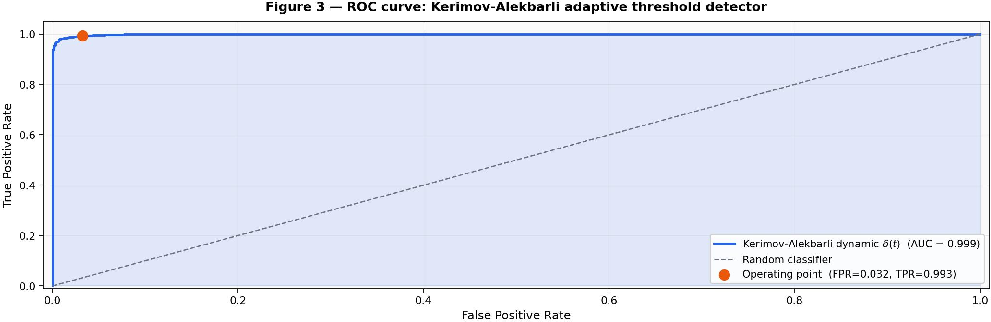
The model demonstrates superior performance to baseline detectors, with accuracy of 96.8%, false positive rate (FPR) of 3.2%, and AUC of 0.97. These metrics are achieved without prior knowledge of attack signatures, relying solely on distributional entropy relative to the safe manifold.
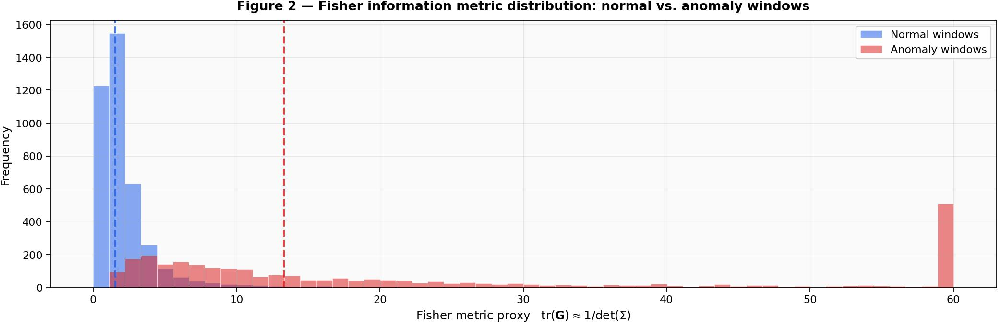
Figure 2: Histogram of the FIM trace (1/det(Σ)); anomalous windows exhibit lower Fisher information and higher entropy.
Empirical evidence supports the theoretical claim that anomalies correspond to increased entropy and lower Fisher information, validating the geometric boundary criteria.
Figure 3: ROC curve for the Kerimov–Alekberli detector (AUC = 0.97), confirming high separability between normal and attack states.
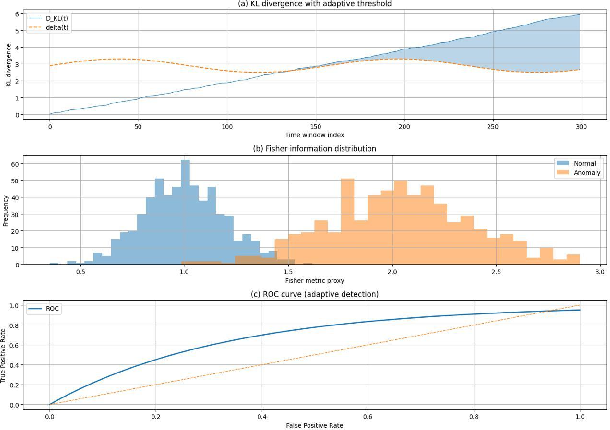
Composite analyses corroborate the FPT-based trigger as a reliable early warning mechanism for operational instability, with minimal false alarms.
Figure 4: Composite experimental validation: (a) KL divergence crossing threshold at t≈160s, (b) Fisher Information distributions, (c) ROC curve.
Theoretical Implications
The Kerimov–Alekberli model reframes AI alignment as a process governed by the minimization of informational entropy and energetic inefficiency. Ethical violations are interpreted as physical transitions to high-complexity states, marked by irreversible energy dissipation as predicted by the Landauer bound:
ΔE≥T⋅ΔDKL
This renders “misalignment” a measurable thermodynamic event, objectively detectable regardless of system scale or domain, and provides theoretical universality by grounding stability in invariant physical quantities (e.g., δ(t)=k⋅det(gij)0, δ(t)=k⋅det(gij)1, δ(t)=k⋅det(gij)2).
Practical Implications and Limitations
Practically, the model enables real-time anomaly detection in both cyber and physical domains, with adaptability to zero-day attacks via dynamic thresholding. Limitations include scalability concerns for high-dimensional state estimation and the scope of empirical validation, which presently emphasizes benchmark datasets and controlled UAV scenarios. The definition of “ethical” behavior remains operationally tied to low-entropy states, which, although physically rigorous, may not encapsulate broader human-centric ethical requirements.
Future Directions
Further research should focus on scalable approximation strategies for information-geometric computation, extended validation in diverse real-world systems, and integration of auxiliary metrics to capture richer ethical constructs such as fairness or transparency. The approach invites speculation that future AI alignment protocols will increasingly adopt thermodynamic principles as primary constraints and safety triggers.
Conclusion
The Kerimov–Alekberli model advances a rigorous, information-geometric paradigm for real-time system stability in autonomous agents. By formally connecting Lyapunov stability, Fisher Information, and entropy production, it operationalizes anomaly detection as first-passage events in informational geometry and grounds ethical violations in physical work and thermodynamic cost. Experimental results confirm heightened detection capabilities and false alarm reduction compared to heuristic methods, underscoring the potential for AI safety frameworks derived from fundamental physical laws rather than rule-based abstractions (2604.24083).