- The paper introduces a hybrid energy-based model that guarantees provable safety and stable identification of complex dynamical systems.
- It employs an innovative combination of absorbing invariance and generalized Lyapunov analysis to manage expressivity–stability trade-offs.
- Empirical validation on synthetic systems with deformed metrics confirms the method's effectiveness in replicating multifaceted energy landscapes.
Hybrid Energy-Based Models for Safe Identification of Port-Hamiltonian Dynamics
Introduction
The paper "Hybrid Energy-Based Models for Physical AI: Provably Stable Identification of Port-Hamiltonian Dynamics" (2604.00277) develops a mathematically rigorous framework for system identification using Energy-Based Models (EBMs) with certified safety and stability guarantees. The work addresses intrinsic limitations of standard EBM formulations—specifically, the tension between model expressivity and formal Lyapunov stability—by proposing a novel hybrid EBM architecture coupled with a comprehensive theoretical treatment of stability for nonsmooth, multilayer models. The framework is extended to Port-Hamiltonian (PH) systems, enabling accurate identification of nonlinear dynamics under state-dependent metric deformations. Theoretical contributions are substantiated by controlled experiments on systems with complex energy landscapes and non-Euclidean geometry.
Theoretical Contributions
Generalized Stability Analysis for EBMs
The paper advances the analysis of stability for EBMs by extending dissipativity results from the smooth (C2) setting to activations that are merely locally Lipschitz. Using Clarke’s generalized gradient and directional derivative, the authors demonstrate that typical EBM training (even with nonsmooth activations) produces a Lyapunov function whose directional derivative along system trajectories is nonpositive almost everywhere. This strictly generalizes the practical design space for neural activation functions in EBMs.
However, the analysis also uncovers a sharp expressivity–stability trade-off: to guarantee global (radially unbounded) stability in fully recurrent EBMs, the asymptotic growth of activation functions must remain strictly sublinear. This observation, formalized by a necessary and sufficient condition relating the growth rate of the energy function to the spectral properties of the parameter matrix, rules out widely used high-order and polynomial activations if global guarantees are required.
Hybrid Multilayer EBM Architecture
To circumvent expressivity constraints, a hybrid EBM architecture is proposed, wherein only the visible (input) layer exhibits dynamical behavior, while hidden layers are implemented as static feedforward-feedback maps. This design guarantees the existence of a compact absorbing invariant set for the visible-layer dynamics—i.e., all trajectories are eventually trapped inside a predictable safe set—without constraining the expressive power of the hidden feature maps. Boundedness is only required of the first hidden layer, which can be enforced via standard normalization.
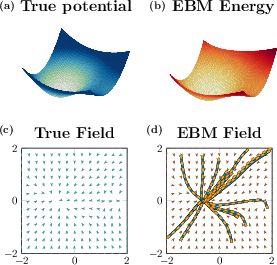
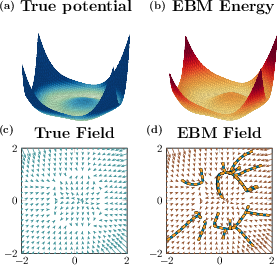
Figure 1: EBM identification of a multi-well potential system: (a) ground-truth potential; (b) learned EBM energy; (c) true vector field; and (d) reconstructed field and flow showing convergence to correct attractors.
The validity and relevance of absorbing invariance, rather than Lyapunov asymptotic stability, is discussed in the context of system identification—where it suffices to confine the model's reconstructed dynamics to a region containing all observed equilibria and attractors, thus ensuring safety by design.
Extension to Port-Hamiltonian Systems
The authors generalize their absorbing invariance and dissipativity guarantees to the case of PH systems, showing that if the original EBM vector field is stable-by-design, it remains so after pre-multiplication by a uniformly positive definite, continuous, state-dependent metric matrix. This is significant for practical applications requiring structure-preserving identification of physical systems with non-Euclidean geometry, gyroscopic effects, or rotational energy components.
Empirical Validation
Synthetic Physical Systems
The framework is benchmarked on two synthetic physical systems in R2:
- Multi-Well Potential System: Characterized by multiple local minima and saddle points, defined by a sum of quadratic and trigonometric terms.
- Exotic Potential System: Features a central ring of equilibria, higher-order polynomial terms, and non-convexities.
Both vector fields are further deformed through a state-dependent, trigonometric metric to simulate non-Euclidean geometry—posing substantial challenges for standard function approximators.
The hybrid EBM with a dynamic visible layer and static hidden layers (using softmax and polynomial activations) is trained on trajectory data generated from the true system using Euler integration. The learned vector fields and energy functions consistently replicate fine structural details of the original system—reconstructing nontrivial basin and attractor geometries and reliably matching flow patterns and trajectory convergence.
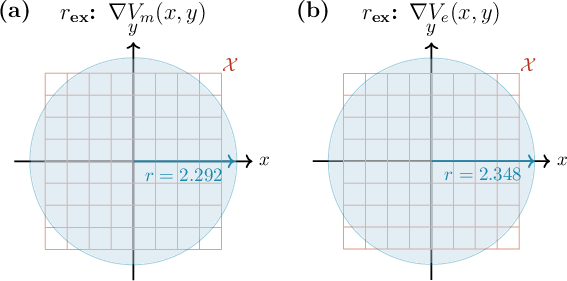
Figure 2: The computed data-driven expansion radius for different system geometries, demonstrating similar order-of-magnitude expansiveness for multi-well and exotic potential systems.
Quantitative Results
Final training and test losses remain uniformly low, with no significant overfitting, even in the presence of strong nonlinearities and metric-induced deformations. The computed data-driven expansion radius, which estimates the domain of guaranteed absorbing invariance, is robust to network depth and varies only slightly with the addition of metric distortions. This affirms the practical attainability of the theoretical safety guarantees on real computation budgets.
Implications and Future Directions
The hybrid EBM/PH framework substantially expands the admissible design space for safe, interpretable system identification in physical AI. By decoupling expressivity from restrictive Lyapunov-type growth constraints, hybrid architectures pave the way for stable high-capacity, multilayer EBMs with performance competitive with (and interpretable relative to) black-box neural ODEs.
The adoption of absorbing invariance as a safety criterion, together with its generalization to PH dynamics, ensures robust control over the reachable set of the reconstructed model—a critical property for deployment in safety-critical industrial, robotic, and autonomous systems domains.
Future research directions include:
- Integration of control and input channels to enable closed-loop identification and model-based controller synthesis under hybrid EBM dynamics;
- Formal analysis of reachability, robustness, and local/global attractivity properties for more general classes of physical systems;
- Scalable certification tools for invariance radii and safety regions beyond the data-driven sampling methods illustrated.
Conclusion
The paper rigorously establishes a class of hybrid energy-based neural architectures for system identification that jointly optimize expressiveness and formal stability guarantees. The development of absorbing invariance as a practical, certifiable safety property, together with extension to port-Hamiltonian models, positions the framework as a compelling foundation for data-driven, reliable physical AI. The results indicate that hybrid EBMs offer a promising and theoretically sound pathway toward interpretable, structure-preserving neural system identification for nonlinear dynamical systems.
(Figure 3)
Figure 3: Expansiveness radius estimated from training data for multi-well and exotic potential systems, before and after metric deformation.

