Neyman Jackknife: Design-Based Variance Estimation for Causal Inference under Interference
Published 27 Apr 2026 in stat.ME and math.ST | (2604.24017v1)
Abstract: We propose a framework, the Neyman Jackknife, for conservative variance estimation in finite-population causal inference under interference. Our approach provides a general, flexible blueprint that enables conservative variance estimation whenever we are able to recompute our target estimator with some treatment assignments omitted. In classical settings, our approach recovers estimators closely related to the Neyman estimator under SUTVA and the Newey-West HAC variance estimator for time series. Numerical experiments suggest that our general-purpose framework yields variance estimators that can match or even surpass the performance of baselines that were purpose-built for specific applications.
The paper introduces the Neyman Jackknife method for conservative variance estimation under interference by recomputing estimators with omitted treatment subsets.
It leverages Markov chains and spectral gap theory to unify classical variance estimators across diverse experimental designs and interference structures.
Empirical evaluations demonstrate NJ’s competitive performance and tight conservative estimates compared to optimized analytic baselines in complex spillover scenarios.
Neyman Jackknife: A Design-Based Variance Estimation Framework for Causal Inference under Interference
Introduction and Motivation
The paper "Neyman Jackknife: Design-Based Variance Estimation for Causal Inference under Interference" (2604.24017) introduces the Neyman Jackknife (NJ), a flexible framework for conservative variance estimation in design-based causal inference settings, explicitly accommodating interference. In classical randomized experiments, variance estimation is notoriously challenging due to the fundamental impossibility of unbiased variance estimation without additional assumptions; this is exacerbated when interference (i.e., treatment spillovers across units) is present. The Neyman Jackknife leverages recomputing approaches—recalculating estimators with subsets of treatment assignments omitted—while encoding random treatment assignment uncertainty through Markov chains and spectral gap theory.
The NJ unifies and generalizes classical estimators—such as the Neyman estimator under SUTVA and Newey-West HAC estimators for time series—within a recomputing-based framework, making it applicable to arbitrary experimental designs, interference structures, and estimators, without requiring well-specified exposure mappings. Empirical evaluations in complex spillover scenarios demonstrate NJ’s capacity to produce conservative variance estimates that are tight and competitive against optimized analytic baselines.
Theoretical Framework and Construction
NJ is constructed around the Poincaré inequality for reversible Markov chains, linking variance of an estimator f(W) (where W is a random vector of treatment assignments) to the spectral gap λ of a Markov transition kernel reflecting treatment resampling. By randomly sampling an index set S (e.g., units to be omitted or rerandomized), exchanging conditional expectation terms, and applying the Poincaré inequality, the Neyman Jackknife yields:
V=λ1E[(f(W)−g(S,W−S))2∣W]
where g(S,W−S) is a user-chosen proxy for the oracle conditional expectation E[f(W)∣S,W−S]. This structure guarantees E[V]≥Var(f(W)) for any proxy, and the tradeoff in estimator tightness is governed primarily by the choice of update set S and the quality of g.
Notably, under SUTVA, NJ recovers the classical Neyman variance estimator (weighted sum of within-group sample variances), and under W0-dependent time series with Bernoulli randomization, it produces a scaled Newey-West variance estimator, establishing conceptual links between Jackknife/bootstrapping and HAC approaches in dependent data.
Algorithmic and Spectral Considerations
Spectral gap calculations are provided for Bernoulli and completely randomized designs—NJ theory is provably tractable for uniform or block index-sampling rules independent of W1. For Bernoulli designs, W2; for block-based updates, W3 scales linearly with block size. When proxies cannot be computed exactly, Monte Carlo approximation is used, maintaining estimator expectations.
In more complex designs, numerical estimation of W4 via Rayleigh quotient optimization or leveraging spectral independence theory may be warranted, suggesting future directions in extending NJ to highly structured or combinatorial assignment spaces.
Empirical Evaluation and Numerical Results
NJ estimator efficacy is demonstrated through two main settings: cycle graphs with binary exposures and switchback time-series experiments with carryover effects. Conservative variance estimation is achieved using proxies based either on simple recomputed averages or regressions leveraging predictive covariates. Numerical results show:
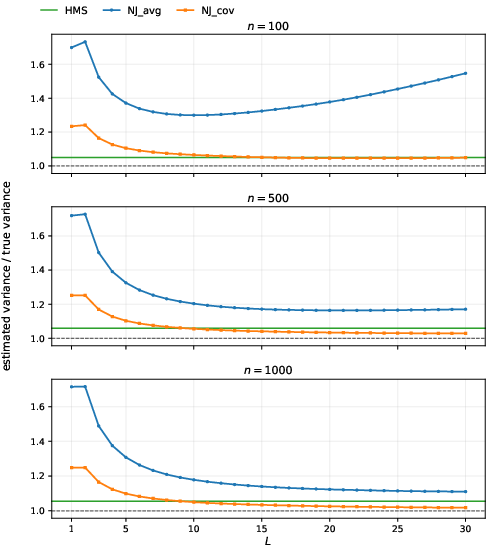
Cycle examples: NJ estimators using covariate-driven proxies exhibit conservativeness ratios approaching unity as W5 grows, outperforming recomputed average proxies and matching optimized quadratic variance estimators ("Optimized variance estimation under interference and complex experimental designs" [harshaw2026variance]).
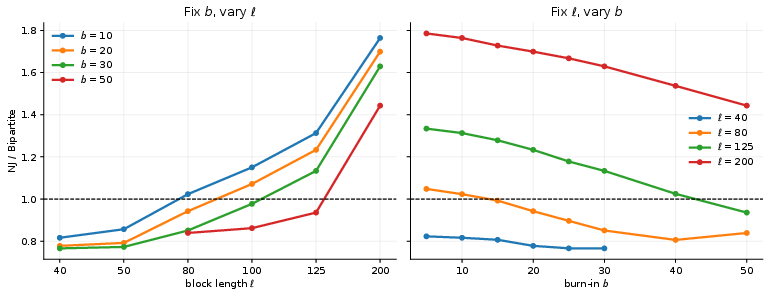
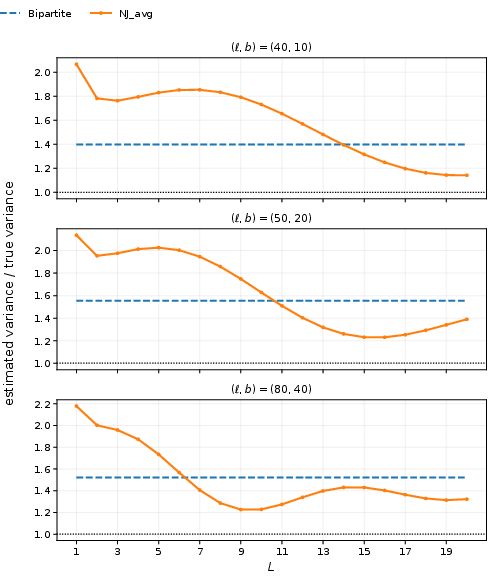
Switchback experiments: NJ is competitive with bipartite-structure analytic baselines ("Design-based causal inference in bipartite experiments" [lu2025design]), outperforming in focal parts of the time series depending on block and burn-in parameterization.
NJ estimates are uniformly conservative, with block size choices yielding tight bounds (see ratio plots in Figures 2 and 3).
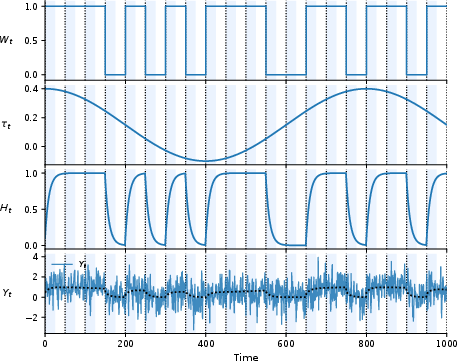
Figure 1: Illustration of the DGP for switchback experiments, indicating block structure, carryover state, and burn-in.
Figure 2: Cycle graph: Comparison of true variance and estimated variances, demonstrating NJ's tightness relative to analytic baselines.
Figure 3: Switchback example: Heatmap of NJ/Bipartite variance estimate ratios across block and burn-in parameters, revealing NJ’s empirical tightness.
Practical and Theoretical Implications
NJ's recompute-based approach is agnostic to exposure mapping specifications, thus robust to misspecification—a significant advantage over analytic frameworks reliant on exposure mapping correctness. Tradeoffs between proxy quality (approximation error) and oracle tightness (update set size) are formally characterized: larger update sets yield tighter bounds but increase proxy approximation error, especially under global interference.
From a theoretical perspective, NJ extends the Efron-Stein inequality's role in variance estimation from independent observations to arbitrary dependent or interference-laden designs via Poincaré-type arguments and spectral gap machinery. The approach's generality suggests potential applications beyond causal inference: structured resampling for combinatorial statistics, robust variance estimation in time series or spatial settings, and even non-causal settings with random vectors governed by complex assignment designs.
Future Directions
Key avenues for development include automatic spectral gap estimation for complex designs, optimal selection strategies for update set parameters (e.g., block length in cycle graphs) under empirical conservativeness criteria, and application of NJ to nonlinear or machine learning-driven estimators such as AIPW. Expansion to high-dimensional assignment spaces, with structured dependence, leveraging spectral independence concepts, remains an open technical challenge.
Conclusion
The Neyman Jackknife provides a general, flexible, and conservative approach for variance estimation in causal inference under interference, subsuming classical estimators and extending to complex designs without exposure mapping assumptions. Empirical evaluations indicate tight conservative estimates, especially as proxy quality improves. The framework is theoretically robust and practicable for a wide range of interference models, with significant implications for design-based causal inference and structured variance estimation.
“Emergent Mind helps me see which AI papers have caught fire online.”
Philip
Creator, AI Explained on YouTube
Sign up for free to explore the frontiers of research
Discover trending papers, chat with arXiv, and track the latest research shaping the future of science and technology.Discover trending papers, chat with arXiv, and more.