- The paper introduces SUDA-Muon, a framework that decouples the modular communication backbone from nonlinear matrix polarization, establishing strict design boundaries.
- It employs a unified primal–dual template to achieve topology-separated convergence rates and demonstrates that tracking-before-polarization is structurally necessary under heterogeneity.
- Empirical results on CIFAR-100 and GPT-2 confirm that decentralized Muon optimization lacks federated-style linear speedup, highlighting intrinsic scalability limitations.
Structural Decomposition and Boundaries of Fully Decentralized Muon: An Expert Analysis
Introduction and Motivation
The paper "SUDA-Muon: Structural Design Principles and Boundaries for Fully Decentralized Muon" (2604.23980) addresses the algorithmic and structural challenges of implementing Muon—a matrix-aware optimizer—in fully decentralized environments. The central issue is the non-commutativity between Muon’s nonlinear matrix-sign operator (msgn) and the linear gossip-averaging mechanisms intrinsic to decentralized communication. This interaction fundamentally breaks standard intuitions from decentralized SGD, making the design of decentralized Muon a structural—not merely numerical—problem. The paper formalizes this by proposing SUDA-Muon, which leverages a unified primal–dual template to decouple the modular communication backbone from the non-modular matrix polarization, and provides detailed convergence analysis with explicit topology-separated terms. Importantly, the work establishes conceptual boundaries in decentralized Muon, with strong claims supported both theoretically and empirically.
The decentralized matrix optimization problem is defined as minimizing f(X)=N1∑i=1Nfi(X) over X∈Rm×n, where each agent only has access to its fi and exchanges information through a graph encoded by a symmetric, doubly stochastic matrix W. Unlike scalar or vector-based optimizers, Muon operates via the matrix polarization direction, specifically: Sik+1=msgn(Hik+1), acting on tracked network signals, not solely local EMA gradients.
SUDA-Muon adopts a unified primal–dual communication backbone parameterized by (A,B,C), which recovers ED/D2, EXTRA, and gradient tracking (ATC-GT) as modular choices. This modularity is critical for separating the effects of topology from those of the matrix geometry, enabling direct comparisons across backbones while keeping msgn fixed.
The full stacked update (for iteration k) is: f(X)=N1∑i=1Nfi(X)0
Theoretical Analysis: Topology Separation and Structural Boundaries
Topology-Separated Rate and Modular Communication Axis
The main convergence result is a topology-separated non-asymptotic bound in the nuclear-norm geometry: f(X)=N1∑i=1Nfi(X)1
where f(X)=N1∑i=1Nfi(X)2 is the SUDA contraction rate depending only on the backbone (choice of f(X)=N1∑i=1Nfi(X)3), and f(X)=N1∑i=1Nfi(X)4 is the mixing rate from f(X)=N1∑i=1Nfi(X)5. The dominant stochastic term is graph/topology free, substantiating the structural claim that communication backbones are modular: substituting ED/Df(X)=N1∑i=1Nfi(X)6, EXTRA, or ATC-GT alters only the transient corrections.
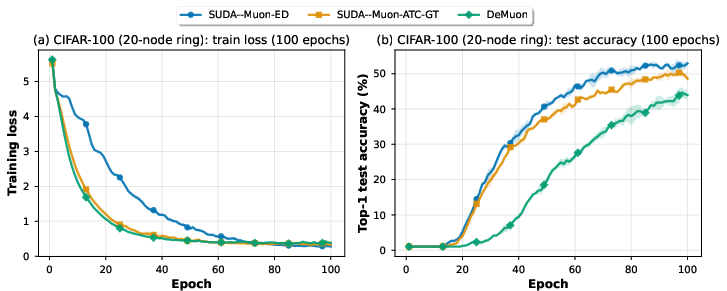
Figure 1: CIFAR-100 performance over 100 epochs. SUDA–Muon-ED clearly outpaces ATC-GT and DeMuon variants in loss and accuracy on a strongly non-IID 20-node ring.
Internal Boundary: Necessity of Tracking Before Polarization
The operator f(X)=N1∑i=1Nfi(X)7 is nonlinear, and polarization on local signals (without tracking) leads to structural failure under heterogeneity. The paper proves that removing gradient tracking produces non-stationary fixed points: even with smooth, lower-bounded objectives, the averaged iterate f(X)=N1∑i=1Nfi(X)8 may remain constant at a non-critical point. Hence, tracking-before-polarization is not merely a design convenience; it is a structural necessity. This is a strong claim, supported via explicit matrix logistic counterexamples.
External Boundary: Decentralized vs. Federated Linear Speedup
A fundamental difference exists between fully decentralized and federated Muon. In federated Muon, server-side averaging before polarization realizes the f(X)=N1∑i=1Nfi(X)9 variance reduction, resulting in linear speedup. In decentralized Muon, local polarization precludes this effect—even with exact averaging on a complete graph. The contraction rate becomes independent of X∈Rm×n0, demonstrating that decentralized Muon cannot simply inherit federated scalability. The distinction is not due to communication degradation, but rather to the order of operations.
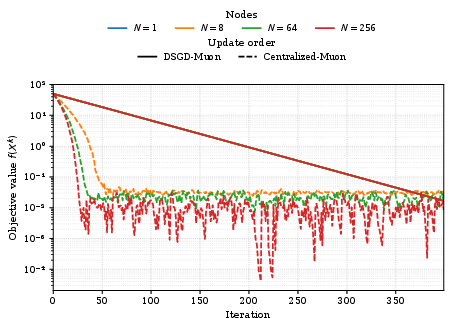
Figure 2: Counterexample for linear speedup under transverse noise; only federated Muon gets accelerated as X∈Rm×n1 increases, while decentralized Muon is insensitive to X∈Rm×n2.
Empirical Validation
Extensive experiments are conducted on CIFAR-100 (strongly heterogenous, Dirichlet X∈Rm×n3) and GPT-2/Wikitext-2 (near-IID), comparing SUDA–Muon–ED, SUDA–Muon–ATC–GT, and DeMuon across varying topologies and node counts.
- CIFAR-100 Long Horizon/Non-IID: SUDA–Muon–ED cleanly outperforms both ATC-GT and DeMuon after 100 epochs on 20-node ring, with over 8-point gap in final accuracy and clear separation in loss trajectories.
- Short Horizon/Near-IID (GPT-2): All variants converge similarly, consistent with the theory that the dominant term is topology-free and backbone choice impacts only transients.
- Topology Ablations: Preferred topology shifts with node count and problem regime; ring, star, and fully-connected graphs show regime-dependent strengths, highlighting the modularity of backbone selection.
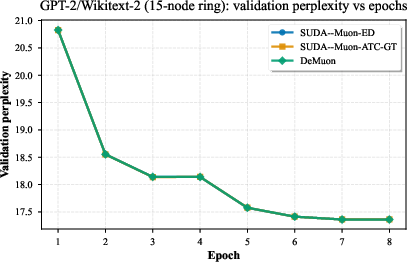
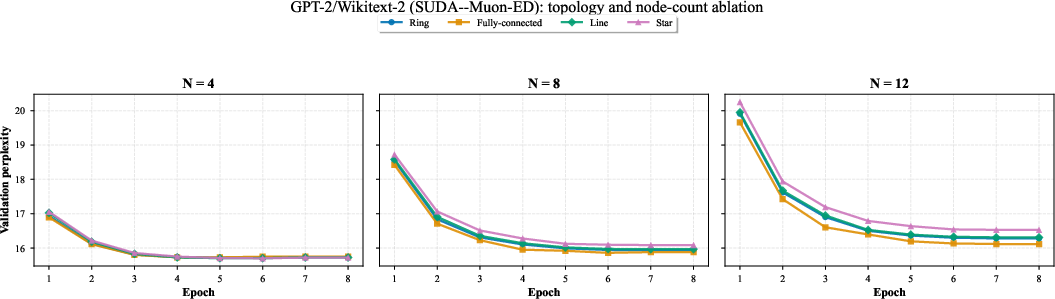
Figure 3: Main 15-node ring run for decentralized GPT-2 fine-tuning; validation perplexity trajectories remain tightly clustered across SUDA–Muon–ED, ATC-GT, and DeMuon.
Implications and Future Directions
Practical implications include the following:
- Algorithm Design: Matrix-aware optimizers in decentralized environments must structurally couple tracking and polarization; backbone/topology selection can be modular, but cannot rectify fundamentally non-modular boundaries.
- Benchmarking: Empirical superiority of the SUDA backbone emerges only in long-horizon, heterogeneity-stressed regimes.
- Variance Reduction: Fully decentralized architectures are not interchangeable with federated ones; order of polarization and averaging is a critical architectural constraint.
Theoretical implications:
- Generalization of topology-separated rates: The SUDA template provides a principled axis for modular design, with sharp analysis separating the effects of communication backbone from those of optimizer geometry.
- Structural counterexamples: The necessity of tracking and the limits of linear speedup cannot be bypassed by tuning or network engineering.
Speculation for future developments:
- Incorporation of communication-efficient mechanisms (e.g., gradient compression), convergence under structured non-convexity (PL or sharp minima), adaptive backbone selection based on regime detection, and large-scale multi-domain extensions for matrix-aware decentralized optimization.
- Further exploration of regime-dependent topology selection and backbone modularity in distributed learning with matrix-valued parameters.
Conclusion
By establishing explicit structural boundaries via formal analysis and empirical tests, the paper demonstrates that fully decentralized Muon optimization is fundamentally governed by the interplay of nonlinear polarization and linear communication. The SUDA–Muon framework enables modular comparison across communication backbones but also exposes strict non-modular requirements—tracking-before-polarization and the absence of federated-style linear speedup. Theoretical convergence rates are topology-separated and numerically validated via CIFAR-100 and GPT-2 benchmarks. These insights delineate the limits of decentralization in matrix-aware optimization and inform the trajectory of both algorithmic design and practical deployments.