DAMA: A Unified Accelerated Approach for Decentralized Nonconvex Minimax Optimization-Part I: Algorithm Development and Results
Published 15 Dec 2025 in math.OC | (2512.13920v1)
Abstract: In this work and its accompanying Part II [1], we develop an accelerated algorithmic framework, DAMA (Decentralized Accelerated Minimax Approach), for nonconvex Polyak-Lojasiewicz minimax optimization over decentralized multi-agent networks. Our approach integrates online and offline stochastic minimax algorithms with various decentralized learning strategies, yielding a versatile framework with broader flexibility than existing methods. Our unification is threefold: (i) we propose a unified decentralized learning strategy for minimax optimization that subsumes existing bias-correction techniques, such as gradient tracking, while introducing new variants that achieve tighter network-dependent bounds; (ii) we introduce a probabilistic gradient estimator, GRACE (Gradient Acceleration Estimator), which unifies momentum-based methods and loopless variance-reduction techniques for constructing accelerated gradients within DAMA, and is broadly applicable to general stochastic optimization problems; and (iii) we develop a unified analytical framework that establishes a general performance bound for DAMA, achieving state-of-the-art results with the best-known sample complexity. To the best of our knowledge, DAMA is the first framework to achieve a multi-level unification of decentralized learning strategies and accelerated gradient techniques. This work focuses on algorithm development and the main results, while Part II provides the theoretical analysis that substantiates these results and presents empirical validation across diverse network topologies using synthetic and real-world datasets.
The paper introduces DAMA, unifying decentralized strategies and probabilistic gradient acceleration (GRACE) to effectively solve nonconvex minimax problems under the PL condition.
The methodology integrates bias-corrected gradient tracking and hybrid variance reduction techniques, achieving state-of-the-art per-agent sample complexities and network-dependent convergence rates.
Empirical validations on synthetic and real tasks demonstrate rapid consensus, robustness across various network topologies, and improved scalability for distributed learning.
DAMA: A Unified Accelerated Approach for Decentralized Nonconvex Minimax Optimization
Introduction and Motivation
This paper presents DAMA (Decentralized Accelerated Minimax Approach), a unified accelerated framework for decentralized nonconvex minimax optimization under the Polyak–Łojasiewicz (PL) condition. The motivation stems from the growing importance of solving nonconvex-nonconcave minimax optimization problems in large-scale multi-agent settings encountered in modern machine learning tasks such as GANs, robust reinforcement learning, domain adaptation, and distributionally robust optimization. Existing solutions are fragmented, often focusing on either small subsets of decentralized strategies or variance reduction mechanisms, and they fail to provide a comprehensive, flexible, and optimal solution framework for both online and offline decentralized minimax learning.
DAMA achieves a multi-level unification:
Decentralized Strategies: It unifies prominent decentralized strategies such as bias-corrected gradient tracking (GT), Exact Diffusion (ED), and EXTRA, and constructs new combinations that achieve improved network-dependent convergence rates.
Gradient Acceleration: It introduces GRACE, a generic and probabilistic gradient estimator subsuming momentum acceleration (e.g., STORM), loopless variance reduction (e.g., PAGE, Loopless SARAH), and their hybridizations.
Analytical Framework: The theoretical analysis encompasses all algorithmic variants and attains state-of-the-art sample complexities, matching and surpassing existing lower bounds.
DAMA addresses the challenges intrinsic to decentralized setups, including communication sparsity, data heterogeneity, asymmetric nonconvex–PL objectives, and non-trivial gradient noise correlations, via an integrated analytical and practical approach.
The DAMA design reinterprets decentralized minimax learning as a constrained multi-level primal-dual saddle-point game across agents connected via a generic network topology. Each agent optimizes its private nonconvex–PL risk and maximization variable, sharing information only with direct neighbors.
This unified view leads to an abstract formulation where consensus constraints are imposed through network-structured penalty or dual variables. Specific choices of the associated projection and combination matrices correspond to classical decentralized algorithms:
ED (Exact Diffusion): Consistent averaging with network-based correction for both primal and dual variables.
ATC-GT (Adapt-Then-Combine Gradient Tracking): Incorporates local momentum and neighbor gradient tracking.
EXTRA: Exploits iterative symmetric correction steps for enhanced network mixing.
The framework's flexibility enables adaptation to arbitrary network topologies (well- or sparsely-connected) and readily accommodates new algorithmic hybrids.
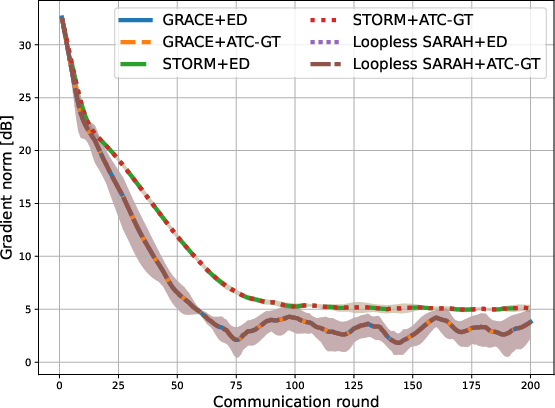
Figure 1: Performance profiles under a well-connected Metropolis network, exemplifying robust and rapid consensus convergence with DAMA.
DAMA introduces GRACE, a general probabilistic gradient estimator, resolving two major limitations of past approaches: the need for case-specific variance reduction methods and the rigidity of nested-loop or highly specialized momentum protocols. GRACE leverages a Bernoulli-driven scheme to stochastically switch between large/minibatch gradient evaluations and employs tunable parameters to activate various correction and smoothing regimes.
Key instantiations include:
STORM-type Momentum for online low-memory acceleration, reducing the impact of stochastic noise via recursive correction terms (first-order or Hessian-informed).
Loopless SARAH and PAGE for finite-sum problems, probabilistically performing full or large-batch updates.
Hybridization through parameter selection enables dynamic adaptation between the above, depending on online conditions (sample size, variance level, communication budget).
The estimator’s generic structure allows additional algorithmic variants not previously explored.
Theoretical Results and Sample Complexities
The main theoretical advance is a unified, non-casewise performance analysis applicable to all DAMA variants. By developing a novel transformed recursion in the reduced eigenspace of the network mixing matrix, the authors derive convergence bounds that reveal:
Best-known per-agent sample complexity for decentralized nonconvex–PL minimax:
For STORM+ED, sample complexity is
O(Kκ3ε−3+(1−λ)2κ2ε−2)
The dominant term is independent of the network spectral gap (1−λ), matching minimization lower bounds and outpacing momentum-based GT results.
For PAGE/Loopless SARAH+ED, in large finite-sum (offline) regimes:
O(Kκ2Nε−2)
Improving upon recent methods by a factor of O(K).
The only known exception requiring prior spectral information or additional communication is DREAM [chen2024efficient].
Strong (and for some configurations, new) results are established for the transient time to achieve linear speedup with increasing agents. The derived bounds are attained without resorting to multi-step mixing or requiring explicit knowledge of network spectral properties.
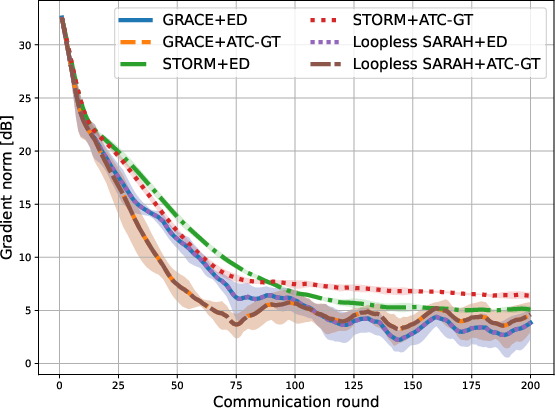
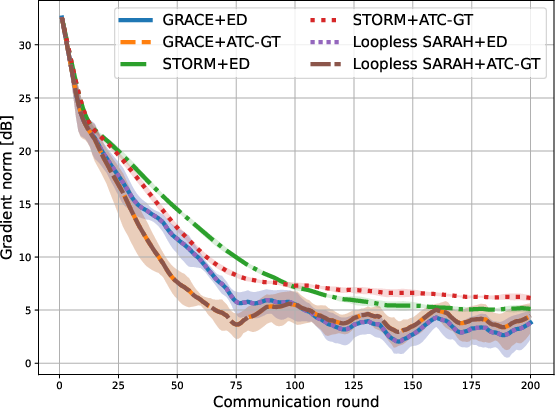
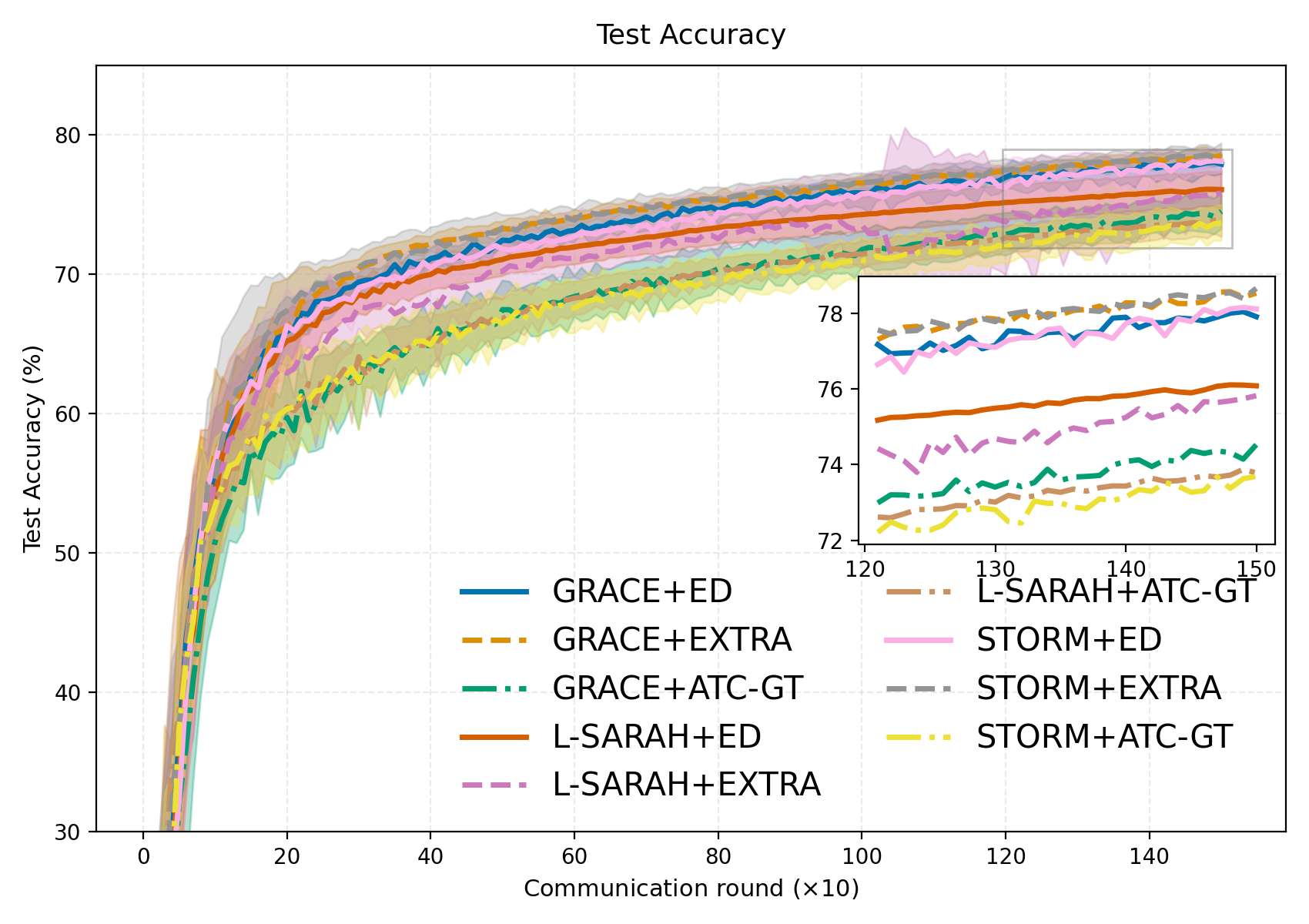
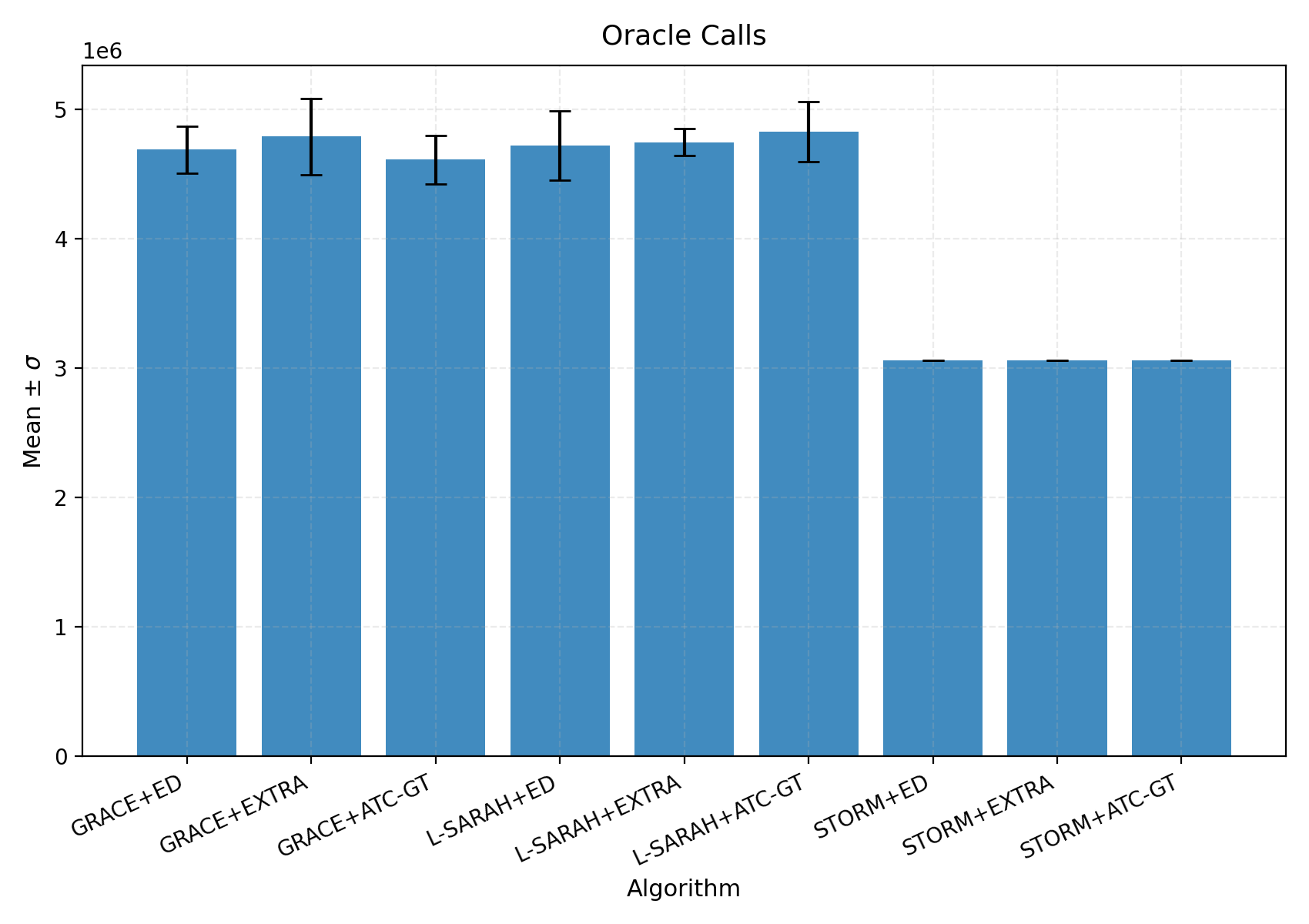
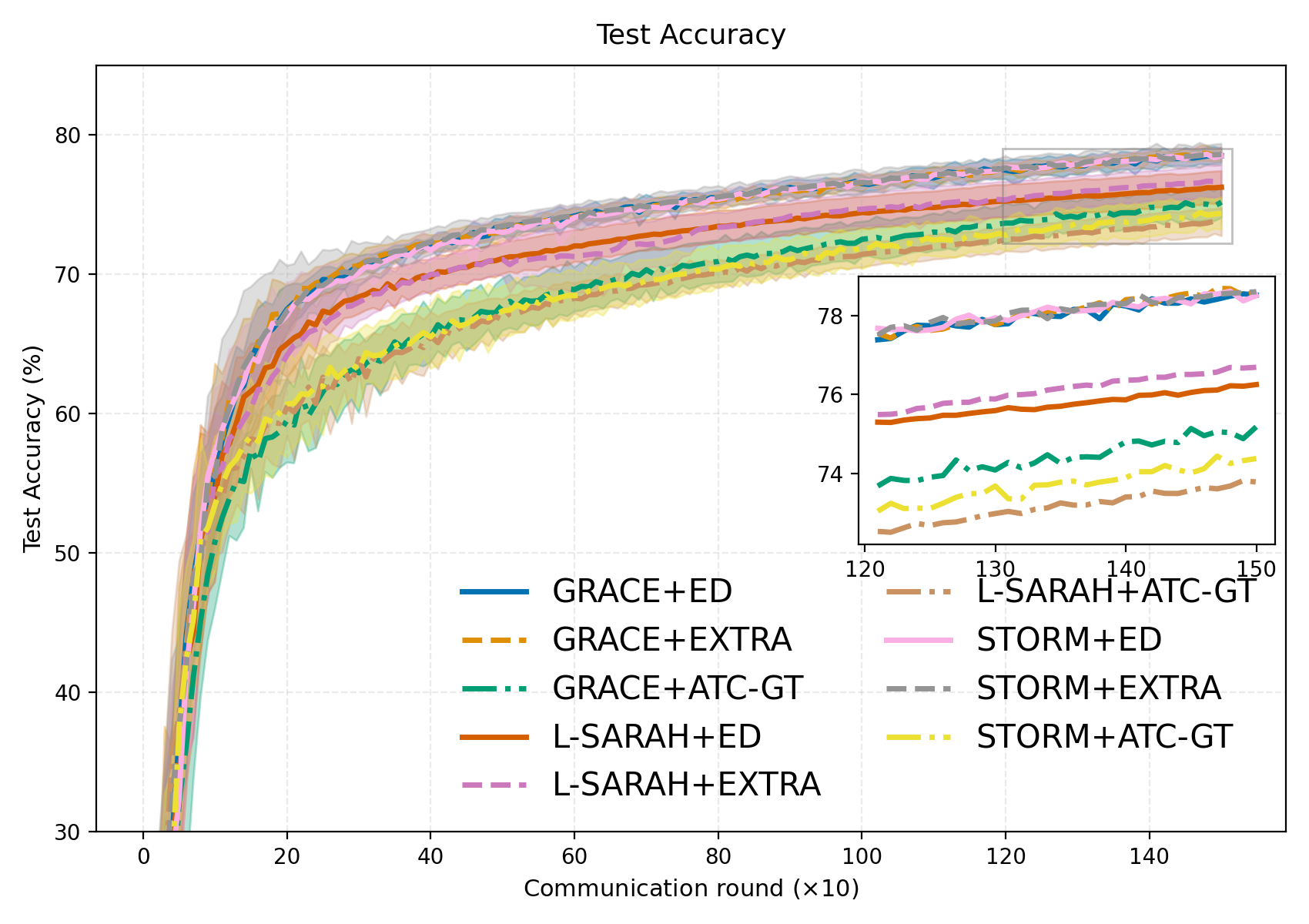
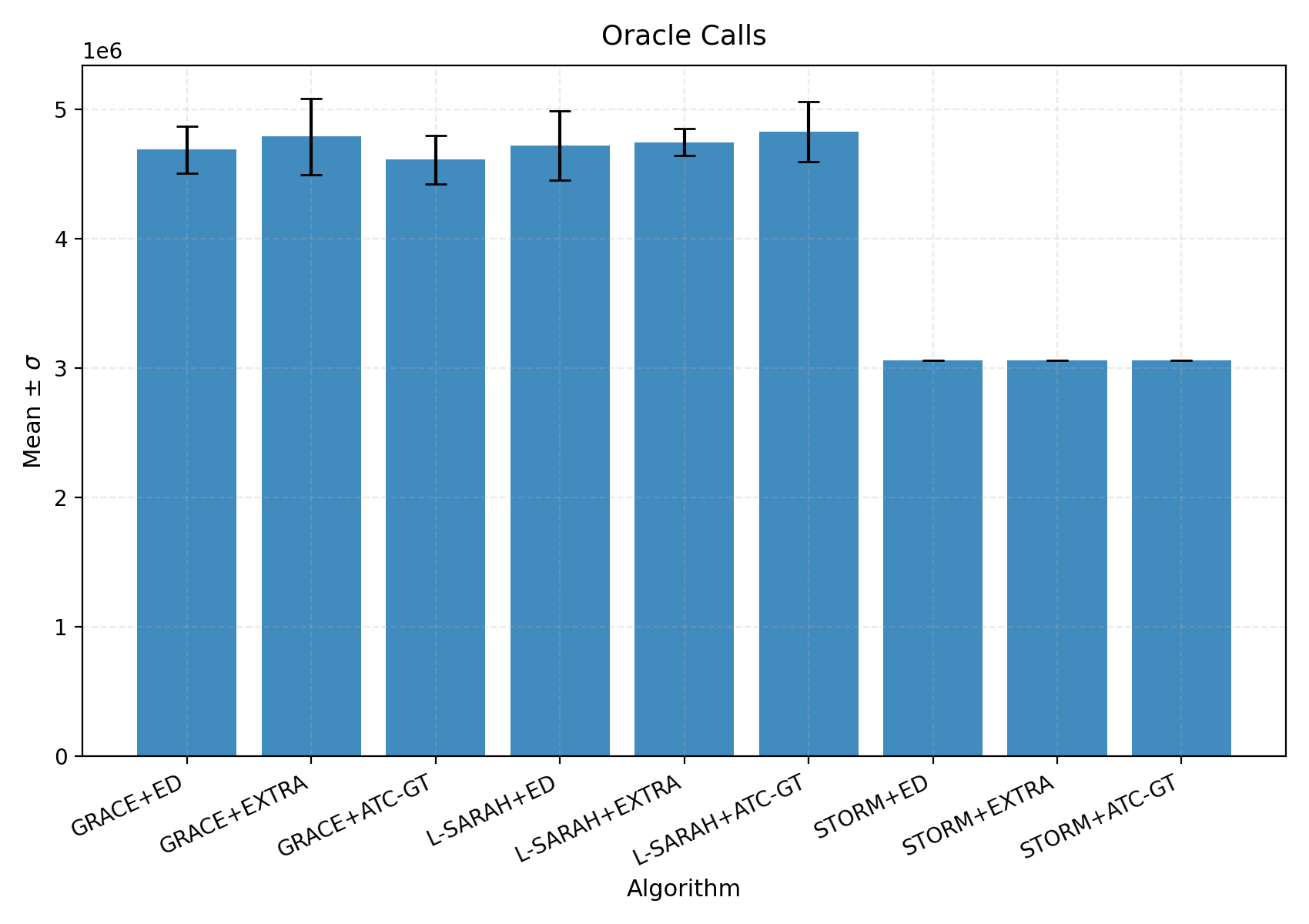
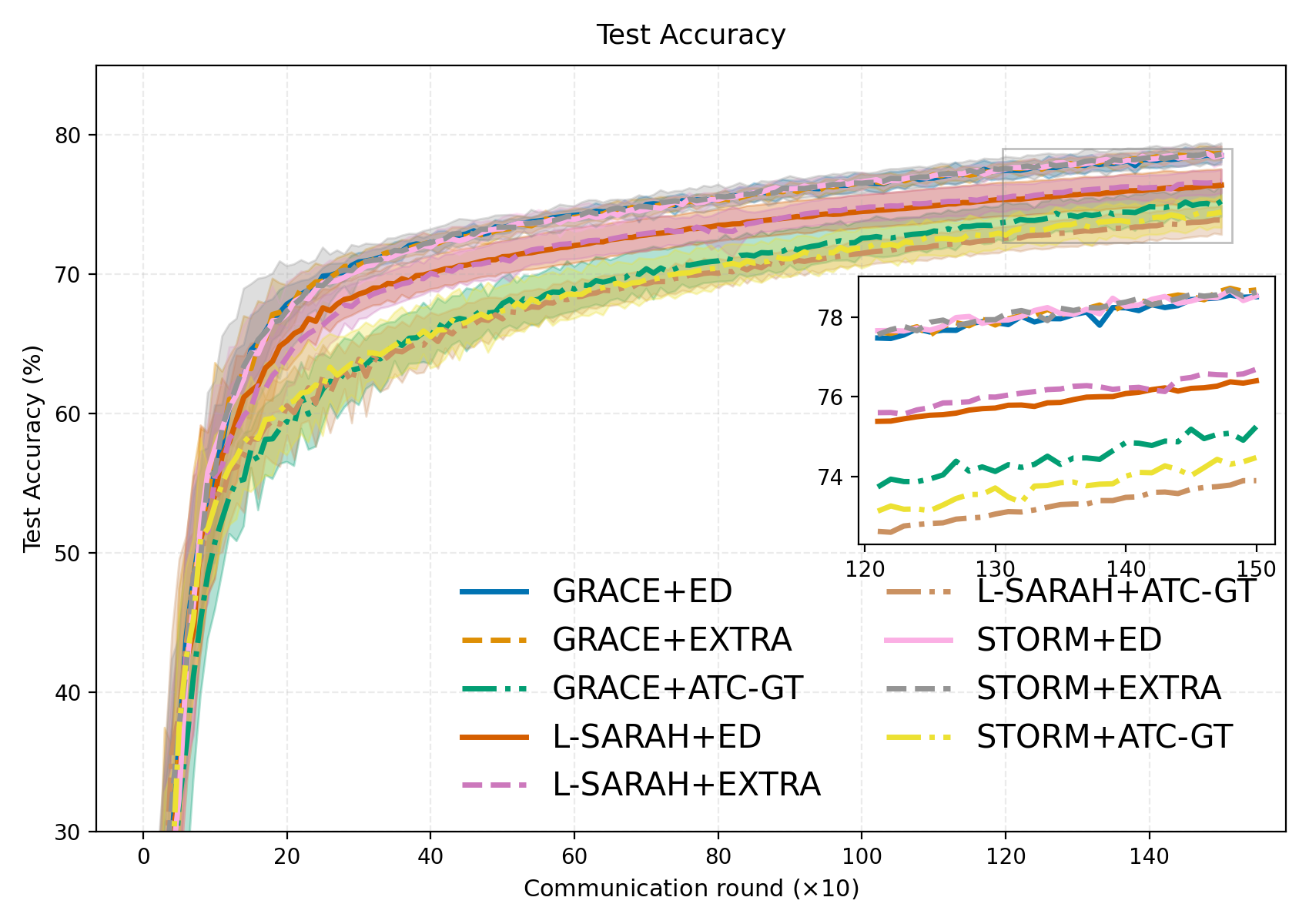
Figure 2: Test accuracy comparison in a well-connected network, illustrating DAMA’s superior performance in finite rounds.
Figure 3: Test accuracy in a ring topology, highlighting robustness under sparse connectivity.
Figure 4: Test accuracy in a line topology, focusing on the effect of local information propagation and estimator choice.
Empirical Validation
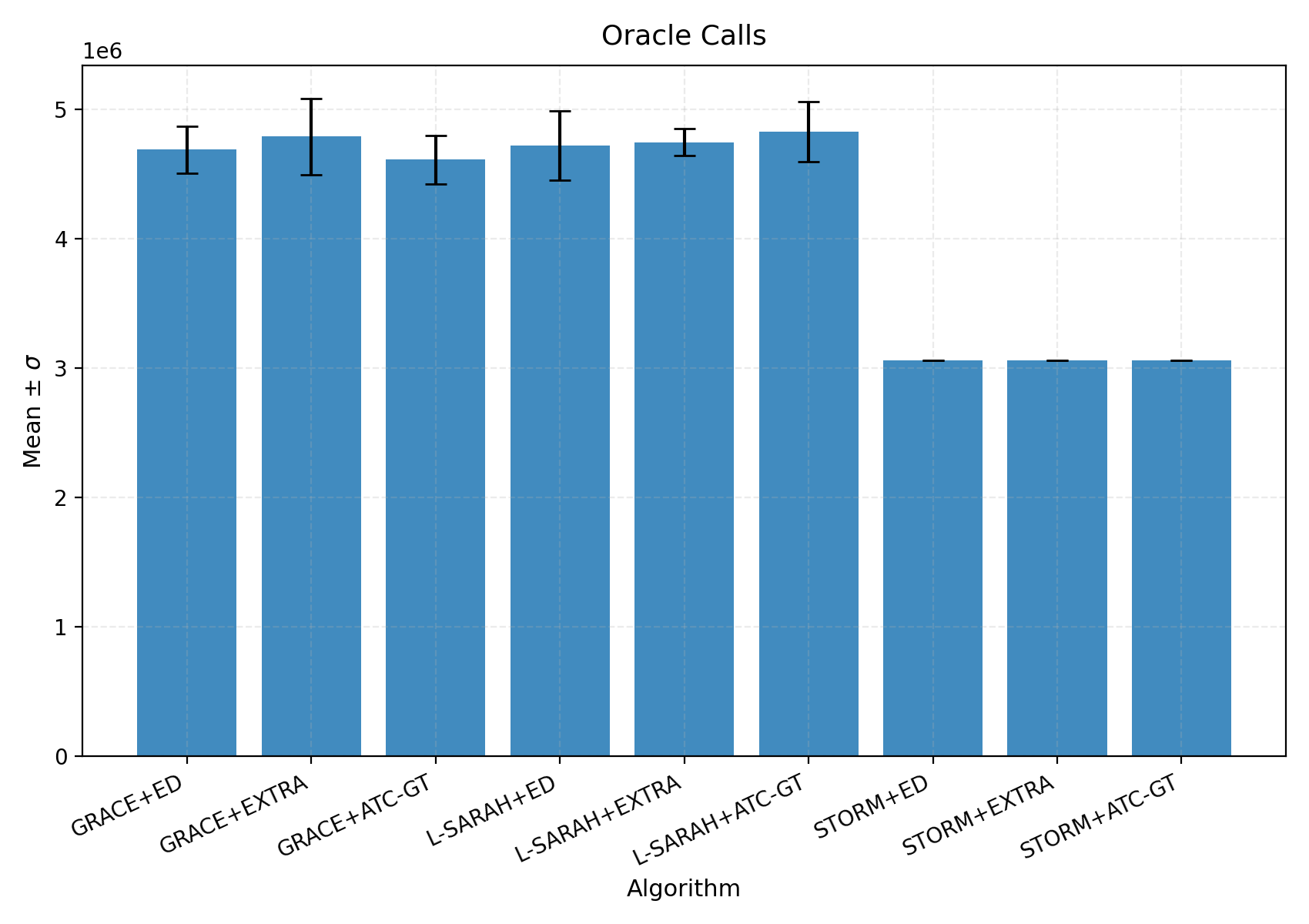
Comprehensive simulations are conducted on synthetic minimax problems and fair classification tasks (e.g., balanced FashionMNIST neural classifiers). The experiments benchmark all key variants of DAMA (ED, ATC-GT, EXTRA × GRACE, STORM, PAGE, Loopless SARAH) under different network structures, data partitions, and heterogeneity levels.
Findings highlight:
All DAMA instances achieve rapid consensus and competitive accuracy in dense (e.g., Metropolis) networks.
ED-based variants consistently outperform other strategies on sparse networks.
GRACE- and Loopless SARAH-accelerated estimators yield improved steady-state error at the cost of increased computation.
The performance gap versus existing approaches becomes apparent on larger or sparser networks and in high data heterogeneity.
Implications and Future Directions
DAMA's unification of decentralization and acceleration for nonconvex minimax unlocks several implications:
Practical: The framework enables scalable, communication-efficient, and variance-adaptive optimization—critical for federated learning, distributed adversarial training, robust multi-agent reinforcement learning, and distributed robust learning under privacy constraints.
Theoretical: The coupled consensus/variance reduction analysis closes a longstanding optimality gap in decentralized minimax learning theory and provides a foundation for further lower-bound studies in the field.
Future Developments: Extensions to time-varying or directed networks, fully adaptive or self-tuning hyperparameters, and applicability to higher-order games and compositional minimax problems.
Conclusion
This work introduces DAMA, a rigorously analyzed, highly flexible, and provably optimal framework for decentralized nonconvex minimax optimization. By simultaneously unifying network learning strategies and stochastic gradient accelerators under a single transformable analysis, DAMA achieves and in several scenarios surpasses state-of-the-art performance. The empirical and theoretical findings serve as a new foundation for decentralized minimax optimization in both theory and practice (2512.13920).
“Emergent Mind helps me see which AI papers have caught fire online.”
Philip
Creator, AI Explained on YouTube
Sign up for free to explore the frontiers of research
Discover trending papers, chat with arXiv, and track the latest research shaping the future of science and technology.Discover trending papers, chat with arXiv, and more.