- The paper introduces a generalized Aubry-André formula, extending spectral measure analysis to all even moments with explicit polynomial representations.
- It demonstrates that the AMO's intersection spectrum measure depends continuously on parameters (α, λ) in the weak-* topology, ensuring analytic regularity except at critical points.
- Using trace formulas and symmetry properties, the study reconciles prior spectral ambiguities and offers tools for analyzing quantum transport and localization.
Introduction and Historical Context
The Almost Mathieu Operator (AMO), defined on ℓ2(Z) by
(Hα,λ,θψ)n=ψn+1+ψn−1+2λcos(2π(nα+θ))ψn,
is foundational in the modern spectral theory of ergodic Schrödinger operators. Its spectral phenomena, including the Hofstadter butterfly—an intricate fractal structure revealed numerically by Hofstadter—have played a central role in the mathematics and physics of quasicrystals and electron dynamics in magnetic fields. Spectral measures and the nature of the spectrum (absolutely continuous, singular continuous, pure point) for various regimes of coupling λ and irrational frequencies α have motivated conjectures with broad implications, such as the Aubry-André conjecture and the Ten Martini Problem.
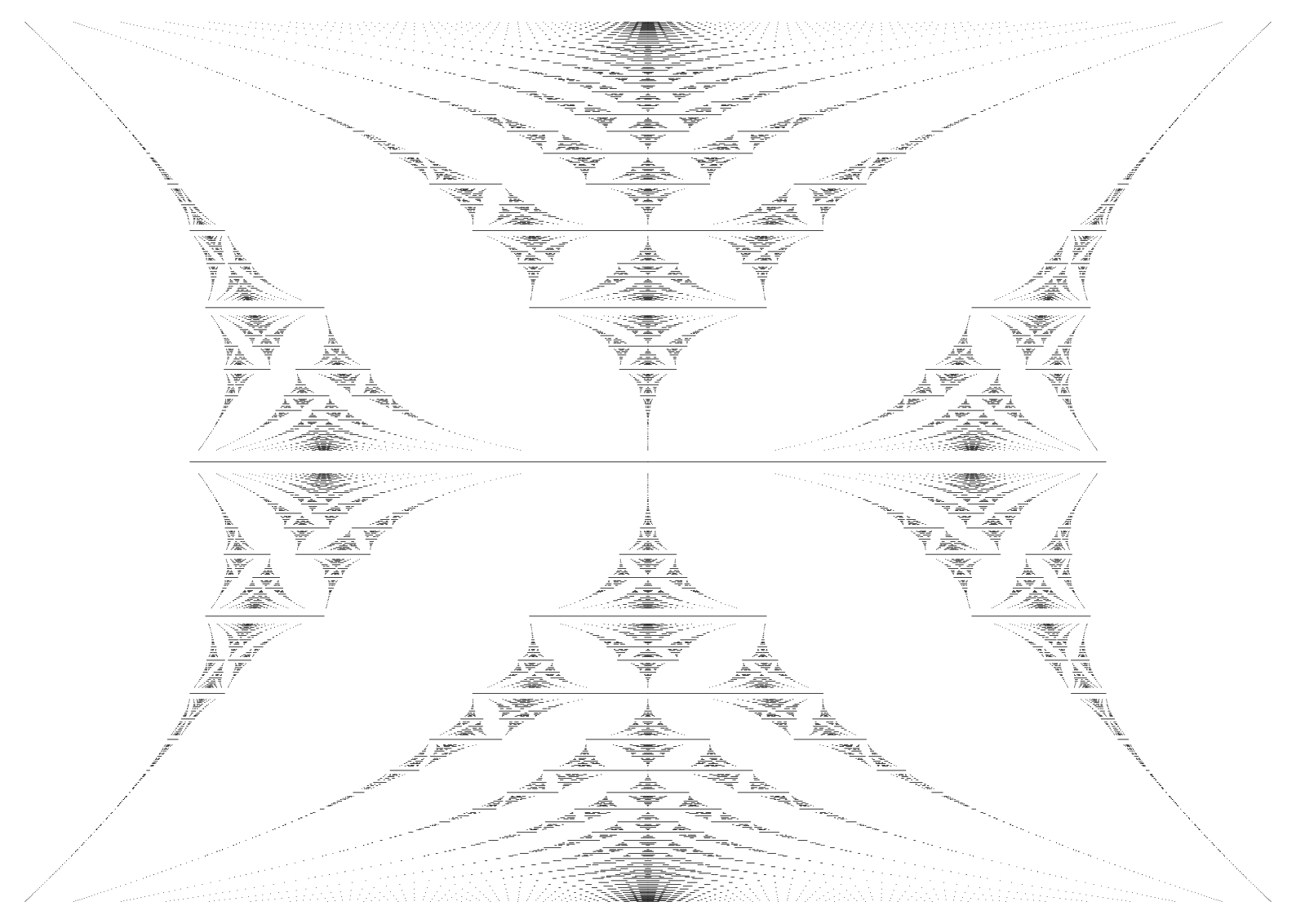
Figure 1: Hofstadter butterfly, λ=1, exhibiting the fractal structure of the AMO spectrum as a function of frequency α.
Intersection Spectrum and Parameter Continuity
While prior work established the continuity of the union spectrum Σα,λ+=θ⋃Σα,λ,θ in α and λ in the Hausdorff metric, the behavior of the intersection spectrum
Σα,λ−=θ⋂Σα,λ,θ
was less transparent. This paper shows that continuity for the intersection spectrum should be understood through the family of measures (Hα,λ,θψ)n=ψn+1+ψn−1+2λcos(2π(nα+θ))ψn,0, i.e., Lebesgue measure restricted to (Hα,λ,θψ)n=ψn+1+ψn−1+2λcos(2π(nα+θ))ψn,1. It is proven that (Hα,λ,θψ)n=ψn+1+ψn−1+2λcos(2π(nα+θ))ψn,2 depends continuously on (Hα,λ,θψ)n=ψn+1+ψn−1+2λcos(2π(nα+θ))ψn,3 in the weak-* topology, thus reconciling prior confusion about spectral continuity at rational and irrational frequencies.
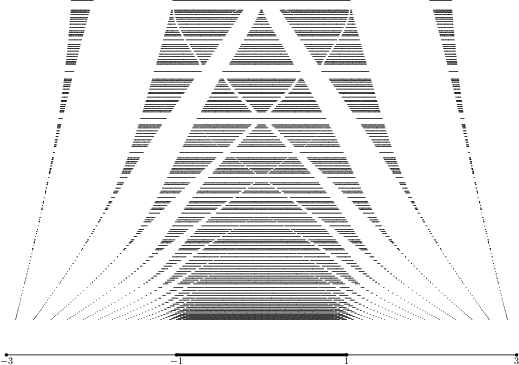
Figure 2: Hofstadter butterfly for (Hα,λ,θψ)n=ψn+1+ψn−1+2λcos(2π(nα+θ))ψn,4, magnified near (Hα,λ,θψ)n=ψn+1+ψn−1+2λcos(2π(nα+θ))ψn,5 with the intersection spectrum (Hα,λ,θψ)n=ψn+1+ψn−1+2λcos(2π(nα+θ))ψn,6 indicated. Weak convergence of measures is visible as (Hα,λ,θψ)n=ψn+1+ψn−1+2λcos(2π(nα+θ))ψn,7.
A principal result of the paper is the discovery that moments of the measure (Hα,λ,θψ)n=ψn+1+ψn−1+2λcos(2π(nα+θ))ψn,8 are polynomials in (Hα,λ,θψ)n=ψn+1+ψn−1+2λcos(2π(nα+θ))ψn,9 whose coefficients are trigonometric polynomials in λ0. Explicitly, for even λ1,
λ2
can be written as
λ3
where λ4 has degree λ5 in λ6 and coefficients in λ7. Odd moments vanish by spectral symmetry. The leading coefficient and the polynomial structure are rigorously justified via trace formulas linked to the symmetry properties of the AMO at rational λ8.
This result subsumes the original Aubry-André formula for the Lebesgue measure of the spectrum, extending it to higher moments and thus providing more refined information about the spectral distribution.
Analytic and Smooth Dependence on Parameters
The study further establishes that the measure of any connected component of the spectrum (i.e., between two persistent gaps) is analytic in λ9 and α0 in α1, as long as the relevant gaps do not bifurcate within a parameter domain. The analyticity persists except at the non-analytic critical point α2, but passage to normalized measures removes even this singularity.
The technical approach relies on a four-trace formula, reducing the analysis of measures and their moments to tractable computations with traces of finite- and infinite-dimensional operators possessing certain reflection symmetries. Exponential decay (Combes–Thomas-type) estimates for matrix elements ensure convergence and regularity.
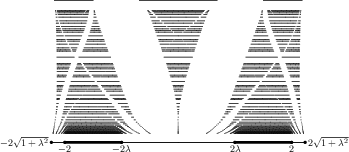
Figure 3: Hofstadter butterfly for fixed α3 near α4, showing the role of spectral symmetry in the trace computations used for moments.
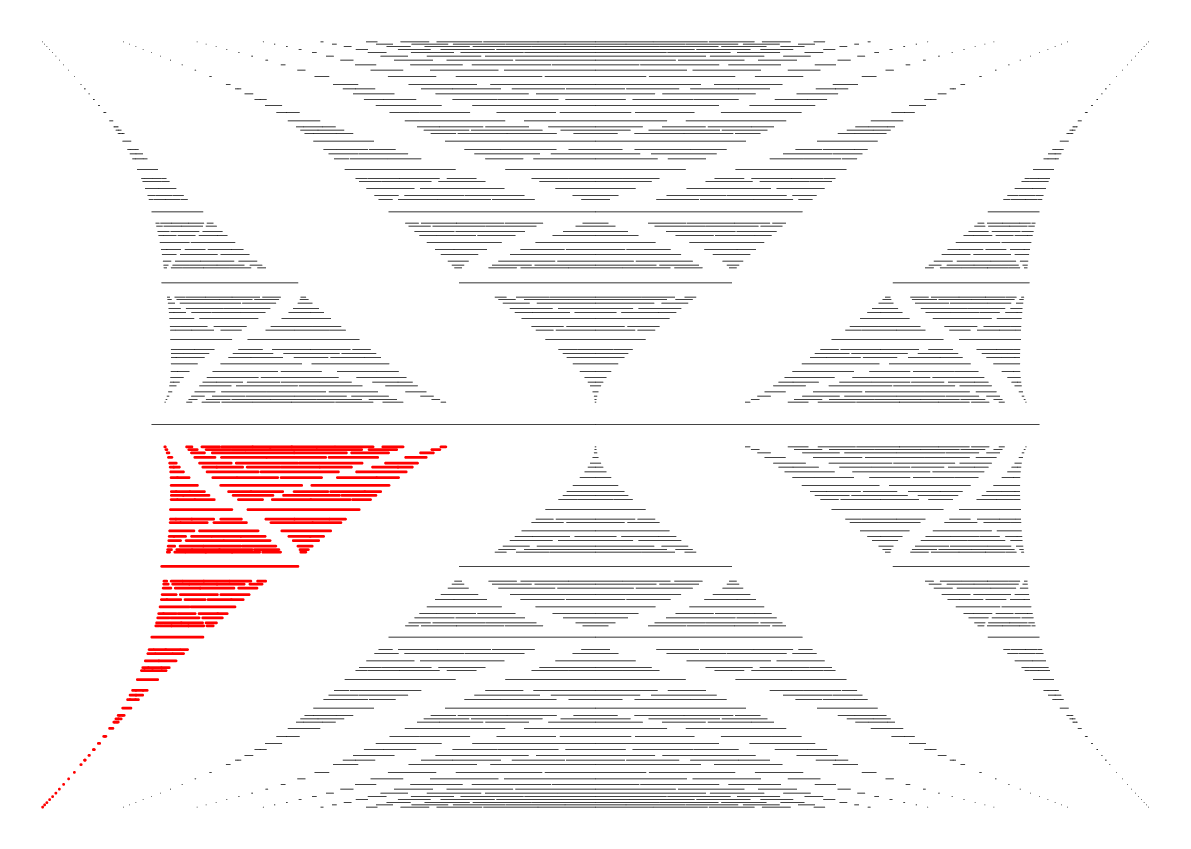
Figure 4: Magnified Hofstadter butterfly for α5, highlighting a region between non-bifurcating gaps where analyticity in α6 is established.
Explicit Computation of Moments and Spectral Identities
The paper provides explicit polynomials for low-order moments, reinforcing the generalized Aubry-André structure: α7
with similar expressions for higher moments. Furthermore, duality relations between moments at α8 and α9 are established, illustrating a robust and deep algebraic structure in the AMO’s spectral measures.
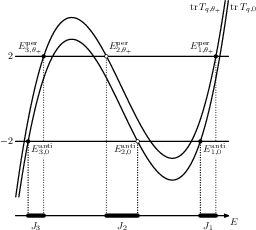
Figure 5: Traces of transfer matrices λ=10 at rational frequencies, underpinning the construction of moment polynomials and the four-trace formula.
Singularity and Non-analyticity in Frequency
While analyticity in λ=11 is robust (and can be "restored" at λ=12 by normalization), dependence on frequency λ=13 is λ=14 but not analytic for general test functions. The argument rests on explicit counterexamples motivated by invariant graph constructions over irrational rotations, specifically demonstrating non-analytic behavior in constructed quasi-periodic cocycles even when all formal derivatives exist.
Implications and Prospects for Future Research
The results provide both conceptual and computational advances:
- Parameter regularity: The established continuity and analyticity of spectral measures constitute a definitive answer to prior ambiguities regarding the limiting behavior of spectral quantities at rational/irrational λ=15 and away from the critical coupling.
- Fine spectral invariants: By encoding higher moments of the intersection spectral measure as explicit polynomials, new invariants for spectral analysis and their duality relations become available. These may inform the study of quantum transport, localization, and the multifractal features of the spectrum.
- Extension to broader classes: The methodological framework—combining trace identities, symmetry, and cocycle dynamics—invites extension to more general quasi-periodic Schrödinger potentials and more complex spectral phenomena, as well as potential applications in mathematical physics beyond one-dimensional models.
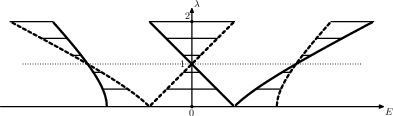
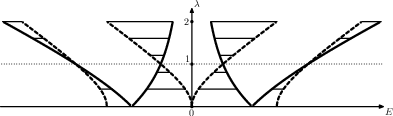
Figure 6: Regions in λ=16 parameter space for fixed rational approximation, clarifying the loci where spectral regularity results uniformly apply.
Conclusion
This work provides a rigorous and explicit framework for understanding the parameter dependence of spectral measures for the Almost Mathieu operator, generalizing the Aubry-André formula to all moments and proving continuity and analyticity properties previously unclear for intersection spectra. The approach—blending explicit combinatorial operator computations, symmetry exploitation, and dynamical systems reasoning—sets a new standard for achieving explicit spectral information and parameter regularity in quasi-periodic operator theory. The polynomial invariants and trace formulae provided offer powerful tools for further exploration of the AMO and related operators.