- The paper introduces symmetric equilibrium propagation that provides unbiased, physically local gradient estimation via a two-phase, analog training protocol.
- It leverages bilinear low-rank couplings and symmetric nudging to cancel leading bias terms, reducing bias order from O(β) to O(β²).
- Empirical results show robust gradient alignment and up to 10³–10⁴× energy savings per training step over digital GPU methods.
Symmetric Equilibrium Propagation for Thermodynamic Diffusion Training: A Technical Overview
Introduction
This work addresses the fundamental challenge in scaling score-based generative diffusion models: the prohibitive energy and wiring costs associated with training and inference on conventional digital accelerators. While previous research demonstrated that the reverse process in score-based diffusion can be realized with massive energy savings on an analog substrate by exploiting overdamped Langevin dynamics and structured low-rank inter-module couplings, the crucial question remained—whether the entire training loop could be closed on such a substrate using only local information, entirely obviating the need for digital backpropagation. The paper rigorously resolves this, showing that equilibrium propagation (EqProp), when suitably generalized and symmetrized, delivers unbiased, physically local gradient estimation for bilinearly-coupled thermodynamic hardware, with provable and favorable bias–variance trade-offs.
Bilinear Substrate Architecture and Training Protocol
The proposed substrate partitions state vectors into input, hidden, and output blocks, each mapping to a physical module. Dense skip connections in canonical U-Net backbones are infeasible for analog substrates due to the quadratic scaling of wiring. This architecture instead realizes skip connections as low-rank bilinear couplings between modules, reducing complexity from O(D2) to O(Dk) for D-dimensional modules and rank k. Configuration and operation of the substrate utilize canonical overdamped Langevin SDEs, with both inference and learning dynamics occurring in the same physical system.
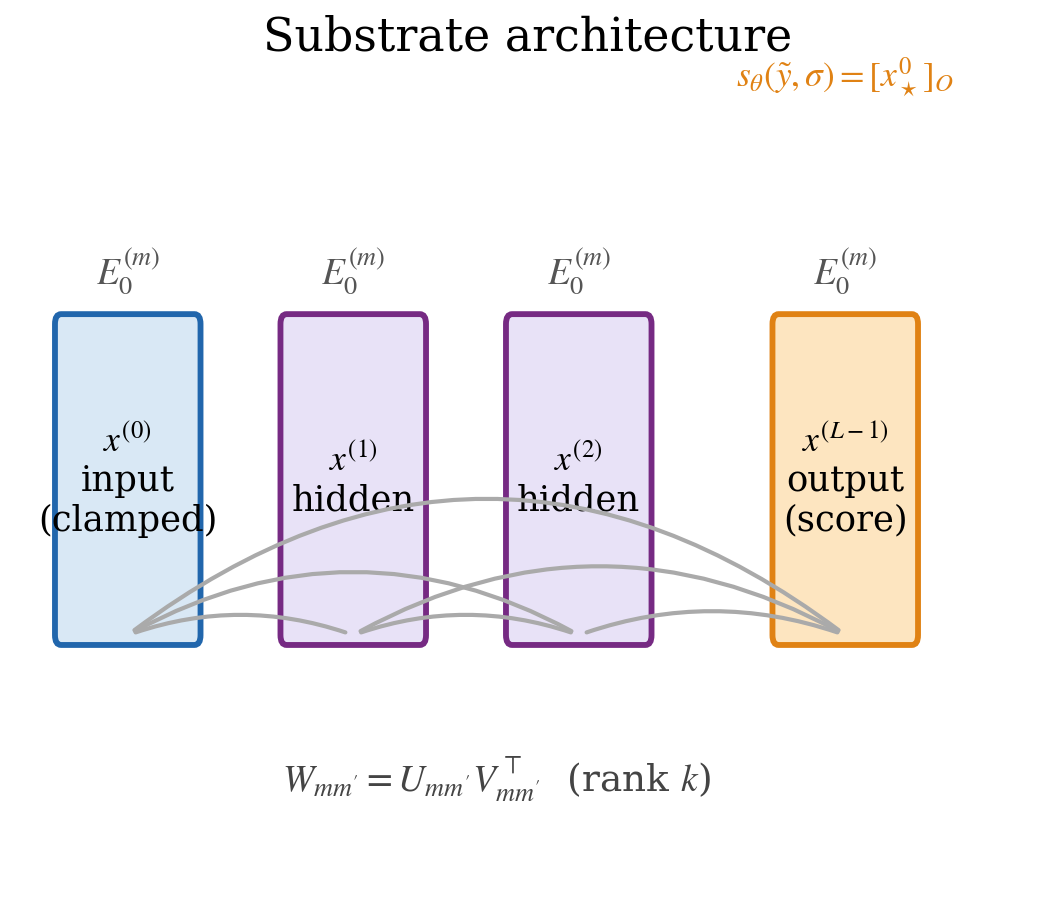
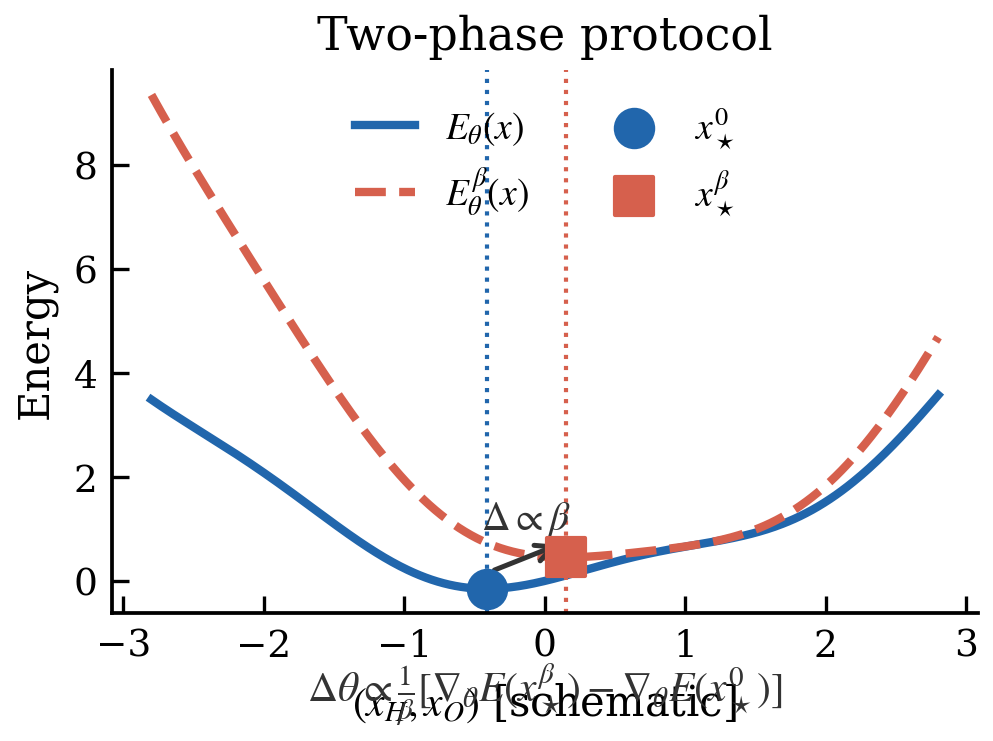
Figure 1: Module decomposition and low-rank bilinear couplings enable tractable analog realization, with the two-phase EqProp protocol supplying local, equilibrium-based gradient signals.
EqProp involves a two-phase training cycle for each example: (1) the free phase, in which the system relaxes to a globally stable equilibrium with inputs clamped; (2) the nudged phase, with a slight output-bias perturbation, leading to a locally shifted equilibrium. The parameter update is extracted as a finite-difference over these two equilibria. Crucially, only equilibrium values and local parameter derivatives are needed—no global backward signal or digital computation is required.
Theoretical Guarantees: Gradient Bias and Symmetrization
The paper formally proves, under standard smoothness and stability assumptions, that EqProp in the zero-nudge limit computes an unbiased estimator of the denoising score-matching gradient. For finite nudges (required in hardware), the estimator exhibits bias characterized by explicit upper bounds:
- For standard (one-sided) EqProp, the bias scales as O(β), where β is the nudge strength. The leading bias term depends on the interplay of substrate stiffness, curvature, and loss-gradient norm.
- By exploiting the bilinear structure, the dominant third-order cross-derivative bias for coupling-parameters vanishes, simplifying analysis and further reducing bias.
More significantly, symmetric nudging (using both +β and −β perturbations) cancels the leading O(β) term, upgrading the bias to O(β2) at negligible additional cost.
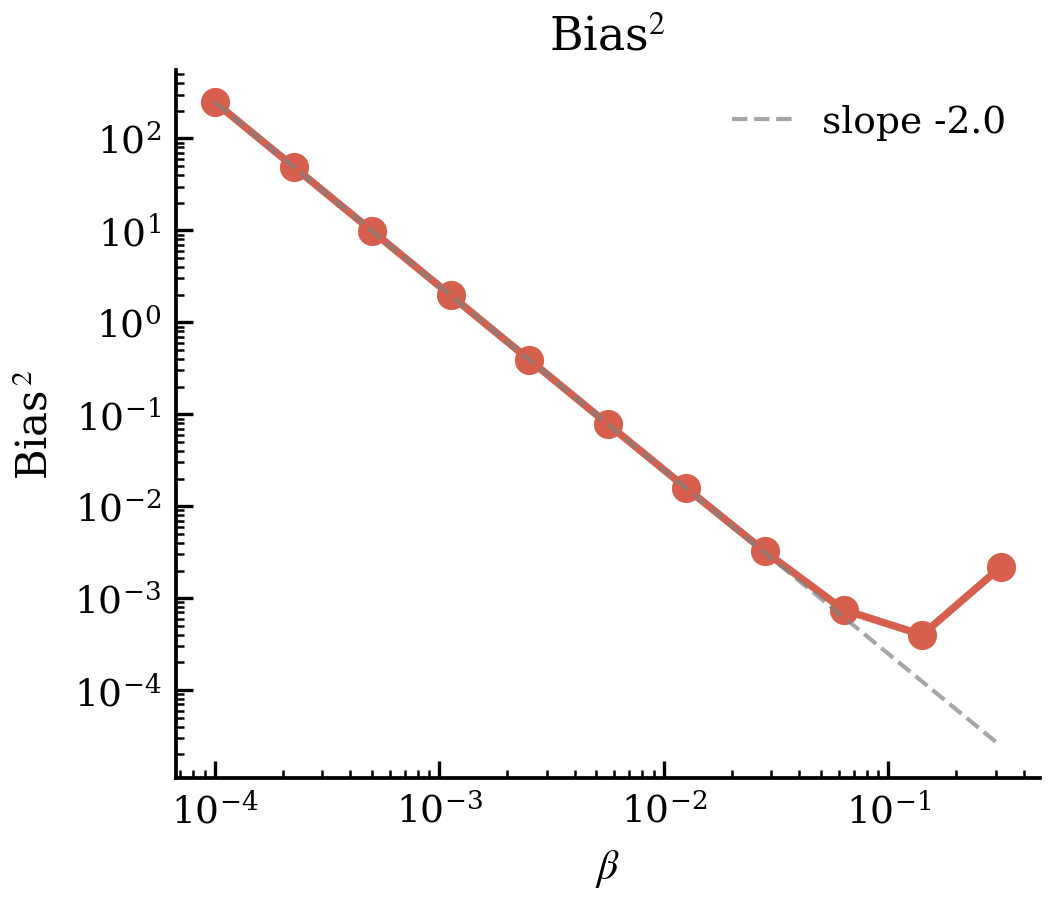
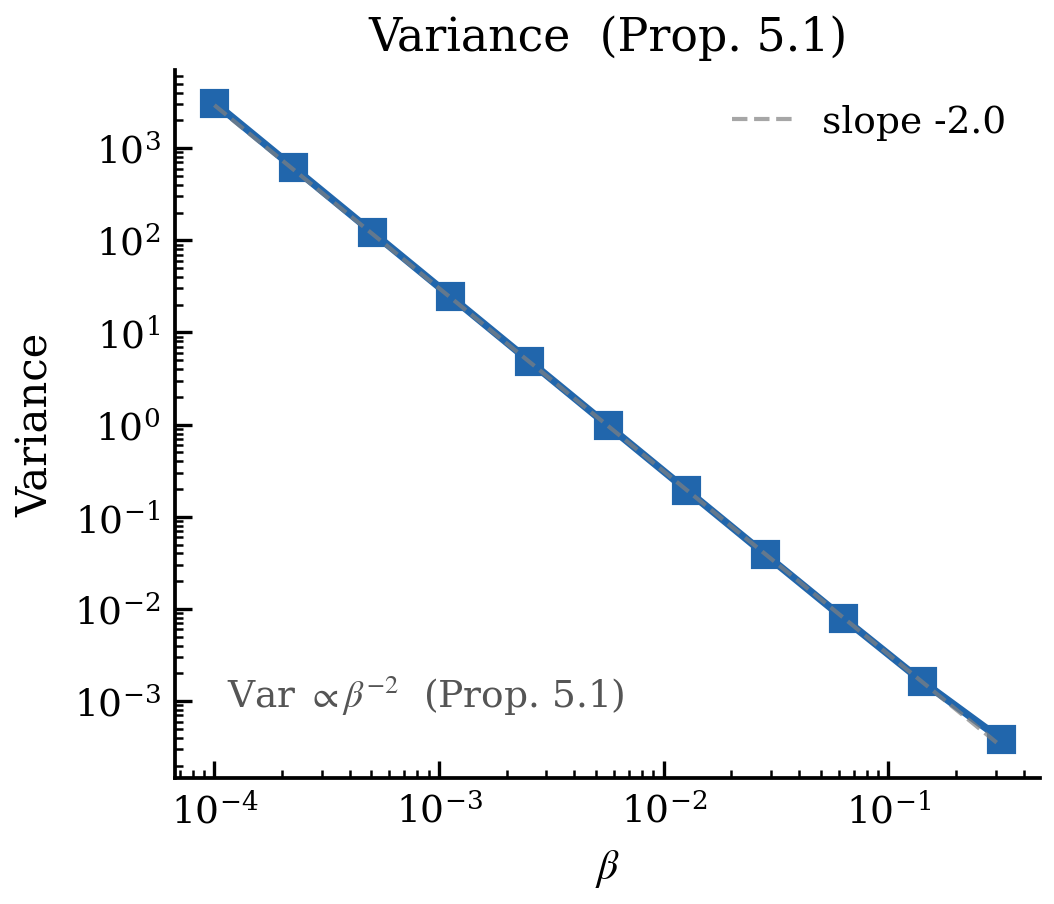
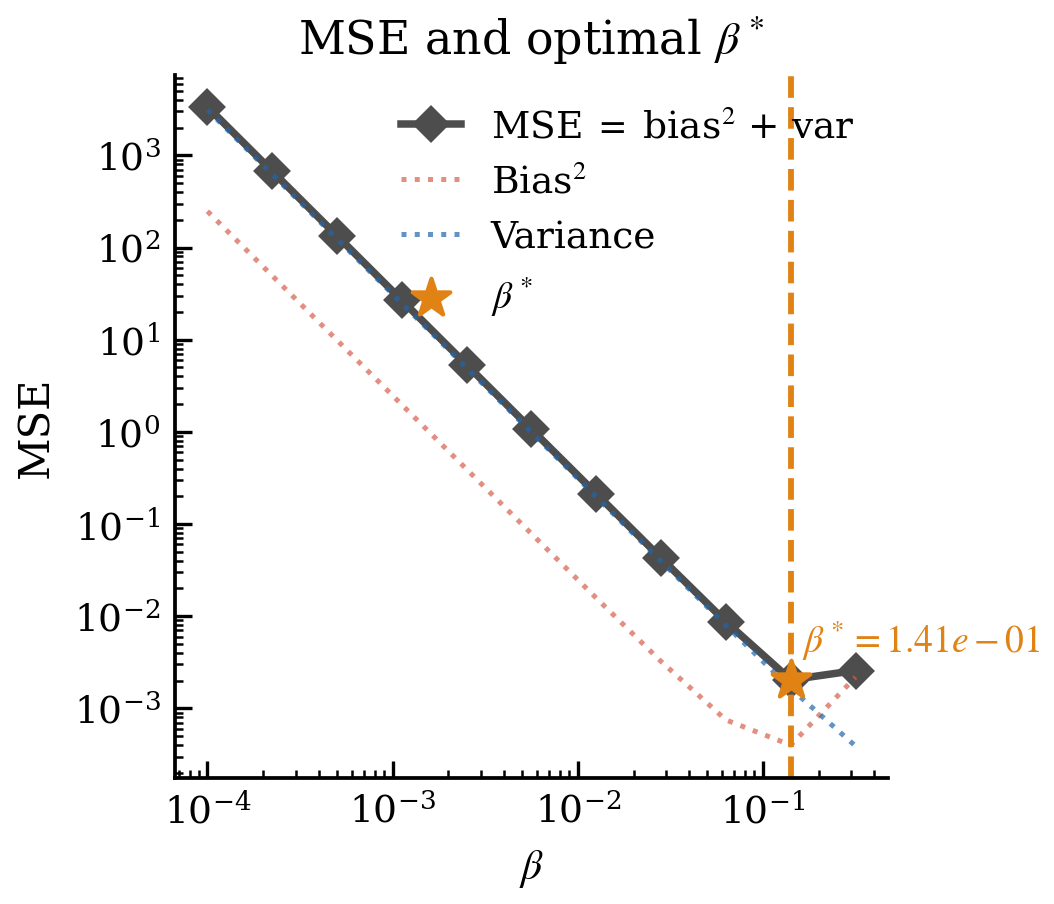
Figure 2: Bias term is eliminated in the symmetric estimator, optimizing accuracy for physical implementations.
This bias suppression is critical: under finite relaxation constraints, typical in analog substrates, the one-sided estimator yields anti-correlated gradients, while the symmetric estimator maintains robust alignment with the true gradient flow direction.
For stochastic physical realizations, the estimator variance scales as O(Dk)0, setting up a classic bias–variance trade-off. The optimal O(Dk)1 can be analytically determined to minimize the mean-squared estimation error for any given substrate and protocol.
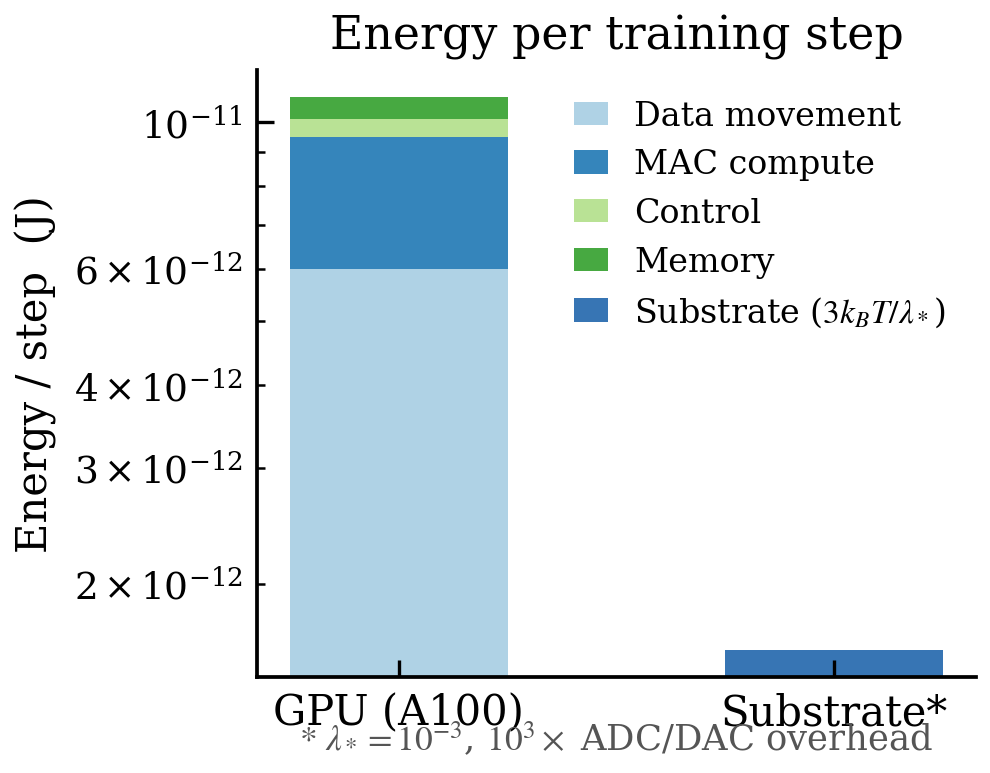
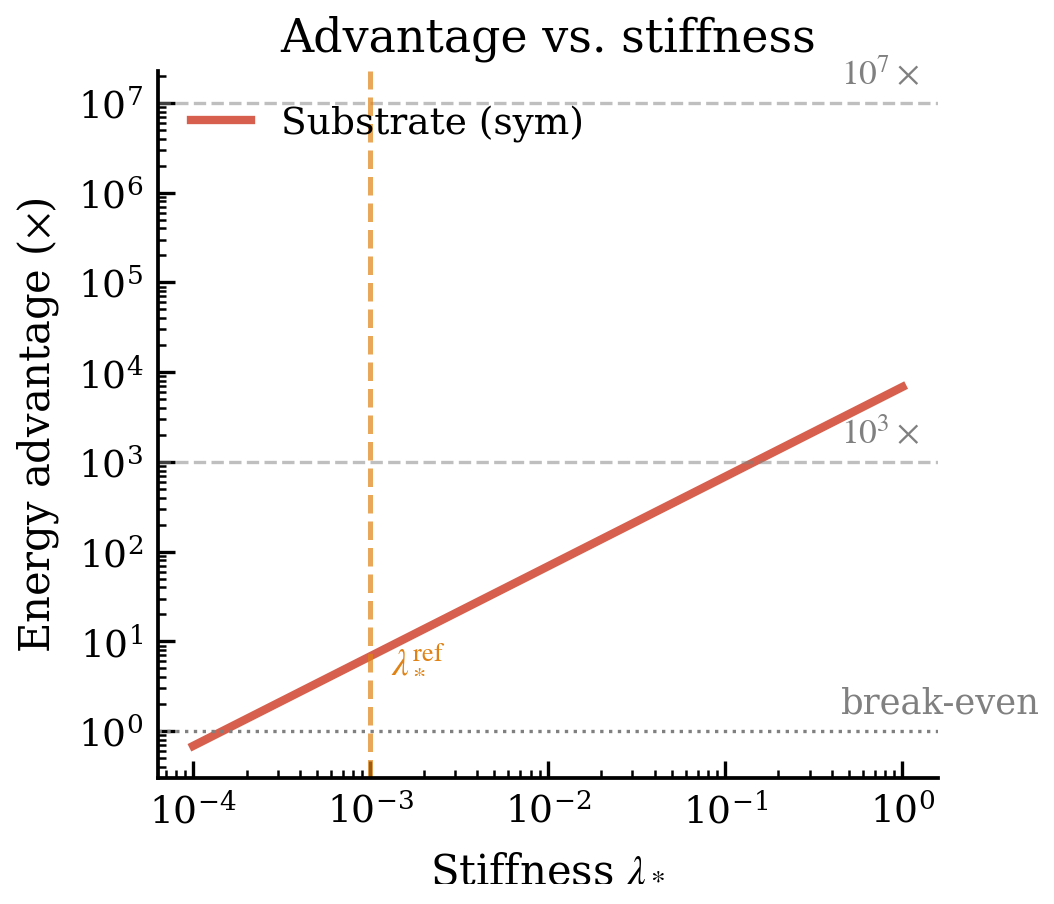
Figure 3: Energy per training step and scaling of the analog advantage with substrate stiffness highlight the efficiency of the method.
End-to-end accounting projects a O(Dk)2--O(Dk)3 energy-per-training-step advantage over standard GPU-based digital training—even when accounting for all physical equilibration and readout costs.
Empirical Validation: Gradient Quality and Learning Behavior
Simulations on bilinearly-coupled systems with O(Dk)4, O(Dk)5, and O(Dk)6 modules validate the theoretical findings:
- Gradient Agreement: The cosine similarity between EqProp and true backpropagation gradients is O(Dk)7 for one-sided and O(Dk)8 for symmetric protocols, confirming the necessity of symmetrization.
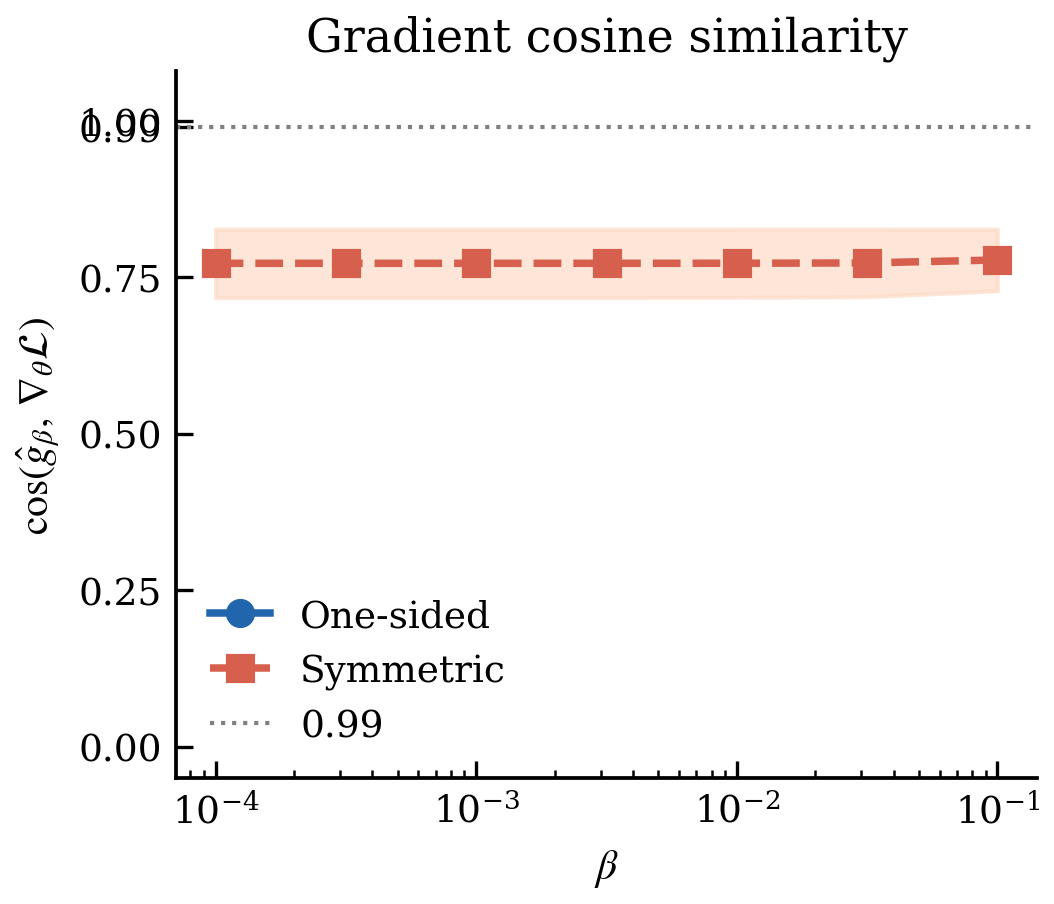
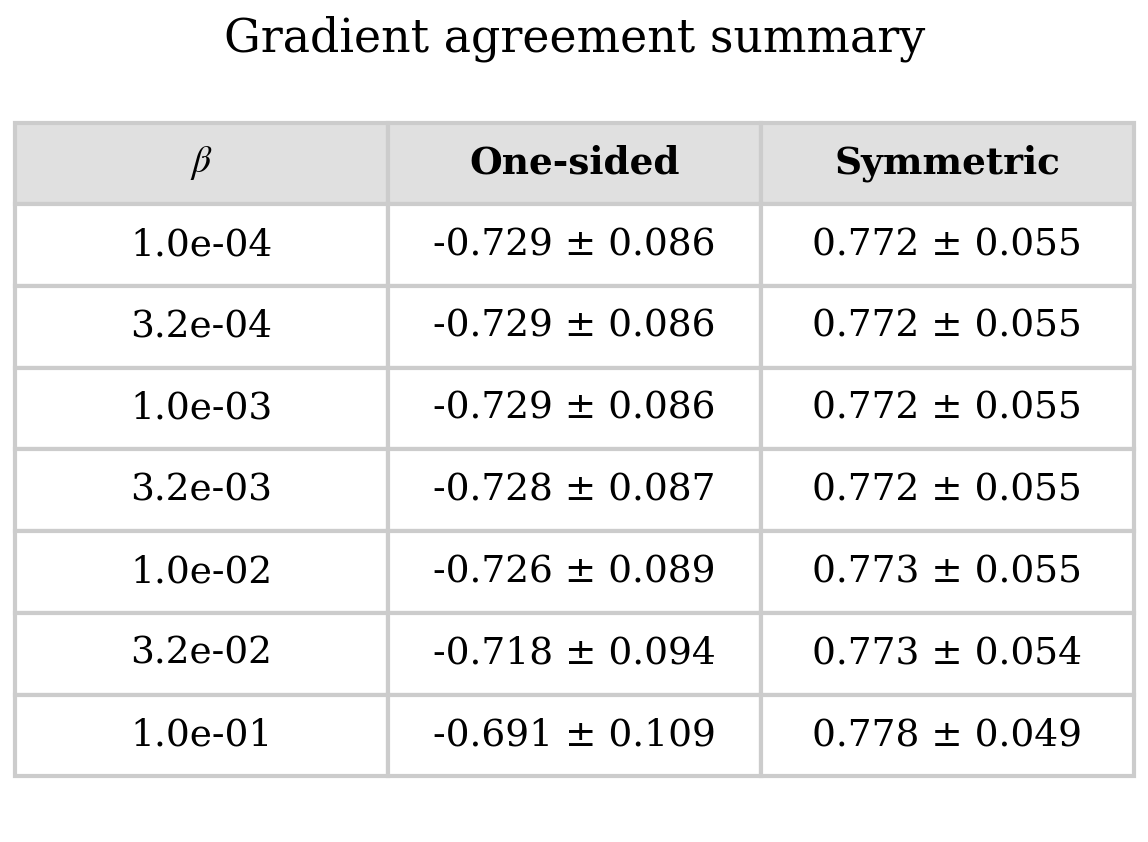
Figure 4: Cosine similarity emphasizes strong anti-correlation for one-sided EqProp and robust alignment for the symmetric variant.
- Bias Scaling: Direct measurement of the log-log plot of bias magnitude versus O(Dk)9 shows a slope of 0.41 for one-sided and 2.00 for symmetric nudging, precisely matching theoretical predictions.
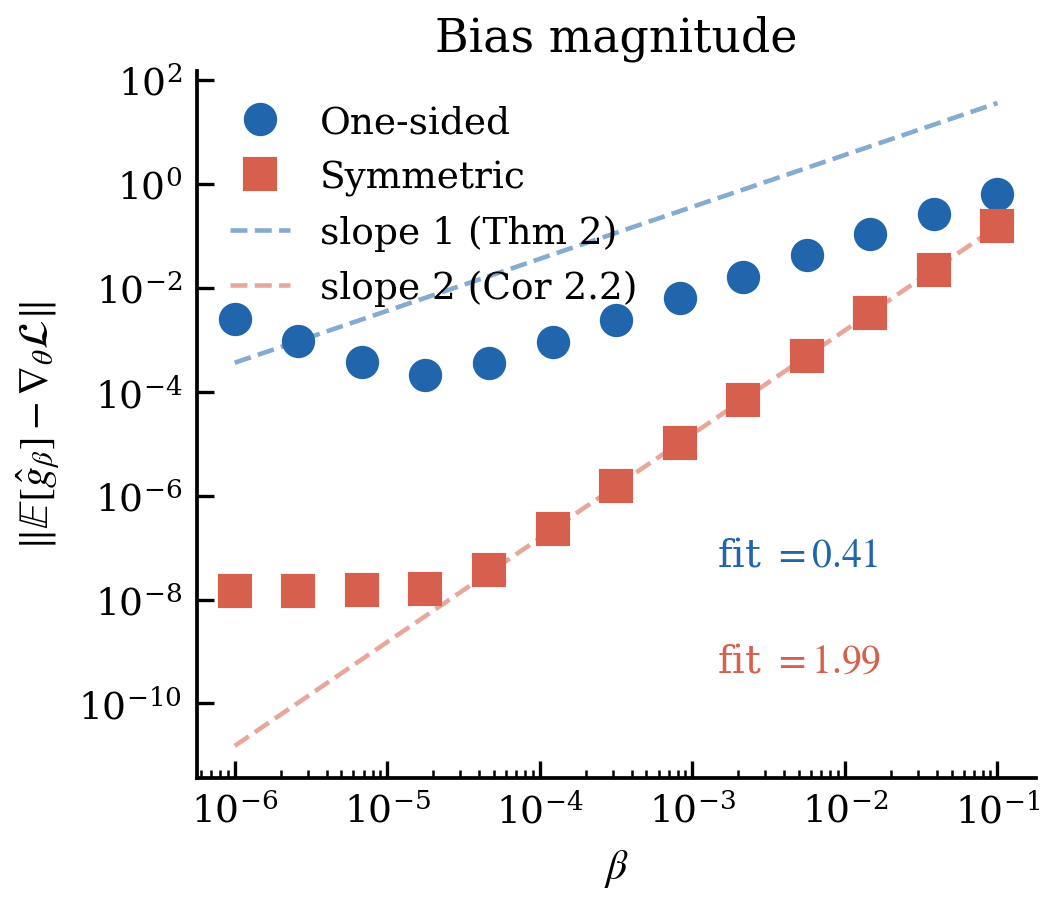
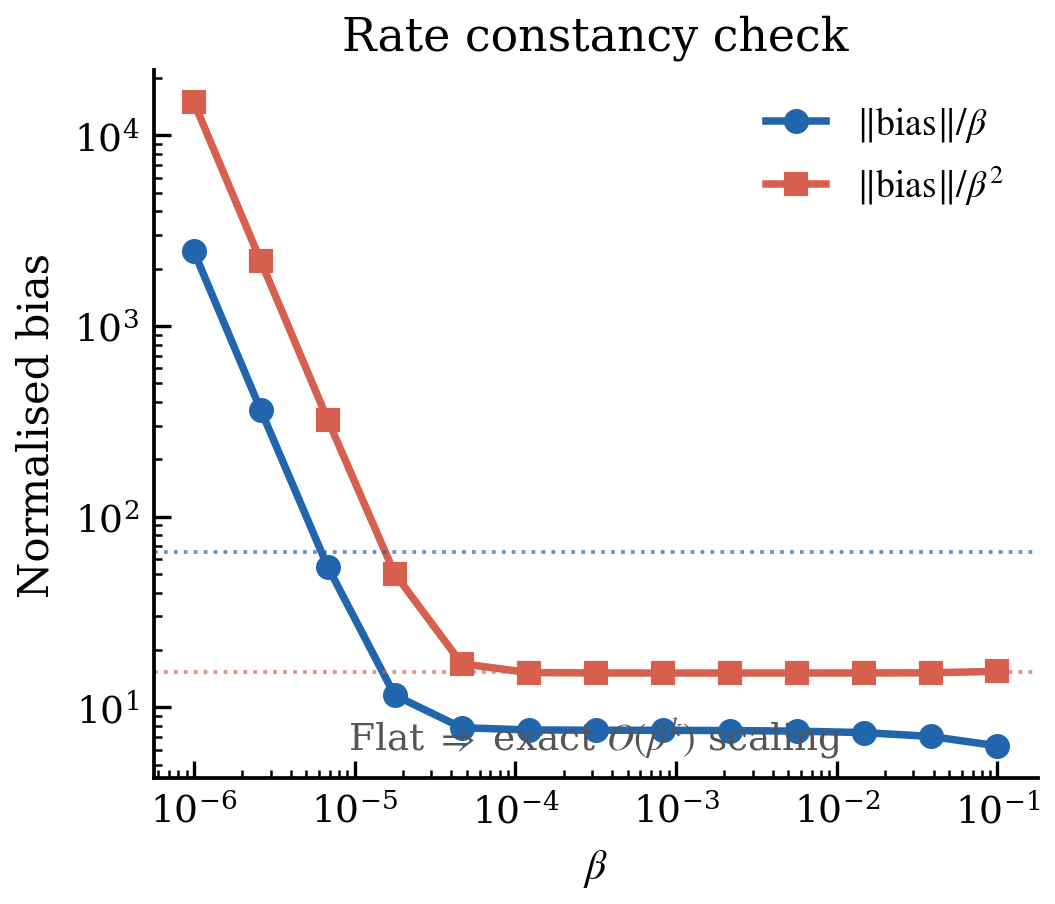
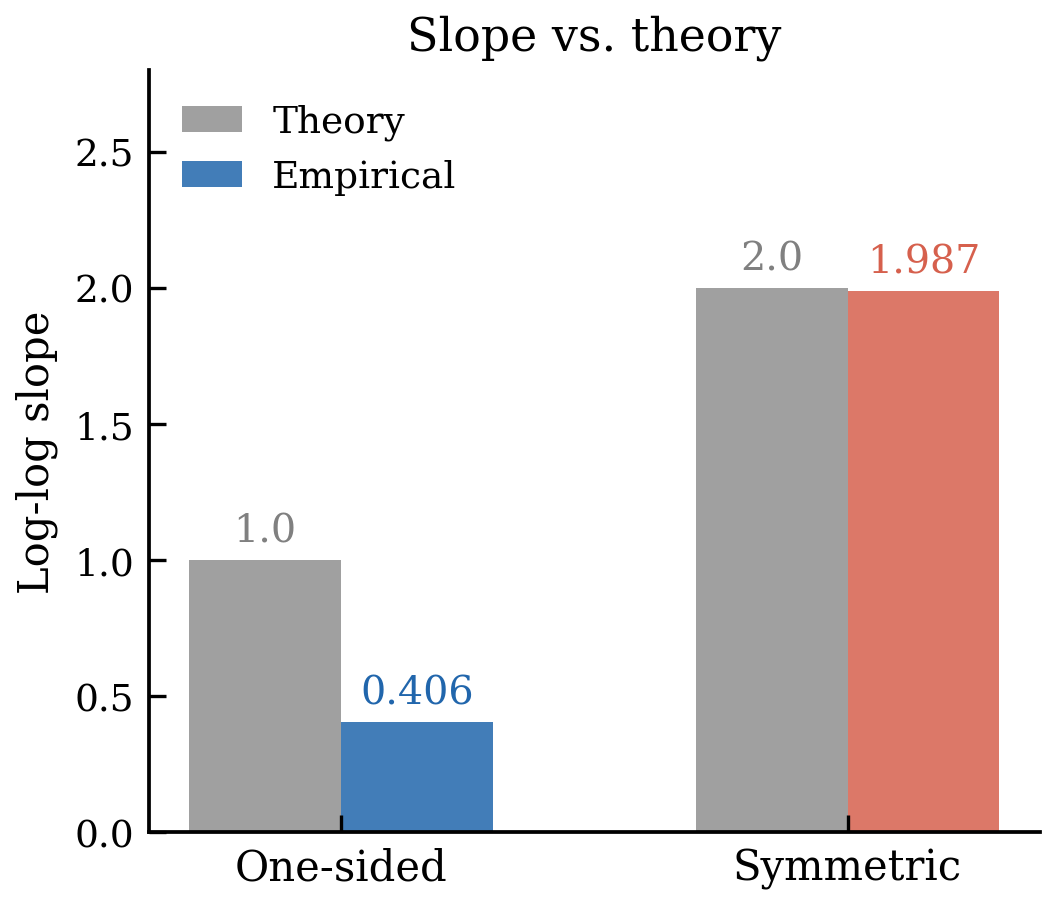
Figure 5: Bias magnitude versus D0 demonstrating exact bias-order scaling for both protocols.
- Training Dynamics: Mean-squared error minimization, consistent with the optimal analytic D1, yields stable and rapid training. Loss curves and gradient alignment match or exceed digital baselines.
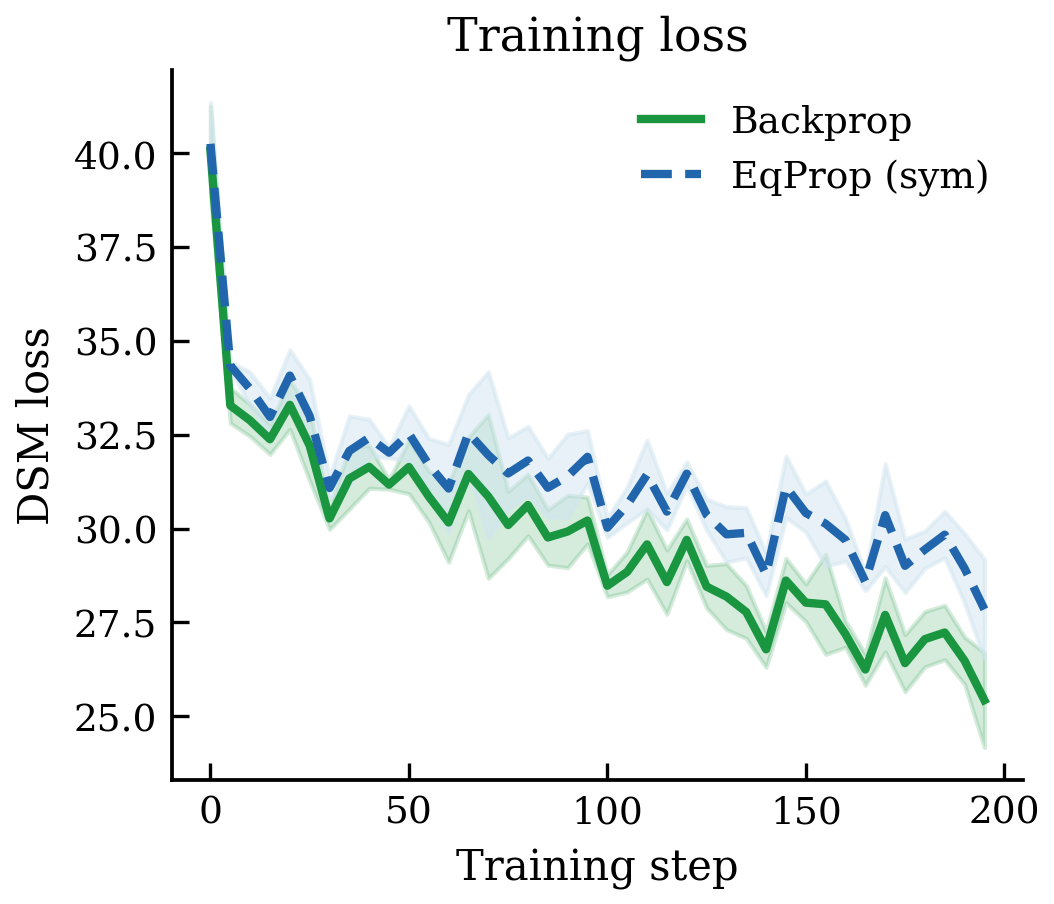
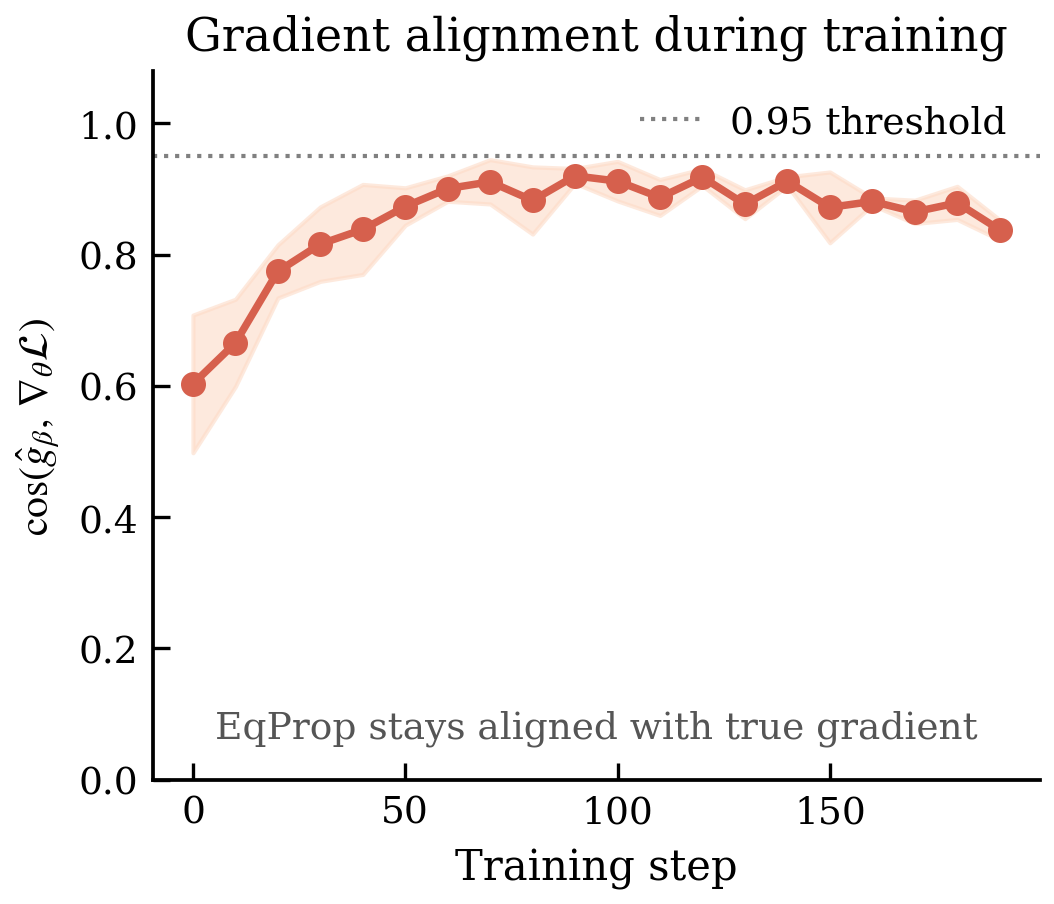
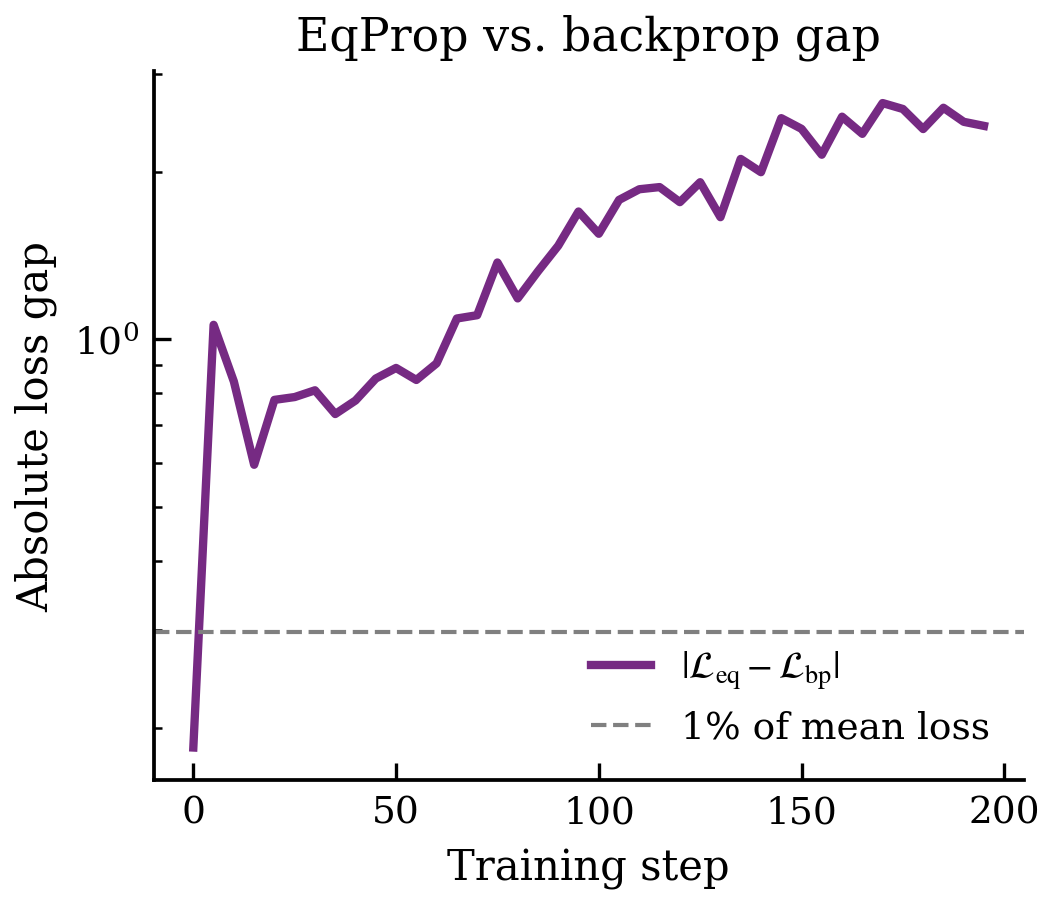
Figure 6: Training loss curves show near-identical convergence for symmetric EqProp and digital baselines, corroborating theoretical claims.
Implications, Limitations, and Future Directions
This study positions symmetric bilinear EqProp as the first physically local, readout-only training protocol that maintains the structured couplings necessary for scalable, thermodynamic diffusion models. The bias–variance framework provides actionable guidance for parameter selection under hardware constraints. Given the demonstrated and projected energy advantages, this approach promises substantial practical implications for sustainable, scalable generative AI.
Several limitations remain. The current results assume idealized Langevin dynamics and are validated primarily in simulation with synthetic data; real-hardware implementations and evaluation on large-scale data are outstanding. Non-idealities such as device mismatch, drift, or parasitic effects could impact fidelity and require further circuit-level studies. Finally, extensibility to more complex energy landscapes and architectures warrants continued investigation.
Conclusion
This work rigorously establishes that symmetric equilibrium propagation closes the learning loop for thermodynamic diffusion models on bilinearly-coupled analog substrates, delivering unbiased, physically local gradient estimators and orders-of-magnitude projected energy savings per training iteration. The results both resolve fundamental open questions in physical generative modeling and open viable pathways toward sustainable, hardware-native AI at scale.

