- The paper's main contribution is a three-sided equilibrium model exposing AI's dual role that alters incentive structures in peer review.
- The methodology employs subgame-perfect Nash strategies to analyze the phase transition in reviewer effort at a critical AI capability threshold.
- Key implications include a sign reversal in optimal editorial policy, highlighting trade-offs between reviewer detection and acceptance standards.
Editorial Design in AI-Assisted Peer Review: An Expert Summary
This paper develops a formal equilibrium framework analyzing the effects of generative AI on academic peer review, modeling interactions between authors, reviewers, and editors. It focuses on the dual role of AI: authors use AI for manuscript polishing, while reviewers may use AI to submit superficially plausible but substantively empty reports without exerting actual evaluative effort. The model characterizes how the joint adoption of AI by both authors and reviewers disrupts incentive structures and yields counterintuitive implications for editorial policy, including a sharp sign reversal in optimal acceptance standards.
Model Structure and Theoretical Results
The paper formulates a three-sided equilibrium model comprising:
- Authors: Invest in costly polishing (e.g., language, figures) to improve presentation without affecting the underlying quality, incurring quadratic costs. The "rat race" among authors arises because acceptance is based on relative polish, thus incentivizing rent-dissipating competition.
- Reviewers: Have heterogeneous conscientiousness and choose among declining to review, exerting real evaluative effort, or submitting AI-generated (low-effort) reports. The payoff for shirking increases with AI capability γ, leading to a phase transition in participation.
- Editor: Chooses the number of review invitations N, acceptance rate K, and AI-detection intensity λ, with detection costly and imperfect. Detection screens out some shirking reports, raising the effective evaluative effort share M but at the expense of lost reports.
The equilibrium is realized through subgame-perfect Nash strategies: reviewers decide on participation and effort before observing detection; authors select polishing levels informed by reviewers’ likely effort; editors set policies cognizant of equilibrium outcomes and subject to an author-welfare constraint (to ensure reforms are politically feasible).
Reviewer Participation Phase Transition and Welfare Misalignment
A key analytical result is the phase transition in reviewer effort as AI capability γ crosses a critical threshold γ1=−R/ψα, where R is the net baseline reviewer cost and ψα the appearance reward. Below γ1, only sufficiently conscientious reviewers accept and exert full effort. Above N0, reviewers with lower conscientiousness now accept and opt to shirk, causing average effort (and thus signal informativeness) to collapse discontinuously:
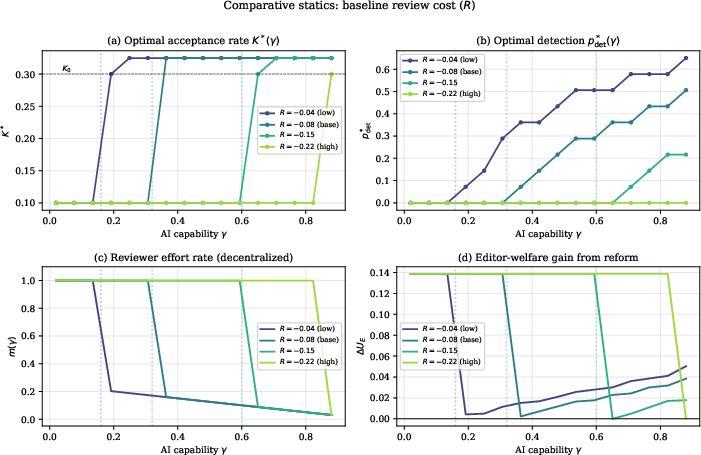
Figure 1: The sign reversal in acceptance rate N1, vertical drop in reviewer effort at the transition, and the gain in editor welfare pre-transition due to tightening standards with low AI capability.
This transition yields a welfare misalignment:
- Authors' welfare increases since the rat-race intensity moderates: reduced reviewer attention dilutes the returns to polishing, lessening wasted effort.
- Editors' welfare sharply decreases as the informativeness of reviews collapses, harming sorting quality even if reviewer participation numerically rises.
Author Rat Race and Comparative Statics
The equilibrium demonstrates that with higher average reviewer effort, the marginal value of author polishing increases—intensifying the rat race and elevating social dissipation. Analytical characterization under quadratic costs and log-concave quality distributions allows explicit comparative statics:
Editorial Policy: The Sign Reversal Principle
The editor faces the constrained optimization problem of maximizing welfare subject to author utility not falling below its decentralized AI equilibrium value. The main policy instruments—acceptance rate (N5) and detection intensity (N6)—do not act as substitutes once reviewer AI adoption is prevalent.
- Pre-transition (N7): Tightening acceptance standards (lower N8) simultaneously improves sorting and reduces author rent dissipation as the IR constraint binds at lower N9.
- Post-transition (K0): The optimal editorial policy reverses sign. Detection becomes valuable (since it screens out a larger fraction of shirking reviews), but its rat-race intensification effect can only be compensated by loosening acceptance (K1). In this regime, higher selectivity would be counterproductive, as it amplifies author rent dissipation without restoring sorting.
Analytically, the sign flip in the impact of K2 on the author IR constraint is shown to follow from a sharp drop in K3 at the transition, not as an independent assumption but as a structural consequence for log-concave distributions.
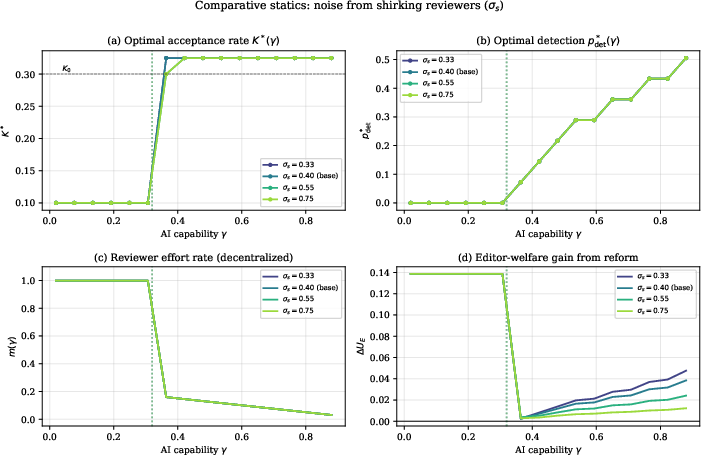
Figure 3: The impact of shirking noise K4 on policy and welfare; policy responses are robust, but editor welfare gains shrink as AI-shirking becomes more damaging.
Crucially, the model establishes that no post-transition combination of policy instruments (K5, K6, detection) can restore pre-AI editor welfare (Corollary: incomplete restoration).
Implications and Comparative Statics
Practical and theoretical implications include:
- Decoupling of Selectivity and Monitoring: Post-transition, tighter standards exacerbate rent dissipation; instead, selective AI-detection and higher acceptance are optimal.
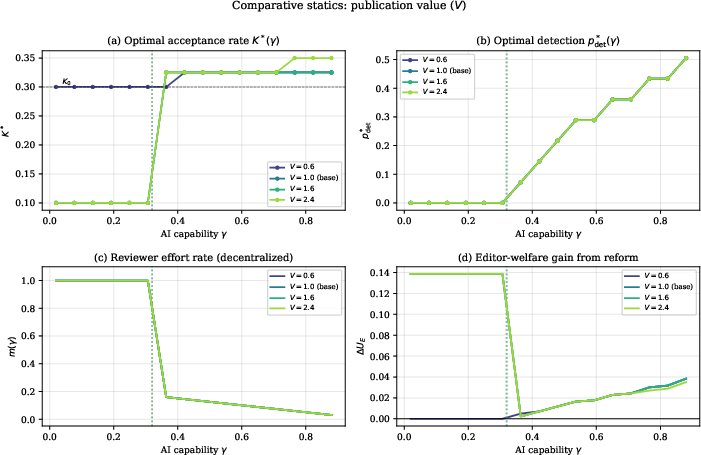
- Calibration-Dependent Magnitudes: The timing and sharpness of the sign reversal, and the potential welfare gains, depend on reviewer reluctance (K7), reward structure, and publication value (K8), but the qualitative reversal itself is robust.
- Empirical Observability: The phase transition and its policy implications yield observable traces, such as abrupt declines in reviewer engagement and shifts in acceptance policies.
The analysis naturally extends to broader settings with weakly-compensated evaluation, including grant review, performance appraisals, and other organizational screening processes.
Robustness of Results
The findings are robust across:
- Functional forms for effort costs and signal noise
- Detection mechanisms (provided detection is ex post and costly)
- Variations in the severity of reviewer shirking (K9)
- Institutional constraints on the number of reviewers per paper
The sign reversal is abrogated only when: stakes are too low for the IR constraint to bind pre-transition; reviewer effort does not collapse sharply at the threshold; or detection is prohibitively costly/ineffective.
Conclusion
This work rigorously demonstrates that the diffusion of generative AI into peer review triggers a structural phase transition in reviewer dynamics, rendering classical editorial responses obsolete. Rather than tightening standards in response to AI-induced noise, editors must optimally combine monitoring of reviewers with looser accept/reject thresholds in order to maximize welfare and minimize dissipative author competition. While these instruments cannot completely recover pre-AI welfare, properly calibrated, they provide the only viable path to Pareto-improving reform given observable reviewer behavior.
The framework generalizes beyond peer review, yielding actionable organizational-design insights for evaluative bodies encountering new forms of strategic, AI-enabled gaming.